Table of contents
Key Takeaways
- The median DTC beauty conversion rate is 3.2% on Shopify, outperforming apparel at 2.2% and home goods at 1.7% — but mobile conversion still lags desktop by 30–50%.
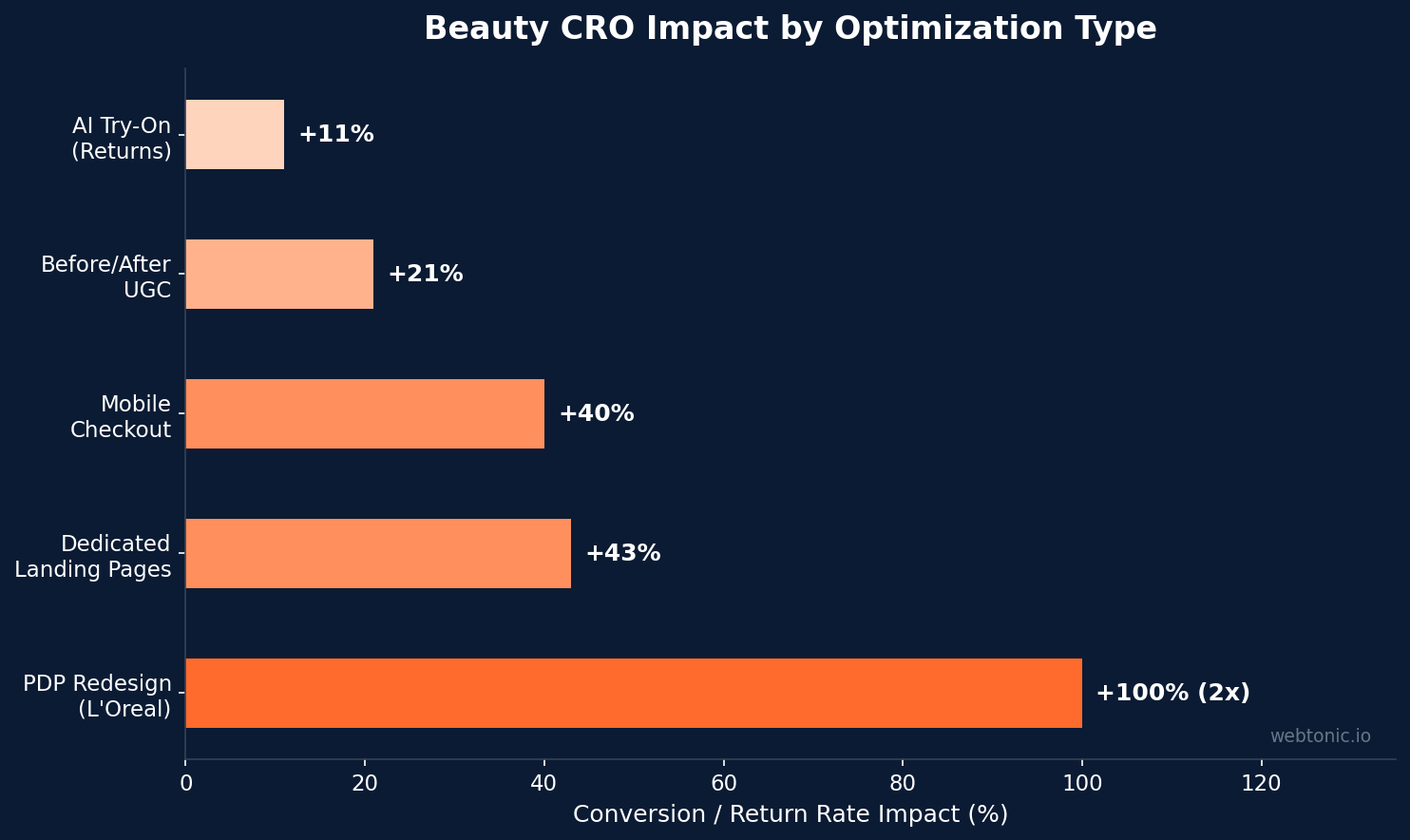
- L'Oréal Paris doubled its product page conversion rate after a comprehensive UX redesign across 55 global markets, with click-to-buy increasing 28%.
- Beauty landing pages with dedicated post-click experiences lift conversions by 43% on average, as demonstrated by Laura Geller's SplitBase campaign optimization.
- AI virtual try-on in the buy box reduces return rates by 8–14%, as customers self-select out of bad shade matches before purchasing.
- TikTok Shop is now the fourth-largest US beauty e-commerce retailer, with sales surpassing $4.4 billion and reshaping how brands think about social commerce landing experiences.
- Creator-specific landing pages lift conversions significantly over generic affiliate links, replacing the warm-click-cold-page problem that plagues most influencer campaigns.
| Conversion Metric | Beauty Average | Top Quartile | vs. Other Verticals |
|---|---|---|---|
| Desktop CVR | 3.4% | 5.2% | +55% above cross-industry |
| Mobile CVR | 2.2% | 3.1% | 30–50% below desktop |
| Skincare CVR | 2.8–4.2% | 4.2%+ | Best in beauty segment |
| Cart Abandonment | 81.71% | ~75% | Near cross-industry average |
Beauty Landing Page Conversion Rates: The Complete Benchmark
Beauty and skincare landing pages convert at rates that consistently outperform most e-commerce verticals, driven by strong replenishment demand and high consumer intent. According to Acceleroi's 2026 Shopify benchmark, the median DTC beauty conversion rate is 3.2%, with top-performing brands exceeding 3.5%.
Desktop conversion rates for beauty sites average 3.4% and reach 5.2% at the top quartile. However, the mobile experience remains a persistent gap: mobile conversion rates lag desktop by 30–50%, averaging just 2.2% across the beauty vertical. Given that beauty e-commerce traffic skews 70–80% mobile, closing this conversion gap represents the single largest revenue opportunity for most skincare and cosmetics brands.
Brands below the 2.2% conversion threshold typically lack customer before-and-after social proof or personalization tools. The data suggests that improving these two elements alone can move conversion rates from below-average to median performance levels. For brands investing in growth marketing, landing page optimization offers the highest return per dollar invested.
Product Page Optimization: What the Best Beauty Brands Do Differently
The most impactful beauty landing page case study comes from L'Oréal Paris, which redesigned its product pages across 55 global markets. The results: engaged users convert at 2× the previous rate, and click-to-buy increased 28%. The redesign used immersive content modules that guide consumers from evaluation through decision with compelling visual experiences.
Laura Geller's collaboration with SplitBase demonstrates the power of dedicated landing pages for paid traffic. Their optimized landing page experience increased conversions by 43% on average, transforming high customer acquisition costs into low acquisition costs while dramatically improving return on ad spend.
Lancôme's partnership with Dataïads focused on the post-click experience specifically — the moment between ad click and product page load. By optimizing this transition, the brand saw measurable conversion improvements that compounded across their entire paid media portfolio.
| Brand | Optimization | Conversion Lift | Key Insight |
|---|---|---|---|
| L'Oréal Paris | PDP redesign (55 markets) | 2× conversion rate | Immersive modules drive evaluation-to-decision |
| Laura Geller | Dedicated landing pages | +43% average | Post-click experience matches ad creative |
| Lancôme | Post-click optimization | Significant lift | Ad-to-page transition speed matters |

AI Virtual Try-On and Interactive Product Pages
AI-powered virtual try-on technology is moving from novelty to conversion essential. When beauty brands place AI try-on directly in the buy box, they see measurable impacts on both conversion and returns. Return rates on products purchased via virtual try-on are 8–14% lower than products bought without it, because consumers self-select out of bad shade matches before completing the purchase.
The technology is particularly impactful for cosmetics categories where shade matching drives purchase hesitation — foundation, concealer, and lip color. Brands deploying try-on report that the feature shifts consumer behavior from browsing to buying by reducing the cognitive load of color decision-making on product pages.
Beauty sites using AI personalization see conversion rates increase to 3.4% across beauty sites overall, compared to non-personalized experiences. The combination of virtual try-on, personalized product recommendations, and dynamic social proof creates a landing page experience that outperforms static product pages by significant margins.
Mobile Conversion and the Desktop Gap
The mobile conversion gap is the most persistent challenge in beauty e-commerce landing page optimization. Despite 70–80% of traffic coming from mobile devices, mobile conversion rates average 2.2% versus desktop's 3.4% — a gap of 30–50% that directly impacts revenue per visitor.
Beauty brands that have closed this gap share common approaches: simplified mobile checkout flows, thumb-friendly product image galleries, mobile-optimized social proof sections, and accelerated page load times. CuFinder's 2026 personal care benchmarks confirm that the top beauty brands maintain a 4:1 customer lifetime value to customer acquisition cost ratio while optimizing for mobile-first experiences.
For Meta Ads campaigns specifically, where the majority of traffic arrives on mobile, ensuring landing page mobile performance is a prerequisite for achieving competitive ROAS. A page that converts at 2.2% on mobile versus 3.4% on desktop effectively wastes 35% of paid social budget on under-converting experiences.
Social Commerce Landing Pages and TikTok Shop
TikTok Shop has fundamentally changed what a beauty landing page looks like. The platform is now the fourth-largest health and beauty e-commerce retailer in the US, with total sales surpassing $4.4 billion. Q2 2026 beauty sales reached $980 million, an 82% increase year-over-year, demonstrating that consumers increasingly complete purchases without ever visiting a traditional product page.
This shift creates a dual-track optimization challenge: brands must optimize both their DTC landing pages for search and paid traffic, and their social commerce product listings for in-platform discovery and conversion. The skills required for each are different — social commerce landing pages prioritize video content, creator endorsement, and social proof over traditional CRO elements.
Creator-specific landing pages are emerging as a high-impact format for bridging the gap between influencer content and brand conversion. When brands replace generic affiliate links with creator-branded landing pages, they solve the warm-click-cold-page problem that drags down influencer campaign ROI. Data from DTC brands across beauty, fashion, and health categories confirms significant conversion lifts from this approach.
Beauty Landing Page CRO Best Practices Backed by Data
| CRO Element | Impact | Implementation Priority | Best For |
|---|---|---|---|
| Before/After UGC | +21% CVR lift | High | Skincare, anti-aging, acne |
| AI Virtual Try-On | −8–14% returns | Medium | Foundation, lip color, cosmetics |
| Dedicated Ad Landing Pages | +43% CVR | High | Paid social campaigns |
| Mobile Checkout Optimization | +30–50% mobile CVR | Critical | All DTC beauty brands |
| Social Proof Integration | Above 2.2% floor | High | Brands below median CVR |
What These Landing Page Statistics Mean for Your Beauty Brand
The beauty landing page data for 2026 reveals three priority areas for optimization:
- Close the mobile conversion gap first. With 70–80% of traffic on mobile and a 30–50% conversion deficit versus desktop, mobile UX improvements deliver the largest absolute revenue gains for most beauty brands.
- Build dedicated landing pages for paid campaigns. A 43% conversion lift from SplitBase-style optimization pays for itself within the first week of campaign spend for most beauty advertisers.
- Adopt social commerce as a parallel channel, not an afterthought. TikTok Shop's $4.4 billion in beauty sales means consumers are buying without visiting your website. Optimize both channels or lose market share to competitors who operate on both fronts.
For brands running Google Ads strategy alongside social campaigns, landing page performance directly impacts Quality Score and ad rank. Improving conversion rates from the median 3.2% toward the top quartile 5.2% reduces effective CPA across every acquisition channel.
Sustainable Beauty and Long-Term Landing Page Investment
The global beauty market's projected growth to reach billions over the coming decade means landing page optimization is a long-term investment in sustainable brand building. Top beauty marketing statistics show that brands combining social commerce via TikTok Shop with traditional e-commerce landing pages capture consumers across both discovery-intent and purchase-intent moments in the customer journey.
Clean beauty and longevity-focused skincare brands face unique landing page challenges — their products often require more educational content and social proof before consumers commit to purchase. Personal care market brands that address these concerns through content-rich product pages, real time personalization tools, and integrated influencer marketing elements consistently outperform competitors relying on generic page layouts and standard marketing approaches.
Beauty brands investing in long-term landing page infrastructure should consider implementing progressive profiling tools that capture consumer preferences over time. This data feeds back into ad targeting and creative personalization, creating a virtuous cycle where landing page interactions improve the quality of upstream advertising campaigns across Meta, TikTok, and Google channels.
The convergence of beauty advertising and landing page optimization is creating measurable advantages for brands that treat the entire customer journey as a unified experience. Data from top beauty companies shows that aligning ad creative messaging with landing page content — including consistent imagery, headline themes, and social proof elements — reduces bounce rates by 15–25% and improves overall campaign efficiency across all paid acquisition channels.
Skincare Ingredient Transparency and Product Page Trends
One of the strongest landing page trends in the beauty industry is the demand for ingredient transparency. Consumers will increasingly scrutinize product pages for complete ingredient lists, with skincare brands that display ingredients prominently seeing higher engagement and lower bounce rates than brands that bury this information. The shift toward clean beauty means that ingredient-focused content on product pages is no longer optional — it is expected by informed buyers.
Top beauty brands are adapting their landing pages to reflect evolving consumer routines. As skincare routines grow more sophisticated — with multi-step regimens incorporating serums, moisturizers, and active treatments — product pages must educate consumers on how each product fits into their existing routine. Makeup brands face similar challenges, with shade-matching tools, application tutorials, and skin type quizzes becoming standard landing page elements that drive online conversion.
The trend toward personalized beauty experiences will accelerate through 2027, with AI-powered skin analysis and ingredient recommendation engines becoming mainstream on product pages. Brands that invest in these interactive elements today position themselves to capture longer customer lifetimes and higher average order values as the market continues its rapid expansion.
Online beauty shopping behavior continues to evolve, with consumers expecting product pages to feature real skin results, before-and-after comparisons, and dermatologist endorsements alongside standard product information. The brands that will win in 2026 and beyond are those treating their landing pages as dynamic content hubs rather than static product listings — adapting content in real time based on the traffic source, user segment, and seasonal trends that drive skincare and makeup purchasing decisions. This approach to beauty marketing transforms every product page into a personalized shopping experience that matches each consumer's unique skin concerns and beauty goals.
What is the average landing page conversion rate for beauty brands?
The median DTC beauty landing page conversion rate is 3.2% on Shopify, with skincare-specific pages converting at 2.8–4.2%. Desktop conversion averages 3.4% while mobile lags at 2.2%, creating a significant optimization opportunity for most beauty brands.
How much can landing page optimization improve beauty conversions?
Dedicated landing page optimization delivers substantial results. Laura Geller saw a 43% conversion increase through SplitBase, while L'Oréal Paris achieved 2× conversion rates across 55 markets through product page redesign. The typical range for focused CRO programs is a 20–40% lift.
Does AI virtual try-on actually improve beauty product page performance?
Yes. When placed directly in the buy box, AI virtual try-on reduces return rates by 8–14% because consumers self-select out of bad shade matches before purchasing. Beauty sites using AI personalization see overall conversion rates reach 3.4% versus lower rates on non-personalized product pages.
How important is mobile optimization for beauty landing pages?
Critical. Beauty e-commerce traffic skews 70–80% mobile, but mobile conversion rates average only 2.2% versus 3.4% on desktop. Closing this 30–50% gap is the single largest revenue opportunity for most DTC skincare and cosmetics brands.
What role does social commerce play in beauty landing page strategy?
TikTok Shop is now the fourth-largest US beauty e-commerce retailer with over $4.4 billion in annual sales. Brands must optimize both traditional landing pages and social commerce product listings. Creator-specific landing pages that replace generic affiliate links solve the warm-click-cold-page problem and lift influencer campaign conversions.
Sustainable Beauty Brands and Long-Term Landing Page Strategy
The global beauty market's projected growth to reach billions in the coming decade means landing page optimization is a long-term investment in sustainable brand building. Top beauty marketing statistics show that brands combining social commerce via TikTok Shop with traditional e-commerce landing pages capture consumers across both discovery and purchase intent moments.
Clean beauty and longevity-focused skincare brands face unique landing page challenges — their products often require more educational content and social proof before consumers commit to purchase. Personal care market brands that address these concerns through content-rich product pages, real time personalization, and influencer marketing integration consistently outperform competitors relying on generic approaches to beauty advertising and web design.
Beauty Marketing Statistics and Product Page Implications
The beauty industry's shift toward influencer marketing and social media-driven product discovery creates new demands for landing page experiences. Beauty ads that send consumers to dedicated, content-aligned landing pages see higher conversion rates than those directing traffic to generic product pages. The best beauty brands align their landing page content with the specific creative and messaging used in their top-performing ads across platforms.
Market data shows the global skincare market will continue expanding rapidly, with anti-aging, sustainable beauty, and clean beauty products driving the highest growth rates. Brands that optimize their product pages for these high-growth categories — with targeted social proof, UGC integration, and longevity-focused messaging — position themselves to capture disproportionate market share as billions in consumer spending flows into the beauty industry over the next decade.
Related reading
- 2026 Fintech Landing Pages & CRO Report: Trends, Stats & Performance Data
- Fitness Landing Page Statistics: 2026 Conversion Benchmarks, A/B Testing Data & CRO Insights
- Franchise Landing Page Statistics: 2026 Conversion Benchmarks for Multi-Location Brands
- Landing Page Design services at Web Tonic
Sources
acceleroi.com — Shopify Beauty Conversion Rate Benchmark 2026
yournextlandingpage.com — Beauty DTC Conversion Rate Benchmarks
icrossing.com — L'Oréal Paris Product Page Optimization
splitbase.com — Laura Geller Conversion Case Study
beauty2point0.com — AI Try-On in the Buy Box
dataiads.io — Lancôme Post-Click Experience
cufinder.io — Personal Care and Beauty Benchmarks 2026
emarketer.com — TikTok Shop Reshapes US Beauty Ecommerce
influencermarketinghub.com — Creator Storefront Conversion Data
metricuno.com — Beauty Ecommerce Benchmarks 2024
metricuno.com — PDP Conversion Rate Benchmarks