Table of contents

Google Shopping accepts B2B software only as a subscription prepaid for at least 12 months: monthly billing, onboarding and managed services are all excluded under Google's Unsupported Shopping content policy. So the budget question is first an eligibility question, then an acquisition-cost one.
Key Takeaways
- Only software prepaid for 12 months or more is eligible for Shopping.
- Google's taxonomy lists 35 Software categories out of 5,595.
- Business and Productivity Software is category 5300; the parent is 313.
- Median B2B SaaS CAC payback: 16 months in CY-2025 (Benchmarkit, n=342).
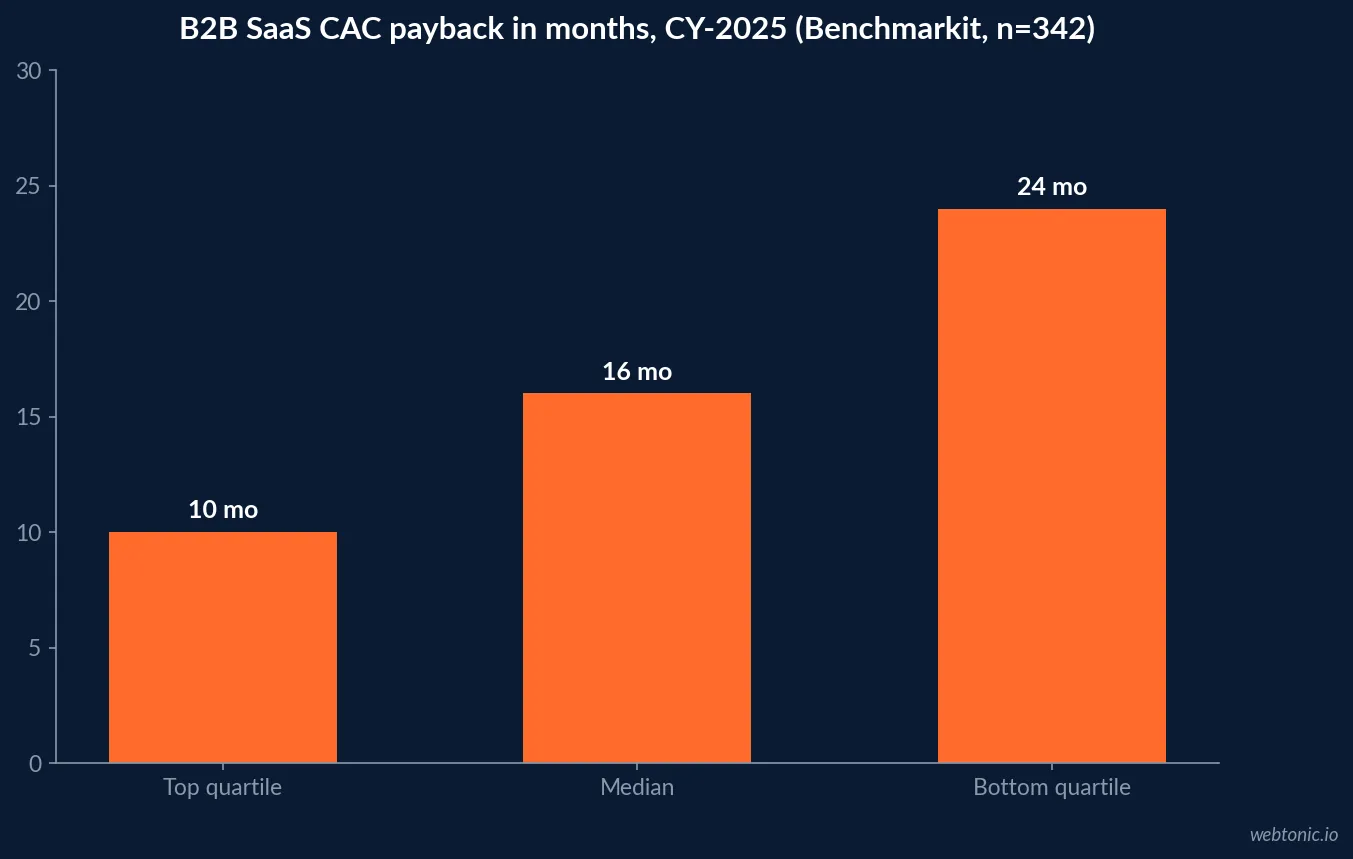
- Top quartile pays back in 10 months, bottom quartile in 24.
- Blended CAC ratio improved to USD 1.30.
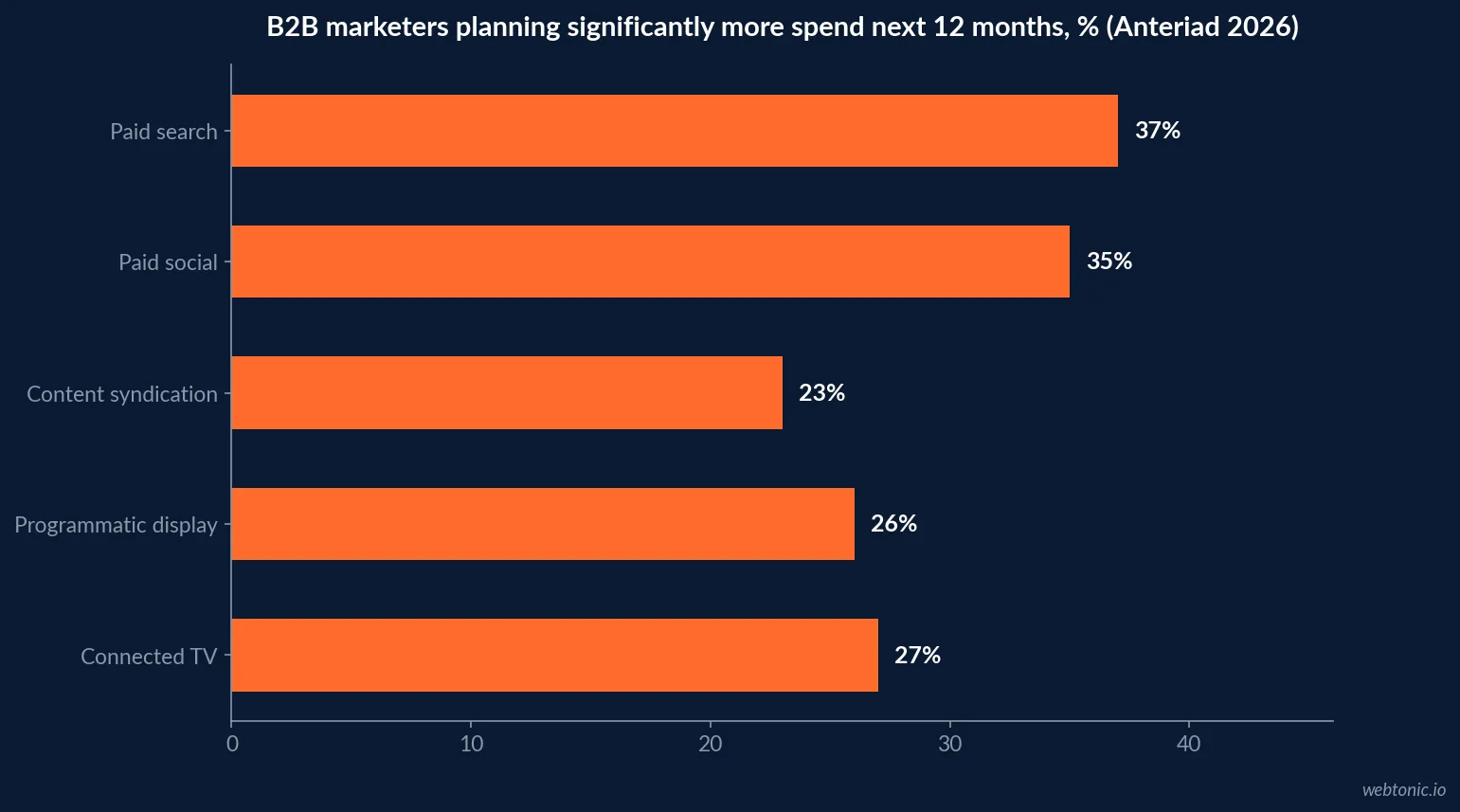
- 37% of B2B marketers plan significantly more paid search spend (Anteriad 2026).
- 53% of attribution leaders plan the same.
- 63% of B2B marketers reported a 2026 budget increase.
- Google advises a Performance Max daily budget of at least 3x CPA.
- US search ad revenue: USD 114.2 billion in 2025, up 11.0% (IAB/PwC).
Google's digital-goods rules, word for word
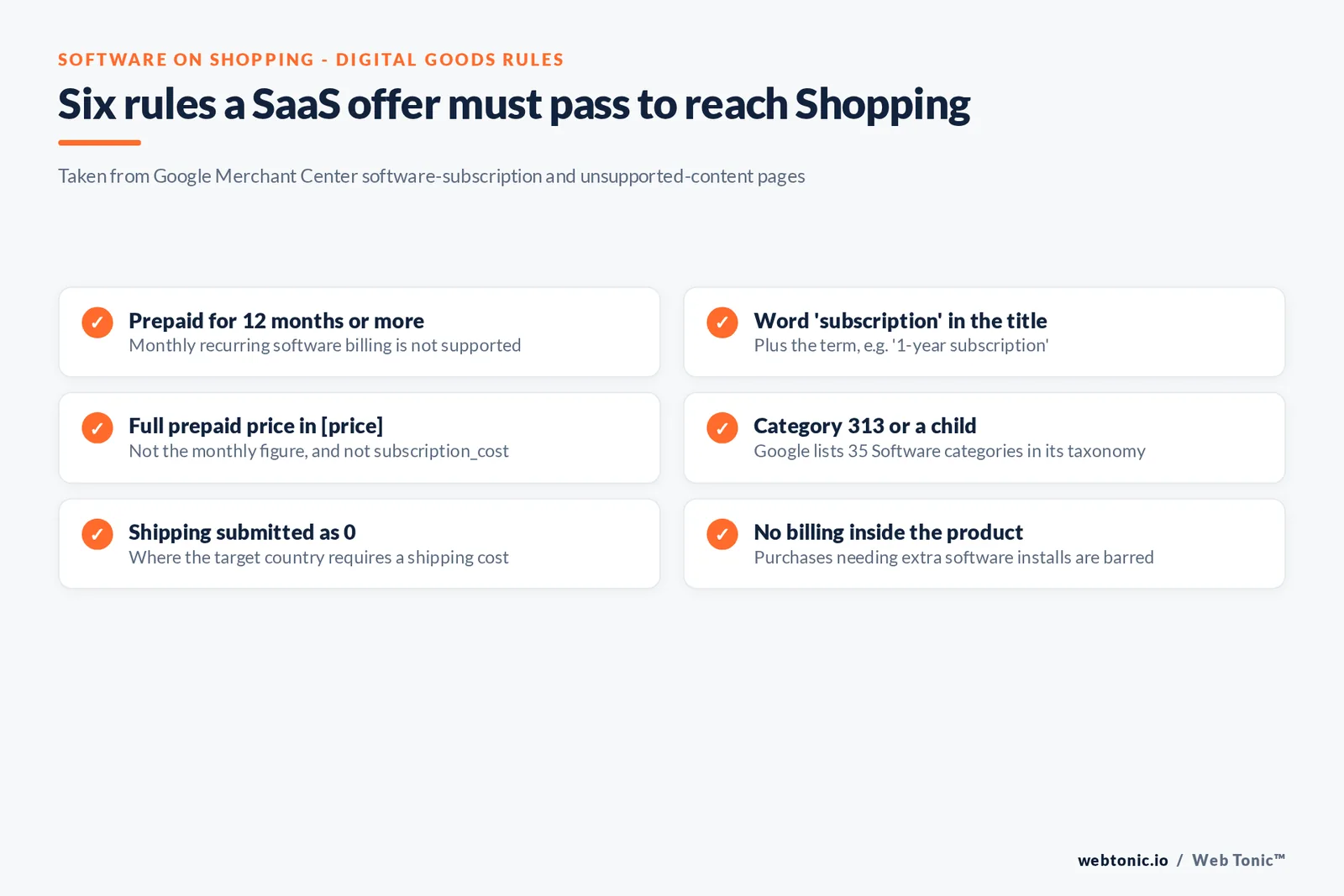
The policy's "Recurring billing" section says "software subscriptions that are prepaid and autorenew only annually are allowed", and lists as not allowed "payment methods that allows users pay for goods on an ongoing basis, at regular intervals in the future", with "digital content with recurring payment subscriptions" as an example. A separate "Billing processed by product software" section bars purchases that "require additional software installation to complete the purchase". Services - "labor, time, effort, expertise" - are excluded outright, including services "sold bundled with physical goods".
Google's software subscription guide then sets the mechanics: the subscription "must be available in prepaid, 12-month (yearly) increments with a duration of at least 1 year"; the title must include "subscription" and the duration, e.g. "Your Product (1-year subscription)"; and the price is the full prepaid term. Its worked example: a USD 120 annual plan with the first month free is submitted at USD 110. The subscription_cost page is explicit: "Don't use the subscription cost attribute for software subscriptions."
| SaaS offer | Shopping status | Rule that decides it | Alternative on Google |
|---|---|---|---|
| Monthly self-serve plan | Not eligible | Recurring billing not annual | Search, Performance Max |
| Annual plan, prepaid | Eligible | Annual prepaid software allowed | Shopping or PMax with feed |
| Multi-year prepaid licence | Eligible | Prepaid price for multiple years allowed | Shopping |
| Usage-based or metered billing | Not eligible | Ongoing payments at intervals | Search |
| Implementation and onboarding | Not eligible | Services: labor and expertise | Search |
| Free trial or freemium | Not eligible as priced product | Price must be the prepaid term | Search, Demand Gen |
Feed attributes a software listing needs
Google asks for the Software > Computer Software category (ID 313) or one of its children, and its taxonomy has 35 Software categories in total, including Business and Productivity Software (5300), Antivirus and Security Software (5299) and Financial, Tax and Accounting Software (5304). Where a target country requires shipping, the guide says to submit it as 0. The landing page must pre-select and display the full prepaid price, give each tier - "basic", "premium", "enterprise" - its own page, and state renewal and cancellation terms.
| Attribute | Required value for SaaS | Common failure |
|---|---|---|
| title | Includes 'subscription' and the term | Brand name only |
| price | Full prepaid price, minimum 1 year | Monthly price |
| google_product_category | 313 or a child such as 5300 | Left to auto-categorisation |
| shipping | 0 where the country requires it | Missing, causing disapproval |
| link | One landing page per tier, price pre-selected | Pricing page with a monthly toggle |
| subscription_cost | Do not use for software | Used to show a monthly figure |
What B2B acquisition actually costs in 2026
No published source reports Shopping CTR, conversion rate or ROAS for SaaS, and we do not estimate one. The useful budget input is the company's own unit economics, and the best 2026 benchmark is the Benchmarkit 2026 B2B SaaS and AI-Native Performance Benchmarks (n=342). It puts median CAC payback at 16 months, improved from 18 months in CY-2024, with the first quartile at 10 months and the fourth at 24. The blended CAC ratio improved to USD 1.30 - the sales and marketing spend needed to add one dollar of new ARR.
Read against Google's rule, this matters: an annual prepaid Shopping sale collects twelve months of revenue up front, which is inside the median payback window before renewal. That is the economic case for building an annual SKU at all.
| Benchmarkit CY-2025 metric | Figure | What it tells a Google budget |
|---|---|---|
| Median CAC payback | 16 months (18 in CY-2024) | Budget horizon for a new customer |
| Top-quartile CAC payback | 10 months | Room to bid harder |
| Bottom-quartile CAC payback | 24 months | Annual prepaid sale covers only half |
| Blended CAC ratio | USD 1.30 per USD 1 of new ARR | Ceiling on acquisition spend |
| Median Rule of 40 | 25% (from 15%) | Efficiency over growth at any cost |
Where B2B budgets are heading
The Anteriad and Ascend2 2026 B2B Marketing Edge Report found 63% of respondents received a budget increase for 2026. Asked how investment would change over the next 12 months, 37% of all marketers expected significantly more paid-search spend, against 53% of "attribution leaders", the group that can tie revenue back to marketing. Paid social followed at 35% and 47%. Those intentions correlate with measurement maturity; they do not show that paid search causes growth.
Retention is why the annual SKU matters
Benchmarkit's retention data explains why an annual prepaid offer is worth building even for a company that prefers monthly plans. Median gross revenue retention fell from 88% to 84% in CY-2025, the largest single-year drop in the series, and the top quartile fell from 95% to 91%. Median growth declined for a fourth consecutive year, to 20% from 26%. An annual prepaid contract removes eleven monthly churn decisions from the first year, which is exactly the period in which CAC is being paid back. That is the business logic behind the only SaaS format Google Shopping accepts, and it is why the Shopping line in a SaaS budget should be judged on first-year cash collected rather than on click metrics.
The same report shows median ARR per employee at USD 193K, with the 75th percentile at USD 253K - a reminder that the people cost of running a feed, landing pages per tier and Merchant Center diagnostics belongs in the budget alongside media.
Where search ranks in B2B marketing mixes
Independent B2B survey data puts paid search in the middle of the mix, not at the top. The Sagefrog 2026 B2B Marketing Mix Report (B2B firms across healthcare, technology, industrial and business services) ranks search engine marketing as a top area of 2026 spend for 20% of respondents, behind content marketing at 30% and AI tools at 28%. As a lead source, SEM is cited by 25%, behind content syndication and directories at 36% each and email at 33%. For a SaaS budget, that places Google spend as one line among several, sized by payback, not as the default channel.
| Top B2B lead source, 2026 | Share of respondents | Relation to Google formats |
|---|---|---|
| Content syndication or partner networks | 36% | Outside Google Ads |
| Directories, sponsorships, listings | 36% | Outside Google Ads |
| Email marketing | 33% | Outside Google Ads |
| Paid social media | 30% | Outside Google Ads |
| Search engine marketing | 25% | Search, Shopping, Performance Max |
| Search engine optimization | 11% | Organic, incl. free listings |
Turning payback into a daily budget
Google's rules convert a target CPA into a budget floor. The Performance Max setup page says to "set an average daily budget of at least 3 times your CPA", and the budget page caps a month at 30.4 times the average daily budget, with single days up to 2 times. A SaaS team that knows its acceptable CPA from payback math can set the floor directly. The cross-industry cost trend is benign: Tinuiti's Q4 2025 report (vendor, client data) showed Shopping CPC down 1% and Shopping spend up 16%, with Performance Max at 62% of Shopping spend for brands running both.
| Budget input | Source | Value |
|---|---|---|
| Performance Max daily floor | Google Ads help | At least 3x target CPA |
| Monthly ceiling | Google Ads help | 30.4x average daily budget |
| Peak-day spend | Google Ads help | Up to 2x average daily budget |
| Shopping CPC trend | Tinuiti Q4 2025 | -1% YoY |
| US search ad market | IAB/PwC FY 2025 | USD 114.2 billion, 38.8% share |
Search is where most SaaS demand is bought
Because most SaaS pricing is monthly and most B2B deals involve a sales conversation, Search - not Shopping - carries the bulk of Google spend for the category. The IAB/PwC FY 2025 report shows US search revenue rising by USD 11.4 billion to USD 114.2 billion, 38.8% of internet ad revenue, though growth slowed to 11.0% from 15.9% in 2024. Performance Max can also run for SaaS without a feed, using assets across Search, YouTube, Display, Discover, Gmail and Maps, per Google's Performance Max overview. For click-cost context, read our Google Ads cost guide.
Review and rating claims in listings
SaaS ads lean on review-site badges and customer quotes. The FTC's Endorsement Guides, 16 CFR Part 255 govern those claims: endorsements must reflect the honest opinions of the endorser and material connections must be disclosed. Keep feed titles to product, tier and term, and put rating claims only where you can substantiate them.
A budget checklist for B2B SaaS
- Decide whether you sell an annual prepaid SKU; if not, skip Shopping and budget Search.
- If you do, build one landing page per tier with the prepaid price pre-selected.
- Set the Performance Max daily floor at 3x the CPA your payback allows.
- Keep onboarding and services out of the feed entirely.
- Measure pipeline, not clicks, before raising budget.
Our data intelligence practice connects CRM pipeline to ad spend, and the B2B SaaS CTV data covers upper-funnel budgets.
Frequently Asked Questions
Can a SaaS product be advertised in Google Shopping?
Only in a narrow form. Google allows software subscriptions that are prepaid and auto-renew only annually. The offer must be available in prepaid 12-month increments with a duration of at least one year, use the full prepaid price, and include the word subscription and the term in the title. Digital content sold with recurring payment subscriptions is listed as not allowed.
Can a monthly SaaS plan be listed?
No. Google's recurring-billing rule only admits annual prepaid software, and its subscription_cost help page says not to use that attribute for software subscriptions at all: software must be submitted using the yearly prepaid cost as the price.
Does implementation or onboarding count as a product?
No. Onboarding, implementation, consulting and managed services are labor or expertise under Google's Unsupported Shopping content policy, which also excludes services sold bundled with goods. Only the software licence itself can be the listed item.
How should a B2B SaaS company size a Google budget?
From its own acquisition economics. Benchmarkit's 2026 report on 342 B2B SaaS and AI-native companies puts median CAC payback at 16 months (top quartile 10, bottom quartile 24) and the blended CAC ratio at USD 1.30. Google's own guidance adds that a Performance Max daily budget should be at least 3 times the target CPA.
Are B2B marketers adding paid search budget in 2026?
Anteriad and Ascend2's 2026 B2B Marketing Edge Report found 37% of all respondents expected to invest significantly more in paid search over the next 12 months, rising to 53% among attribution leaders, and 63% reported a budget increase for 2026.
Sources
Google Merchant Center - Unsupported Shopping content
Google Merchant Center - Software subscriptions
Google Merchant Center - subscription_cost
Google product taxonomy
Google Ads - Performance Max budget
Benchmarkit - 2026 B2B SaaS and AI-Native Performance Benchmarks
Anteriad and Ascend2 - 2026 B2B Marketing Edge Report
Tinuiti - Digital Ads Benchmark Report Q4 2025
IAB/PwC - Internet Advertising Revenue Report FY 2025
eCFR - 16 CFR Part 255
Sagefrog - 2026 B2B Marketing Mix Report