Table of contents
The average cost per click in Google Ads sits at $5.42 in 2026, but that single number hides a nearly 6x spread between the cheapest and most expensive of the 23 industries WordStream tracks. Cost per click is the price of the bid itself - what you pay before a visitor converts into anything - and it moves on different forces than cost per lead or cost per acquisition.
Key Takeaways
- Average Google Ads cost per click is $5.42 in 2026, across 13,474 campaigns.
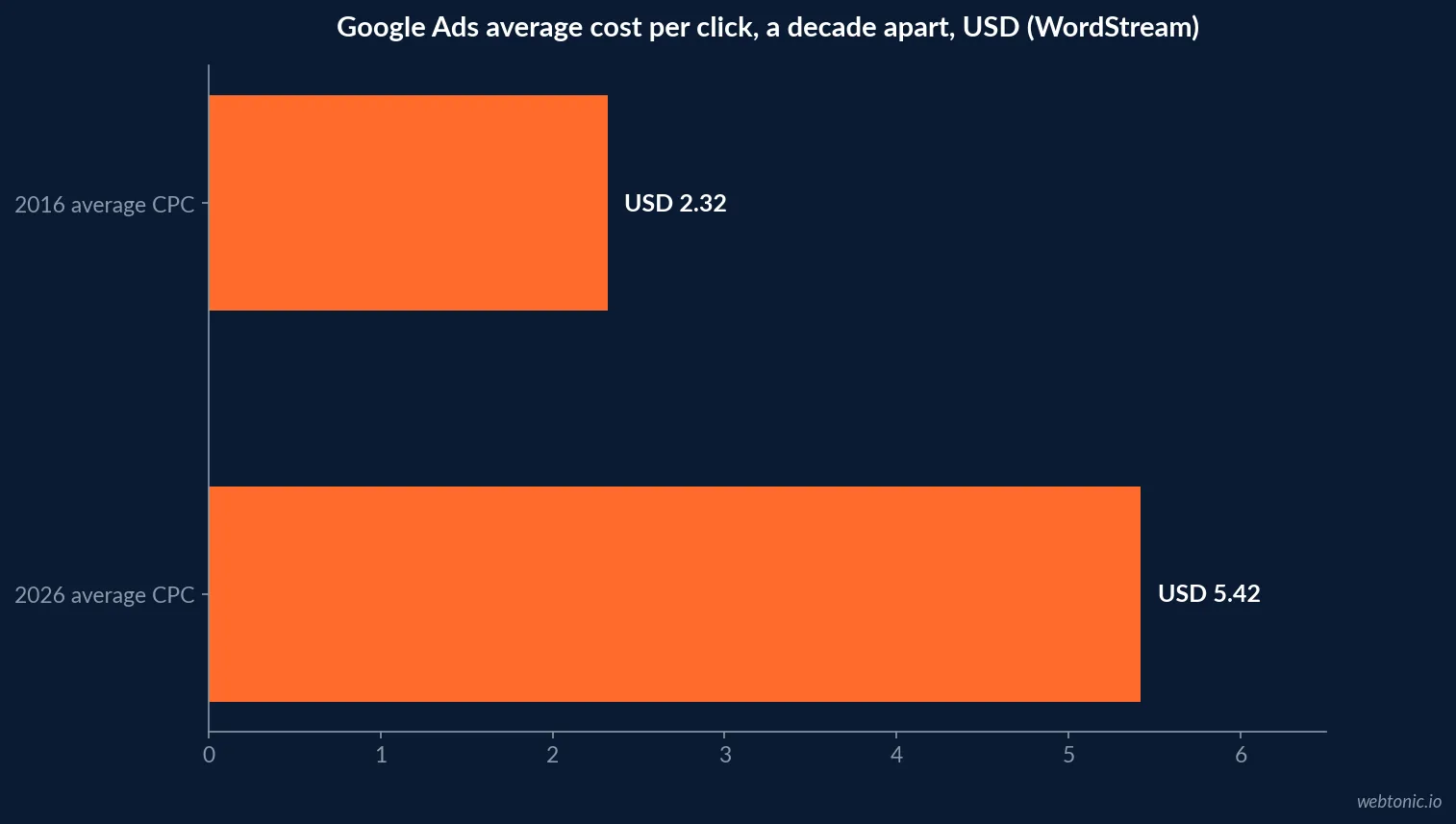
- That is more than double the $2.32 average recorded in 2016, a decade earlier.
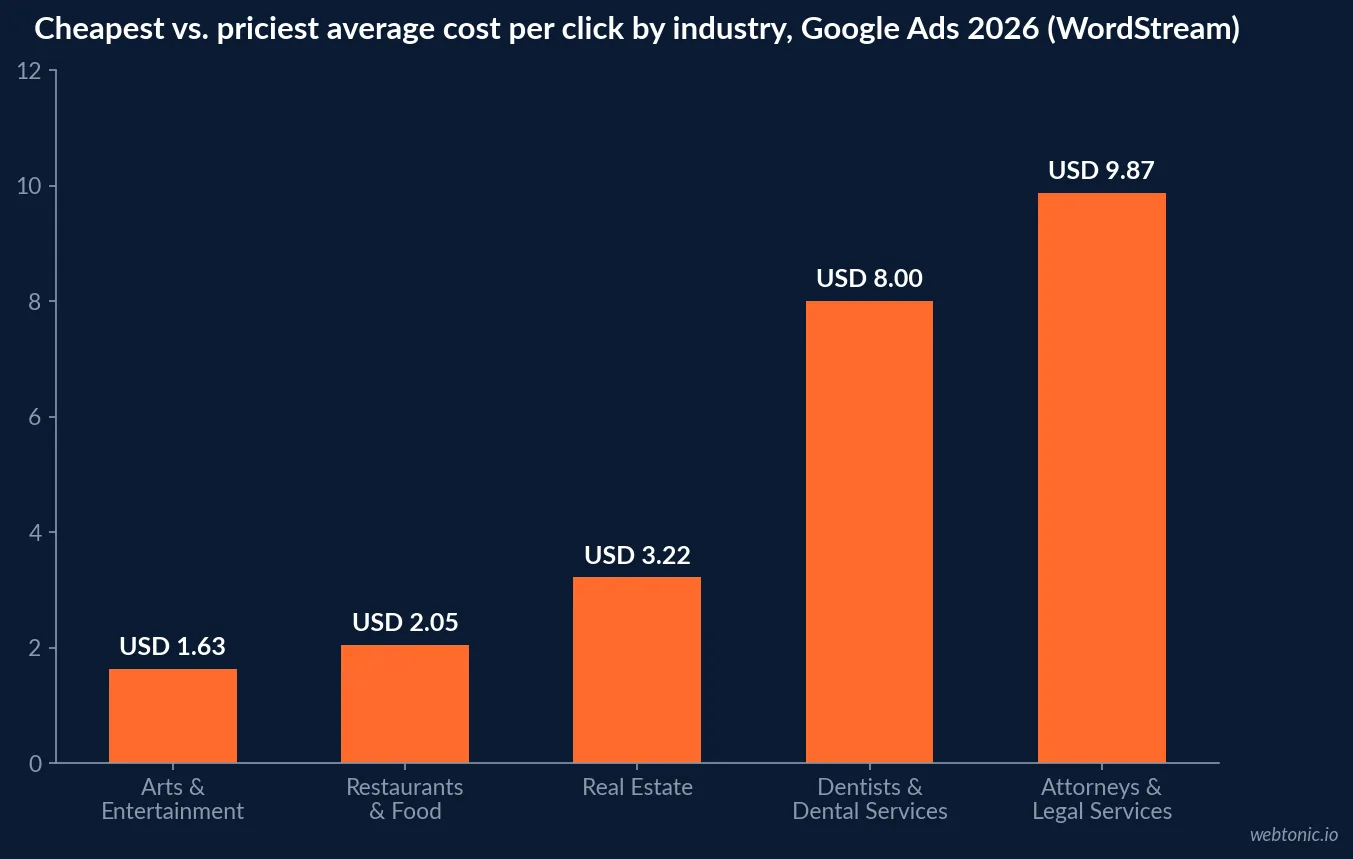
- Arts and Entertainment has the cheapest CPC at $1.63.
- Attorneys and Legal Services has the priciest CPC at $9.87, a 6x spread.
- Home and Home Improvement runs $8.33 per click, the second highest tracked.
- Dentists and Dental Services runs $8.00 per click, third highest tracked.
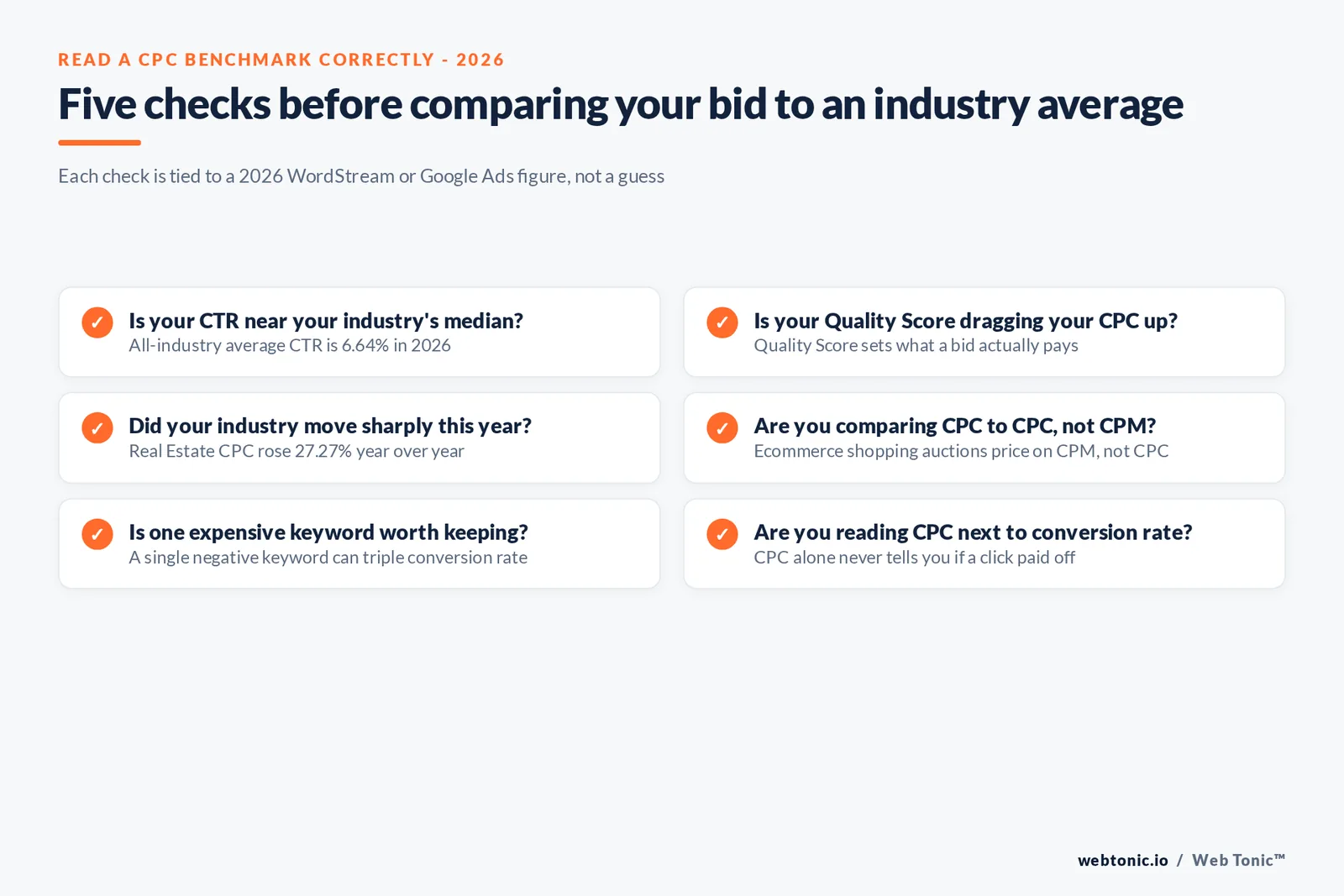
- Real Estate CPC rose 27.27% year over year, the sharpest increase measured.
- Education and Instruction CPC fell 22.79% year over year, the sharpest drop.
- Average click-through rate across all industries is 6.64% in 2026.
- Arts and Entertainment has the highest CTR at 12.75%.
- Automotive Repair, Service and Parts has the lowest CTR at 5.56%.
- Ecommerce brands paid a median $12.13 CPM on Google Ads for Apparel in 2025-26.
- Health and Wellness ecommerce CPM reached $22.40, the highest tracked by Triple Whale.
- Overall Google Ads CPM for ecommerce brands rose 13.34% year over year to $15.35.
- 87% of industries saw conversion rate rise year over year in WordStream's sample.
- One added negative keyword can triple a campaign's conversion rate, per WordStream.
What "cost per click" actually measures
Cost per click is the price paid for a single ad click, set by a real-time auction that weighs bid amount against Quality Score and expected click-through rate. It is the earliest cost metric in the funnel - before a click becomes a lead (cost per lead) or a sale (cost per acquisition) - which is why an industry can carry a high CPC and still be profitable, or a low CPC and still lose money, depending on what happens after the click.
WordStream's 2026 Google Ads Benchmarks report is the primary source for this page: 13,474 LocaliQ customer search campaigns across 23 industries, running April 2025 through March 2026, roughly 80-85% of spend on Google and 15-20% on Microsoft Ads.
Cost per click by industry: the full 2026 table
The average cost per click in Google Ads in 2026 is $5.42. Here is the complete 23-industry breakdown WordStream publishes, from cheapest to most expensive bid.
| Industry | Avg. CPC (2026) | Source |
|---|---|---|
| Arts & Entertainment | $1.63 | WordStream |
| Restaurants & Food | $2.05 | WordStream |
| Travel | $2.14 | WordStream |
| Automotive - For Sale | $2.27 | WordStream |
| Sports & Recreation | $2.77 | WordStream |
| Real Estate | $3.22 | WordStream |
| Finance & Insurance | $3.39 | WordStream |
| Furniture | $3.97 | WordStream |
| Automotive - Repair, Service & Parts | $4.35 | WordStream |
| Shopping, Collectibles & Gifts | $4.14 | WordStream |
| Animals & Pets | $4.06 | WordStream |
| Apparel / Fashion & Jewelry | $4.44 | WordStream |
| Beauty & Personal Care | $4.62 | WordStream |
| Physicians & Surgeons | $4.76 | WordStream |
| Education & Instruction | $4.81 | WordStream |
| Career & Employment | $5.81 | WordStream |
| Business Services | $5.87 | WordStream |
| Industrial & Commercial | $5.87 | WordStream |
| Health & Fitness | $6.17 | WordStream |
| Personal Services | $7.17 | WordStream |
| Dentists & Dental Services | $8.00 | WordStream |
| Home & Home Improvement | $8.33 | WordStream |
| Attorneys & Legal Services | $9.87 | WordStream |
Click-through rate moves the same auction
CPC does not move alone; it is set against click-through rate in the same ad auction. The average click-through rate across all industries in Google Ads in 2026 is 6.64%. High-CTR categories tend to hold their CPC down even under heavy competition, because a higher expected click-through rate improves Quality Score and lowers the price Google needs to charge to win the same ad position.
| Metric | Highest industry | Value | Lowest industry | Value |
|---|---|---|---|---|
| Click-through rate | Arts & Entertainment | 12.75% | Automotive - Repair, Service & Parts | 5.56% |
| Cost per click | Attorneys & Legal Services | $9.87 | Arts & Entertainment | $1.63 |
| Conversion rate | Animals & Pets | 16.22% | Finance & Insurance | 2.64% |
What moved in 2026: the biggest CPC swings
Overall metrics were unusually stable across the 23-industry sample in 2026 compared to the sharp swings WordStream recorded in 2024 and 2025. But two industries moved sharply in opposite directions.
| Direction | Industry | YoY CPC change | Source |
|---|---|---|---|
| Up | Real Estate | +27.27% | WordStream 2026 |
| Up | Personal Services | +23.41% | WordStream 2026 |
| Up | Health & Fitness | +23.41% | WordStream 2026 |
| Down | Education & Instruction | -22.79% | WordStream 2026 |
| Down | Beauty & Personal Care | -18.95% | WordStream 2026 |
| Down | Automotive - For Sale | -5.81% | WordStream 2026 |
Real Estate's 27.27% jump lines up with tighter housing-market competition for buyer and seller leads; Education's 22.79% drop tracks a cooling in the paid search market for course and program searches after several years of aggressive bidding. A CPC swing this large moves the entire cost per lead calculation for that industry even if conversion rate stays flat.
A decade of Google Ads cost per click
The $5.42 average CPC in 2026 is more than double the $2.32 recorded when WordStream's benchmark report launched in 2016. Cost per lead over the same period rose a comparatively modest 13%, from $59.18 to $66.69 - which means conversion rate improvements and account optimization have absorbed most of the click-price inflation, keeping the downstream lead cost from rising in lockstep.
| Metric | 2016 | 2026 | 10-year change | Source |
|---|---|---|---|---|
| Average cost per click | $2.32 | $5.42 | +133.6% | WordStream |
| Average cost per lead | $59.18 | $66.69 | +12.7% | WordStream |
Why ecommerce auctions run on CPM, not CPC
Cost per click is the right lens for lead-generation search ads, but ecommerce brands running Google Shopping and broad-match campaigns increasingly get reported on cost per thousand impressions (CPM) instead, because impression volume - not click volume - is what an ecommerce catalog auction actually prices. Triple Whale's Google Ads benchmarks, built on 18,000-plus ecommerce brands from August 2025 to July 2026, put the median ecommerce CPM at $15.35, up 13.34% year over year.
| Ecommerce category | Median CPM (Aug 2025-Jul 2026) | Source |
|---|---|---|
| Apparel & Accessories | $12.13 | Triple Whale |
| Toys, Art & Collectibles | $12.64 | Triple Whale |
| Sports & Outdoors | $14.53 | Triple Whale |
| Electronics | $15.04 | Triple Whale |
| Home & Garden | $15.76 | Triple Whale |
| Food & Beverage | $15.94 | Triple Whale |
| Beauty | $18.38 | Triple Whale |
| Health & Wellness | $22.40 | Triple Whale |
Put side by side, the two datasets are not interchangeable: WordStream's CPC figures price a single click on a lead-gen search ad across 23 general business categories, while Triple Whale's CPM figures price a thousand impressions inside an ecommerce shopping auction across a narrower set of product verticals. Comparing a $5.42 CPC to a $15.35 CPM as if they measured the same thing produces a meaningless number - always check which metric, and which auction type, a benchmark is quoting before using it.
What actually moves a bid inside these ranges
Three forces set where an individual account lands inside its industry's range: competitor count bidding the same keywords, average transaction value (which sets how much an advertiser can afford to bid), and account-level Quality Score. WordStream's broader research on 15,000-plus accounts found that foundational account structure - tight ad groups, negative keyword lists, strong Quality Score - has an outsized impact on where a given account's real CPC lands relative to its industry median.
The clearest lever inside an account is negative keywords: WordStream reports that adding a single well-chosen negative keyword can triple a campaign's conversion rate, which does more to improve effective cost per outcome than almost any bid adjustment. See our Google Ads strategy guide for the account-structure checklist behind that kind of result.
What Quality Score actually buys you
Two advertisers in the same industry, bidding on the same keyword, rarely pay the same CPC. Google's ad rank formula multiplies bid by Quality Score, so an account with a strong Quality Score can win the same ad position for meaningfully less than a competitor with a weaker one. Quality Score itself is built from three inputs: expected click-through rate, ad relevance, and landing page experience - the same three levers WordStream points to when it explains why some accounts sit well below their industry's average CPC while running the same category of ads.
In practice this means the industry averages in the table above are not a fixed price - they are a midpoint that a well-optimized account can beat and a poorly structured one will miss badly. An account with generic ad groups, thin landing pages, and no negative keyword hygiene will pay closer to the top of its industry's real CPC range than the median this page reports, regardless of how aggressive or conservative its bids are.
Reading a CPC benchmark without overreacting to it
A CPC above the industry median is not automatically a problem, and a CPC below it is not automatically a win - both have to be read against conversion rate and downstream lead value. Our performance creative team treats CPC as a diagnostic signal for auction competitiveness, not a target metric on its own, and pairs every bid review against the account's actual cost per lead and cost per acquisition.
For a fuller breakdown of what a Google Ads account should budget across CPC, CPL and management fees together, see our complete Google Ads pricing guide, or talk to our team about where your account's bids sit against these 2026 industry medians.
How the auction actually sets the price
Cost per click is not a rate card - it comes out of a real-time auction that weighs bid amount against ad relevance. Google's own Quality Score documentation explains that expected click-through rate, ad relevance, and landing page experience combine into the score that decides how much a given bid actually has to pay to win a position - which is why two advertisers bidding the same amount in the same industry can end up with very different real CPCs. Google's own glossary defines CPC simply as the amount an advertiser pays each time someone clicks their ad, distinct from CPM (cost per thousand impressions) and CPA (cost per completed action).
Semrush's guide to cost per click frames the same idea from the buyer's side: CPC by itself only tells you what you paid for traffic, not whether that traffic was worth having, which is exactly why every table above should be read next to a conversion-rate or cost-per-lead number, never in isolation.
Frequently Asked Questions
What is the average cost per click in Google Ads in 2026?
$5.42, according to WordStream's 2026 Google Ads Benchmarks report, which analyzed 13,474 search advertising campaigns across 23 industries running April 2025 through March 2026. That is more than double the $2.32 average recorded a decade earlier when WordStream's report first launched in 2016.
Which industry has the cheapest cost per click?
Arts and Entertainment has the lowest average cost per click at $1.63, followed by Restaurants and Food at $2.05 and Travel at $2.14, per WordStream's 2026 data. These categories combine low competition for search terms with a high click-through rate, which keeps the auction price down.
Which industry has the most expensive cost per click?
Attorneys and Legal Services has the highest average cost per click at $9.87, ahead of Home and Home Improvement at $8.33 and Dentists and Dental Services at $8.00. High-value, infrequent transactions support a bid that would be unprofitable for a business selling a $30 product.
Why did cost per click rise so much over the past decade?
WordStream attributes the rise from $2.32 in 2016 to $5.42 in 2026 to inflation and competition compounding year over year, alongside more advertisers bidding in the same auctions as digital budgets have grown. The increase has not been linear - 2026 was actually a comparatively stable year for CPC after the sharper jumps recorded in 2024 and 2025.
Is cost per click the right metric to optimize for?
Not by itself. WordStream's own guidance is that a higher CPC can be worth paying if it moves an advertiser closer to its actual conversion goals - culling every expensive keyword can lower CPC while quietly cutting the campaign's best-converting traffic. CPC should be read alongside conversion rate and cost per lead, not optimized in isolation.
Sources
WordStream - 2026 Google Ads Industry Benchmarks
WordStream - How Much Does Google Ads Cost (full CPC table)
WordStream - Search Advertising Benchmarks by Industry, 2026 PDF
WordStream - Digital Benchmarks by Industry: PPC
Triple Whale - Google Ads Benchmarks by Industry
Google Ads Help - About Quality Score
Google Ads - Cost Per Click (CPC) glossary definition
Semrush - Cost Per Click: Definition and How to Measure It