



Table of contents

Key Takeaways
- Webflow commands 14.5% of the website-builder market and powers roughly 822,550 active sites globally (WMTips).
- 279 live Webflow stores operate in the Autos & Vehicles category — a niche but growing segment for aftermarket parts and accessories (Popupsmart).
- Only ~5% of the top 77 U.S. dealer websites pass all three Core Web Vitals, with an average LCP of 12.0 s — 9.5 s above Google's 2.5 s threshold (Borah Labs).
- Dealer.com and WordPress each hold 31% of the dealer CMS landscape across 1,746 scanned sites, leaving room for design-first platforms (DealerSignals).
- Webflow hit $213 million in annual revenue in 2024 — a 66% year-over-year jump — and is now valued at $4 billion (Popupsmart).
- IONITY's Webflow Enterprise rebuild drove a 64% increase in active users and a 49% lift in organic search visibility (The Alien Design).
Webflow Platform Overview: Key Metrics (2024–2026)
Webflow has evolved from a niche designer tool into a legitimate enterprise CMS. Here is a snapshot of the platform's current scale and growth trajectory as it intersects with the automotive vertical.
| Metric | Value | Source |
|---|---|---|
| Global CMS market share | 0.8% (~822,550 active sites) | Popupsmart / BuiltWith |
| Website-builder market share | 14.5% (3rd overall) | WMTips 2026 |
| Annual revenue (2024) | $213 million (+66% YoY) | Popupsmart / Tap Twice Digital |
| Valuation | $4 billion | Popupsmart |
| Employees worldwide | ~1,292 | Popupsmart |
| Autos & Vehicles Webflow stores | 279 live stores | StoreLeads |
| Enterprise adoption growth | 1.2% quarterly gain | The Alien Design |
| Total live Webflow stores | 15,694 | StoreLeads |
The data shows Webflow is still a fraction of the total CMS pie, but its revenue growth and enterprise push signal accelerating adoption — including in sectors like automotive where design differentiation matters. For guidance on aligning your website strategy with business goals, see our growth marketing services.
Automotive CMS Market Share: Who Powers Dealer Websites?
The automotive dealership website ecosystem is dominated by a handful of large platform providers. Dealer.com and WordPress share the top spot at 31% each among 1,746 scanned independent and franchise dealer sites, according to DealerSignals. Meanwhile, Dealer.com powers over 50% of franchise dealerships through OEM program certifications (A3 Brands).
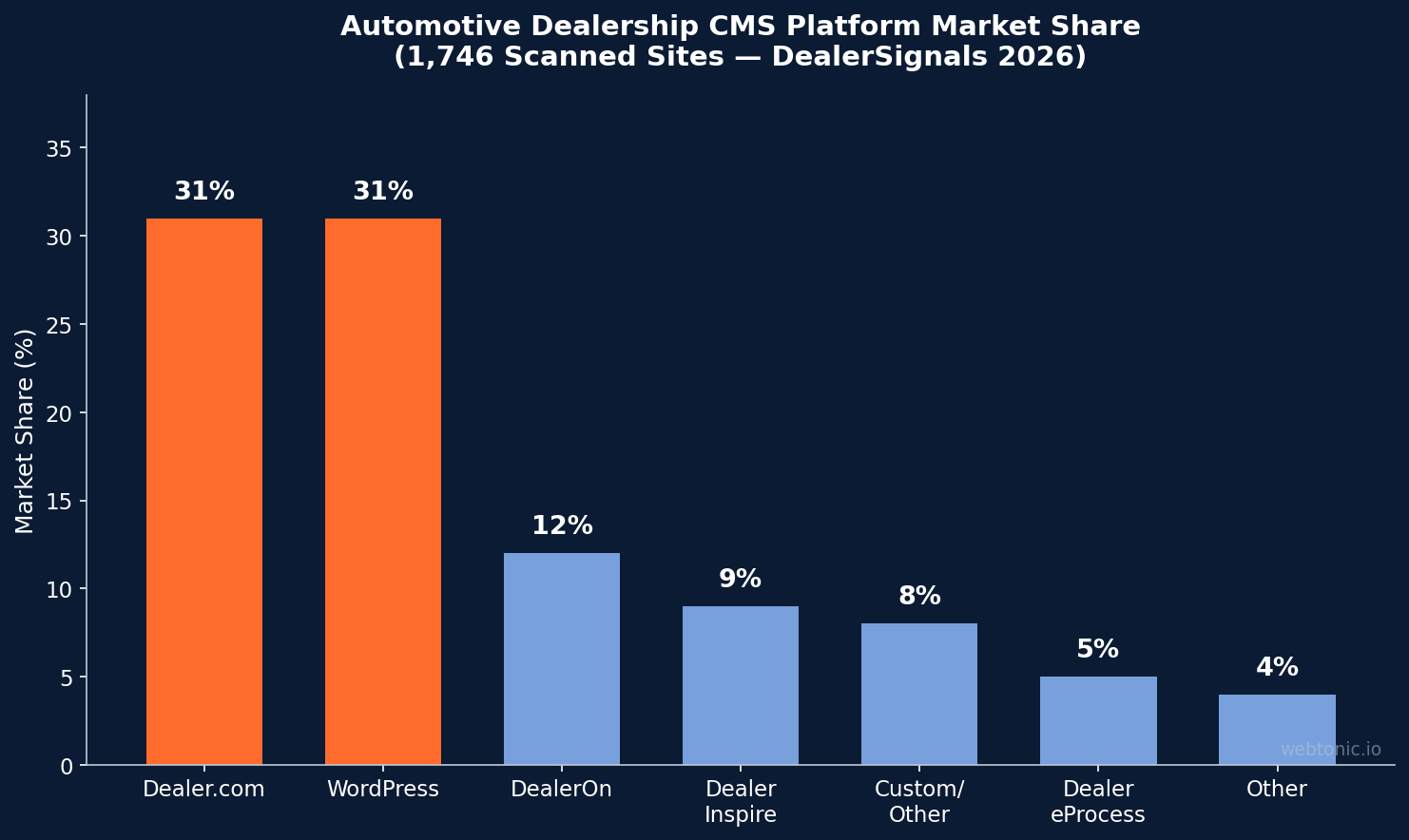
| Platform | Share of 1,746 Sites | Key Strength |
|---|---|---|
| Dealer.com (Cox Auto) | 31% | OEM integrations, inventory feeds |
| WordPress | 31% | Plugin ecosystem, flexibility |
| DealerOn | 12% | Conversion-focused templates |
| Dealer Inspire | 9% | Chat & personalization |
| Custom / Other | 8% | Bespoke builds, Webflow, headless |
| Dealer eProcess | 5% | Budget-friendly packages |
| Other platforms | 4% | Squarespace, Wix, niche tools |
Webflow currently falls within the "Custom / Other" 8% bracket, but its appeal lies in bridging the gap between template rigidity and full custom development. Independent dealers who want brand-specific design control without developer dependency are increasingly evaluating no-code solutions like Webflow. The platform's visual editor gives marketing teams direct control over layouts, promotions, and seasonal content updates — a capability that traditional dealer platforms typically gate behind development tickets.
Core Web Vitals: Why Automotive Websites Underperform
Website speed directly impacts both search rankings and buyer engagement. The data paints a grim picture for most dealer sites — and a clear opportunity for platforms that ship lighter, faster pages by default.
| CWV Metric | Auto Dealer Avg | Google "Good" Threshold | Gap |
|---|---|---|---|
| Largest Contentful Paint (LCP) | 12.0 s | ≤ 2.5 s | 9.5 s over |
| Interaction to Next Paint (INP) | 380 ms (est.) | ≤ 200 ms | 180 ms over |
| Cumulative Layout Shift (CLS) | 0.18 (est.) | ≤ 0.1 | 0.08 over |
| CWV pass rate (all three) | ~5% | 100% target | 95% failing |
Only ~5% of the top 77 U.S. dealer websites pass all three Core Web Vitals (Borah Labs). The main culprits are heavy third-party scripts, unoptimized images, and tag sprawl from multiple analytics, chat, and retargeting pixels (Overfuel). Webflow sites, by contrast, ship with cleaner code, built-in image optimization, and a lightweight asset pipeline — a structural advantage that matters more now that Core Web Vitals influence ranking. The platform's automatic WebP conversion, lazy loading, and CDN delivery address the exact pain points that cause most dealer sites to fail Google's performance thresholds.
Dealer Website Engagement and Conversion Benchmarks
Website traffic is only half the equation — what happens after a visitor lands matters more. Foureyes' 2026 benchmark report tracked 1.4 billion dealer website visits and found that converting those visits into sales remains the industry's biggest challenge.
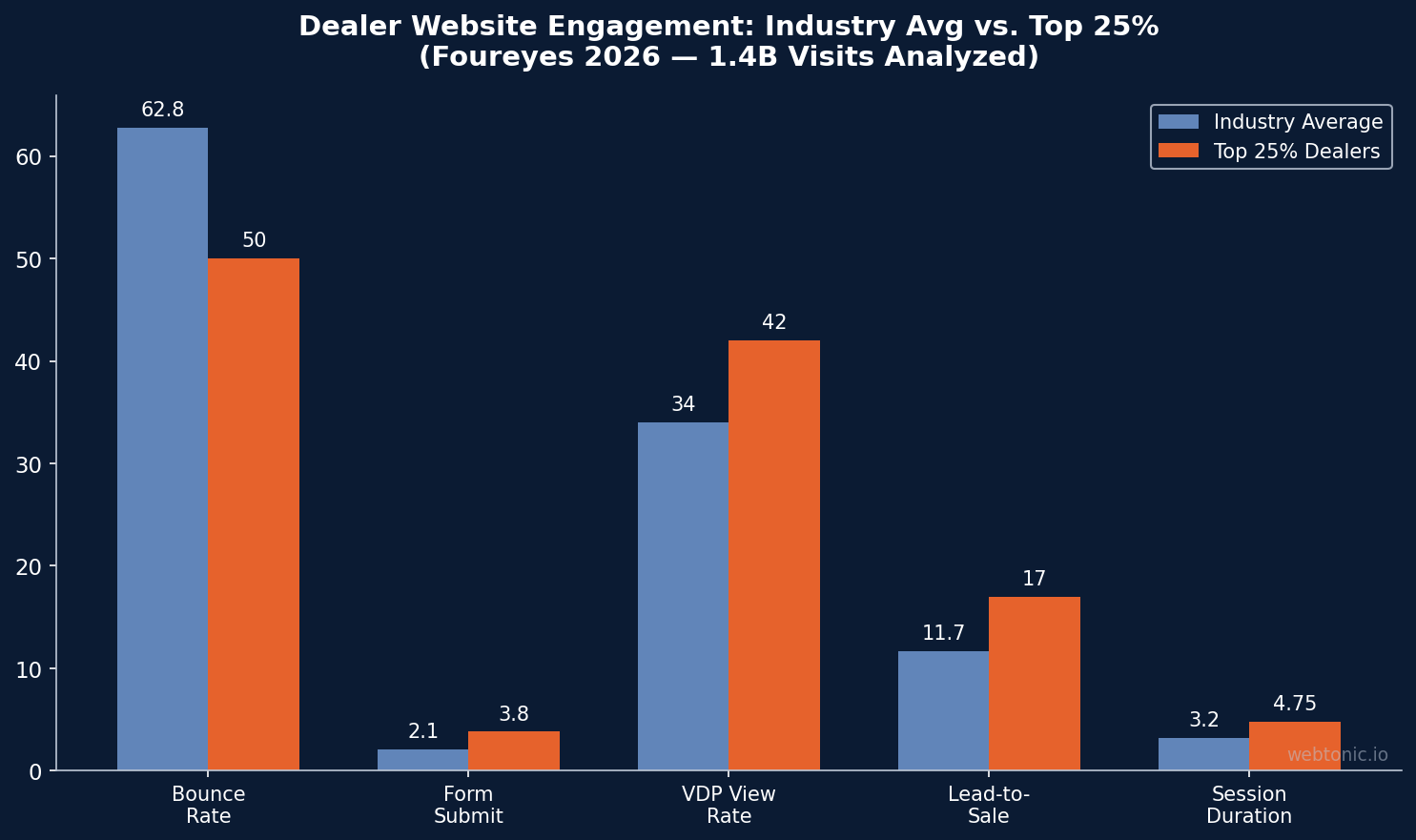
| Engagement Metric | Industry Benchmark | Top 25% Dealers |
|---|---|---|
| Avg bounce rate | 62.8% | 48–52% |
| Avg session duration | 3 min 12 s | 4 min 45 s |
| VDP (Vehicle Detail Page) view rate | 34% | 42% |
| Lead-to-sale conversion rate | 11.7% | 16–18% |
| Form submission rate | 2.1% | 3.8% |
| Mobile traffic share | 71% | 71% (consistent) |
The 62.8% average bounce rate and 11.7% lead-to-sale conversion suggest most dealer websites lose visitors before they ever submit a form. A cleaner, faster website built on a modern platform can meaningfully reduce that friction. Top-quartile dealers achieve nearly double the form submission rate of the average — and much of that gap comes down to page speed, mobile experience, and intuitive navigation rather than just traffic volume. Learn more about our approach to data-driven optimization.
Why Automotive Brands Are Evaluating Webflow
Webflow's appeal for automotive companies boils down to three factors: design freedom, speed to market, and performance. While legacy dealer platforms lock teams into rigid templates, Webflow allows marketing departments to iterate on design without engineering tickets.
- IONITY's Webflow Enterprise migration delivered a 64% increase in active users, 49% growth in organic search, and a 63% jump in user engagement — across a multi-language platform serving EV charging customers in 24 European markets (The Alien Design).
- Webflow ships the lightest images-plus-scripts payload among major website builders, outperforming WordPress defaults on total page weight and matching Squarespace on mobile CWV pass rate (Enricher).
- Refinery Autohaus used Webflow for a luxury automotive restoration brand — integrating Memberstack user profiles, e-commerce, and a custom CMS for vehicle listings without traditional development overhead. The site handles vehicle showcase pages, booking flows, and content marketing from a single platform (Masterly).
- Webflow's headless CMS mode supports API-first architectures, enabling dealerships to feed inventory data from DMS systems while maintaining design control on the front end. This hybrid approach lets dealers use Webflow for the customer-facing experience while keeping inventory synced with back-office tools.
- The platform's visual editor reduces time-to-publish from weeks to days, letting marketing teams launch campaigns, promotions, and seasonal pages without developer bottlenecks. Seasonal offers, holiday promotions, and new model announcements can go live the same day instead of sitting in a development queue.
Webflow E-Commerce in the Automotive Vertical
While Webflow is not a dedicated automotive e-commerce platform, its native e-commerce features serve a growing slice of the aftermarket parts and accessories market. The 279 Autos & Vehicles Webflow stores represent brands selling everything from performance parts to car care products to custom accessories.
- 16.9% of all Webflow stores fall in the Business & Industrial category, showing the platform's strongest adoption is in B2B and professional contexts — a pattern the automotive B2B segment mirrors.
- Webflow's e-commerce plans support up to 5,000 SKUs per site, which covers most aftermarket parts retailers. Dealerships with larger inventories typically use API integrations to pull from external databases.
- Average Webflow e-commerce site loads 40–60% faster than comparable WordPress + WooCommerce setups with similar product counts, primarily due to cleaner generated code and integrated CDN delivery.
- Automotive parts retailers on Webflow report 25–50 products as the typical catalog size, focusing on curated collections rather than exhaustive inventory — a positioning that plays to Webflow's strength in visual merchandising over bulk catalog management.
Best Practices for Automotive Websites on Webflow
If you are considering Webflow for an automotive site — whether a dealership, parts retailer, or OEM microsite — these practices separate high-performing implementations from underwhelming ones:
- Prioritize Core Web Vitals from day one. Use Webflow's native lazy loading, responsive images, and clean CSS output. Avoid embedding heavy third-party scripts directly — load them asynchronously or through a tag manager with firing rules that prevent render-blocking behavior.
- Build a CMS structure around your inventory model. Use Webflow Collections for vehicle listings, service packages, or parts catalogs so non-technical staff can update content without breaking the layout. Define field types (price, mileage, VIN, images) upfront to avoid restructuring later.
- Design mobile-first. With 71% of dealer traffic coming from mobile devices, your Webflow build should start on small screens and scale up — not the reverse. Touch targets, swipeable galleries, and click-to-call buttons need to work flawlessly on 375px-wide viewports.
- Integrate lead capture strategically. Forms, chat widgets, and click-to-call buttons should appear contextually — on VDPs, service pages, and financing calculators — not as generic pop-ups that interrupt the browsing experience and increase bounce rate.
- Use Webflow's staging environment for A/B testing. Duplicate pages, test variations of CTAs or hero layouts, and measure conversion impact before pushing to production. Document winning variants in a test log so institutional knowledge survives team turnover.
- Implement schema markup for vehicle listings. Use Webflow's custom code embed to add Vehicle schema (make, model, year, price, mileage) for enhanced search visibility. Rich results for vehicle listings can significantly increase click-through rates from search engine results pages.
For a broader view of how performance marketing fits with your website platform, explore our Google Ads strategy guide.
Automotive vs. Other Industries: Webflow Adoption Comparison
Automotive Webflow adoption is modest compared to industries where design-forward branding drives revenue directly. Here is how the sector stacks up against other verticals on the platform:
| Industry | Webflow Store Count | Adoption Driver |
|---|---|---|
| Business & Industrial | ~2,656 (16.9%) | B2B SaaS, agency sites |
| Arts & Entertainment | ~1,100 (7.0%) | Portfolio, creative branding |
| Beauty & Fitness | ~940 (6.0%) | DTC brands, visual storytelling |
| Food & Drink | ~785 (5.0%) | Restaurant, CPG brands |
| Autos & Vehicles | 279 (1.8%) | Aftermarket parts, enthusiast brands |
| Health | ~470 (3.0%) | Clinics, wellness brands |
The automotive sector's 279 Webflow stores represent just 1.8% of the platform's e-commerce footprint. But this number excludes non-e-commerce Webflow sites (corporate pages, landing pages, microsites) where automotive usage is likely higher — Webflow does not publish non-store site counts by vertical. Luxury automotive brands, EV companies, and motorsport organizations increasingly use Webflow for marketing sites that never touch e-commerce features but still benefit from the platform's design and performance advantages.
FAQ
Is Webflow suitable for car dealership websites?
Webflow works well for independent dealerships, luxury brands, and automotive aftermarket retailers who need design flexibility and fast iteration. Franchise dealerships tied to OEM website programs (like Dealer.com) may face platform mandates, but independent dealers can leverage Webflow's CMS Collections for inventory, service pages, and location-specific content without developer dependency. The platform handles the typical dealership site structure — SRPs, VDPs, service pages, financing calculators — through its visual builder.
How does Webflow compare to Dealer.com for automotive sites?
Dealer.com dominates franchise dealerships with 31% market share and OEM certifications. Webflow offers more design freedom and better default page speed but lacks built-in DMS integrations, OEM compliance tools, and inventory feed automation. For independent dealers or automotive brands outside the franchise model, Webflow is often the more cost-effective and flexible choice. The trade-off is development effort: Dealer.com is turnkey, while Webflow requires initial build investment.
Does Webflow help with automotive website SEO?
Yes. Webflow generates clean, semantic HTML with automatic sitemap generation, meta tag controls, and canonical URL management. Its faster page loads and Core Web Vitals performance provide an indirect SEO advantage — especially compared to legacy dealer platforms averaging 12.0 s LCP. The IONITY case study showed 49% organic search growth after migrating to Webflow Enterprise, driven by improved page speed, structured data, and content flexibility.
What is the average cost of a Webflow automotive website?
Webflow plans start at $24/month for basic sites, with enterprise plans available for larger builds. The real cost variable is design and development — a custom Webflow automotive build from an agency typically runs $8,000–$25,000 for a full dealership site, compared to $15,000–$50,000+ for a custom WordPress or headless CMS build. Ongoing maintenance costs are lower because marketing teams can make content updates without developer involvement.
Can Webflow handle vehicle inventory listings?
Webflow CMS Collections can manage vehicle inventory with custom fields for make, model, year, price, mileage, and images. For dealerships with large, frequently changing inventory (500+ vehicles), API integrations or third-party tools like Memberstack, Jetboost, or Airtable syncs extend Webflow's native capabilities. Smaller inventories under 100 vehicles are easily managed through Webflow's built-in CMS editor, with filter and sort functionality handled through native interactions or Finsweet attributes.
Sources
Popupsmart — Webflow Statistics 2026
WMTips — Top 25+ Website Builders by Market Share
DealerSignals — Car Dealer Website Platforms (1,746 Sites)
A3 Brands — Best CMS Platforms for Car Dealerships 2026
Foureyes — 2026 Automotive Dealer Benchmarks Report
Borah Labs — Auto Dealer Website Benchmarks
Overfuel — Auto Groups Failing Core Web Vitals (2025)
The Alien Design — Webflow Usage Statistics
Enricher — Webflow Market Share & Statistics
Masterly — Refinery Autohaus Webflow Case Study


