



Table of contents
Shopify powers over 43,000 automotive e-commerce stores worldwide — and the aftermarket parts segment is growing faster than nearly any other product category on the platform.
The automotive e-tailing market reached $72.01 billion in 2026, growing at 12.9% CAGR from $63.79 billion in 2025 (Research and Markets). Within this expansion, Shopify has carved out a 22.24% platform share of the autos and vehicles e-commerce vertical — trailing only WooCommerce — with 43,680 active stores and a specialized auto parts segment of 14,407 stores adding 675 new merchants in the last 30 days alone (AfterShip, BootLeads). This guide compiles 70+ verified automotive Shopify statistics for 2026, covering platform market share, store economics, conversion benchmarks, and revenue projections.
Key Takeaways
- The automotive e-tailing market is worth $72.01 billion in 2026, projected to reach $112.26 billion by 2030 at 11.7% CAGR (Research and Markets).
- Shopify holds 22.24% of the autos & vehicles e-commerce market with 43,680 active stores — second only to WooCommerce's 37.20% (AfterShip).
- 14,407 active Shopify auto parts stores exist, with an average catalog of 2,476 products and an average listed price of $683 (BootLeads).
- Automotive parts conversion rate is 1.6% — 30% below the 2.3% e-commerce average, with mobile conversion at just 1.1% (WisePIM).
- Shopify's Q1 2026 revenue grew 22% year-over-year to $2.8 billion, with Merchant Solutions (payments, shipping, capital) now outpacing subscription revenue (Online Store News).
- Average order value for auto parts on Shopify is $145, on par with the broader e-commerce average of $143 (WisePIM).
| Metric | Automotive / Auto Parts | E-Commerce Average |
|---|---|---|
| E-tailing market size (2026) | $72.01B | — |
| Shopify platform share | 22.24% | ~28% (global) |
| Active Shopify stores (auto) | 43,680 | — |
| Avg. order value | $145 | $143 |
| Conversion rate | 1.6% | 2.3% |
| Mobile conversion rate | 1.1% | 2.85% |
| Return rate | 10% | 17.5% |
| Repeat purchase rate | 58% | 28.5% |
Automotive E-Commerce Market Size
The global automotive e-tailing market is expanding rapidly, driven by increasing internet penetration, convenience-driven consumer behavior, and the continued growth of the aftermarket parts segment.
- The market grew from $63.79 billion in 2025 to $72.01 billion in 2026 — a 12.9% compound annual growth rate (Research and Markets).
- Projected to reach $112.26 billion by 2030 at an 11.7% CAGR, driven by cross-border e-commerce growth, electric vehicle aftermarket demand, and AI-based product recommendations.
- Key growth drivers include: expansion of omnichannel sales models, rising demand for branded components, integration of digital payment platforms, and faster logistics networks.
- CarParts.com generated $34.9 million in online revenue in May 2026 alone, with a conversion rate of 1.50–2.00% and an AOV of $150–$175 (Grips Intelligence).
- RockAuto outperformed at $68.8 million in monthly revenue with 27.7 million sessions and an AOV of $200–$225, demonstrating the scale achievable in auto parts e-commerce.
Shopify Platform Share in Automotive
Shopify has become the second-largest e-commerce platform in the automotive vertical, trailing WooCommerce but growing its merchant base rapidly with purpose-built features for product-heavy catalogs.
| Platform | Auto Store Count | Market Share |
|---|---|---|
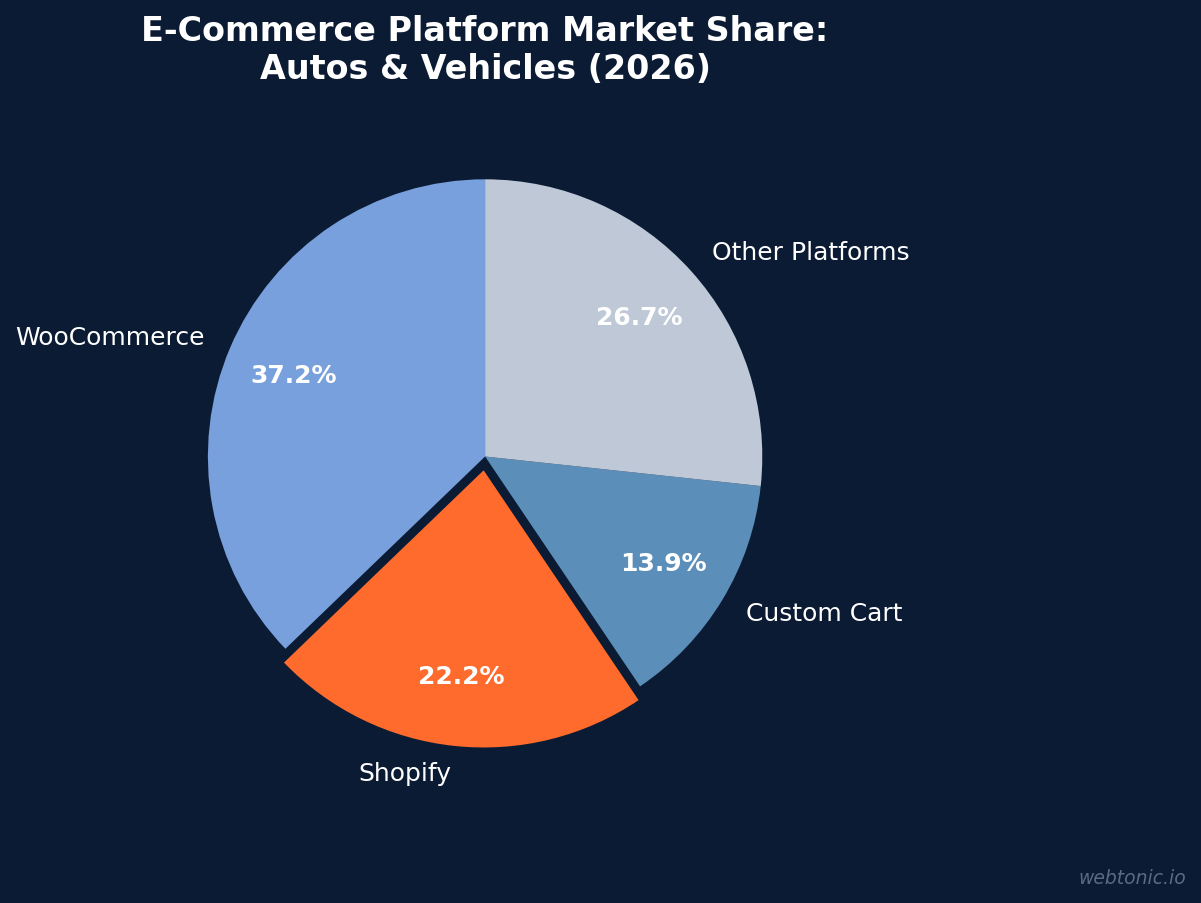
| WooCommerce | 73,070 | 37.20% |
| Shopify | 43,680 | 22.24% |
| Custom Cart | 27,230 | 13.86% |
| Other platforms | 52,380 | 26.70% |
AfterShip's 2026 data across 196,360 autos & vehicles stores reveals WooCommerce leading with 73,070 stores (37.20%), followed by Shopify with 43,680 stores (22.24%) and Custom Cart solutions at 27,230 stores (13.86%) (AfterShip). The concentration of Shopify merchants in the United States, Australia, and United Kingdom mirrors the broader platform's geographic distribution, though cross-border commerce is expanding Shopify's reach into European and Asian automotive markets.
Shopify Auto Parts Store Economics
The auto parts niche on Shopify has distinct economics compared to other e-commerce verticals — larger catalogs, higher price points, lower return rates, and significantly higher repeat purchase rates (BootLeads).
- 14,407 active Shopify stores operate in the auto parts segment, with 675 new stores added in the past 30 days (5% of total).
- Average product catalog size is 2,476 items — 6× larger than the Shopify average of 409 products per store.
- Average listed product price is $683 — more than 3× the Shopify platform average of $217.
- The 50–199 product range is the most common catalog size, though the category average is skewed upward by large-catalog retailers with 10,000+ SKUs.
- Growth has slowed — the 5% monthly new-store rate is below Shopify's overall average of 14%, suggesting the market is maturing with established players defending their positions.
- Subcategory breakdown: auto parts (8,057 stores), car accessories (1,276), motorcycle parts (306), hand tools (380).
- Geographic concentration: the strongest Shopify auto parts store concentrations are in the United States, Australia, and the United Kingdom — markets where aftermarket parts culture and DIY automotive repair drive sustained consumer demand.
- Pricing structure skews premium — the most common price range is $500+, reflecting the high-value nature of replacement components, performance upgrades, and specialty accessories that dominate the automotive Shopify ecosystem.
Conversion Rate and Customer Behavior
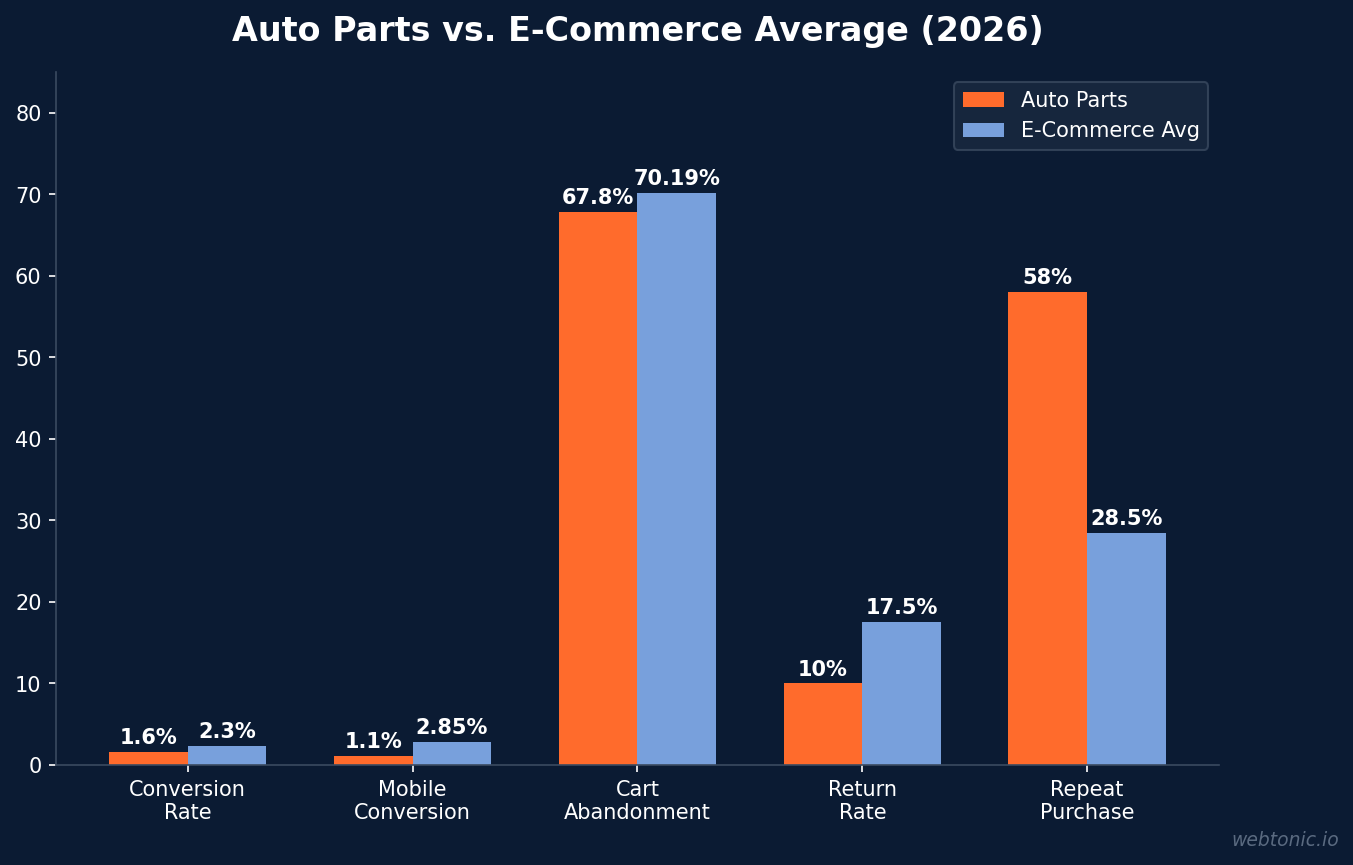
Automotive parts and accessories have a unique conversion profile: lower initial conversion rates but dramatically higher repeat purchase rates, creating strong customer lifetime value for merchants who optimize the post-purchase experience (WisePIM).
| Conversion Metric | Auto Parts | E-Commerce Avg | Delta |
|---|---|---|---|
| Overall conversion rate | 1.6% | 2.3% | 30% lower |
| Mobile conversion rate | 1.1% | 2.85% | 61% lower |
| Cart abandonment rate | 67.8% | 70.19% | 3% lower |
| Return rate | 10% | 17.5% | 43% lower |
| Repeat purchase rate | 58% | 28.5% | 104% higher |
| Average order value | $145 | $143 | On par |
The 58% repeat purchase rate stands out as the most strategically significant metric — more than double the 28.5% e-commerce average. This loyalty advantage, combined with a low 10% return rate (43% below average), means that automotive Shopify merchants who invest in customer retention strategies and email sequences can achieve outsized lifetime value per customer. The mobile conversion gap of 61% below the e-commerce average represents the largest immediate optimization opportunity for auto parts retailers.
Shopify Platform Growth Statistics (2026)
Shopify's broader platform performance provides context for the automotive vertical's growth trajectory. The platform's shift from subscription-led revenue to merchant-solutions-led growth has significant implications for automotive retailers.
- Shopify Q1 2026 revenue reached $2.8 billion, a 22% year-over-year increase (Online Store News).
- Shopify crossed $1 trillion in cumulative gross merchandise volume in Q4 2025 — a milestone that underscores the platform's scale.
- Merchant Solutions (payments, shipping, capital) now outpaces subscription revenue, meaning Shopify earns more from transaction fees than from monthly store subscriptions.
- Monthly recurring revenue growth from subscription plans has decelerated, and SMB-tier merchant churn has ticked upward.
- U.S. import tariffs and softening consumer discretionary spending are creating headwinds for DTC brands — including automotive aftermarket sellers — that power Shopify's GMV engine.
- Shop Pay continues to gain merchant adoption, processing a growing share of Shopify transactions and reducing checkout friction for automotive buyers purchasing high-AOV items.
- Shopify's app store ecosystem powers automotive-specific functionality — fitment finders, year-make-model filters, and vehicle compatibility tools that are critical for converting knowledgeable parts buyers who require exact specifications before purchasing.
Automotive Shopify Revenue Benchmarks
Revenue data from the largest automotive e-commerce operations provides benchmarks that Shopify merchants can use to assess their own performance and identify growth opportunities (Grips Intelligence).
| Retailer | May 2026 Revenue | Sessions | AOV |
|---|---|---|---|
| RockAuto | $68.8M | 27.7M | $200–$225 |
| PartsGeek | $52.9M | 10.4M | $225–$250 |
| NAPAOnline | $40.7M | 8.2M | $175–$200 |
| CarParts.com | $34.9M | 11.6M | $150–$175 |
The revenue spread reveals how catalog depth, brand recognition, and AOV optimization drive outsized results in automotive e-commerce. PartsGeek achieves the highest AOV ($225–$250) with fewer sessions than CarParts.com, demonstrating that conversion quality matters more than raw traffic volume. For Shopify merchants entering or scaling in the automotive space, these benchmarks set the competitive floor for revenue-per-session optimization.
Best Practices for Automotive Shopify Merchants
- Optimize mobile conversion first — with mobile CVR at 1.1% (61% below average), improving mobile checkout flow is the highest-leverage improvement available.
- Invest in retention, not just acquisition — the 58% repeat purchase rate means email sequences, loyalty programs, and post-purchase flows generate outsized ROI.
- Implement structured fitment data — year-make-model search functionality is table stakes for auto parts buyers; stores without it lose to competitors that offer it.
- Leverage Shopify's app ecosystem — specialized auto parts apps handle fitment lookups, vehicle catalogs, and compatibility displays that generic stores cannot provide.
- Price strategically — at an average listed price of $683, automotive Shopify stores serve a premium buyer; product photography, detailed specifications, and trust signals (warranty, return policy) directly influence conversion.
- Reduce cart abandonment — although the 67.8% rate is slightly below average, recovery email flows targeting high-AOV carts can meaningfully boost revenue per session.
- Expand to cross-border markets — Shopify's built-in multi-currency and international shipping tools position automotive merchants for the cross-border growth driving the market to $112B by 2030.
Related reading
- Mortgage Shopify & E-Commerce Statistics: Platform Data, Conversion Rates & Market Trends for 2026
- Painting Shopify Statistics: 2026 Data & Benchmarks
- PI Law Shopify Stats & Data
- Custom Web Development services at Web Tonic
FAQ
How many automotive stores are on Shopify?
AfterShip tracks 43,680 active Shopify stores in the autos & vehicles category, representing 22.24% of the total automotive e-commerce market. Within this broader category, BootLeads identifies 14,407 active Shopify stores specifically in the auto parts and accessories niche, with an average catalog of 2,476 products — 6× larger than the typical Shopify store.
What is the conversion rate for automotive Shopify stores?
The automotive parts and accessories conversion rate is 1.6% — 30% below the 2.3% e-commerce average. Mobile conversion drops further to 1.1%, which is 61% below the e-commerce mobile average of 2.85%. However, the category compensates with a 58% repeat purchase rate (more than double the 28.5% average) and a low 10% return rate, meaning each customer is worth significantly more over their lifetime.
How big is the automotive e-commerce market?
The automotive e-tailing market reached $72.01 billion in 2026, growing from $63.79 billion in 2025 at a 12.9% CAGR. It is projected to reach $112.26 billion by 2030 at 11.7% CAGR, driven by cross-border commerce, electric vehicle aftermarket demand, and AI-based product recommendations. Leading online auto parts retailers like RockAuto generate $68.8 million per month in revenue.
What is the average order value for auto parts on Shopify?
The average order value (AOV) for automotive parts and accessories is $145, on par with the broader e-commerce average of $143. However, the average listed product price on Shopify auto parts stores is $683 — more than 3× the Shopify platform average of $217 — reflecting the high-value nature of automotive components, performance parts, and specialty accessories. Top retailers like PartsGeek maintain AOVs of $225–$250.
Is Shopify growing or slowing in the automotive segment?
Growth is continuing but decelerating. The auto parts segment added 675 new Shopify stores in the past 30 days (a 5% monthly growth rate), which is below Shopify's overall average of 14%. This suggests the market is maturing, with established retailers defending positions. At the platform level, Shopify's Q1 2026 revenue grew 22% year-over-year to $2.8 billion, though SMB merchant churn has increased and macroeconomic headwinds (tariffs, consumer spending softness) are affecting DTC brands.
Sources
researchandmarkets.com/reports/5997586/automotive-e-tailing-market-report
aftership.com/ecommerce/statistics/stores/autos-vehicles
bootleads.com/stores/shopify/niches/vehicle-parts/
wisepim.com/ecommerce-industry-insights/automotive-parts
onlinestorenews.com/shopifys-global-merchant-sales-in-2026/
gripsintelligence.com/insights/retailers/carparts.com


