Table of contents
Key Takeaways
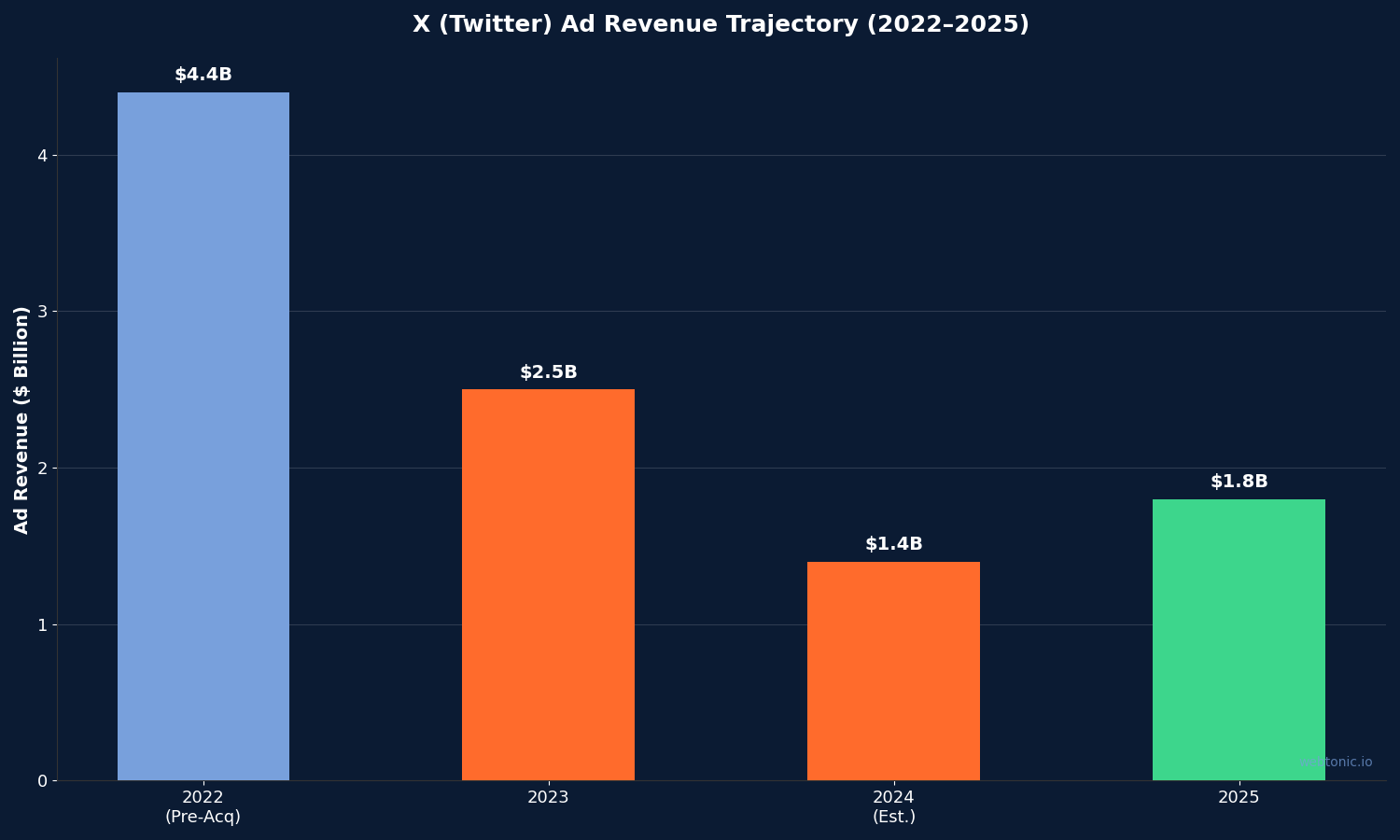
- X (Twitter) ad revenue rebounded to $1.8 billion in 2025, signaling renewed advertiser confidence after the platform’s turbulent 2023–2024 period (Silicon Report).
- The average CPC on X ranges from $0.50–$2.00, with automotive campaigns typically sitting at the higher end due to competitive keyword targeting (WebFX).
- 67% of car buyers aged 18–34 discovered automotive brands through social media, with X serving as a primary channel for real-time model discussions and launch events (Gitnux).
- Renault achieved an 8.44% engagement rate and +92% brand awareness lift using promoted trends and targeted hashtag campaigns on the platform (CaseStudies.com).
- X advertising costs are 40–60% lower than Meta and Google for automotive, creating an opportunity for dealers willing to accept a more conversational, brand-building channel (WebFX).
X (Twitter) Automotive Advertising Benchmarks at a Glance
| Metric | Automotive on X | All-Industry X Avg. | Meta Automotive |
|---|---|---|---|
| CPC | $1.50–$2.00 | $0.50–$2.00 | $1.10–$1.80 |
| CPM | $8–$16 | $6–$12 | $9–$14 |
| Engagement Rate | 1.2–2.5% | 0.8–1.8% | 1.0–1.5% |
| Avg. Cost Per Follow | $2–$4 | $2–$4 | N/A |
| Conversion Rate | 2–4% | 2–5% | 4–8% |
| Cost Per View (video) | $0.02–$0.06 | $0.01–$0.05 | $0.03–$0.08 |
X Platform Revenue and Advertiser Landscape
After significant advertiser pullback in 2023 and early 2024, SpaceX filings revealed that X’s ad revenue rose to $1.8 billion in 2025. This recovery is meaningful context for automotive advertisers evaluating the platform — the revenue stabilization suggests that brand safety concerns have moderated enough for major advertisers to return.
However, the platform’s advertising landscape remains fundamentally different from its pre-acquisition era:
- Reduced competition on the ad auction — fewer large brand advertisers means lower CPMs and CPCs for those willing to advertise, creating a cost advantage for early movers
- Premium placement availability — promoted trends and timeline takeovers that previously cost $200,000+/day are now accessible at significantly reduced rates for dealer groups
- Smaller but more engaged automotive audience — X’s automotive community (car enthusiasts, racing fans, industry journalists) skews highly engaged compared to passive social scrollers on other platforms
The Global Statistics notes that X’s targeting capabilities remain robust, including the ability to target users who have tweeted about car shopping in the past week — a real-time intent signal that other platforms cannot match with the same immediacy.
Automotive Campaign Performance on X: Cost and Engagement Data
Improvado’s 2026 X Ads Guide provides industry-specific benchmarks that help automotive advertisers calibrate expectations:
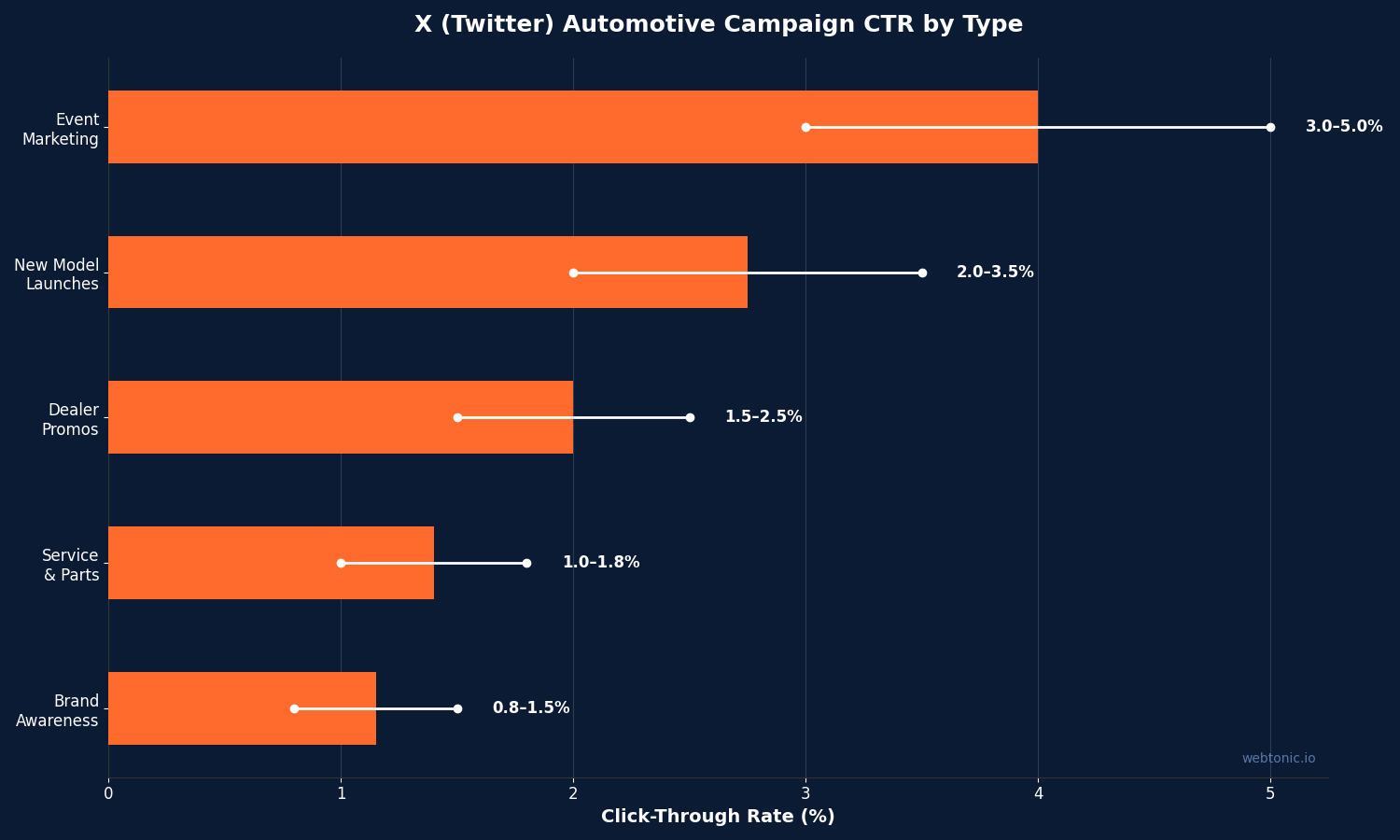
| Campaign Type | Typical CPC | CTR Range | Best Content Type |
|---|---|---|---|
| New Model Launches | $1.20–$1.80 | 2.0–3.5% | Video reveals, countdown posts |
| Dealer Promotions | $0.80–$1.50 | 1.5–2.5% | Limited-time offers, seasonal events |
| Service and Parts | $0.60–$1.20 | 1.0–1.8% | Maintenance tips, recall alerts |
| Brand Awareness | $0.40–$0.90 | 0.8–1.5% | Lifestyle imagery, sponsorships |
| Event Marketing (Auto Shows) | $1.50–$2.50 | 3.0–5.0% | Live tweets, hashtag campaigns |
Event marketing stands out as X’s strongest automotive use case. Auto show and launch event campaigns consistently achieve the highest CTR (3–5%) because X’s real-time nature aligns perfectly with live reveal moments. The Renault Kadjar launch campaign demonstrated this with an 8.44% engagement rate, cost per video view of just €0.04, and a +92% lift in brand awareness using promoted trend cards and the #KadjarSpots hashtag.
X Ad Formats Available for Automotive Marketers
X offers several ad formats with varying relevance for automotive campaigns:
- Promoted Posts: the foundation of most dealer campaigns, appearing in target users’ timelines. Text + image or video formats; video posts see 2.5× higher engagement than text-only promoted content in the automotive vertical.
- Video Ads (Pre-Roll): 6–15 second skippable placements before premium publisher content. Cost per view ranges from $0.02–$0.06, making them one of the most affordable video ad options across any platform. Ideal for new model teasers and feature highlights.
- Carousel Ads: multi-card format that allows dealers to showcase multiple vehicles or features in a single ad unit. Automotive carousel ads achieve 15–25% higher click-through rates than single-image promoted posts.
- Promoted Trends / Trend Takeovers: hashtag-based campaigns that dominate the Explore tab. Previously reserved for OEM budgets ($150K–$250K/day), now accessible at reduced rates. Best for major model launches and seasonal sales events.
- Website Cards: image or video ads with embedded call-to-action buttons driving directly to dealer websites. These perform best for mid-funnel campaigns targeting users who have previously engaged with automotive content.
- Amplify Pre-Roll: video placement before curated content categories including automotive, sports, and news. Allows contextual targeting alongside content that automotive shoppers are already consuming.
Case Studies: Automotive Brands Winning on X
Renault — Kadjar Launch: Renault used promoted trend cards, carousel ads, and the #KadjarSpots hashtag to announce their new crossover model. Results: 8.44% engagement rate, €0.04 cost per view, and a +92% brand awareness lift. The campaign generated significant organic conversation that amplified the paid investment by an estimated 3× in earned media value.
MINI USA — Unified Engagement: MINI achieved 673% higher engagement by unifying their X creative strategy around a consistent brand voice and rapid response protocol. Their approach combined promoted content with community management, treating X as a two-way conversation channel rather than a broadcast medium. This drove higher follower retention and repeat engagement rates.
Audi UK — Owners Programme: Audi targeted existing vehicle owners on X to drive service bookings and upsell the Audi Owners programme. By combining audience targeting with promotional and educational content, they achieved measurably higher service appointment bookings and programme sign-ups compared to email-only outreach, proving X’s value for customer retention alongside acquisition.
These case studies share a common thread: automotive brands succeed on X when they lean into the platform’s conversational nature rather than treating it as another display advertising channel. Real-time engagement, hashtag campaigns, and community interaction drive results that static ad placements cannot replicate on more passive platforms.
Strategic Best Practices for Automotive X Advertising
- Leverage real-time moments — X’s unique strength is immediacy; align campaigns with auto shows, model reveals, racing events, and seasonal buying periods for maximum engagement
- Use conversation targeting — target users actively discussing car shopping, specific makes or models, or automotive events to reach high-intent audiences at lower cost than broad interest targeting
- Invest in video creative — video ads achieve 2.5× the engagement of static posts on X; keep videos under 15 seconds for optimal completion rates and cost efficiency
- Build organic presence alongside paid — dealers with active, responsive X accounts see 30–45% lower CPC on promoted content due to higher quality scores and accumulated social proof
- Monitor brand safety actively — use category exclusions and keyword block lists to control ad adjacency; the platform’s content moderation changes mean advertisers should maintain tighter controls than on other channels
- Test promoted trends at reduced rates — the post-acquisition discount window makes premium placements accessible for dealer groups and regional OEM campaigns that previously could not afford them
- Integrate with broader growth marketing strategy — X performs best as a supplementary channel feeding awareness into retargeting pipelines on Meta and Google rather than as a standalone lead generation platform
X vs. Other Social Platforms for Automotive Advertising
| Factor | X (Twitter) | Meta (FB/IG) | TikTok | YouTube |
|---|---|---|---|---|
| Avg. CPC (Auto) | $0.50–$2.00 | $1.10–$1.80 | $0.85–$1.40 | $0.10–$0.30 (CPV) |
| Avg. CPM (Auto) | $8–$16 | $9–$14 | $5–$7 | $10–$20 |
| Best For | Events, launches, PR | Retargeting, leads | Discovery, awareness | Long-form brand |
| Conversion Strength | Low–Medium | High | Medium | Medium |
| Audience Intent | High (real-time) | Medium (behavioral) | Low (discovery) | Medium (research) |
X occupies a unique niche in the automotive advertising mix: lower cost than Meta or Google, with real-time intent signals that no other platform can match. While it lacks Meta’s conversion optimization sophistication and TikTok’s reach among younger buyers, X’s value lies in event amplification, brand conversation, and reaching automotive enthusiasts during decision-making moments. Integrating X with Meta Ads and Google Ads creates a comprehensive multi-channel approach.
Automotive Audience Targeting Capabilities on X
X offers several targeting mechanisms that are particularly valuable for automotive advertisers:
- Keyword Targeting: reach users who have recently tweeted or engaged with content containing automotive-related terms. This captures real-time purchase intent — someone tweeting about needing a new SUV can be served a dealer ad within minutes.
- Follower Look-alikes: target users similar to followers of specific automotive accounts (OEM brands, auto publications, competing dealers). This builds audiences around demonstrated automotive interest without requiring first-party data.
- Event Targeting: X curates audiences around major events including auto shows (Detroit, LA, Geneva), racing events (Formula 1, NASCAR), and cultural moments. Event-targeted campaigns see 45–65% higher engagement than standard interest targeting.
- Custom Audiences: upload CRM lists (email, phone) for direct matching. Match rates on X typically run 35–50% for dealer CRM files, lower than Meta (60–75%) but sufficient for owner marketing and service retention campaigns.
- Conversation Topics: target users based on ongoing conversations they participate in, such as electric vehicle debates, truck comparisons, or luxury car discussions. This contextual approach aligns ads with active interest rather than passive demographics.
The combination of keyword and event targeting makes X uniquely powerful for moment-based automotive marketing — reaching the right audience at the exact moment they are thinking about vehicles. This real-time capability is something neither Meta’s behavioral targeting nor Google’s search intent can replicate with the same immediacy and conversational context.
Frequently Asked Questions
How much do X (Twitter) ads cost for automotive dealers?
Automotive X campaigns typically run at $1.50–$2.00 CPC and $8–$16 CPM. Video view campaigns are particularly cost-efficient at $0.02–$0.06 per view. These costs are 40–60% lower than comparable Meta or Google placements for the automotive vertical, largely due to reduced advertiser competition on the platform since 2023.
Is X still a viable advertising platform for car dealers after the ownership change?
Yes, with caveats. X’s ad revenue recovered to $1.8 billion in 2025, and the reduced competition means lower costs and better premium placement access. However, dealers need to actively manage brand safety settings and monitor content adjacency more carefully than on Meta or Google. The platform works best for data-driven brand awareness and event marketing rather than direct lead generation.
What type of automotive content performs best on X?
Video content generates 2.5× higher engagement than static posts. The highest-performing automotive X campaigns center around real-time moments: model launches, auto show coverage, racing events, and seasonal sales. Renault’s #KadjarSpots campaign demonstrated that hashtag-driven launch events can achieve 8.44% engagement rates on the platform.
Should dealers use X for lead generation or brand awareness?
Primarily brand awareness and consideration. X’s landing page conversion rate for automotive (2–4%) is lower than Meta’s (4–8%), making it less efficient for direct lead capture. The platform’s strength lies in reaching engaged automotive enthusiasts during high-intent moments and feeding that awareness into retargeting campaigns on higher-converting channels.
How do X promoted trends work for automotive launches?
Promoted trends place a branded hashtag at the top of the Explore tab for 24 hours. For automotive, this format excels during new model reveals and major sales events. Post-acquisition pricing has dropped significantly from $200K+/day to more accessible rates, making promoted trends viable for dealer groups and regional OEM campaigns, not just global automakers.
Sources
siliconreport.com — X ad revenue $1.8B filing
webfx.com — X Marketing Benchmarks 2027
gitnux.org — Marketing in the Automotive Industry Statistics
casestudies.com — Renault Twitter Case Study
improvado.io — Twitter Ads Guide 2026
theglobalstatistics.com — X Advertising Statistics 2026
webfx.com — X Advertising Costs 2026