Table of contents

X sells impressions at $5.65 per thousand and clicks at $0.74 — among the cheapest inventory in social. It also converts lead-generation campaigns at about 0.77% and delivers leads at $41. For a painting contractor, that makes X a reach and citation channel, not a lead channel.
Key Takeaways
- X has about 611 million monthly and 259 million daily active users in 2026.
- US users number 95.4 million, roughly 15.6% of global monthly actives.
- Average CPC is $0.74 within a $0.27–$1.95 range.
- Average CPM is $5.65, against $8.15 on Instagram, $9.10 on LinkedIn and $4.10 on TikTok.
- Average CTR is 0.86%; promoted video ads lead at 1.24%.
- Average cost per lead is $41, versus $82 on LinkedIn and $24 on Facebook.
- Lead-generation conversion rate averages 0.77%, against 1.11% on Facebook.
- Reported lead quality is about 34% lower than LinkedIn.
- The audience is 60.9% male and largest at 25–34 (29.6%).
- 68% of users live in urban areas — the highest share of any major platform.
- 42% are college-educated and 34% work in the knowledge economy.
- Keyword targeting delivers roughly 31% higher CTR than interest targeting.
- Vertical video ads perform about 28% better than horizontal on the platform.
- Roughly 45% of Grok citations are X posts — 34% organic and 11% verified-only.
- Posts above 50,000 likes are cited by Grok at 11.2x the baseline probability.
- Painting search still costs $13.74 per click and $138.38 per lead — the comparison that matters.
X Ads Benchmarks at a Glance
Platform-level figures compiled from 80+ X advertising and audience statistics, with the painting comparison attached so the numbers mean something operationally.
| Metric | X average | Range or comparison | What it means for painting |
|---|---|---|---|
| CPC | $0.74 | $0.27 – $1.95 | About 19x cheaper than a $13.74 search click |
| CPM | $5.65 | Meta $7.19, LinkedIn $9.10 | Cheap local awareness inventory |
| CTR | 0.86% | Video 1.24% | Comparable to Facebook at 0.90% |
| Cost per engagement | ~$0.13 | $0.03 – $0.50 | Cheapest social engagement available |
| Cost per lead | $41 | Facebook $24, LinkedIn $82 | Below painting's $138.38, above its quality bar |
| Lead-gen conversion rate | 0.77% | Facebook 1.11% | Roughly one lead per 130 clicks |
| Median CPA (agency data) | $21.55 | Aggregated across verticals | Not a booked-job number |
| Promoted Trends | $100k – $250k/day | US pricing | Not a contractor product |
The cheap-media story is real and it has a cause: 52% of advertisers who bought X before the acquisition reduced or stopped spending, and estimated 2026 ad revenue of $2.5 billion is roughly 54% below the 2021 figure. Fewer bidders means lower clearing prices. The same withdrawal is why brand-safety scoring is the other half of the decision — an issue that matters more for a national brand than for a local painting company, but not zero for one bidding on news-adjacent inventory.
Cheap Impressions, Compared Honestly
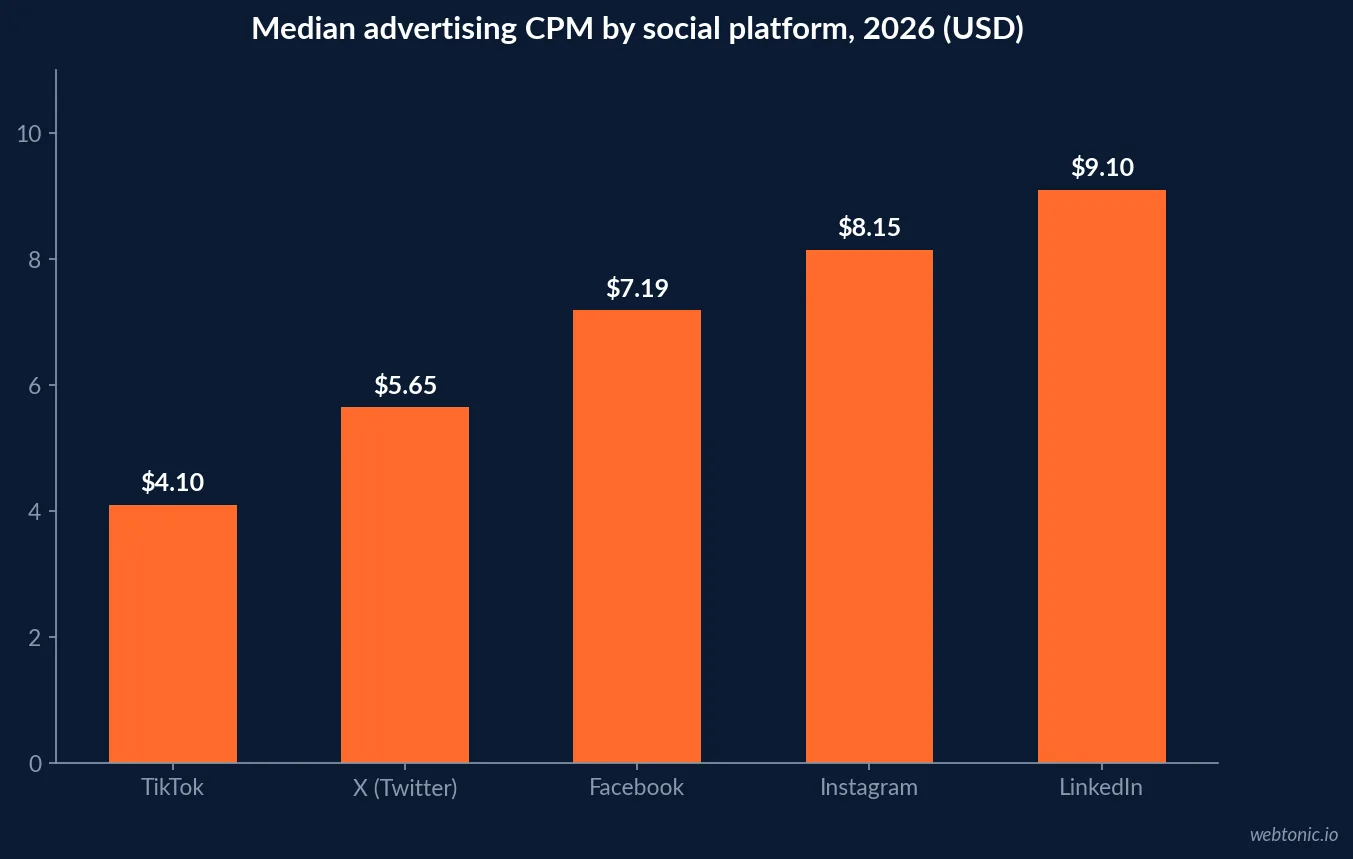
X sits second-cheapest on CPM behind TikTok, and roughly 22% under Meta. That is genuinely useful for one job: putting a painting brand in front of an urban, higher-income audience in a metro for very little money. It is not useful for the job most contractors want, because cheap impressions in a low-intent feed do not become estimates. The relevant arithmetic: at a 0.86% CTR and a 0.77% lead-gen conversion rate, 10,000 impressions produce about 86 clicks and well under one lead.
Independent benchmark sets diverge sharply here, and the divergence is instructive rather than contradictory. One aggregation of agency account data reports a $0.18 CPC and a 0.02% conversion rate; another practitioner analysis reports $0.85 CPC and 2.1% conversion. The gap is objective mix: engagement-optimised campaigns buy very cheap interactions that almost never convert, while conversion-optimised campaigns buy costlier clicks that sometimes do. Ask which objective any X benchmark was measured on before you plan against it.
The Audience Question for a Homeowner Business
X’s audience profile is unusually well documented, and it is unusually poorly matched to residential repainting demand.
| Audience attribute | X figure | Painting demand reality | Verdict |
|---|---|---|---|
| Largest age band | 25–34 (29.6%) | Median homeowner is 54 | Mismatch |
| Aged 45 and over | 19.5% | 40–69 = ~65% of renovation spend | Thin coverage |
| Gender split | 60.9% male | Repaint decisions skew female or joint | Mismatch |
| Urban share | 68% | Painting demand is suburban-heavy | Partial mismatch |
| College-educated | 42% | Correlates with higher home value | Favourable |
| Knowledge-economy workers | 34% | Commercial and office decision-makers | Favourable for B2B |
| Primary use case | 63% news and current events | Painting is a considered local purchase | Wrong context |
| Lurker share | 47% rarely or never post | — | Reach is passive |
Two behavioural facts sharpen the picture. 20% of users generate 98% of posts, which makes X the most concentrated major platform — great for reaching decision-makers who post, useless for community-building around a local trade. And the For You algorithmic feed generates 78% of impressions, so follower count matters less than it used to; a small verified account with one strong post can outreach a large dormant one.
Where the profile does work is commercial. A painting company chasing property managers, general contractors, facility directors and HOA administrators is chasing exactly the urban, educated, knowledge-economy cohort X over-indexes on. Commercial painting economics tolerate the cost: tenant improvement projects run $10,000–$45,000, office repaints $45,000–$180,000 and master service agreements $250,000–$1.2 million. A $41 lead is 30% of a residential job’s gross profit and a rounding error against an MSA. Our painting LinkedIn Ads data covers the same commercial audience at a higher price and higher quality.
Keyword Targeting: The One Real Advantage
X is the only major social platform that lets you target based on what people recently posted or searched, and it delivers roughly 31% higher CTR than interest targeting. That is the closest thing to intent available on the platform, and it is what makes narrow commercial plays viable.
| Targeting approach | Relative performance | Painting application |
|---|---|---|
| Keyword targeting | ~31% higher CTR than interest | Metro property-management and fit-out conversation |
| Follower lookalikes | Moderate | Followers of local commercial developers and REITs |
| Retargeting | Strongest conversion | Site visitors who viewed commercial service pages |
| Interest targeting | Baseline | Too broad for a service radius |
| Demographic only | Weakest | Not recommended for painting |
Format guidance is short. Promoted video carries the highest CTR at 1.24% against a 0.86% platform average, and vertical 9:16 video performs about 28% better than horizontal. Given 82% of X traffic is mobile, the same short vertical asset produced for other channels works here — which keeps the incremental cost of testing X close to zero.
Grok: The Reason to Post Even If You Never Advertise
This is the genuinely new item in the 2026 data, and it is the strongest argument for a painting company maintaining an X presence. Grok is grounded in the live X stream in a way no other assistant is. Continuous monitoring across 4,400 prompts found that about 45% of Grok citations are X posts — 34% organic and 11% verified-only — with conventional web sources making up the other 55%.
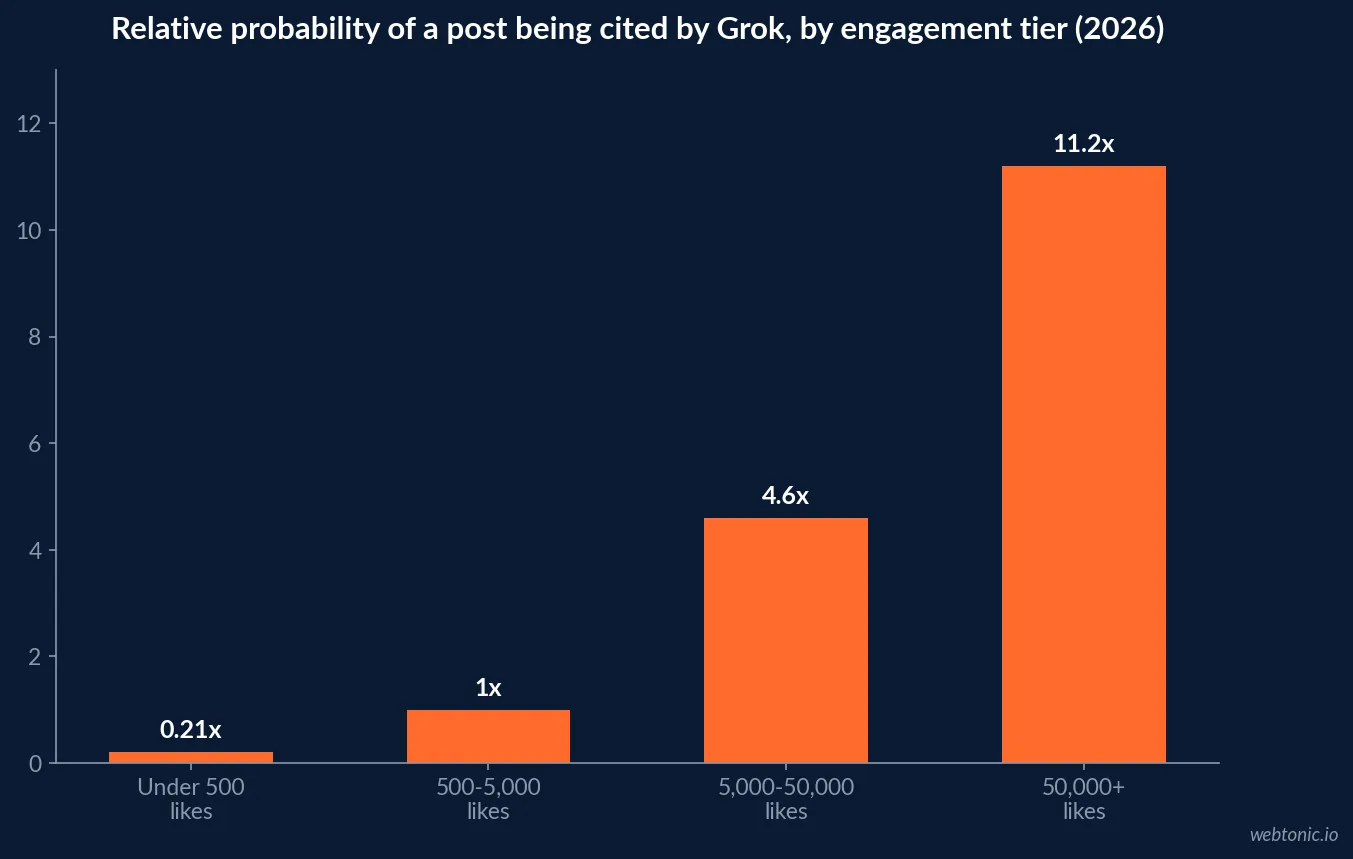
Citation selection is engagement-weighted and sharply non-linear. Against a 500–5,000-likes baseline, posts under 500 likes are cited at 0.21x, posts at 5,000–50,000 at 4.6x and posts above 50,000 at 11.2x. Verified accounts are cited at 2.8x the rate of equivalently engaged unverified accounts, rising to 4.7x on finance-style queries. Grok cites an average of 4.7 sources per answer.
Independent measurement supports the pattern with different numbers: an analysis of 6,400 Grok answers over 14 weeks put X posts at 47% of cited sources, and a ranking of Grok’s most-cited domains places x.com inside the top dozen. Read these as directional — sample sizes and prompt sets differ — but the structural conclusion is consistent.
Set expectations honestly for a local contractor. A painting company will not clear 50,000 likes, and no realistic X strategy makes it a top-cited domain. What is achievable: a verified business account, a consistent posting habit around local project work, and occasional posts that clear the low thousands of engagements in a metro conversation — enough to be a plausible source when someone asks Grok about painting in your city. It is a cheap hedge on one answer engine, not a lead channel.
How Painting Should Actually Use the Channel
Four uses survive the numbers, in priority order:
- Commercial prospecting with keyword targeting. Property managers, GCs and facility directors are on X in urban metros. A $41 lead is negligible against a $250,000 master service agreement.
- Retargeting site visitors. At a $5.65 CPM, staying in front of people who already viewed a commercial services page is the cheapest useful impression in the mix.
- Organic posting for Grok grounding. Verified account, real project content, and the acceptance that citation probability scales with engagement you may never reach.
- Customer service and reputation. 31% of business interactions on X happen in DMs, and X remains the fastest public channel for handling a complaint before it becomes a review.
What does not survive: residential lead generation at scale, brand campaigns that need adjacency control, and any plan that treats a $0.74 click as comparable to a $13.74 search click. Different intent, different unit. Our painting social media benchmarks put the whole channel set side by side, and our painting branding data explains why cheap reach is still worth something to a trade paying the highest click price in home services.
Platform Risk Worth Pricing In
Two structural facts belong in any 2026 plan. X’s valuation fell about 72% from the $44 billion purchase price to a $12.5 billion third-party estimate, and headcount is down roughly 80% from 7,500 to about 1,500. Product and policy have changed repeatedly, and support for small advertisers is thin. Meanwhile reach in Western Europe declined about 14% between 2023 and 2026, with the sharpest fall among 18–24s.
None of that makes the inventory unusable — it explains why it is cheap. It does mean a painting contractor should treat X as a discretionary line item that can be switched off in a month, not as infrastructure. Independent commentary reaches the same conclusion: for most local businesses, X targeting is less precise than Google or Meta for local campaigns, and reported return on ad spend clusters around 2:1 to 2.5:1, below search.
The Verdict for Painting Contractors
Do not build a residential pipeline on X. Do consider a small, permanently capped budget for commercial keyword targeting and retargeting, and do maintain a verified organic presence for the Grok channel — it costs a posting habit rather than media dollars. Our growth marketing team builds these mixes for home-services operators, and our data intelligence team measures whether the cheap impressions ever reach a booked job.
Frequently Asked Questions
Should a painting company advertise on X in 2026?
Rarely as a residential lead channel. X carries the second-cheapest CPM of the major platforms at $5.65 and a $0.74 average CPC, but its conversion rate for lead generation is about 0.77% and cost per lead averages $41 with reported lead quality 34% below LinkedIn. Commercial and property-management targeting is the defensible use case, not homeowner acquisition.
How much do X ads cost in 2026?
Average CPC is $0.74 within a $0.27–$1.95 range, average CPM is $5.65, and average CTR is 0.86% with promoted video highest at 1.24%. Cost per engagement medians sit near $0.13. Promoted Trends remain a brand product at $100,000–$250,000 per day in the US.
Who actually uses X, and are they homeowners?
X has about 611 million monthly and 259 million daily users, 95.4 million of them in the US. The audience is 60.9% male, largest at 25–34 (29.6%), 68% urban and 42% college-educated. Only 19.5% are 45 or older, while the median US homeowner is 54 — the same age mismatch that limits most social platforms for painting.
Why do painting companies post on X if the ads are weak?
Because of Grok. Roughly 45% of Grok citations are X posts — 34% organic and 11% verified-only — which is far higher than any other major AI assistant. Citation probability scales sharply with engagement, and verified accounts are cited at 2.8x the rate of equivalently engaged unverified accounts.
What is the best X campaign type for a painting contractor?
Keyword targeting, which is unique to X and delivers roughly 31% higher CTR than interest targeting. For a painting company that means targeting posts about property management, commercial fit-outs, HOA administration and local development in your metro — not generic homeowner interests.
Sources
SearchLab — X (Twitter) statistics 2026
SocialPilot — X (Twitter) statistics and demographics 2026
Onclusive — X (Twitter) statistics 2026
Enrich Labs — X (Twitter) advertising benchmarks
Pryani — X (Twitter) ads performance medians
Christoph Olivier Consulting — X ads cost and payback 2026
HeyOz — Are X (Twitter) ads worth it for businesses
Presenc AI — Grok citation patterns 2026
MaxAEO — How Grok selects sources
Netzender — The 50 most-cited websites in Grok
Improvado — X (Twitter) ads costs and targeting guide
BaaDigi — Painting marketing benchmarks 2026