Table of contents

X sells a surrogacy agency the cheapest impressions in social at a $5.65 CPM, the weakest lead-generation conversion of any major platform at 0.77%, and roughly 45% of everything Grok cites. Only one of those three numbers is a reason to be there.
Key Takeaways
- X reports 611 million monthly and 259 million daily users.
- Average CPC is $0.74; average CPM is $5.65.
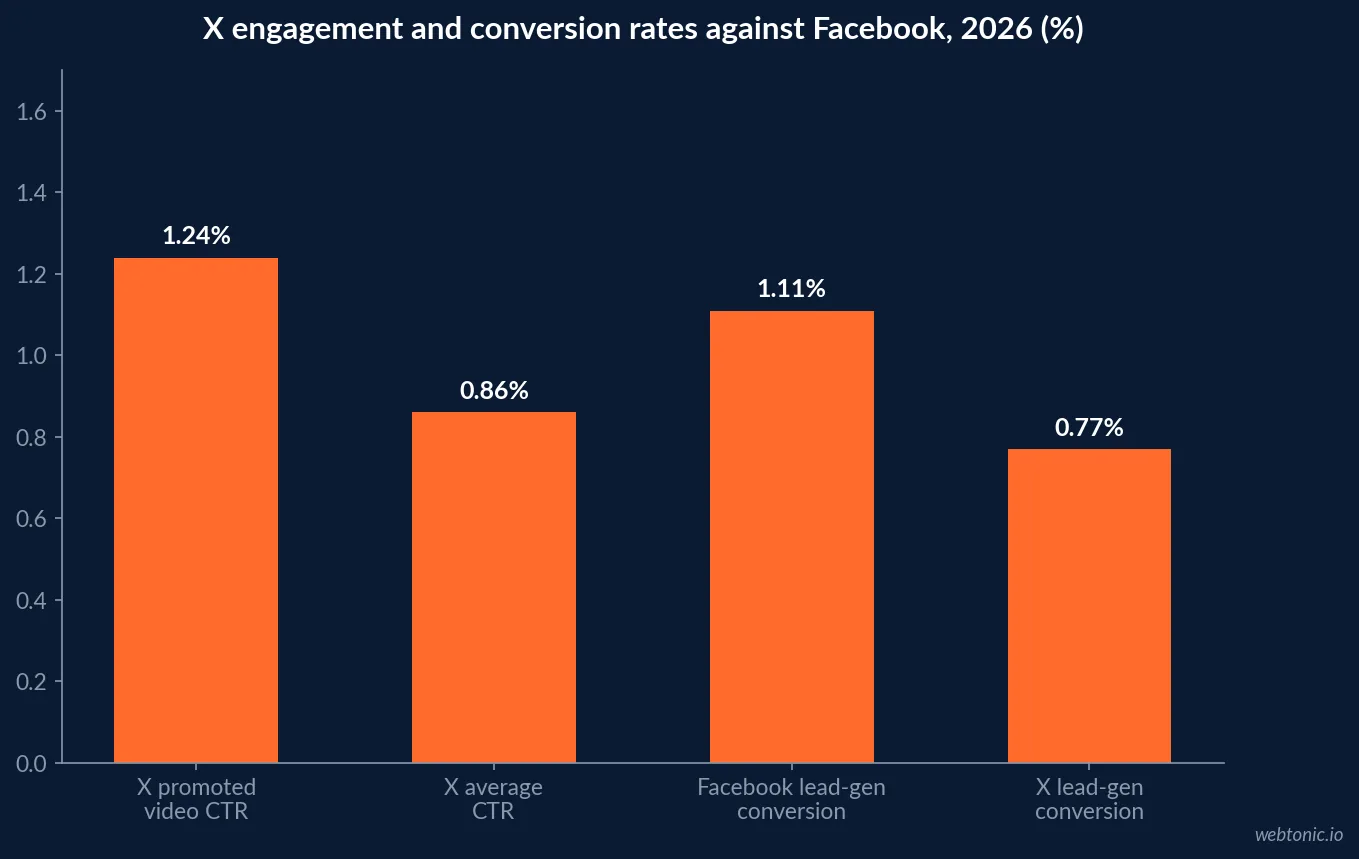
- Average CTR is 0.86%, rising to 1.24% on promoted video.
- Average cost per lead is $41.
- X lead-gen conversion is 0.77% against Facebook’s 1.11%.
- The base is 60.9% male and peaks at 25-34.
- Keyword targeting lifts CTR about 31% over interest targeting.
- Roughly 45% of Grok citations are X posts.
- Fertility search runs $9.84 CPC, 5.28% CTR, 6.8% CVR, $112 CPA.
- Meta fertility CTR is 1.72% at a 2.8x ROAS.
- Surrogacy CPL on certified channels runs $120-$300, tier-one $200-$450.
- An intended parent is worth an $800-$3,000 CPA on $120,000-$200,000+ journey revenue.
- Inquiry-to-qualified on the surrogate side is only 2-3%.
- The surrogacy market is $28.91B in 2026 growing at a 22.19% CAGR.
- Over 210,000 cycles ran in 2025; North America holds 45%.
- Gestational arrangements exceed 95% of the total.
- State law bounds geography: 13 states plus DC are considered protective.
X media costs at a glance
Platform figures come from 2026 X platform statistics, SocialPilot’s Twitter statistics compilation and Improvado’s X Ads benchmark guide, with fertility comparisons from fertility clinic paid-media benchmarks.
| Metric | X benchmark | Fertility / surrogacy comparison | Read |
|---|---|---|---|
| CPC | $0.74 | $9.84 fertility search | 13x cheaper click |
| CPM | $5.65 | Meta fertility inventory higher | Cheapest reach in social |
| CTR | 0.86% | 1.72% Meta, 5.28% search | Weakest engagement of the three |
| Promoted video CTR | 1.24% | Closer to Meta | The only format worth buying |
| Lead-gen conversion | 0.77% | 1.11% Facebook, 6.8% search | Bottom of the market |
| Cost per lead | $41 | $120-$300 certified CPL | Cheap and unqualified |
| Keyword targeting | +31% CTR | - | Biggest lever on the platform |
Why the $41 lead is the expensive one
A $41 cost per lead next to a $120-$300 certified-channel CPL looks like an obvious win, and it is the most common way agencies waste money on this platform. Surrogate recruitment converts 2-3% of inquiries into qualified applicants on well-targeted channels; a channel that is 60.9% male and skewed to a demographic largely outside the eligibility criteria will sit below that, not at it.
| Channel | Cost per lead | Qualification rate | Effective cost per qualified applicant |
|---|---|---|---|
| Google Search (certified) | $112 CPA | Top of the 2-3% band | $3,700-$5,600 |
| Meta (certified) | $120-$300 | Within the 2-3% band | $4,000-$10,000 |
| X promoted video | $41 | Below the band | Unproven, likely higher |
| Low CPC, 30-50% under Meta CPMs | Below the band | Research-stage only | |
| Referral from a past surrogate | Near zero | Far above the band | Lowest in the category |
The observed qualified-surrogate cost of $1,500-$8,000 and matched cost of $3,000-$15,000 already prices in this attrition. Any channel evaluated on raw lead cost will beat the channels that actually fill the roster - which is exactly the reporting error our surrogacy dashboard benchmarks are built to prevent.
The audience is topical, not demographic
Audited X platform figures put the base at 611 million monthly and 259 million daily users, 60.9% male, peaking at 25-34. For surrogate recruitment that is the wrong gender skew; for intended parents it is the wrong wealth and age profile. What X does have is the conversation itself: state legislation, clinic controversies, ethics debates and journalist sourcing.
| Audience | Present on X? | Reachable by ads? | Better channel |
|---|---|---|---|
| Prospective surrogates 21-42 | Thinly | Poorly | Meta, organic short-form |
| Intended parents | Somewhat | Weak targeting | Google Search, LinkedIn |
| Fertility clinicians and REIs | Yes | Yes, small volume | LinkedIn for B2B |
| Journalists and policy staff | Heavily | Organic, not paid | Owned account |
| AI answer engines | Indirectly | Not purchasable | Consistent public posting |
The Grok citation layer is the real argument
Roughly 45% of Grok citations are X posts, per citation analysis of the most-cited sources in Grok. Surrogacy is precisely the kind of expensive, emotionally loaded, jurisdiction-dependent decision people now put to an assistant first. If an agency has never posted about state law, screening criteria or cost breakdowns, it cannot be surfaced in that answer.
This is a visibility asset, not a media buy, and it compounds with the technical work covered in our surrogacy technical SEO benchmarks. The parallel on other platforms is documented too: Reddit supplies 46.7% of Perplexity’s top-ten cited sources, which we cover in the surrogacy Reddit Ads benchmarks.

What to post if the ad account stays small
Intended-parent marketing research is consistent on this point: the questions that stall a decision are cost, legality and timeline, in that order. Those are also the questions an AI assistant answers badly without primary sources.
| Content type | Why it earns citation | Cadence |
|---|---|---|
| State-by-state legal status updates | Jurisdiction questions dominate queries | As legislation moves |
| Full journey cost breakdowns | $140k-$180k needs itemising, not a range | Quarterly refresh |
| Screening criteria explainers | Filters remove 95%+ of inquiries | Monthly |
| Success-rate context | PGT-tested transfers reach 70-80% live birth | Quarterly |
| Timeline realism posts | IP cycle 3-12 months, surrogate 2-6 months | Monthly |
Journey cost is the highest-value transparency play. A US journey runs $140,000 to $180,000, above $200,000 in California, split across agency fees of $25,000-$50,000, IVF at $20,000-$50,000, legal at $8,000-$18,000 and escrow plus insurance at $12,000-$25,000, with surrogate base compensation of $60,000-$110,000, per 2026 surrogacy cost and success data.
What the surrogacy market looks like underneath the ad account
Channel decisions only make sense against category economics. The surrogacy and fertility consulting market is worth $28.91 billion in 2026 and compounding at 22.19% a year through 2031, with more than 210,000 cycles run in 2025. North America accounts for 45% of activity and the United States alone for roughly 40% of gestational arrangements, which now exceed 95% of the total.
| Indicator | 2026 figure | Why it changes media strategy |
|---|---|---|
| Market size | $28.91B | Enough demand to fund brand, not just direct response |
| Growth rate | 22.19% CAGR | Supply, not demand, is the binding constraint |
| Annual cycles | 210,000+ in 2025 | Volume is national, delivery is state-bound |
| North America share | 45% | US-first media plans dominate |
| Gestational share | Above 95% | Traditional surrogacy is effectively legacy |
| Protective jurisdictions | 13 states plus DC | Geo-exclusions before creative |
The consequence for a channel like X is unforgiving. When a category is supply-constrained, the media question is not "what is the cheapest impression" but "what fills the roster", and a platform that is 60.9% male with a 0.77% lead-gen conversion rate does neither for surrogate recruitment. Its value has to be argued on visibility.
Budget shape for a supply-constrained category
Recruitment budgets in the category cluster tightly: Meta takes 35-55%, Google 25-35%, and everything else splits the remainder. X belongs in that remainder, capped and measured differently from the channels around it.
| Line | Share | Primary metric | Review cadence |
|---|---|---|---|
| Meta | 35-55% | Cost per qualified applicant | Weekly |
| Google Search | 25-35% | $112 CPA, 6.8% CVR | Weekly |
| Landing page and CRO | 5-10% | 6.2% conversion benchmark | Monthly |
| Organic and creator content | 5-15% | Branded search lift | Quarterly |
| X (paid test) | 3-8% | Branded search lift, not CPL | 90-day kill decision |
Two things make that cap defensible. First, a certified channel with a $112 CPA and a 6.8% conversion rate is simply a better place for the marginal dollar. Second, the surrogate funnel already loses 95%+ of inquiries to screening, so buying more unqualified volume adds screening cost without adding matches.
Trust signals travel further than ad spend
Reputation research across 671 US fertility practices and 63,513 reviews, published via fertility centre rating analysis, found a weighted average of 4.20 stars with 35.6% of practices below 4.0. The top decile averages 4.86 and collects 33.5% of all reviews; the bottom decile sits at 2.97.
An agency arguing publicly on X while carrying a 3.4-star profile is amplifying a liability. Fix the rating first: around 89% of patients check reviews and 51% read at least six before contacting a provider.
A defensible X test plan
- Cap X at 3-8% of recruitment budget; Meta keeps 35-55%, Google 25-35%.
- Buy promoted video only - 1.24% versus 0.86% CTR.
- Use keyword targeting for the +31% CTR lift, not interest categories.
- Exclude states outside your legal footprint before anything else.
- Never optimise to X lead forms at 0.77% conversion; send traffic to a real page.
- Post cost, legality and timeline content weekly for the citation layer.
- Baseline branded search, then measure lift at 60-90 days.
- Track assistant answers for your brand the way you track rankings.
- Kill the paid test at 90 days if branded search has not moved.
- Keep the organic account running regardless - it costs staff time, not media.
Read alongside the paid channels that carry the volume: our surrogacy Google Ads benchmarks and data intelligence work cover the measurement side that makes a small X test readable at all. Context for the category: the market is $28.91 billion in 2026, compounding at 22.19%, with more than 210,000 cycles in 2025 and gestational arrangements above 95%.
Frequently Asked Questions
Do X (Twitter) ads work for surrogacy agencies?
Not for recruitment. X lead-generation conversion runs 0.77% against 1.11% on Facebook, and a $41 cost per lead on X buys a far less qualified applicant than a $9.84 fertility search click that converts at 6.8%. The audience is 60.9% male and peaks at 25-34, which is the wrong end of both surrogacy audiences at once. The defensible uses are brand presence in policy conversations and AI-answer visibility.
What do X ads cost in 2026?
Average CPC is $0.74 and average CPM is $5.65, making X one of the cheapest impression buys in social. Average CTR is 0.86%, rising to 1.24% on promoted video. Average cost per lead is $41. Keyword targeting - bidding on the words in a post rather than an interest category - lifts CTR about 31%, which is the single biggest performance lever on the platform.
Why does X matter for AI visibility in surrogacy?
Because Grok is trained on and cites X directly: roughly 45% of Grok citations are X posts. Surrogacy is a high-consideration, heavily debated topic where prospective parents and surrogates increasingly ask an AI assistant before they ask a search engine. An agency with no presence in the conversation is invisible to that answer layer regardless of how well its website ranks.
Is X's audience right for surrogacy marketing?
Demographically, no. X reports 611 million monthly and 259 million daily users, but the base is 60.9% male with a 25-34 peak, while surrogate recruitment targets women aged roughly 21 to 42 and intended parents skew older and more affluent. The platform's value is topical rather than demographic: legislation, clinic news and journalist attention live there.
What should a surrogacy agency spend on X?
A small, capped test - typically 3-8% of a recruitment budget - run as promoted video and keyword-targeted conversation ads, with the primary success measure being branded search lift and AI-answer citation rather than cost per lead. Meta should still hold 35-55% of the recruitment budget and Google 25-35%, because both have certification paths and documented conversion economics.
Sources
SearchLab - X (Twitter) Statistics 2026
SocialPilot - Twitter Statistics
Improvado - X Ads Benchmark Guide
Digital Applied - X Platform Statistics 2026
HeyOz - Are X (Twitter) Ads Worth It
Netzender - Most Cited Websites in Grok
Tandem - Intended Parent Marketing
Benchmarketing - Fertility Clinic Benchmarks
ACRC Global - Surrogacy Statistics 2026
Fertility Bridge - Fertility Center Google Ratings