



Table of contents
Key Takeaways
- The Google Maps Map 3-Pack captures 42% of all clicks for proximity-based queries in the clinical sector, making it the single highest-value SERP feature for practices in the specialty.
- 45.8% of patients visiting an allergist are self-referring — they skip the primary-care referral and search online, putting organic search at the center of new-patient acquisition.
- 71% of individuals use search engines as their first step before booking an appointment, and the dominant engine handles 92% of those queries.
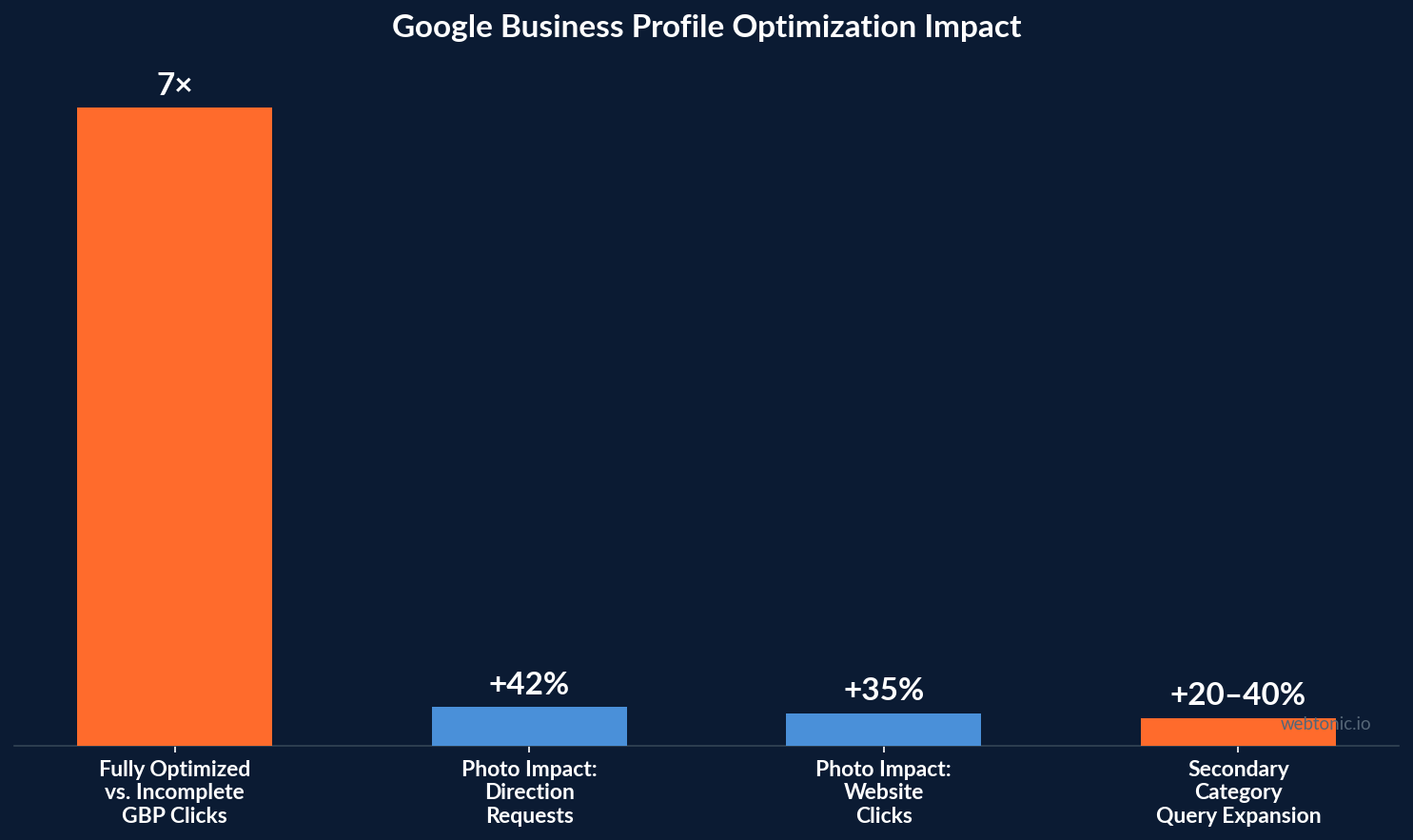
- A fully optimized Google Business Profile receives 7× more clicks than an incomplete listing, yet most allergy practices treat their GBP as a one-time setup.
- 73% of individuals require a minimum 4-star rating before they will even consider engaging with a provider, making reviews the decisive conversion factor.
- Listings with photos generate 42% more direction requests and 35% more click-throughs to the practice website.
| Metric | Benchmark | Source |
|---|---|---|
| Map Pack click share (local medical) | 42% | MedRank SEO |
| Self-referring allergy patients | 45.8% | NAMCS |
| Patients starting with search engines | 71% | Aragil |
| Google share of clinical queries | 92% | MedRank SEO |
| Optimized vs. incomplete GBP click ratio | 7× | MedRank SEO |
| Minimum star rating patients require | 4.0+ | Aragil |
| Photo impact on direction requests | +42% | Aragil |
Why Local SEO Is the Top Channel for Allergy Practices
Unlike many specialties that depend on physician referrals, the allergy and immunology vertical is driven by patients who find their own providers. The 45.8% self-referral rate reported by the National Ambulatory Medical Care Survey means nearly half of all visits originate from the patient's own search — not a referral slip (Aragil).
When 71% of those individuals use a search engine as their first step and the dominant search engine controls 92% of clinical queries (MedRank SEO), the math is clear: organic search directly controls the largest lead acquisition channel for any office in the niche that wants to grow without relying on generic healthcare marketing or paid ads alone.
Google GBP Optimization Benchmarks
The Google Business Profile (GBP) is the single most important asset for local SEO in the specialty. A fully optimized GBP listing receives 7× more clicks than an incomplete one — yet most practices fill out the basics and never revisit the listing (MedRank SEO).
| GBP Element | Impact on Performance | Optimization Priority |
|---|---|---|
| Primary category ("Allergist") | Determines which queries trigger the listing | Critical |
| Secondary categories (Immunologist, Asthma Specialist) | Expands query coverage by 20–40% | High |
| Service descriptions (allergy testing, immunotherapy) | Improves relevance for long-tail searches | High |
| Photos (monthly updates) | +42% direction requests, +35% website clicks | High |
| Business profile attributes (online booking, wheelchair access) | Filters into specialized search results | Medium |
| Q&A section | Pre-empts common visitor questions | Medium |
| Posts (weekly updates) | Signals activity to Google's algorithm | Medium |
Practices that treat their GBP as an ongoing optimization opportunity — not a one-time setup — consistently outperform competitors in the map pack. Adding secondary categories like "Immunologist" or "Asthma Specialist" alone can expand query coverage by 20–40% (Aragil).
Map Pack Performance and Click-Through Data
The local 3-Pack dominates the SERP for proximity-based queries. When a patient searches "allergist near me" or "allergy clinic in [city]," the map pack results appear above all organic listings and capture 42% of all clicks (MedRank SEO).
Practices ranking in the top 3 map pack positions receive significantly more appointment requests than those in positions 4–10, even when rating counts are similar. The ranking gap is driven by three factors (Authority Specialist):
- Relevance: How well the GBP matches the search query — driven by categories, services, and content on the associated website.
- Distance: Proximity to the searcher, which the practice cannot control but can influence through multi-location strategies.
- Prominence: The combination of reviews, web authority, citations, and backlinks — the factor where consistent marketing effort compounds over time.
Patient Reviews: The Decisive Conversion Factor
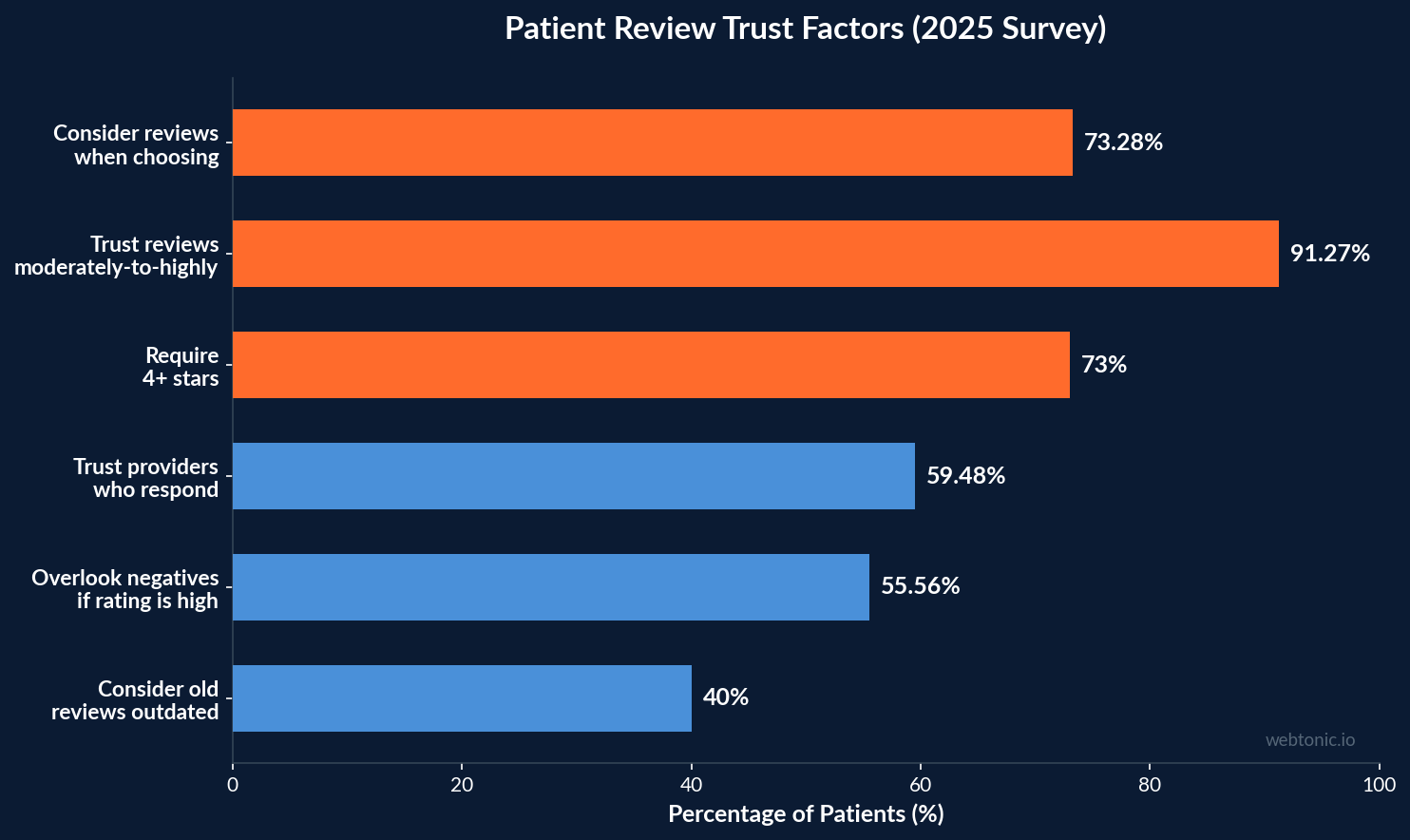
Reviews function as trust signals that influence both ranking position and decision-making. The data from RepuGen's 2025 survey is stark (RepuGen):
| Review Metric | Percentage | Implication for the Practice |
|---|---|---|
| Consider reviews when choosing a provider | 73.28% | Reviews are a primary decision factor |
| Trust reviews at moderate-to-high level | 91.27% | Review content directly builds consumer trust |
| Overlook negatives if ratings are high | 55.56% | Volume and recency matter more than perfection |
| Require 4+ star minimum | 73% | Below 4 stars = invisible to most patients |
| Trust providers who respond to reviews | 59.48% | Response rate directly impacts conversion |
| Consider reviews older than 1–2 years outdated | 40% | Recency drives perception more than total count |
The dominant engine dominates review platforms at 84.03% awareness and 77.78% usage in 2025 — up 2.41% year-over-year. For allergy practices, this means platform reviews carry more weight than any other platform, and responding to every review is not optional (RepuGen).
Near-Me Search Trends and Mobile Behavior
Mobile devices account for the majority of proximity-based searches, and the trend continues accelerating. Key data points for the allergy and immunology space:
- Position 1 on organic results captures approximately 27% of clicks for clinical queries. By position 5, click-through rates fall below 5% — making the office functionally invisible (MedRank SEO).
- Structured schema and verified physician entity signals boost organic CTR by 18–34% compared to listings without them (Authority Specialist).
- AI Overviews are beginning to suppress traditional blue-link clicks on symptom queries, shifting optimization priority toward featured-snippet and entity-answer formats — a new consideration for practices publishing condition-specific content.
- Case study results: One telemedicine clinic saw a 75% rise in phone calls, 150% rise in website clicks, 110% increase in map-based visibility, and a 20% rise in new ratings after six months of consistent optimization work (MedRank SEO).
Local SEO ROI Versus Paid Advertising for the Specialty
Organic acquisition through organic acquisition compounds over time, while paid advertising costs typically rise year over year. The financial comparison for the specialty:
| Channel | Cost per New Patient | Trend Over Time | Time to First Results |
|---|---|---|---|
| Local SEO (organic) | $180–$420 | Decreasing | 4–9 months |
| Google Ads (paid search) | $280–$900 | Increasing | Immediate |
| Meta Ads (social) | $150–$600 | Variable | 1–2 weeks |
With lifetime patient values (LPV) of $8,000–$22,000 over a five-year relationship, the ROI from local SEO far exceeds paid channels for most offices in the vertical (Authority Specialist). Practices investing in growth marketing that combines organic visibility with paid search see the strongest combined results.
Citation Consistency and NAP Accuracy
Beyond the GBP listing itself, citation consistency across the web plays a significant role in map pack positioning. NAP (Name, Address, Phone) accuracy across directories, listing aggregators, and niche sites reinforces the prominence signal that determines map pack eligibility.
- Inconsistent NAP across directories is one of the most common technical issues undermining organic visibility for single-location offices. Even minor differences — "Suite 200" vs. "Ste. 200" or "(555) 555-1234" vs. "555.555.1234" — can fragment authority signals.
- Core directories to audit: Healthgrades, Vitals, WebMD, Zocdoc, Yelp, the Better Business Bureau, and industry-specific listings maintained by professional associations.
- Automated citation management tools like BrightLocal, Yext, or Moz can monitor and correct inconsistencies at scale — particularly valuable for multi-location groups that cannot manually audit dozens of directory entries.
Organic Visibility Checklist for the Specialty
Based on the benchmarks above, the highest-impact actions for the specialty in 2026:
- Claim and fully optimize the GBP listing — primary category "Allergist," secondary categories for immunology, allergy testing, and asthma treatment.
- Upload fresh photos monthly — office exterior, interior, providers, and treatment rooms. Photo-rich listings earn 42% more direction requests.
- Implement a systematic reputation-generation program — target a minimum 4.0 star rating with at least 50 verified ratings. Respond to every piece of feedback within 24 hours.
- Build consistent NAP citations across directories, listing aggregators, and niche listing sites to reinforce prominence signals.
- Add structured data markup (LocalBusiness, Physician, MedicalClinic schema) to boost CTR by 18–34% and improve visibility in AI Overviews.
- Publish location-specific content — pages targeting "[city] allergist," "food allergy testing near [area]," and condition-specific queries that build topical authority.
- Track booked patients from clicks and calls using call tracking and form attribution — practices without proper attribution undercount organic conversions by 30–50%.
The Role of Content Marketing in Organic Visibility
Beyond optimizing the GBP listing, content marketing plays a critical role in building the topical authority signals that drive map pack rankings. Effective content strategies for the specialty include:
- Condition-specific pages targeting queries like "food allergy testing in [city]" or "immunotherapy options near [area]" — these pages build relevance signals that reinforce the GBP listing's category match.
- FAQ content addressing common concerns — questions about allergy testing procedures, immunotherapy timelines, and insurance coverage generate long-tail traffic and featured-snippet opportunities.
- Seasonal content calendars aligned with pollen seasons, back-to-school food allergy awareness, and flu/respiratory peaks — creating natural engagement spikes that boost overall domain authority.
- Provider bio pages with structured schema — verified physician entity signals achieve 18–34% higher organic CTR, directly supporting both organic and map-based visibility.
Investing in professional creative content and social engagement amplifies these signals, driving more branded searches that in turn lift map pack prominence.
Related reading
- Allergy & Immunology SEO Statistics: Key Data Points for 2026
- Allergy & Immunology Technical Seo Statistics
- Local SEO for Solar in 2026: 55+ Map Pack and Review Statistics
- Local SEO Services services at Web Tonic
Frequently Asked Questions
How important is the Google Business Profile for a practice in the niche's local SEO?
The Google Business Profile is the single most critical asset. A fully optimized business profile receives 7× more clicks than an incomplete one, and the map pack — powered entirely by GBP data — captures 42% of all clicks for proximity-based medical queries. Any office investing in data-driven marketing should prioritize GBP optimization above all other local SEO tactics.
What star rating do patients expect from an allergist?
73% of patients require a minimum 4-star rating before considering a provider. Below that threshold, the office is effectively invisible regardless of its map pack position. Star ratings and sentiment matter more than raw rating volume — 55.56% of individuals overlook some negative feedback if the overall rating remains high.
How long does local SEO take to deliver results for an allergy clinic?
Most practices see measurable improvements within 4–9 months of consistent optimization. A telemedicine clinic case study showed a 75% rise in phone calls and 150% rise in website clicks after six months. Competitive metro markets typically take longer (6–12 months), while suburban practices often see faster movement.
Should an allergy practice invest in organic search or paid ads first?
Both, when possible. paid search deliver immediate visibility while local SEO builds compounding organic authority. Organic acquisition costs ($180–$420 per patient) trend downward over time, while paid costs ($280–$900) trend upward. For practices with limited budgets, organic visibility offers the stronger long-term ROI, but paid campaigns bridge the gap during the 4–9 month ramp-up period.
What are the most important review platforms for allergy and immunology practices?
The dominant platform holds 84.03% awareness and 77.78% usage among individuals seeking providers. Specialized platforms like Healthgrades and WebMD carry supplementary weight, particularly for patients comparing specialists. The highest-impact strategy is to optimize Google reviews first, then ensure profiles on Healthgrades and WebMD are complete and accurate. Learn more about advertising costs and how they compare to organic channels.
Sources
https://www.aragil.com/blog/local-seo-allergy-clinics-rank-city
https://authorityspecialist.com/industry/health/doctor/healthcare-seo-statistics
https://authorityspecialist.com/industry/health/medical-practice/seo-statistics
https://authorityspecialist.com/industry/health/medical-practice/seo-roi
https://medrankseo.com/local-seo-for-doctors-2026-guide/
https://www.repugen.com/patient-review-survey
https://brightlocal.com/research/local-consumer-review-survey/
https://firstpagesage.com/reports/patient-conversion-rate-by-practice-type/


