



Table of contents
Key Takeaways
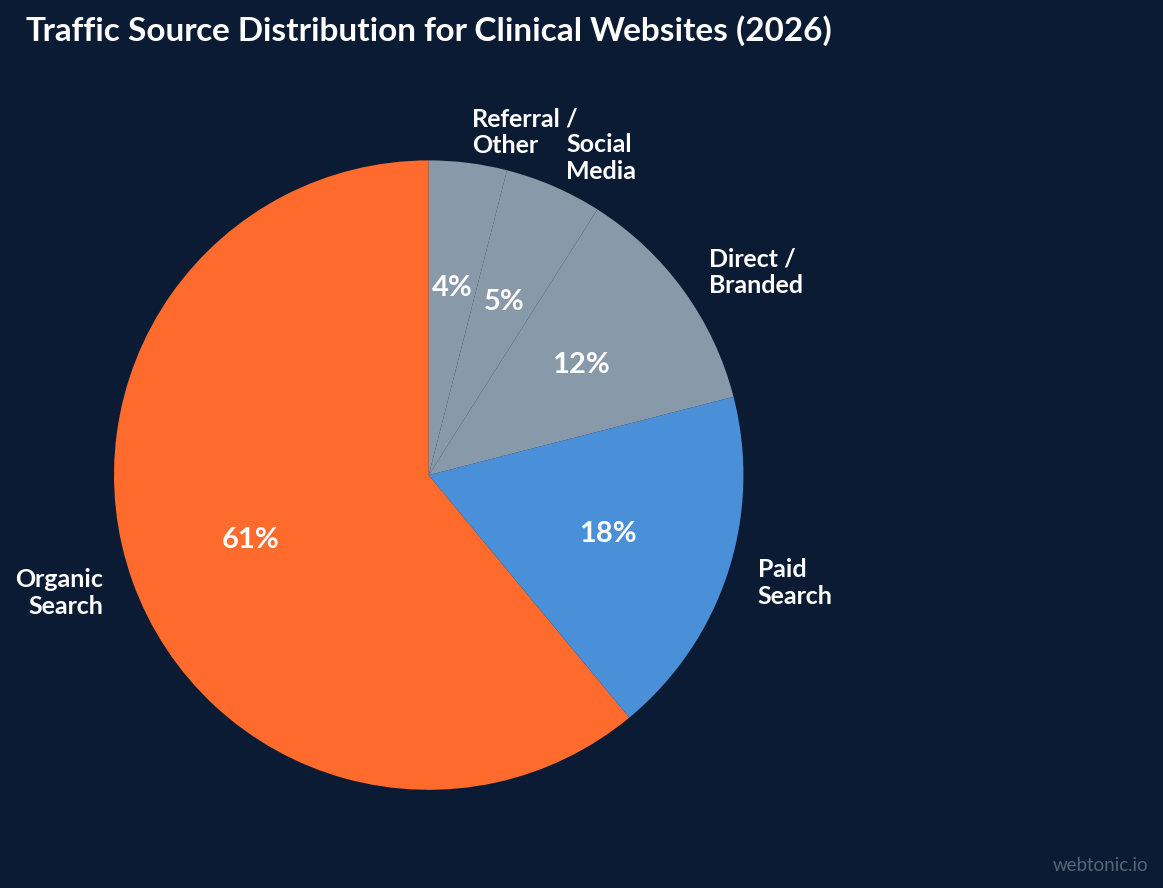
- Organic search drives 54–68% of new visitor sessions for multi-specialty practices, making it the dominant acquisition channel for the allergy and immunology vertical.
- The median Domain Authority for sector websites is 42 across 427 analyzed sites, with the top quartile reaching DA 60+ — a benchmark that directly correlates with map pack and organic ranking eligibility.
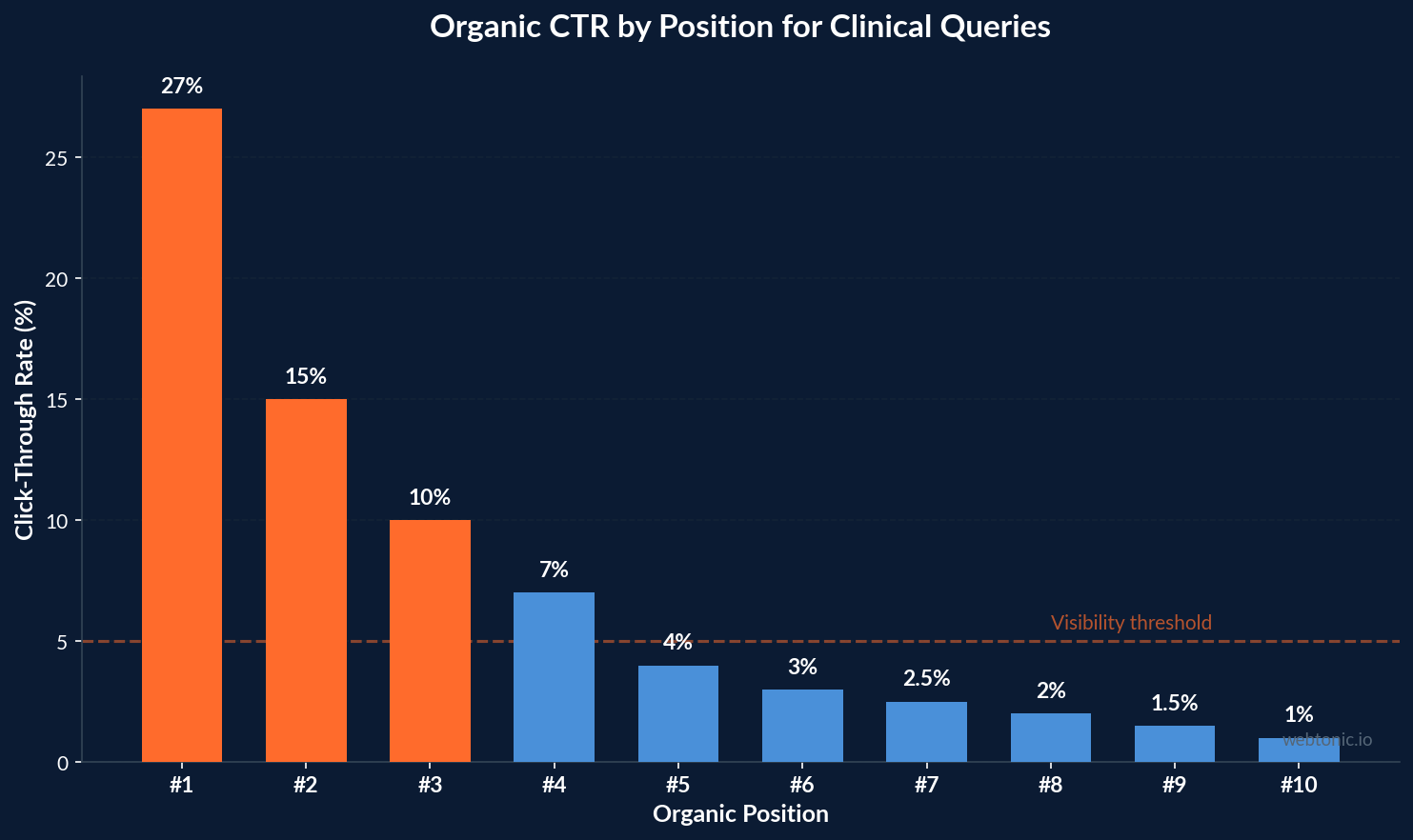
- Position one captures approximately 27% of clicks for specialty queries, while positions below five fall under 5% — making top-three ranking essential for visibility.
- Structured schema and verified physician entity signals boost organic CTR by 18–34% compared to listings without them.
- Organic lead acquisition costs $180–$420 per prospect, compared with $280–$900 via paid search — with organic costs declining over time as rankings compound.
- 45.8% of individuals visiting an allergist are self-referring, meaning organic visibility directly determines how many prospective visitors discover the practice without a referral.
| Metric | Benchmark | Source |
|---|---|---|
| Organic share of new visitor sessions | 54–68% | Authority Specialist |
| Median Domain Authority (clinical sites) | 42 | SEO Juice |
| Position 1 organic CTR | ~27% | MedRank SEO |
| CTR boost from schema markup | +18–34% | Authority Specialist |
| Self-referral rate (allergy visits) | 45.8% | NAMCS |
| Organic cost per acquisition | $180–$420 | Authority Specialist |
| Time to measurable ROI | 6–9 months | Authority Specialist |
Why Organic Search Dominates the Specialty
The allergy and immunology vertical operates in a unique position within digital marketing. Unlike procedure-driven specialties that rely heavily on paid advertising, this niche benefits from a massive volume of informational and condition-specific queries — from food allergy diagnosis to immunotherapy treatment options — that create a large organic opportunity surface.
71% of individuals use a search engine as their first step before booking an appointment (Aragil), and with 45.8% of visits being self-referred (National Ambulatory Medical Survey), the connection between organic visibility and new-visitor volume is direct. Practices that invest in growth marketing built around organic visibility consistently outperform those relying solely on paid channels.
Organic Traffic and Ranking Benchmarks
Based on 2026 benchmark data across multi-specialty practices, organic visibility delivers the majority of website sessions for clinical offices (Authority Specialist):
| Organic Metric | Range / Benchmark | Context |
|---|---|---|
| Organic share of new sessions | 54–68% | Highest for condition-specific content pages |
| Position 1 CTR | ~27% | Steep drop-off: position 5 falls below 5% |
| CTR boost from structured schema | +18–34% | Physician entity and MedicalClinic markup |
| Map Pack click share | 42% | For proximity queries ("near me" + city) |
| Time to rank (competitive metro) | 6–12 months | Suburban/rural markets move faster |
Specialty practices in the niche see particularly strong performance from condition-specific content — pages covering food allergy testing, immunotherapy protocols, and seasonal reaction management tend to rank more readily than generic service pages because they target long-tail queries with high informational intent (Authority Specialist).
Domain Authority Benchmarks for the Clinical Sector
An analysis of 427 sector websites measured by SEO Juice in July 2026 provides a clear picture of the competitive landscape (SEO Juice):
- Median Domain Authority: 42 across 23,741 pages analyzed.
- 10th percentile: DA 12 — representing new or neglected websites with minimal backlink profiles.
- 90th percentile: DA 72+ — large systems and established multi-location groups.
- The specialty niche (single-location practices) typically sits between DA 15–45, with most competitive opportunities concentrated in the DA 25–40 range.
For an allergist, crossing DA 30 often represents the threshold where organic rankings begin to materialize for moderate-competition queries. Above DA 40, the office enters a position to compete for more competitive keywords alongside larger institutional players.
Click-Through Rate Data by Position
The CTR curve for specialty queries follows the same steep pattern seen across all verticals, but with one important distinction: organic listings earn higher trust signals than paid results for sensitive topics like diagnosis, treatment, and care — which means the gap between position 1 and lower positions is even more pronounced (MedRank SEO).
| Position | Estimated CTR | Visibility Status |
|---|---|---|
| 1 | ~27% | Dominant — captures majority of clicks |
| 2 | ~15% | Strong — viable for lead generation |
| 3 | ~10% | Competitive — threshold for meaningful traffic |
| 4–5 | 4–7% | Marginal — below fold on most devices |
| 6–10 | 1–3% | Functionally invisible — minimal traffic |
AI Overviews are beginning to suppress traditional blue-link clicks on symptom and condition queries. For the allergy niche, this shift prioritizes entity-answer formats and featured snippets over standard ranking — a trend that will accelerate through the remainder of the year (Authority Specialist).
ROI and Cost-per-Acquisition Comparison
The financial case for organic search investment in the specialty is compelling when measured against paid channels (Authority Specialist):
| Channel | Cost per New Lead | Cost Trend Over Time | Lifetime Value per Lead |
|---|---|---|---|
| Organic search | $180–$420 | Decreasing | $8,000–$22,000 (5-year) |
| Paid search (PPC) | $280–$900 | Increasing | $8,000–$22,000 (5-year) |
| Social advertising | $150–$600 | Variable | $8,000–$22,000 (5-year) |
The critical insight: organic acquisition costs decrease over time as rankings compound, while paid advertising costs trend upward year over year. For practices with lifetime values of $8,000–$22,000 per individual, each organically acquired lead returns 19–122× the acquisition cost — making organic search the highest-ROI channel available.
However, ROI becomes measurable at month 6–9 once rankings stabilize. Practices without call-tracking and form attribution undercount organic conversions by 30–50%, which distorts the ROI calculation before it starts. Investing in proper data infrastructure is a prerequisite for accurate measurement.
Food Allergy and Immunotherapy Content: Organic Traffic Drivers
The specialty has a unique advantage in organic search because of the breadth and depth of condition-specific content opportunities. The most effective content strategies for the niche center around high-volume informational queries:
- Food allergy diagnosis and testing: With food-related reactions among children rising approximately 50% since 1997, queries around testing protocols, elimination diets, and oral challenge procedures generate significant organic traffic.
- Immunotherapy treatment outcomes: Subcutaneous and sublingual immunotherapy content attracts visitors actively researching long-term treatment options — a high-intent audience ready to book consultations.
- Seasonal reaction management: Content aligned with pollen calendars and seasonal peaks creates predictable organic traffic spikes each spring and fall, driving appointment requests during the specialty's busiest periods.
- Anaphylaxis emergency preparedness: This category generates high-authority backlinks from school districts, community organizations, and emergency preparedness resources — amplifying domain authority across the entire site.
- Asthma and respiratory care overlap: With approximately 25 million Americans affected by respiratory conditions, content bridging the specialty-respiratory connection captures additional search volume beyond the core specialty.
Technical Optimization Priorities for the Niche
Beyond content and backlinks, technical factors play a critical role in organic performance for clinical websites:
- Structured data markup (Physician, MedicalClinic, FAQPage schema) achieves 18–34% higher CTR than pages without it — and positions content for AI Overview extraction.
- Mobile page speed: With the majority of proximity searches occurring on mobile devices, Core Web Vitals compliance directly impacts both ranking and user experience.
- HIPAA-compliant forms: Conversion tracking must balance attribution accuracy with regulatory compliance — a challenge that leads many offices to undercount organic conversions by 30–50%.
- Physician entity verification: Creating verified entity signals through consistent author markup, professional association links, and LinkedIn sameAs references builds the E-E-A-T signals that clinical websites need to compete under YMYL evaluation.
Practices that combine strong technical foundations with quality content creation and a focused backlink strategy consistently outperform those investing in any single channel alone.
The Broader Digital Marketing Mix for the Specialty
While organic search delivers the highest long-term ROI, the most successful practices in the allergy and immunology niche integrate multiple channels into a cohesive growth strategy. Understanding how each channel contributes helps allocate budgets effectively:
- Content marketing and blogging: Condition-specific articles covering topics like elimination diets, sublingual immunotherapy protocols, and indoor air quality management serve dual purposes — they rank for informational queries and build the topical authority signals that strengthen the entire domain.
- Social media engagement: While social signals are not a direct ranking factor, social content drives branded query volume, which in turn lifts organic visibility. Educational posts about seasonal triggers, label reading, and preparedness tips consistently outperform promotional content.
- Email marketing to existing visitors: Reactivating past visitors through seasonal reminders (pollen forecasts, back-to-school prep) and email campaigns generates repeat bookings without additional acquisition cost.
- Paid advertising: PPC campaigns bridge the 6–9 month organic ramp-up period and capture high-intent queries where organic rankings have not yet materialized.
Emerging Trends Shaping Organic Visibility in 2026
Several shifts are reshaping how organic search works for the specialty sector. Practices that adapt early will maintain competitive advantages:
- Generative Engine Optimization (GEO): AI-generated responses now appear above traditional results for many condition-related queries. Optimizing for extraction — through FAQ schema, clear answer formatting, and authoritative citation patterns — is becoming as important as traditional ranking factors.
- Zero-click behavior: An increasing share of proximity and condition queries are answered directly in the SERP (map pack, knowledge panels, AI Overviews) without the user clicking through. Practices must optimize for both click-through visibility AND brand impression in zero-click contexts.
- Video content integration: Short-form educational videos explaining testing procedures, treatment options, and preventive measures are gaining organic visibility in both standard and video search results.
- Voice search optimization: Natural-language queries like "what does an allergist do" and "how is a food reaction diagnosed" are growing rapidly. FAQ-structured content captures these queries more effectively than traditional keyword-targeted pages.
Related reading
- Allergy & Immunology Local SEO Trends: Data-Driven Insights for 2026
- Allergy & Immunology Technical Seo Statistics
- Link Building Adoption & ROI in Allergy & Immunology: 65+ Key Stats (2026)
- GEO & AEO services at Web Tonic
Frequently Asked Questions
What percentage of new leads come from organic search for allergy practices?
Organic search drives 54–68% of new visitor sessions for multi-specialty offices. For single-location practices in the niche, the share can be even higher when condition-specific content pages — covering food allergy testing, immunotherapy, and seasonal reaction management — rank for long-tail informational queries.
What Domain Authority does an allergist's website need to rank competitively?
The median DA for clinical websites is 42, but single-location offices typically sit between DA 15–45. Crossing DA 30 is often the threshold where rankings begin materializing for moderate-competition queries. Complementary paid strategies can bridge visibility gaps while organic authority builds.
How long does organic search optimization take to show results for the specialty?
Most offices see measurable improvements within 6–9 months in competitive metro markets. Suburban and rural markets often move faster. The key is consistent investment in content, technical optimization, and authority signals — sporadic effort rarely produces sustainable rankings.
Is organic visibility a better investment than paid advertising for an allergist?
Long-term, yes. Organic acquisition costs $180–$420 per lead versus $280–$900 through paid campaigns, and organic costs decrease over time while paid costs increase. However, paid search delivers immediate visibility during the 6–9 month organic ramp-up period. Most successful growth strategies combine both channels.
How are AI Overviews affecting organic search for the clinical sector?
AI-generated summaries are beginning to appear above traditional blue-link results for symptom and condition queries. For the specialty, this shifts optimization priority toward featured-snippet formatting, entity-answer structures, and FAQ schema — content formats that AI Overviews are more likely to extract and cite. Practices that adapt early will maintain visibility as this trend accelerates.
Sources
https://authorityspecialist.com/industry/health/medical-practice/seo-statistics
https://authorityspecialist.com/industry/health/medical-practice/seo-roi
https://seojuice.com/seo-benchmark/healthcare/
https://medrankseo.com/local-seo-for-doctors-2026-guide/
https://www.aragil.com/blog/local-seo-allergy-clinics-rank-city
https://backlinko.com/search-engine-ranking
https://www.semrush.com/blog/seo-statistics/
https://firstpagesage.com/reports/patient-conversion-rate-by-practice-type/


