



Table of contents
How we vet every listicle
Every agency featured on Web Tonic passes our 84-point editorial review before a single listicle goes live. This is how we vet each pick:
Verified client outcomes: We require real case studies with measurable KPIs — revenue, ROAS, CPA, retention — tied to the exact category being ranked. No cherry-picked wins, no unverifiable numbers.
Independent reputation: We cross-check Clutch, Google, G2, and Trustpilot ratings, and screen for review-bombing or suspicious patterns. Only operators with a consistent, verifiable track record make the cut.
Beyond that, every listing goes through a quarterly re-audit. We check 84 criteria across 6 pillars to make sure it still holds up — here are some of the checks we run:
Key Takeaways
- The most effective 2020 advertising examples prioritized emotional resonance over product features, reflecting research showing emotional campaigns achieve approximately twice the market share growth of rational messaging
- Award-winning campaigns correlated with business results, with Nike's "You Can't Stop Us" generating $8.95 million in media value and 82% online sales growth, while Burger King's "Moldy Whopper" increased sales by 14%
- Creative breakthrough doesn't require premium budgets, as campaigns like The Tampon Book and Emily Crisps' outdoor work demonstrate that strategic ingenuity can achieve cultural impact through earned media
- Pandemic-era advertising succeeded when brands either provided genuine empathy backed by action or offered entertainment and escapism without opportunistic crisis messaging
- Working with experienced creative partners who understand both brand strategy and cultural context can help mid-market and enterprise businesses develop campaigns that achieve breakthrough impact while delivering measurable ROI
What Are Advertising Examples and Why 2020 Stands Out?
Advertising examples are real-world marketing campaigns that show effective communication strategies and measurable business results. These campaigns serve as case studies for marketers trying to understand what actually works when connecting brand identity with a target audience.
2020 changed advertising. The World Advertising Research Center (WARC) found that the median revenue ROI of successful advertising campaigns reached 4.34:1 that year. This was the highest since tracking began in 2017. Marketers prioritized measurable results even during one of the most challenging economic periods in recent memory.
What made 2020 different? The COVID-19 pandemic upended traditional marketing approaches in March. Brands faced a critical choice: go silent or adapt with messaging that actually landed with audiences navigating uncertainty.
For mid-market and enterprise businesses evaluating their marketing investments, these 2020 ad campaign examples offer practical lessons on balancing brand purpose with commercial objectives.
The Definitive List: 30+ Award-Winning Advertising Campaigns from 2020
The following advertising examples earned recognition at the industry's most prestigious award shows, including Cannes Lions, The One Show, D&AD Awards, and the Effie Awards. The approaches vary widely.
Super Bowl LIV Campaigns (February 2020)
The Super Bowl remains advertising's biggest annual stage, where brands tap into pop culture moments to reach massive audiences. Brands invested approximately $5.6 million per 30-second spot in 2020. Adweek's analysis found that standout campaigns leveraged celebrity talent in unexpectedly creative ways rather than simply banking on star power alone.
| Campaign | Brand | Agency | Key Achievement |
|---|---|---|---|
| Groundhog Day | Jeep | Highdive | #1 ranked Super Bowl ad; Bill Murray's first national commercial |
| Loretta | In-house | Most emotional ad of the night; 10M+ YouTube views in first month | |
| #BeforeAlexa | Amazon | Droga5 London | Strong viral engagement; creative historical humor |
| Smaht Pahk | Hyundai | Innocean USA | High brand recall; demonstrated product feature memorably |
| Comfortable | Rocket Mortgage | Highdive | Unexpected celebrity subversion with Jason Momoa |
Pros of Super Bowl advertising:
- Massive simultaneous reach of 100+ million viewers
- Cultural conversation catalyst that extends beyond game day
- Premium context that elevates brand perception
Cons of Super Bowl advertising:
- Investment requires $5-7 million for airtime alone, excluding production
- Cluttered environment with 50+ competing brand messages
- Success depends heavily on creative breakthrough
Pre-Pandemic Breakthrough: Burger King's Moldy Whopper
Before the pandemic disrupted marketing norms, Burger King's Moldy Whopper launched in February 2020. It became one of the year's most awarded and debated creative works. INGO Stockholm created it with DAVID Miami and Publicis Bucharest. The campaign featured a time-lapse video showing a Whopper decomposing over 34 days.
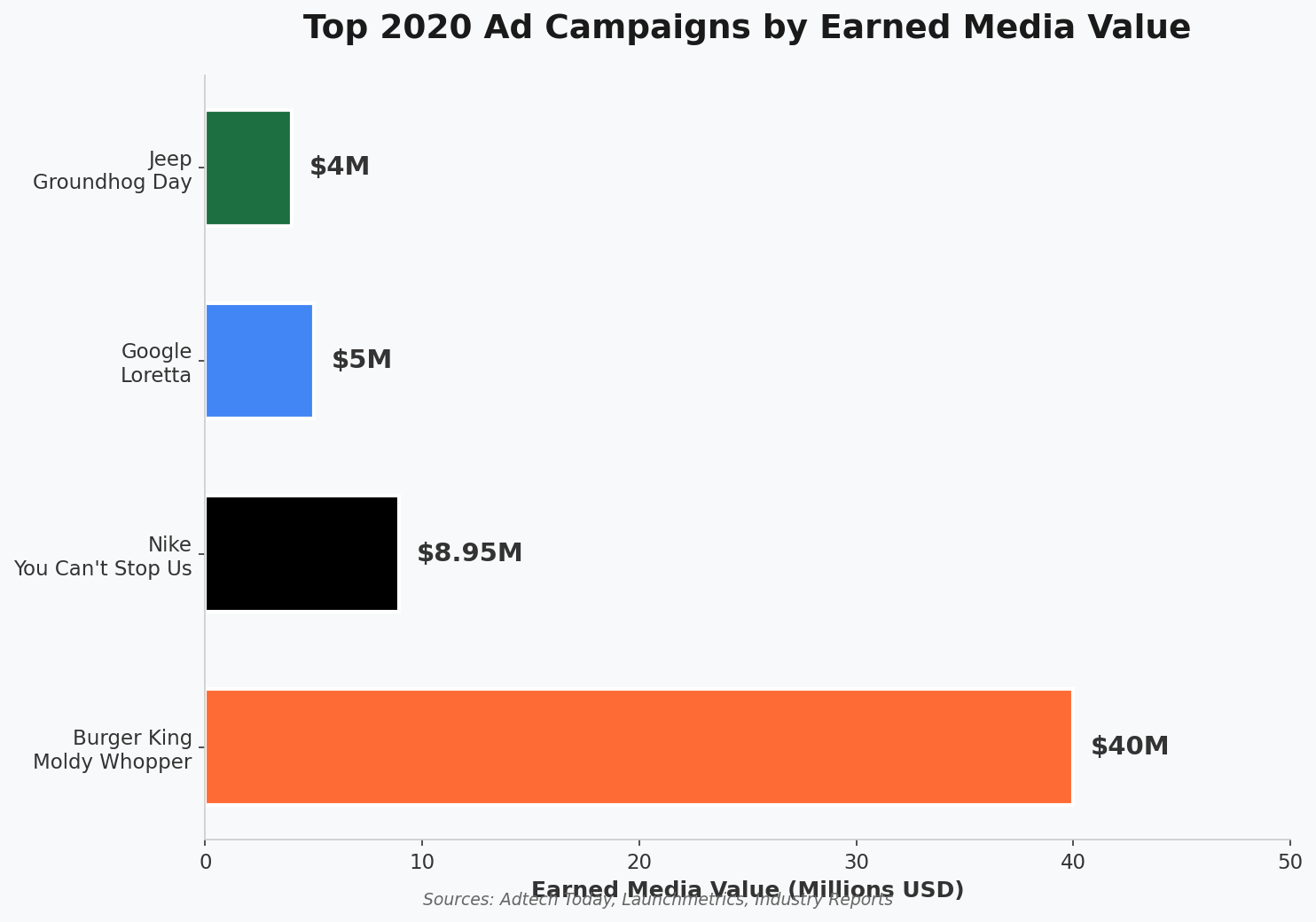
The numbers were striking. Per Adtech Today, the campaign generated an estimated $40 million in earned media value, increased sales by 14%, and boosted brand awareness of artificial preservative removal by 400%. At The One Show 2020, it earned Best of Show honors along with 18 Gold Pencils. That made it the year's most decorated single campaign.
The strategic takeaway: sometimes breaking conventional advertising rules (in this case, showing food in an unappetizing state) creates more brand differentiation than polished perfection.
Nike's "You Can't Stop Us" Campaign
Nike's summer 2020 work became the most talked-about advertising of the pandemic era. Released on July 30, 2020, the 90-second film used split-screen editing to seamlessly pair 53 athletes from different sports and backgrounds into unified movements.
Launchmetrics reported the campaign generated $8.95 million in Media Impact Value from just 1,067 placements. Nike saw active users of the Nike Training Club App increase by more than 100% in the United States during this period. Online sales surged around 82% from June to August 2020.
The work won the Emmy for Outstanding Commercial and the Film Grand Prix at Cannes Lions. It remains a great example of how craft investment pays off. Wieden+Kennedy Portland invested more than 1,000 hours in compositing to create the seamless visual effect.
Pandemic-Era Creative Pivots
When lockdowns began in March 2020, brands faced immediate decisions about their marketing. The most successful pivoted quickly but maintained brand authenticity.
Apple's "Creativity Goes On" (April 2020)
TBWA\Media Arts Lab created this in just two weeks. The campaign featured real people using Apple products creatively during lockdown, interspersed with celebrities including John Krasinski, Oprah Winfrey, and Lily James. It generated over 10 million YouTube views in its first month, spreading rapidly across social media platforms.
Dove's "Courage Is Beautiful" (April 2020)
Dove showcased photographs of healthcare workers' faces marked by protective equipment after long shifts. The work connected directly to Dove's established Real Beauty brand positioning. Dove backed it with substantial donations to COVID-relief efforts in markets where the advertising ran. Purpose-driven messaging required substantive action.
Budweiser's "Whassup" Reimagined
Budweiser repurposed its iconic 2000 "Whassup" campaign for the pandemic era, showing friends checking in on each other via video call. The update resonated because it connected nostalgic brand equity with contemporary behaviour. Kantar/BrandZ recognized it as an example of effective creative adaptation during a crisis.
Common Misconceptions About Award-Winning Advertising
Misconception 1: Awards Don't Correlate with Business Results
The belief that creative awards represent artistic recognition divorced from commercial effectiveness persists. But the evidence says otherwise. Effie Worldwide has tracked marketing effectiveness for over 50 years. Their data shows creatively awarded campaigns demonstrate significantly higher effectiveness scores than non-awarded work. The Effie Index ranks campaigns based on proven business results, not subjective creative merit alone.
The 2020 campaigns that earned both creative and effectiveness recognition (Nike's "You Can't Stop Us" and Burger King's "Moldy Whopper" among them) show that breakthrough creativity and measurable ROI work together rather than against each other. Strong creative builds brand loyalty and expands the customer base simultaneously.
Misconception 2: Pandemic Advertising Required Somber Messaging
Many brands adopted solemn tones in early pandemic messaging. But the campaigns that achieved lasting impact often balanced empathy with optimism or even humor. Jeep's "Groundhog Day" commercial aired at Super Bowl LIV just weeks before widespread lockdowns. It celebrated escapism and joy. Its timing proved fortuitous rather than tone-deaf, providing audiences with entertainment rather than another reminder of impending uncertainty.
And then there was Burger King's "Order from McDonald's" in November 2020. The campaign encouraged customers to support all restaurant workers during lockdowns, including competitors. The unexpected generosity generated enormous positive sentiment precisely because it subverted expectations of corporate self-interest.
Misconception 3: Big Budgets Are Essential for Breakthrough Campaigns
Super Bowl advertisers invested millions. But some of 2020's most effective campaigns operated on modest budgets. The Emily Crisps outdoor campaign featured billboards lamenting their poor timing given lockdown conditions. It gained massive viral traction through earned media without additional paid support. The self-aware humor transformed a potential disaster into a brand-building moment.
The Tampon Book campaign from The Female Company (recognized with The One Show Cultural Driver Gold Pencil) used creative packaging. They hid tampons inside a book to exploit Germany's lower tax rate on books versus sanitary products. This highlighted tax policy inequality. The campaign generated cultural conversation and policy attention through ingenuity rather than media spending.
Why Emotional Resonance Outperformed Feature-Focused Messaging in 2020
The advertising examples that achieved breakthrough performance in 2020 share a common thread: prioritizing emotional storytelling over product specifications.
Effie Worldwide's analysis shows campaigns that build emotional connections with audiences demonstrate stronger long-term brand effects and market share growth compared to those focused primarily on rational product attributes. The IPA (Institute of Practitioners in Advertising) effectiveness database similarly shows that emotional campaigns achieve approximately twice the market share growth of rational messaging.

Why did this accelerate in 2020? Audiences sought meaning and reassurance rather than product information during a period of profound uncertainty. Nike's "You Can't Stop Us" never mentioned specific products or prices. Instead, it connected with viewers on a deeper level, tying brand identity to universal themes of resilience and unity. Google's "Loretta" Super Bowl spot showcased technology through the lens of human memory and love rather than specifications or features.
Both earned their effectiveness through emotional truth rather than rational argumentation.
The Hidden Value of Split-Screen Storytelling
Nike's split-screen technique in "You Can't Stop Us" was more than creative flourish. It created a visual metaphor that audiences could immediately understand and share. The technique paired athletes across different sports, genders, and abilities into seamless movements, physically illustrating the unity message.
Creating it required reviewing over 4,000 pieces of archival footage and newly shot content to identify matching movements. WARC's analysis of campaign effectiveness shows that investments in distinctive creative assets (what researchers call "creative commitment") correlate with stronger ROI outcomes. Nike invested more than 1,000 hours in compositing. That level of craft commitment paid off.
The visual distinctiveness made the work immediately recognizable and shareable. Within 24 hours of release, the campaign accumulated 32 million views.
What's the lesson for brands evaluating creative direction? Campaigns that introduce visual or narrative innovations aligned with their core message achieve stronger breakthrough and memorability than conventional executions.
Real-World Examples and Case Studies
Case Study: Jeep's "Groundhog Day" Super Bowl Campaign
Agency: Highdive (Chicago) Challenge: Launch the Jeep Gladiator pickup truck to a mass audience Approach: Secure Bill Murray for his first-ever national advertisement, reprising his iconic Groundhog Day role with permission from Sony Pictures
The campaign succeeded because it solved a genuine creative problem: how to make a pickup truck launch memorable in a cluttered Super Bowl environment. By casting Murray and reuniting him with co-stars Brian Doyle-Murray and Stephen Tobolowsky, Jeep created cultural conversation that extended far beyond traditional advertising metrics.
Adweek ranked it the year's top Super Bowl advertisement, calling it "a delight for casual viewers and nerdy lovers of ad craft alike." The timing (airing on actual Groundhog Day) added an additional layer of cultural relevance.
Case Study: The Tampon Book (Germany)
Agency: Scholz & Friends Berlin Client: The Female Company Challenge: Highlight Germany's discriminatory tax policy that classified tampons as "luxury goods" taxed at 19% though books faced only 7% taxation
The creative solution: package tampons inside a book, allowing them to legally qualify for the lower tax rate. This drew attention to the policy's absurdity. The campaign generated widespread media coverage, social conversation, and ultimately contributed to policy change. Germany reduced the tampon tax in January 2020.
At The One Show 2020, the campaign won the Cultural Driver Gold Pencil for work that creates significant cultural impact beyond traditional advertising metrics.
Case Study: Starling Bank's Challenger Positioning
Starling Bank's 2020 communications strategy showed how challenger brands can compete against established players through consistent purpose-driven messaging and a strong brand identity. By positioning itself as "a more human alternative to traditional rivals," the mobile-only bank earned recognition as Best British Bank for the third consecutive year.
The strategy succeeds by identifying category conventions (impersonal service, hidden fees, complex products) and consistently communicating against them. This resonates particularly well with younger consumers seeking alternatives to traditional banking. Sustained commitment matters more than individual campaign brilliance here. But it builds competitive advantage over time and attracts new audiences.
Frequently Asked Questions
What made 2020 advertising different from previous years?
The COVID-19 pandemic forced brands to rapidly adapt beginning in March 2020. Campaigns that launched before lockdowns either felt prescient or dated depending on their content. The brands that succeeded demonstrated authentic purpose rather than opportunistic messaging, often backing their communications with substantive action like donations or policy changes.
Which advertising campaign won the most awards in 2020?
Burger King's "Moldy Whopper" earned the most industry recognition in 2020. It won Best of Show at The One Show along with 18 Gold Pencils, the Grand Prix at Cannes Lions in multiple categories, and numerous other accolades. The willingness to show food in an unappetizing state to highlight the absence of artificial preservatives represented creative risk-taking that judges rewarded.
How can mid-market companies apply lessons from these award-winning campaigns?
The most transferable lessons from 2020's best advertising involve strategy rather than budget. Identifying authentic brand purpose, connecting emotionally before rationally, finding unexpected angles on familiar messages. None of that requires multimillion-dollar investments. The Emily Crisps outdoor campaign and The Tampon Book show that creative ingenuity can achieve breakthrough impact without premium media spending.
What role did digital and social media play in 2020's best campaigns?
Digital marketing platforms served as both primary distribution channels and amplification mechanisms. Nike's "You Can't Stop Us" achieved 32 million views within 24 hours through social sharing rather than paid media alone. Brands that created shareable, emotionally resonant content benefited from organic distribution that extended their paid reach significantly. Content marketing and social media campaigns worked together to maximize impact.
Why did some 2020 pandemic advertising feel tone-deaf while other campaigns succeeded?
The tone-deaf campaigns typically made superficial acknowledgments of pandemic conditions without substantive commitments or authentic connections to brand purpose. Successful pandemic advertising either addressed the moment with genuine empathy and supporting action (Dove's "Courage Is Beautiful" backed by donations) or provided entertainment and escapism without pretending to address the crisis (Jeep's "Groundhog Day"). The middle ground consistently underperformed.
Web Tonic works across SEO, paid search and paid social, and you can book a consultation to talk through your own plan.


