Table of contents
No study measures podcast advertising for personal injury firms specifically, so this page uses cross-industry audio data and the bar rules that decide what an injury ad may say. The listening data is strong: Edison Research finds 58% of Americans 12+ consumed a podcast in the last month of its January 2026 survey.
Key Takeaways
- 58% of Americans 12+ are monthly podcast consumers (Infinite Dial 2026).
- 37% of US adult drivers use podcasts in their primary car, up from not being asked in 2016.
- 55% of drivers aged 18-34 play podcasts in the car, against 18% of those 55+.
- US podcast ad revenue reached $2.9 billion in 2025, up 17.6% (IAB/PwC).
- 76% of weekly podcast consumers have acted after hearing an ad (Edison Podcast Metrics).
- Promo codes capture about 24% of podcast conversions (Podscribe, vendor data).
- Florida charges $250 to review a timely filed lawyer ad and $750 when late.
- New York requires lawyer ads to be kept for at least three years.
- An estimated 36,640 people died in US traffic crashes in 2025 (NHTSA early estimate).
- No named dataset publishes a personal injury podcast CPM or cost per case.
Personal Injury Podcast Advertising at a Glance
The table separates what is measured for audio in general from what is known about injury law. The second column is always cross-industry unless the row says otherwise.
| Metric | Figure | Scope and source |
|---|---|---|
| US podcast ad revenue, 2025 | $2.9 billion (+17.6%) | All advertisers, IAB/PwC FY2025 |
| Monthly podcast consumers 12+ | 58% (167 million) | US, January 2026, Edison Infinite Dial |
| Drivers using podcasts in car | 37% | US 18+ who drove or rode last month, 2026 |
| Weekly listeners who acted on an ad | 76% | Edison Podcast Metrics Q2 2025-Q1 2026 |
| Median podcast visitor rate | 0.20% of impressions | Podscribe Q3 2026, vendor data |
| Median podcast cost per acquisition | $168 | Podscribe Q3 2026, all industries |
| Personal injury podcast CPM | Not published | No named dataset found |
Why the Car Is the Injury Firm's Listening Room
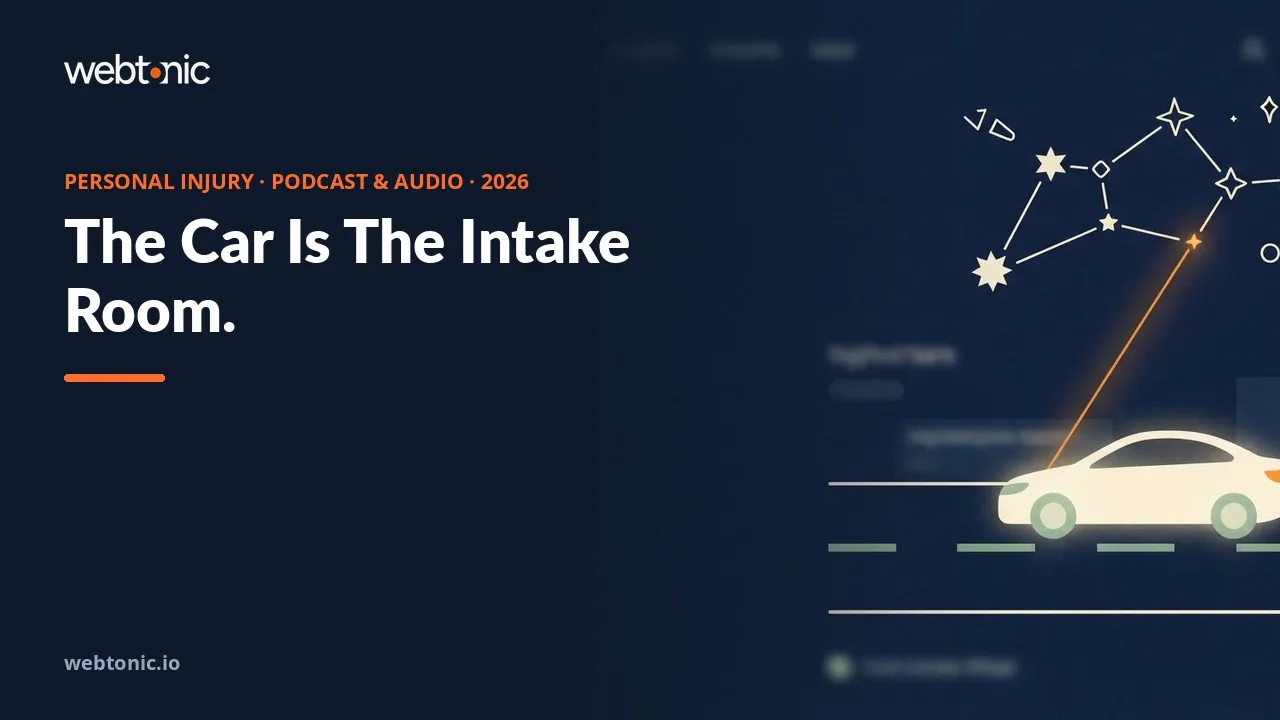
Injury marketing leans on the moment people think about driving risk, and audio reaches them behind the wheel. The Infinite Dial 2026 reports that 37% of US adults who drove or rode in a car last month use podcasts in their primary vehicle. AM/FM radio still leads at 73%, with online audio at 48%. Age changes the picture sharply: podcasts reach 55% of drivers aged 18-34 and 47% of those 35-54 in the car, but only 18% of drivers 55 and older, who remain radio listeners at 81%.
For a firm, that split matters more than any national average. A radio flight and a podcast flight reach different ages of the same commuting market. The survey measures listening, not case sign-ups, so it tells you where attention sits, not what it converts to.
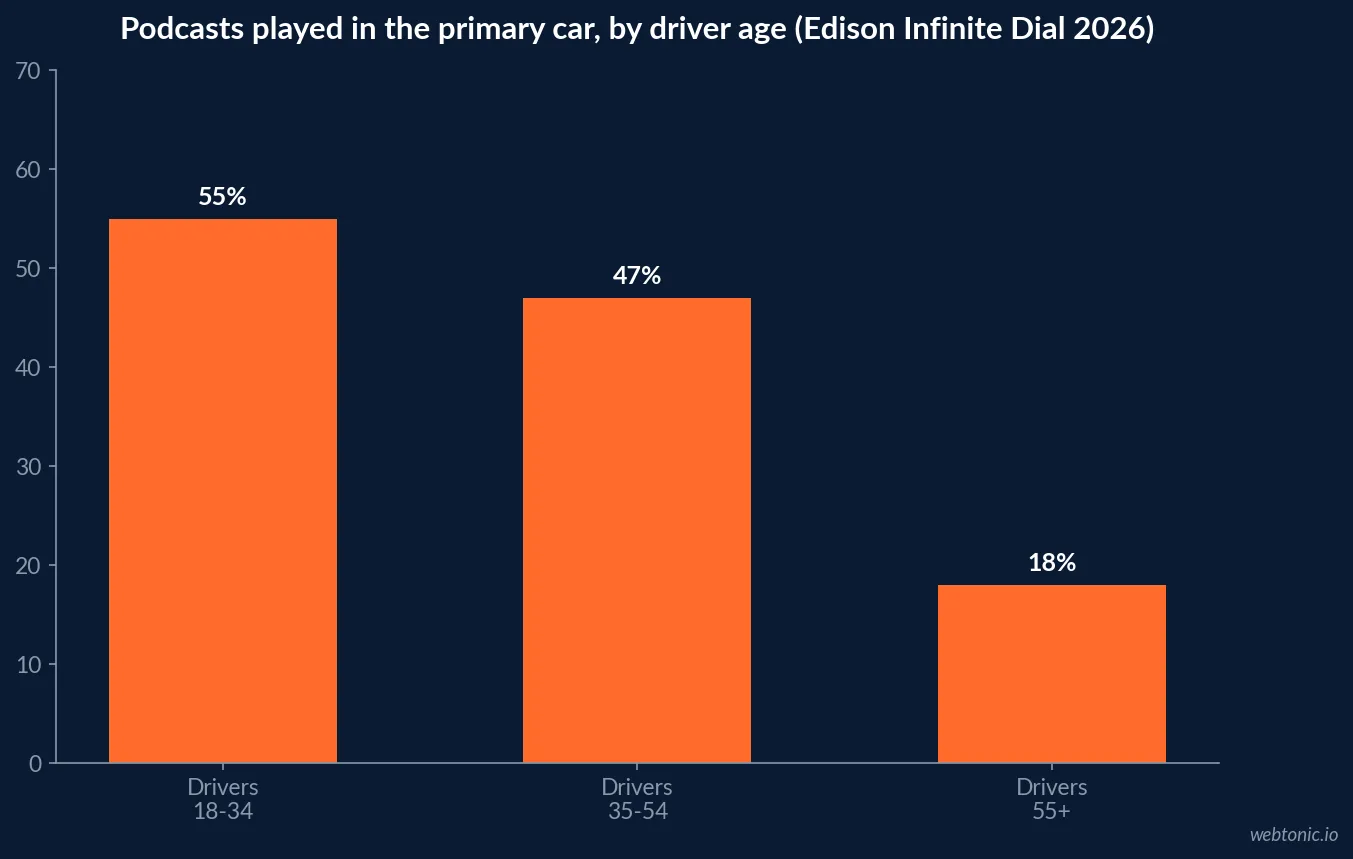
| Driver age | AM/FM radio in car | Online audio in car | Podcasts in car |
|---|---|---|---|
| 18-34 | 65% | 73% | 55% |
| 35-54 | 68% | 54% | 47% |
| 55+ | 81% | 27% | 18% |
| All 18+ drivers | 73% | 48% | 37% |
Source: Edison Research, The Infinite Dial 2026, national survey of 2,050 people 12+ conducted January 2026. Base: US 18+ who drove or rode in a car in the last month.
The Demand Behind Injury Intake
Road crashes remain the largest single source of injury claims, and the federal count is moving down. NHTSA projects that an estimated 36,640 people died in motor vehicle crashes in 2025, a decrease of about 6.7% from the 39,254 deaths reported for 2024. The fourth quarter of 2025 was the 15th consecutive quarterly decline since the second quarter of 2022. The fatality rate fell to 1.10 per 100 million vehicle miles travelled.
Fatalities are only the most severe tip of crash volume, and NHTSA's early estimate does not count injuries or claims. What it does show is that audio budgets for injury intake are chasing a slowly shrinking pool of the most serious cases, which raises the value of reaching the right driver in the right market rather than buying national reach.
Bar Rules That Shape Every Audio Spot
Lawyer advertising is regulated state by state, and podcast and radio reads are advertising. Three rule sets illustrate the range firms face.
| Jurisdiction | What the rule requires | Audio implication |
|---|---|---|
| Florida | Filing with the Bar; $250 fee if timely, $750 if late; any change is a new ad | Every host-read variation can trigger a new filing (Florida Bar FAQ) |
| New York | Ads pre-approved by the firm; copies retained at least three years | Keep every aired read and script (22 NYCRR 1200.7.1) |
| California | No false or misleading communication about the lawyer or services | Outcome claims and implied guarantees are the risk (State Bar Rule 7.1) |
| Federal (FTC) | Disclose material connections an audience would not expect | Hosts cannot pose as unpaid clients (16 CFR 255.5) |
Florida's policy is the one that bites podcast buyers. Host reads are loose by design, and the Florida Bar states that any change of any kind renders the advertisement a new advertisement with a new filing fee of $250. A firm running ad-libbed reads across five shows could face five filings. Many firms solve this with a fixed script the host reads verbatim, which gives up some of the host-read effect in exchange for compliance.
New York's rule also exempts radio and television ads from the "Attorney Advertising" label that applies to most other formats, but not from the retention duty. Firms should treat podcast episodes as permanent: a baked-in read stays in the back catalogue for years after the flight ends.
Host Endorsements and the FTC's Podcast Example
The FTC Endorsement Guides include a podcast case. In Example 12 of section 255.5, a host reads what is obviously a commercial near the start of an episode; listeners would expect payment, so no separate payment disclosure is needed. The same host mentioning the firm in a social post gets no such pass. The practical line for injury firms is simple: a host can read the firm's message, but cannot claim to have been a client, won a settlement or been helped unless that is true, and any undisclosed relationship must be disclosed clearly.
Bar testimonial rules sit on top of the FTC rule. New York, for example, requires informed written consent before a testimonial about a pending matter is used.
Does Host-Read Beat Produced Audio for Law Firms?
No study tests host reads for law firms, but cross-industry data leans toward the host. Magellan AI (vendor data, campaigns January to June 2026) reports host-read ads posted a 3.22% median response rate against 2.09% for produced ads, 54% higher. Nielsen found in 2020 that host-read ads produced an average 50% increase in purchase and recommendation intent against non-host-read ads across more than 260 surveys.
The catch for injury firms is cost per result. Podscribe (vendor data, originally published Q2 2026) finds host reads convert slightly better per impression, 0.018% against 0.016%, but cost more per acquisition, $137 against $123 for producer-read ads. Combined with Florida's filing policy, a scripted producer read can be the more practical first test.
Tracking Calls When Listeners Cannot Click
Audio has no click, and injury leads usually arrive by phone. Podscribe compares attribution methods in its Q3 2026 report: promo codes and vanity URLs capture about 24% of conversions, post-purchase surveys draw a 16% response rate, and pixel-based attribution captures about 4.2 times more than promo codes. The report estimates that roughly 80% of engagement can be missed without pixels and incrementality modelling.
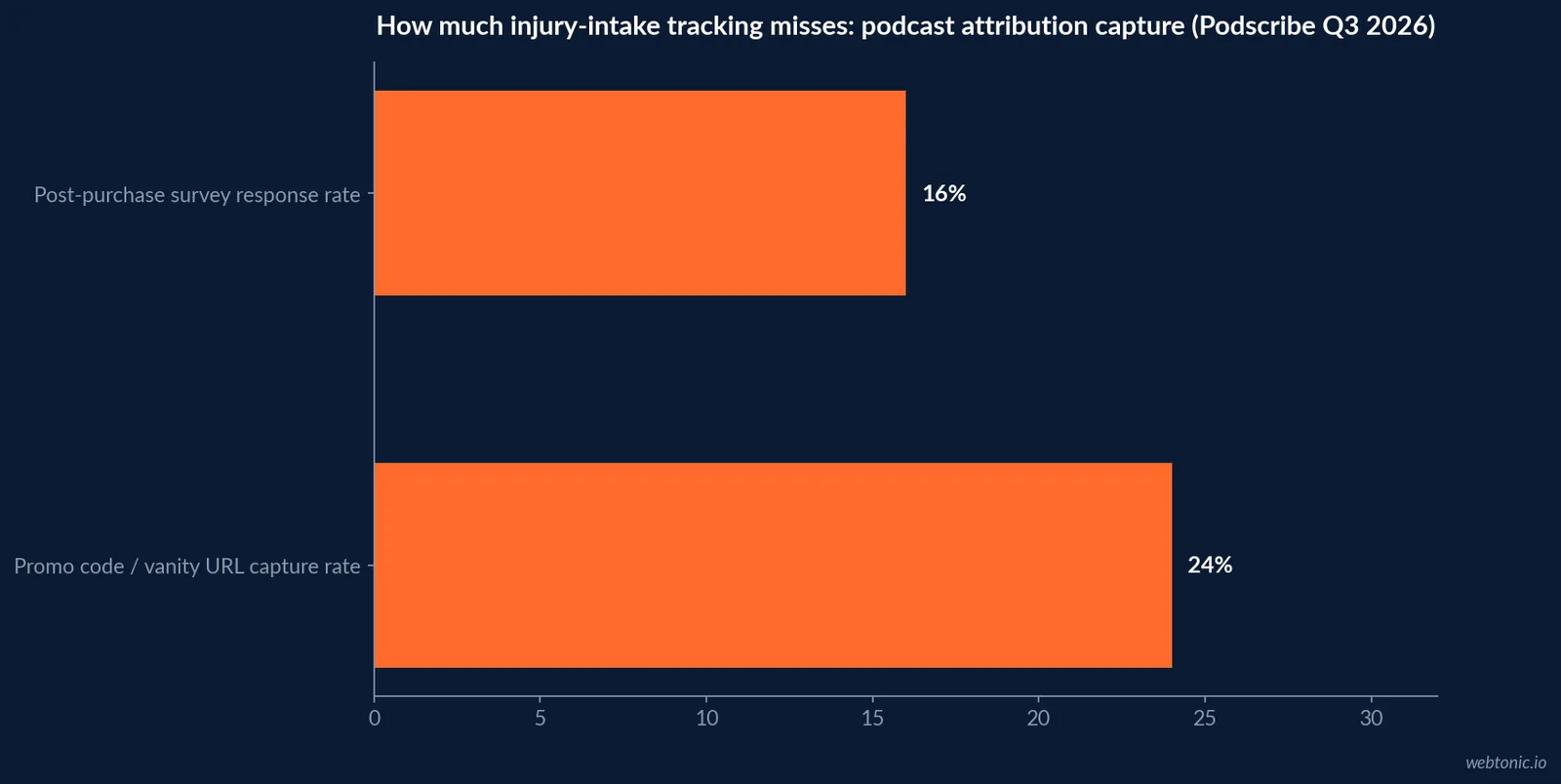
| Method | What it captures | Fit for injury intake |
|---|---|---|
| Promo code or vanity URL | About 24% of conversions | Weak: callers rarely quote a code |
| Post-purchase survey | 16% response rate | Use as an intake question: 'Where did you hear of us?' |
| Pixel attribution | About 4.2x more than promo codes | Captures web form leads, not phone calls |
| Dedicated call tracking number | Not benchmarked in these studies | Standard for phone-first intake |
How Long Injury Leads Take to Show Up
Injury decisions are rarely instant, and podcast response is slow even for consumer products. Podscribe reports podcast incrementality crosses the halfway mark by days 16 to 20 and stays measurable out to 60 days, with a standard 30-day conversion window for podcasts against 14 days for streaming. Magellan AI adds that campaigns judged at seven days show less than half of what they eventually deliver, measured on a 30-day lookback with a 2.23% median response rate.
For intake teams, that argues for flights of at least a month and reporting that does not cut off at week one.
Episodic, Network or Programmatic Buys
Firms that want to reach one metro area face a choice between show buys and targeted buys. Podscribe data (vendor, originally published Q2 2026) puts median podcast cost per acquisition at $98 for direct show buys, $64 for run-of-network and $74 for programmatic. The same report ranks designated market area as the targeting factor with the largest impact on performance, which suits firms licensed in one state.
| Buy type | Median purchase rate | Median CPA | Median visitor rate |
|---|---|---|---|
| Direct show | 0.027% | $98 | 0.25% |
| Direct run-of-network | 0.017% | $64 | 0.28% |
| Programmatic | 0.021% | $74 | 0.32% |
These are consumer-purchase benchmarks across all industries. A signed injury case is a far rarer and more valuable event than an online purchase, so the figures show relative efficiency between buy types, not an expected cost per case.
Where Legal Advertisers Sit in Podcast Revenue
Law does not have its own line in the IAB/PwC podcast revenue study. The 2023 edition places it inside an "Other" group worth 23.4% of revenue, alongside energy, government, non-profit, tech, pets and religion. Total podcast ad revenue has since grown to $2.9 billion in 2025 (IAB/PwC), just under 1% of the $294.6 billion US internet ad market. For injury firms that spend heavily on search and TV, podcasts are still an unconcentrated channel.
Related reading: our personal injury SMS marketing statistics, personal injury Google Ads data, and the broader advertising statistics roundup.
Planning Checklist for an Injury Audio Test
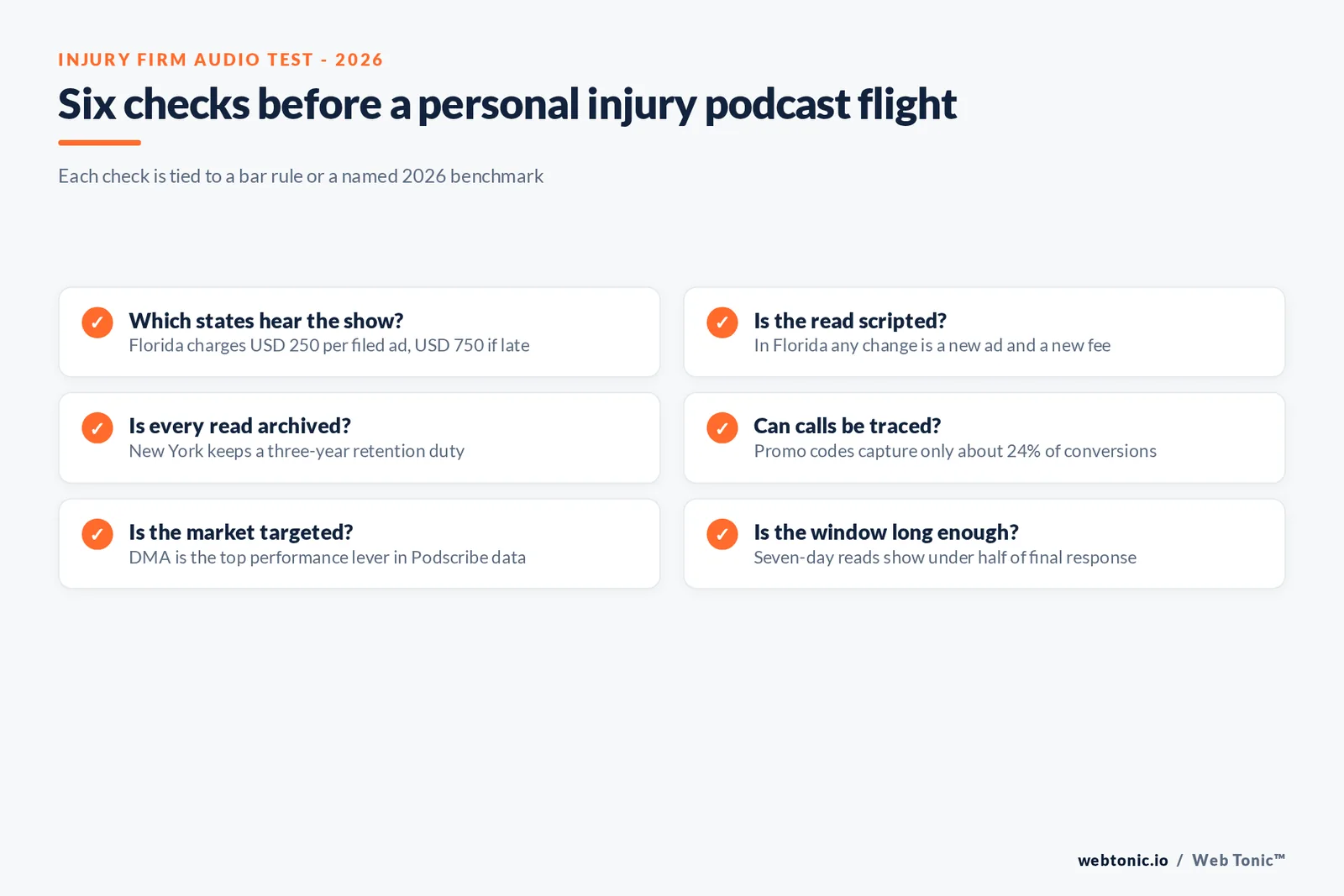
- List every state where the chosen shows are heard and pull each bar's filing and retention rules.
- Lock a script for Florida-style regimes; allow ad-libs only where no per-change filing applies.
- Give each show its own tracking number and vanity URL, and add a "how did you hear" intake question.
- Target by designated market area where the firm is licensed.
- Report on a 30-day window at minimum; do not kill a flight on week-one calls.
- Archive every aired read for at least three years.
Web Tonic builds these tests with firms through our performance creative team; contact us to scope one.
Frequently Asked Questions
Is there a podcast advertising benchmark for personal injury law firms?
No. None of the named datasets used here publishes a personal injury or legal-services podcast CPM, response rate or cost per case. The IAB/PwC podcast study folds law into its 23.4% 'Other' category for 2023. Every performance figure on this page is cross-industry, and firms should treat it as a planning range, not a target.
Do podcast ads for lawyers have to be filed with the state bar?
It depends on the state. The Florida Bar requires filing for broadcast advertising, with a $250 fee for timely filed ads and $750 for late ones, and treats any change as a new ad. New York requires advertisements to be pre-approved by the firm and retained for at least three years. California Rule 7.1 bans false or misleading communications. Check the rules of each state where a show is heard.
Can a podcast host endorse a law firm as if they were a client?
Only if it is true and any material connection is disclosed. The FTC Endorsement Guides (16 CFR 255.5) require clear disclosure of connections a listener would not expect, and bar rules on testimonials apply on top. An obviously commercial host read does not need an extra payment disclosure under the FTC's own podcast example, but the host cannot imply a personal case outcome that never happened.
How should an injury firm track calls from podcast ads?
Use more than a promo code. Podscribe's Q3 2026 benchmark report finds promo codes and vanity URLs capture about 24% of conversions and post-purchase surveys draw a 16% response rate, while pixel attribution captures about 4.2 times more than promo codes. For firms, that means a dedicated tracking number, a vanity URL, a pixel and an intake question.
How long after a podcast ad do injury leads arrive?
Later than most firms expect. Podscribe finds podcast incrementality crosses the halfway mark around days 16 to 20 and remains measurable out to 60 days, and Magellan AI reports that campaigns judged at seven days show less than half of what they eventually deliver. Judge an intake campaign on at least a 30-day window.
Sources
IAB/PwC Internet Advertising Revenue Report, Full Year 2025
Edison Research, The Infinite Dial 2026
Edison Research, The Podcast Consumer 2026
Podscribe Performance Benchmark Report Q3 2026 (vendor)
Magellan AI Podcast Measurement Benchmark Report Q2 2026 (vendor)
Nielsen, Host-Read Podcast Ads Pack a Brand Recall Punch (2020)
The Florida Bar, Lawyer Advertising FAQ
22 NYCRR 1200.7.1 via Cornell LII
State Bar of California, Rule 7.1
16 CFR 255.5, FTC Endorsement Guides
NHTSA Early Estimate of Traffic Fatalities in 2025