



Table of contents
Shopify now powers 5.6 million+ active merchants and commands 30% of US e-commerce platform share — but its reach extends well beyond traditional retail. Wealth management firms are increasingly using Shopify and Shopify Plus to sell digital products, financial education courses, and advisory subscriptions through branded storefronts. With the online course market alone hitting $12.8 billion in 2026 and Shopify's B2B GMV surging 96% year-over-year, the platform has become a legitimate distribution channel for financial services firms looking to diversify revenue beyond AUM-based fees. Our growth marketing services help financial firms build and optimize these digital revenue channels.
Key Takeaways
- Shopify captured 30% of US e-commerce businesses in 2025, with over 875 million shoppers purchasing from its stores (Omnisend).
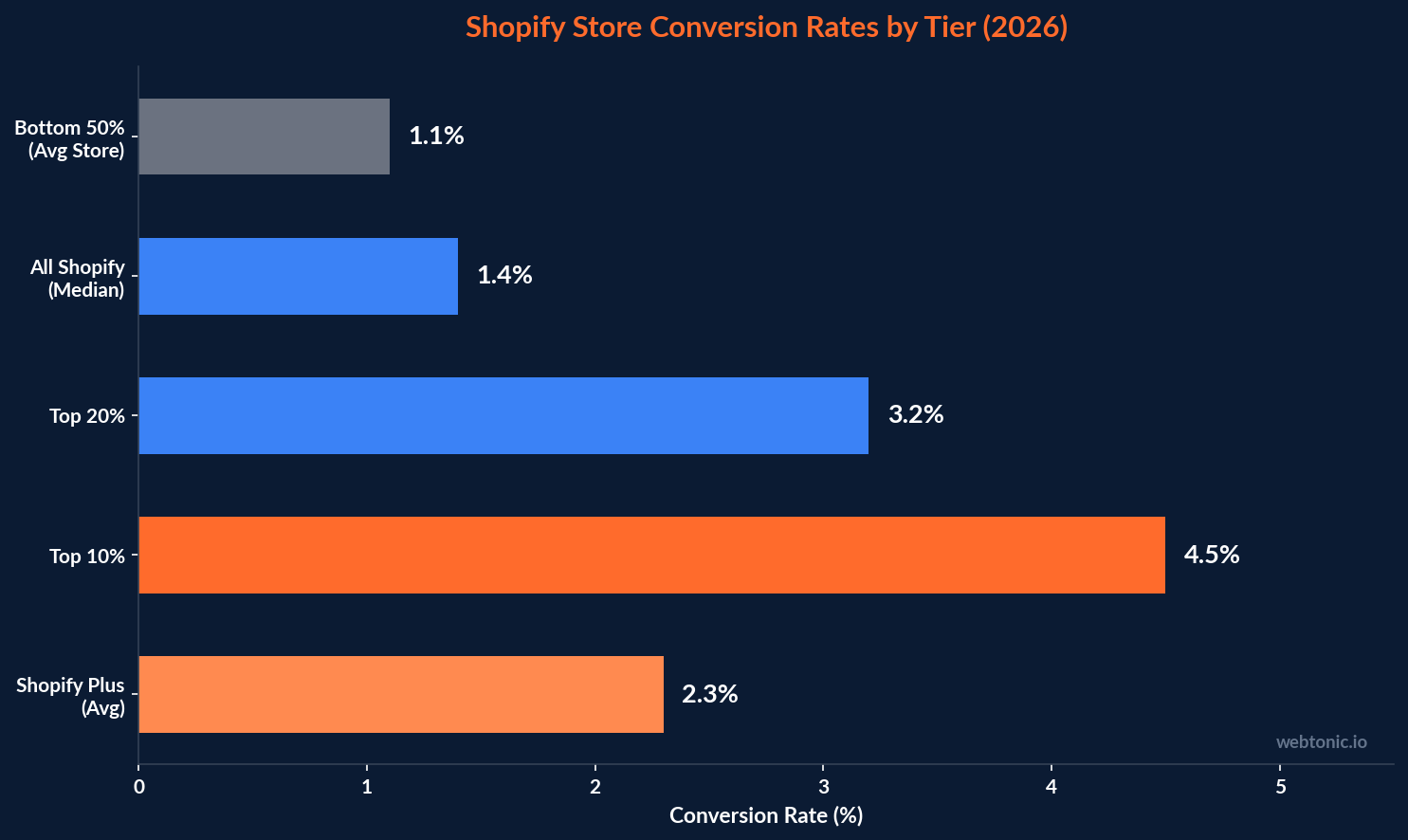
- The average Shopify store converts at 1.4%, while Shopify Plus stores average 2.3% — the top 10% of stores exceed 4.5% (Eevy AI, Littledata).
- Shopify Plus grew 34% year-over-year and now powers over 51,000 enterprise merchants, with Q1 2026 signings including LVMH and Balmain (P3 Media, Axis Intelligence).
- The digital product market reached $12.8 billion in 2026, with online courses averaging $89 per sale — up from $67 in 2023 (Insight Raider).
- Shopify Payments crossed $100 billion in GMV, processing two-thirds of all platform transactions (Ecommerce Times).
- Finance-niche course creators average $11,000 in lifetime revenue per product, with the top 10% earning $100,000+ per course (Insight Raider).
- Shopify B2B GMV surged 96% year-over-year in 2025, with B2B features now available on all plans — not just Plus (Axis Intelligence).
Shopify Platform Statistics at a Glance
| Metric | 2026 Value | Context |
|---|---|---|
| Active merchants | 5.6M+ | 11% YoY store growth in Q2 2026 |
| US platform share | ~30% | WooCommerce at ~18%, Wix at ~15% |
| Global e-commerce share | ~10–11% | 28% global ecommerce platform market |
| Shopify Plus merchants | 51,200+ | 34% YoY growth; 72,426 live domains |
| Q1 2026 MRR | $212M | Up from $182M in Q1 2025 |
| Average conversion rate | 1.4% | Top 20% at 3.2%+, top 10% at 4.5%+ |
| BFCM 2025 sales | $14.6B | Record weekend with 81M+ global buyers |

Why Wealth Management Firms Are Turning to Shopify
The traditional wealth management business model — AUM-based fees tied to portfolio size — faces compression from robo-advisors, fee transparency regulations, and client expectations. Shopify provides wealth managers with a scalable infrastructure to monetize expertise through digital products, without building custom technology from scratch.
Common use cases for Shopify in wealth management include:
- Financial education courses and certifications — firms like CDAA (Certified Digital Asset Advisor) and white-label platforms like GOBYN use e-commerce infrastructure to sell structured financial education at scale. The average finance course price has climbed to $89 in 2026 (Insight Raider).
- Subscription-based advisory tools — financial planning templates, investment calculators, and research subscriptions distributed through Shopify's recurring billing capabilities.
- Client onboarding and document management — Shopify's checkout and membership infrastructure handles KYC-compliant document collection and payment processing for advisory retainers.
- Content licensing — wealth management firms can license educational materials to corporate clients and other advisors, with some licensing deals worth $10,000–$50,000 annually (Kaspian Fuad).
Shopify Conversion Rate Benchmarks for Financial Products
Conversion rates vary dramatically by product type and price point. High-consideration financial products naturally convert at lower rates than impulse purchases, but the average order value and lifetime value more than compensate.
| Product Type | Typical CVR | Avg Order Value |
|---|---|---|
| Financial education course ($50–$200) | 1.2–2.5% | $89 |
| Premium advisory program ($500–$5,000) | 0.5–1.5% | $1,500+ |
| Digital templates and tools ($20–$100) | 2.0–3.5% | $47 |
| Subscription / membership ($30–$100/mo) | 1.0–2.0% | $60/mo |
| All Shopify (median) | 1.4% | Varies by niche |
Shopify Plus stores achieve a 2.3% average conversion rate — outperforming basic Shopify's 1.2% — largely due to enterprise-grade checkout optimization, A/B testing capabilities, and Shopify Flow automation. For wealth management firms selling high-ticket products, the top 10% of stores converting at 4.5%+ demonstrates the ceiling achievable with proper funnel optimization (Eevy AI).
Shopify Plus: Enterprise Features for Financial Services
Shopify Plus has emerged as the enterprise tier driving institutional adoption. Key statistics relevant to wealth management firms:
- 51,200+ distinct merchants on Shopify Plus across 72,426 live domains — some firms operate multiple storefronts for different products or client segments.
- 34% year-over-year growth in Plus adoption, driven primarily by migrations from Magento and Salesforce Commerce Cloud (LaunchTip).
- Shopify Payments now processes two-thirds of all platform GMV — simplifying reconciliation for firms managing subscription revenue, one-time course sales, and retainer payments through a single payment ledger.
- B2B features available on all Shopify plans (previously Plus-only) — enabling wealth management firms to sell licensing deals, corporate training packages, and institutional research subscriptions with dedicated B2B pricing and net terms.
For financial services firms considering Shopify Plus, the $200M–$1B GMV band shows Adobe Commerce at 26% and Shopify Plus at 21% market share — demonstrating that Shopify Plus competes credibly at enterprise scale even in regulated industries (Axis Intelligence).
Digital Product Revenue Benchmarks for Financial Advisors
The digital product market has reached $12.8 billion in 2026, with online courses representing 40% of the total. For wealth management professionals, the economics are increasingly attractive:
| Metric | Finance Niche | All Niches (Average) |
|---|---|---|
| Average course price | $89–$200 | $89 |
| Avg lifetime revenue per product | $11,000 | $11,000 |
| Top 10% revenue per product | $100,000+ | $100,000+ |
| Group coaching program revenue | $500–$5,000/participant | $500–$5,000/participant |
| Content licensing deals | $10,000–$50,000/yr | Varies |
The margin structure is compelling: online courses average $95.74 per sale vs. $47.14 for digital downloads, but courses are 3× harder to sell (115 average sales vs. 293 for digital downloads). For wealth management firms with an existing client base, the built-in distribution advantage makes high-quality course content a natural revenue diversification strategy (Insight Raider).
E-Commerce Platform Market Share: Where Shopify Fits
Understanding Shopify's position in the broader platform landscape helps wealth management firms evaluate their technology options:
| Platform | Global Market Share | US Platform Share |
|---|---|---|
| WooCommerce | ~20% | ~18% |
| Shopify | ~10–11% | ~30% |
| Wix Stores | — | ~15% |
| Magento / Adobe | — | ~8% |
| BigCommerce | — | ~4% |
While WooCommerce leads globally on raw website count (detected on 6.64% of all web origins vs. Shopify's 4.76%), Shopify dominates the US market where most wealth management digital product sales occur. The platform's integrated payments, subscription management, and enterprise security make it the default choice for firms prioritizing operational simplicity over customization flexibility (GravityKit).
Shopify Payments and Financial Infrastructure
Shopify's built-in financial infrastructure has evolved into a full-stack commerce operating system. Key fintech developments relevant to wealth management include:
- Shopify Payments GMV exceeded $100 billion — crossing this threshold signals institutional-grade payment processing reliability.
- Payments revenue grew by $572 million, accounting for approximately 84% of merchant-solutions revenue growth — demonstrating the platform's shift toward financial services revenue (Axis Intelligence).
- Shopify Balance provides integrated business banking — spend, save, transfer, and receive funds without a separate bank relationship.
- Shopify Credit offers merchant financing based on sales data rather than traditional credit underwriting.
- Cart abandonment in financial products averages 71.5% — Shopify's abandoned cart recovery automations can recapture a meaningful percentage of this lost revenue for wealth management digital product sellers.
For wealth management firms selling paid products promoted through social ads, Shopify's integrated analytics provide end-to-end attribution from ad click to purchase — a critical capability for optimizing digital product marketing spend.
Shopify SEO and Marketing Integration for Wealth Managers
Selling digital products on Shopify is only half the equation — wealth management firms need to drive qualified traffic to their storefront. The platform's built-in marketing integrations create a measurable acquisition funnel:
- Organic search optimization — Shopify's SEO architecture supports custom meta titles, descriptions, and URL slugs for every product and collection. Financial education content targeting keywords like "retirement planning course" or "investment fundamentals certification" can rank organically and drive free traffic.
- Email marketing integration — with wealth management email open rates at 36.5% — among the highest across all industries — Shopify's native email tools and Klaviyo integration provide direct-to-customer promotion for course launches and product updates.
- Social commerce — LinkedIn posts by financial advisors generate 3.2× more prospect engagement than firm pages, creating a natural distribution channel for Shopify-hosted digital products.
- Abandoned cart recovery — with financial product cart abandonment averaging 71.5%, automated email sequences recovering even 10–15% of abandoned carts can significantly impact revenue.
Shopify's analytics dashboard tracks the complete customer journey from traffic source to purchase, enabling wealth managers to calculate true paid acquisition costs and lifetime customer value for each marketing channel.
Compliance and Security Considerations for Financial Shopify Stores
Wealth management firms operating e-commerce storefronts face heightened compliance requirements that Shopify addresses through several enterprise-grade features:
- PCI DSS Level 1 compliance — Shopify handles all payment data security, removing the burden of PCI compliance from the firm. This is critical for financial services companies subject to regulatory audits.
- SSL certificates — included on all Shopify plans, encrypting customer data in transit and meeting the baseline security expectations of high-net-worth clients.
- GDPR and privacy tools — built-in cookie consent management, customer data portability, and right-to-erasure workflows support firms operating under international privacy regulations.
- Multi-currency and tax compliance — Shopify automatically calculates sales tax across US jurisdictions and supports international currencies for firms with global clientele.
- Audit trail and access controls — Shopify Plus provides granular user permissions and activity logs that support compliance documentation for SEC, FINRA, and state regulatory examinations.
For firms selling regulated financial education content, Shopify's terms of service permit the sale of educational products and subscription services. However, firms should consult compliance counsel before selling products that could be interpreted as personalized financial advice through a retail channel.
Related reading
- Wealth Management WordPress Statistics (2026)
- Wealth Management Landing Page Statistics: 2026 Conversion Benchmarks & CRO Data
- 34+ Webflow Statistics for Wealth Management Websites in 2026
- Custom Web Development services at Web Tonic
Frequently Asked Questions
Can wealth management firms use Shopify to sell financial products?
Yes. Wealth management firms use Shopify to sell financial education courses, planning templates, research subscriptions, and advisory program enrollments. The platform's subscription billing, membership gating, and enterprise-grade payment processing make it suitable for both digital product sales and recurring advisory fee collection.
What is the average Shopify conversion rate for financial products?
The average Shopify store converts at 1.4% overall, while Shopify Plus stores average 2.3%. Financial education courses typically convert at 1.2–2.5%, and premium advisory programs at 0.5–1.5%. The top 10% of all Shopify stores exceed a 4.5% conversion rate.
How much revenue can a financial advisor generate from online courses?
The average digital product generates $11,000 in lifetime revenue, with the top 10% earning $100,000+ per course. Finance-niche courses command premium pricing at $89–$200 per sale. Content licensing to corporate clients or other advisors can add $10,000–$50,000 in annual revenue.
Is Shopify Plus worth it for wealth management firms?
Shopify Plus is justified when monthly revenue exceeds $500K GMV or when enterprise features like multi-storefront management, B2B pricing, advanced checkout customization, and Shopify Flow automation are needed. Plus stores convert at 2.3% vs. 1.2% for basic Shopify — the conversion lift alone can justify the higher platform cost.
How does Shopify compare to other e-commerce platforms for financial services?
Shopify holds ~30% US platform share vs. WooCommerce's ~18% and Wix's ~15%. For financial services, Shopify's advantages include integrated payment processing, PCI DSS compliance, subscription management, and 51,200+ enterprise merchants on Shopify Plus providing a proven track record at scale.
Sources
Axis Intelligence — Shopify Statistics 2026: Revenue, GMV, Market Share
Eevy AI — Average Shopify Conversion Rate 2026: Benchmarks by Industry
Kaspian Fuad — Shopify Statistics 2026: Citable Numbers with Sources
GravityKit — Ecommerce Platform Market Share 2026
Omnisend — Shopify Statistics 2026: Latest Usage, Sales, and Trends
Insight Raider — Digital Product Market Size 2026
LaunchTip — Shopify Plus Adoption Stats 2026
Cufinder — Wealth Management Industry Marketing Benchmarks 2026


