Table of contents
Snapchat sells full-screen video reach for a $5.84 awareness CPM - roughly 35% below comparable Meta inventory - and reaches 90% of 13- to 24-year-olds in 25+ countries. For a veterinary practice that is not a booking channel, it is a cheap awareness and hiring channel. Here are the 2026 numbers and the honest limits.
Key Takeaways
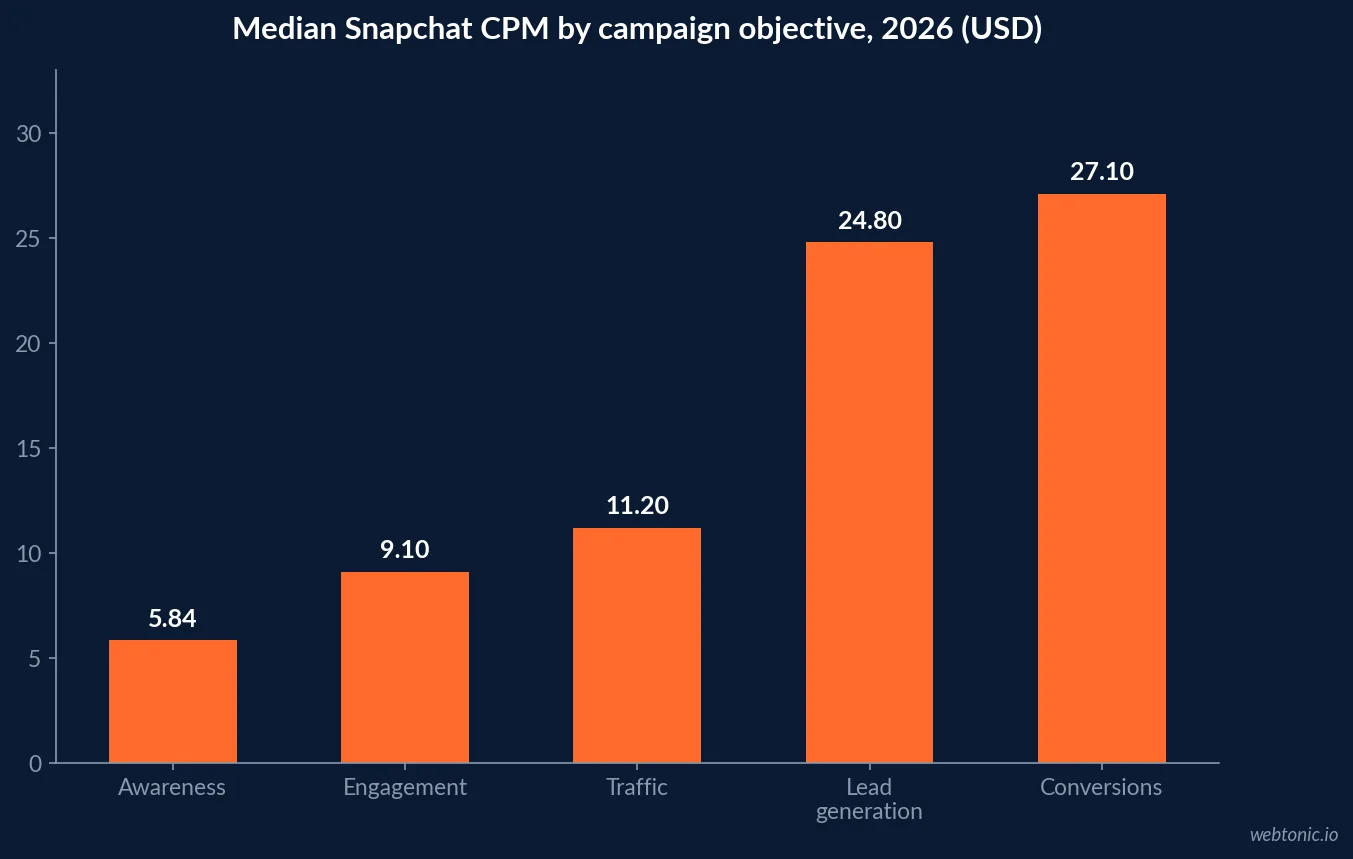
- Median CPM by objective: $5.84 awareness, $9.10 engagement, $11.20 traffic, $24.80 lead generation, $27.10 conversions (2,431-campaign dataset).
- Median CPC is $0.84 across objectives ($0.51-$1.34 interquartile), $0.71 on traffic and $1.18 on conversions.
- Median CTR is 1.04% - about 22% above Meta in matched data - rising to 1.36% on Spotlight and 0.94% on Story ads.
- Awareness CPM sits 30-40% below Meta; blended Snapchat CPM is about $8 versus roughly $10 on TikTok and $14.19 on Meta.
- 483 million daily and 956 million monthly active users in Q1 2026, up about 5% year over year.
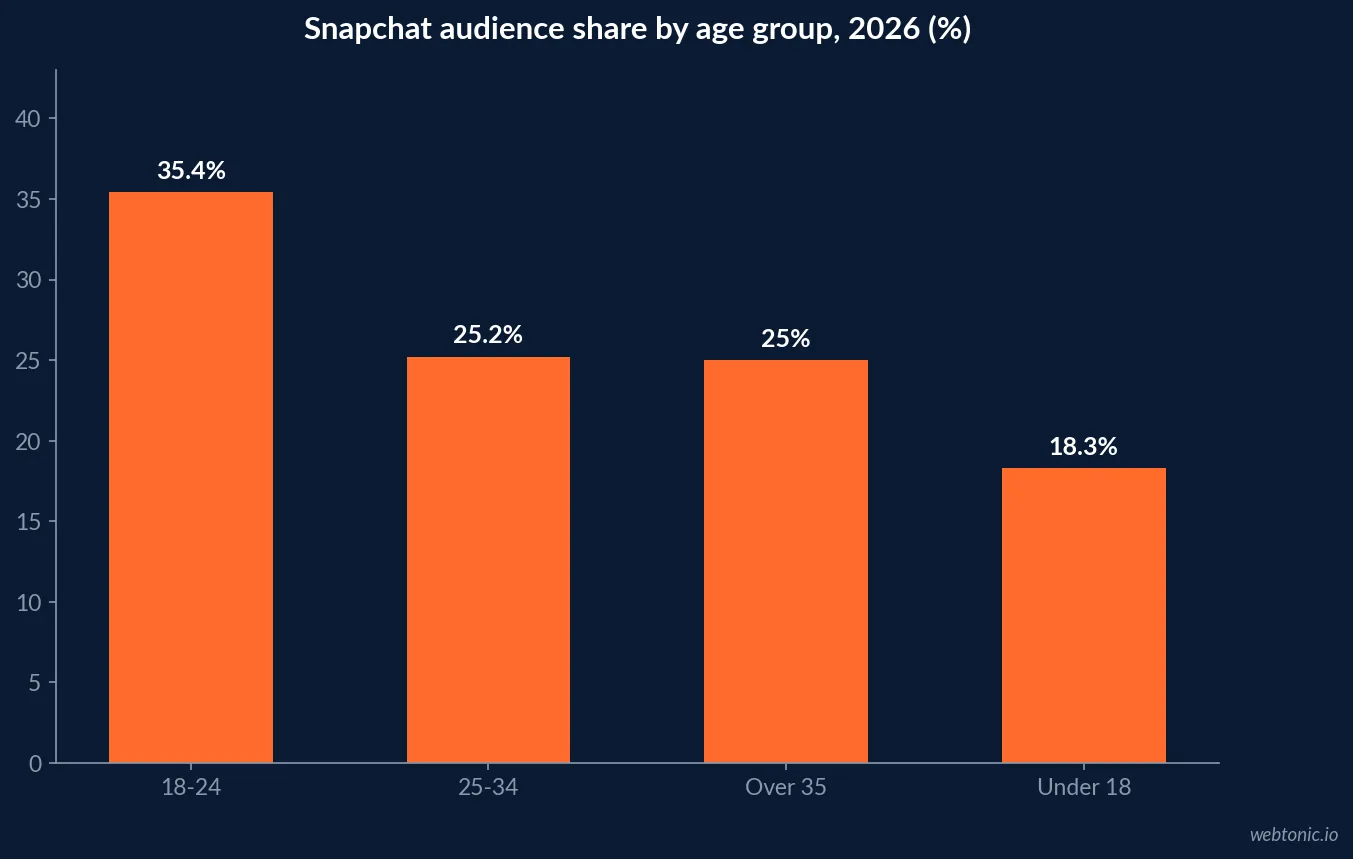
- 18-24s are 35.4% of the audience, 25-34s 25.2%, and about 1 in 4 Snapchatters is over 35.
- Video under seven seconds earns 3.5x the CTR of repurposed landscape imagery; native vertical images beat landscape by 1.5x.
- 95% of Snapchatters claim an active interest in health and wellness; 58% research complex health topics on social.
- 59% say health content on Snapchat changed a real-world behaviour, and 49% became more aware of treatments - 1.5x non-Snapchatters.
- Minimum spend is $5 per day, but conversion objectives at a $27.10 CPM need far more to exit learning.
- Veterinary context: paid search leads cost $31.50, 58% of new-client contact is by phone, and an open veterinarian seat costs $1,500-$3,000 a day.
Snapchat ad costs in 2026, by objective
Snapchat pricing is unusually objective-dependent, which is the single most important thing a practice should understand before spending. A benchmark dataset of 2,431 campaigns published by AdLiftr reports median CPMs of $5.84 for awareness, $9.10 for engagement, $11.20 for traffic, $23.40 for app installs, $24.80 for lead generation and $27.10 for conversions, with a median CPC of $0.84 ($0.71 on traffic, $1.18 on conversions) and a median CTR of 1.04% that rises to 1.36% on Spotlight placements. It also puts Snapchat awareness inventory 30-40% cheaper than equivalent Meta reach while conceding that post-click conversion rates are lower in most verticals.
Pricing analysis from Hack’celeration reaches the same conclusion from another angle: blended Snapchat CPM sits near $8, against about $10 on TikTok and $14.19 on Meta, the platform minimum is $5 a day, and creative production typically runs $150 to $5,000 outside media. Its warning is the one clinics need: at a $27.10 conversion CPM on a $5 daily budget the algorithm never leaves learning and you pay for nothing.
| Objective | Median CPM | 25th-75th percentile | Practical read for a clinic |
|---|---|---|---|
| Awareness | $5.84 | $3.20 - $9.40 | Cheapest reach on the platform |
| Engagement | $9.10 | $5.40 - $13.60 | Story views with a quality filter |
| Traffic | $11.20 | n/a | Send to a service or hiring page |
| App installs | $23.40 | $14.90 - $35.20 | Rarely relevant to practices |
| Lead generation | $24.80 | $15.10 - $39.40 | Variable lead quality |
| Conversions / purchases | $27.10 | $17.40 - $41.80 | Needs real budget and a pixel |
| CPC (all objectives) | $0.84 | $0.51 - $1.34 | Below typical Meta CPC |
| CTR (all objectives) | 1.04% | 0.61% - 1.69% | ~22% above Meta |
The audience: young, large, and buying pet care for the first time
Snapchat’s Q1 2026 results report 483 million daily active users and 956 million monthly active users, with Snap Map above 450 million monthly users, AR lenses used more than 9 billion times a day and 75% of Snapchatters engaging with AR daily. Platform demographics compiled by Sprout Social show 18- to 24-year-olds at 35.4% of the audience, 25- to 34-year-olds at 25.2%, under-18s at 18.3%, reach of 90% of 13- to 24-year-olds in 25+ countries and 75% of 13- to 34-year-olds, plus 5.5 billion Snaps sent per day.
Analysis from InfluencerDB adds the commercial nuance: nearly one in four Snapchatters is over 35, 75% say that when they like something they buy it against 59% of non-Snapchatters, and Snapchatters outspend other platforms’ users by +143% on household goods and +24% on apparel. Independent verification comes from Pew, cited in the same set: 55% of US teens use Snapchat and 46% use it daily. For a clinic, the relevant slice is the 18-34 first-time pet owner - the cohort that adopts, over-researches, and then picks a practice for the next decade.
| Audience metric | 2026 figure | Why a practice should care |
|---|---|---|
| Daily active users | 483M | Scale is not the constraint |
| Monthly active users | 956M | +5% year over year |
| Share aged 18-24 | 35.4% | First-time pet owners |
| Share aged 25-34 | 25.2% | Peak new-pet acquisition years |
| Share over 35 | ~25% | Broader than its reputation |
| Reach of 13-24s | 90% in 25+ countries | Recruiting assistants and techs |
| US teens using Snapchat | 55% (46% daily) | Pew, independent of Snap |
| Use platform for brand research | 23.2% | Discovery, not just messaging |
Health behaviour on Snapchat is stronger than expected
The category evidence is Snap-commissioned, so discount it accordingly - but it is directionally useful because pet health behaves like human health emotionally. Research published by Snap for Business reports 95% of Snapchatters claim an active interest in health and wellness, 58% of daily Snapchatters say social channels help them research complex health topics, 61% use social platforms to compare brands or treatment options, 49% feel more aware of specific treatments after seeing health content - 1.5x the rate of non-Snapchatters, 71% are comfortable sharing health-related Snaps with close friends, and 59% say health content on Snapchat has led them to change real-world behaviours.
Healthcare-side commentary from Bask Health makes the same case with the compliance caveats attached: the platform works for education and awareness in health categories, not for hard-response direct booking. That maps cleanly onto veterinary work - preventive care explainers, dental month, puppy packages, and "when should I actually worry" content perform; discount-led appointment pushes do not.
Creative rules that decide the outcome
Snapchat punishes recycled assets harder than any other platform in the mix. The same 2,431-campaign dataset found the median CTR on video under seven seconds is 3.5 times higher than on landscape images repurposed from other channels, and that native vertical single images beat landscape by 1.5 times. Practically, for a practice:
- Vertical, 9:16, sound-optional. Shot on a phone in an exam room, not in a studio.
- Under seven seconds for reach. One idea per clip: one symptom, one tip, one price, one face.
- Faces beat facilities. A technician answering "does my puppy need this vaccine" outperforms a building exterior every time.
- Hiring creative is a 10-second interview. A team member saying what they like about the job is the highest-performing recruitment format on the platform.
- Spotlight first. At 1.36% CTR it is the most engaged inventory; Story ads at 0.94% are the largest bucket.
- Never send traffic to a slow homepage. Veterinary landing pages convert at 10.5% versus 4.2% site-wide, and 72.4% of veterinary traffic is mobile.
Our veterinary video marketing statistics and landing page benchmarks cover both halves of that in more depth.
Where Snapchat sits against the channels that already work
Cost comparison is where enthusiasm should meet arithmetic. Veterinary benchmark data collected by CUFinder puts animal-care paid search cost per lead at $31.50 with a 12.6% Google Ads conversion rate at a $3.45 CPC, Facebook CPC at $1.15 and CPM at $11.50, click-to-call at 18.3%, Instagram engagement at 1.85% and TikTok engagement at 4.2%. Meanwhile AVMA-sourced figures compiled by Digitail report 0.7% veterinarian unemployment, 94.7% of practices raising wages, and a national shortfall of more than 17,000 veterinarians through 2032.
Read those together and the allocation writes itself: search and local listings buy appointments, Meta and email buy retention, and Snapchat buys two things nothing else buys as cheaply - full-screen attention from young pet owners, and applications from a labour pool that lives on the platform.
| Channel | 2026 cost signal | Job it should own |
|---|---|---|
| Google Search / local | $31.50 CPL, 12.6% CVR | Booked appointments |
| Meta (Facebook / Instagram) | $1.15 CPC, $11.50 CPM | Retention and remarketing |
| Snapchat awareness | $5.84 CPM | Cheapest full-screen reach |
| Snapchat traffic | $0.71-$0.84 CPC | Content and hiring pages |
| Snapchat conversions | $27.10 CPM | Only with pixel and real budget |
| TikTok | ~$10 CPM, 4.2% engagement | Organic-first education |
| Email reminders | 38.4% open (65% transactional) | Recall and reactivation |
| Recruiting on Snapchat | $0.84 CPC vs $1,500-$3,000/day vacancy | Technician and DVM hiring |
A 60-day Snapchat test a practice can defend
Small, instrumented, and judged on the right outcome:
- Weeks 1-2: install the Snap Pixel, build a 10-15 mile radius audience, produce six vertical clips under seven seconds. Budget on awareness only.
- Weeks 3-4: run awareness at $5.84-level CPMs, watch CTR against the 1.04% median, kill anything under 0.6%.
- Weeks 5-6: move winning creative to traffic ($0.71 CPC) pointing at one dedicated page, not the homepage.
- Weeks 7-8: if a role is open, run a hiring campaign with team-member clips; measure applications, not clicks.
- Throughout: track branded search volume and direct calls as the lift signal, since 58% of new-client contact still happens by phone.
- Exit rule: if branded search and call volume are flat after 60 days at a meaningful spend, stop. Cheap reach that moves nothing is still a cost.
Practices comparing this against their paid baseline should start with our veterinary Facebook ads statistics.
Limits of this data
No published dataset isolates veterinary advertisers on Snapchat, so the cost and CTR figures here are cross-vertical medians weighted towards direct-to-consumer ecommerce, where purchase behaviour differs sharply from booking a clinic appointment. The health-behaviour statistics are Snap-commissioned research about human health and are used here as an adjacent signal, not veterinary evidence. Percentile ranges matter more than medians at small budgets: a single practice running a few hundred dollars a month can easily land outside the interquartile band in either direction. User and demographic figures come from Snap’s own quarterly reporting plus third-party compilations, with the Pew teen figures the most independent of the set.
Frequently Asked Questions
How much do Snapchat ads cost in 2026?
Cost depends almost entirely on the objective you pick. Median cost per thousand impressions runs $5.84 for awareness, $9.10 for engagement, $11.20 for traffic, $24.80 for lead generation and $27.10 for conversions - so moving from awareness to conversions multiplies the price of reach by nearly five. Median cost per click across all objectives is $0.84, with an interquartile range of $0.51 to $1.34, and the platform minimum spend is $5 per day.
Is Snapchat worth it for a veterinary practice?
For appointment bookings, no - local search and Google Business Profile do that job far more efficiently, with animal-care paid search leads at about $31.50. Snapchat earns budget for three different jobs: cheap awareness in a defined metro when a clinic is new or relocating, reaching first-time pet owners in the 18-34 bracket, and recruiting veterinary technicians and assistants in an unusually tight labour market. Treat it as reach and hiring media, measured on lift rather than last click.
Who actually uses Snapchat in 2026?
Snapchat reported 483 million daily active users and 956 million monthly active users in Q1 2026, up about 5% year over year. The 18-24 bracket is the largest single group at 35.4% of the audience, followed by 25-34 at 25.2%, and the platform claims reach of 90% of 13- to 24-year-olds and 75% of 13- to 34-year-olds across 25+ countries. Roughly one in four Snapchatters is over 35, so it is broader than its reputation - but it is still the youngest major ad platform.
What Snapchat creative works for a veterinary clinic?
Vertical, fast and unpolished. In one 2,431-campaign dataset the median click-through rate on video under seven seconds was 3.5 times higher than on landscape images repurposed from other channels, and native vertical single images beat landscape by 1.5 times. For a clinic that means phone-shot clips: a technician answering one question, a puppy first-visit walkthrough, a before-and-after dental, a 10-second team introduction for a hiring ad. Production budgets for professionally made Snap creative run $150 to $5,000.
Do Snapchat users engage with health content?
More than most platforms, according to Snap-commissioned research: 95% of Snapchatters say they have an active interest in health and wellness, 58% of daily Snapchatters say social channels help them research complex health topics, 61% use social to compare treatment or brand options, 49% report becoming more aware of specific treatments after seeing health content (1.5 times the rate of non-Snapchatters), and 59% say health content on Snapchat has changed a real-world behaviour. Pet health is an adjacent, similarly emotional category.
Bottom line
Snapchat will not fill next week’s appointment book. What it will do, at a $5.84 awareness CPM and $0.84 median CPC, is put a real face from your practice in front of the 18-34 pet owners choosing a clinic for the first time - and put a hiring ad in front of the technicians every practice in your city is chasing. Spend small, shoot vertical, measure lift. Our performance creative team builds platform-native clinic creative at volume; get in touch if you want a test designed properly.
Sources
AdLiftr - Snapchat ads cost benchmarks 2026 (2,431 campaigns)
Hack’celeration - Snapchat ads pricing in 2026
Snap Inc. - Q1 2026 financial results
Sprout Social - Snapchat statistics 2026
InfluencerDB - Snapchat statistics and audience analysis
Snap for Business - Health on social research
Bask Health - Snapchat advertising for health brands
CUFinder - Veterinarians marketing benchmarks 2026
Digitail - Veterinary statistics and findings 2026
SocialPilot - Snapchat statistics 2026