



Table of contents

Key Takeaways
- 91% of businesses use video as a marketing tool in 2026 — matching the all-time high — yet only 27% of veterinary clinics currently invest in video marketing (Wyzowl, 2026; Marketing LTB, 2026).
- TikTok Shop pet supplies GMV surged 129% YoY to $780 million in 2025, with 2026 projections reaching $2 billion globally (Charm.io, 2026).
- TikTok engagement for veterinary content averages 4.2%, making pet content one of the top-performing categories on the platform (CuFinder, 2026).
- Video content reaches approximately 92% of global internet users, and 64% of Gen Z recently discovered products via social video (Stethon Digital, 2026).
- 36% of veterinary clinics use video testimonials in their marketing, with video testimonial ads generating 3× more engagement than static posts (Marketing LTB, 2026).
- YouTube skippable in-stream ads for veterinary deliver a $0.01–$0.03 CPV with ~30% view rates (Stethon Digital / Strike Social, 2026).
Veterinary Video Marketing Benchmarks at a Glance
| Platform / Metric | Veterinary / Pet Benchmark | Cross-Industry Reference |
|---|---|---|
| TikTok Engagement Rate | 4.2% (vet content) | 2.6% (median all creators) |
| Instagram Reels Engagement | 1.85% (vet practices) | 0.60% (industry avg.) |
| YouTube CPV (Skippable) | $0.01–$0.03 | $0.01–$0.05 |
| YouTube View Rate | ~30% | ~25–35% |
| TikTok Shop Pet GMV (2025) | $780M (+129% YoY) | N/A |
| Clinics Using Video Marketing | 27% | 91% (all businesses) |
| Clinics Using Video Testimonials | 36% | N/A |
| Clinics Using YouTube | 23% | N/A |
The Video Adoption Gap in Veterinary Marketing
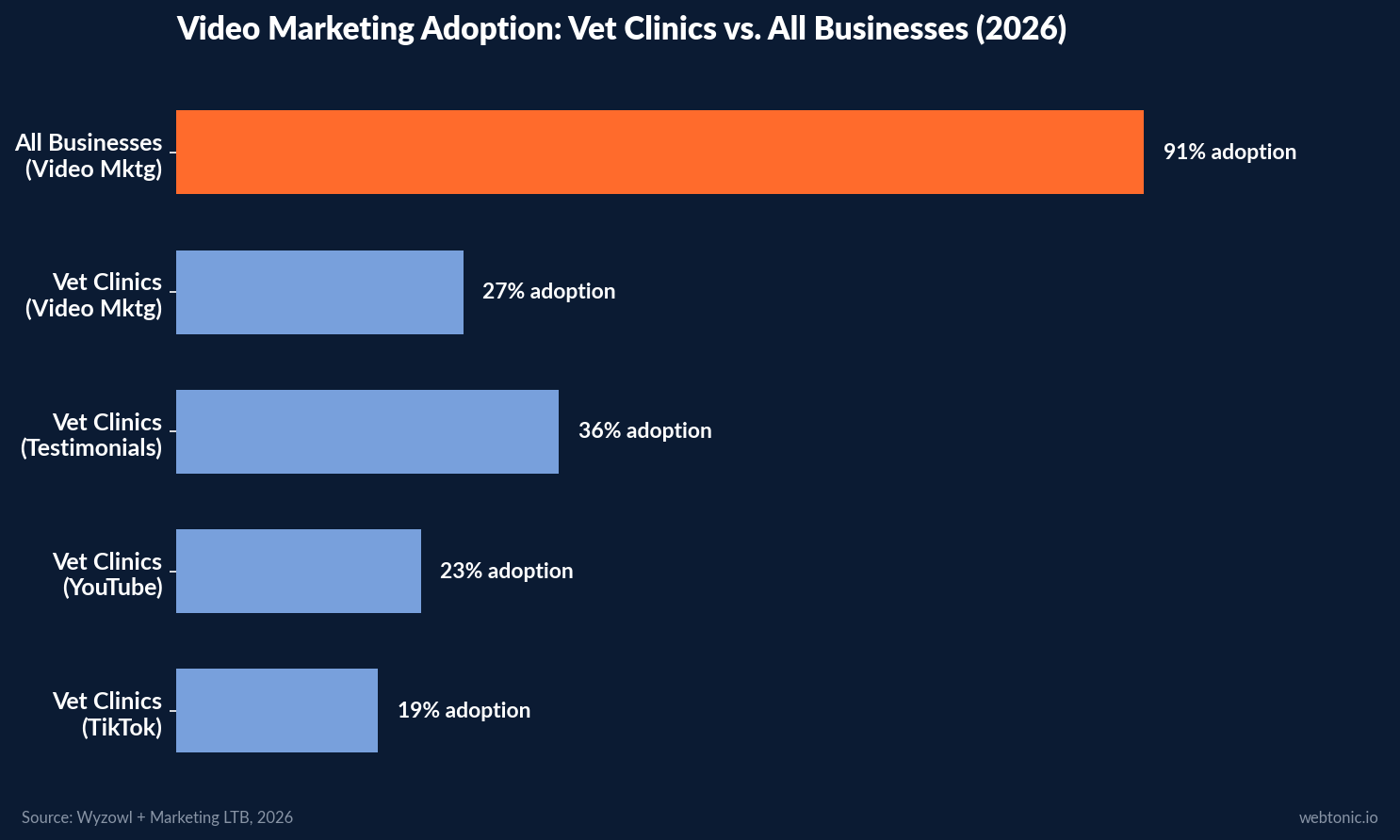
Video marketing has reached near-universal adoption across industries, with 91% of businesses using video as a marketing tool in 2026 — matching the all-time high (Wyzowl, 2026). Yet veterinary practices are dramatically behind this curve: only 27% of clinics invest in video marketing, 23% use YouTube for educational content, and 19% have adopted TikTok marketing (Marketing LTB, 2026).
This adoption gap is especially striking given the natural advantages veterinary content has on video platforms. Pet content is inherently emotional, visual, and shareable — qualities that drive algorithmic distribution on every major platform. 64% of Gen Z and 59% of Millennials recently discovered products through social video, and video content reaches approximately 92% of global internet users (Stethon Digital, 2026). The contrast is even sharper when looking at specific formats. 36% of clinics use video testimonials, but fewer than 1 in 5 have a dedicated TikTok presence. Meanwhile, 42% of clinics report digital marketing as their fastest-growing acquisition channel, signaling readiness to invest — just not yet in video at the scale the data warrants (Marketing LTB, 2026).
Practices that bridge this gap now will build brand equity in a market where 68% of pet owners search online before choosing a clinic and 67% of mobile veterinary searches lead to same-day action (Marketing LTB, 2026).
TikTok: The Fastest-Growing Video Channel for Pet Brands
TikTok has emerged as the most impactful video platform for veterinary and pet product marketing, with growth metrics that outpace every other social channel. TikTok Shop pet supplies reached $780 million in global GMV in 2025, up from $341 million in 2024 and just $6 million in 2022 — a 130× increase in three years (Charm.io, 2026).
The trajectory continues to accelerate. Charm.io projects worldwide GMV at $2 billion for 2026, with the US market alone tracking toward $389 million — more than doubling from $200 million in 2025 (Charm.io, 2026). TikTok pet product searches grew 180% from 2023 to 2025, and the 2026 projection of 107 billion worldwide pet video views confirms that the audience is still in early expansion (Foundry CRO, 2026).
Engagement data reinforces TikTok's position. Veterinary TikTok content averages a 4.2% engagement rate (CuFinder, 2026), and dedicated pet creators see roughly 5% engagement — nearly double the 2.6% TikTok median across all creators (Foundry CRO, 2026). For veterinary practices, even 2 TikTok videos per week can build significant local brand equity, particularly with behind-the-scenes clinic content, pet recovery stories, and educational quick-tip formats.
YouTube Performance and Cost Benchmarks
| YouTube Metric | Veterinary Benchmark | Context |
|---|---|---|
| Cost Per View (Skippable In-Stream) | $0.01–$0.03 | Common budgeting range |
| View Rate | ~30% | Benchmark summary |
| Clinics Using YouTube | 23% | Marketing LTB, 2026 |
| TikTok has | 1B+ monthly users | Stethon Digital, 2026 |
| Video Reach (Global Internet Users) | ~92% | Stethon Digital, 2026 |
YouTube remains the primary long-form video platform for veterinary education, with 23% of clinics using it for educational content (Marketing LTB, 2026). YouTube skippable in-stream ads for veterinary services deliver a cost per view of $0.01–$0.03 with approximately 30% view rates (Stethon Digital / Strike Social, 2026).
For practices investing in performance creative, YouTube offers a distinct advantage: long-form content builds deeper trust than short-form clips. 60% of pet owners prefer clinics with educational content (Marketing LTB, 2026), and detailed procedure explanations, breed-specific health guides, and "what to expect" clinic walkthroughs perform exceptionally well on YouTube. The platform's search-driven discovery model also means these videos compound in value over time, generating organic views months or years after publication.
Video Testimonials and Trust-Building Content
Video testimonials are one of the most effective formats for veterinary practices, with adoption growing steadily. 36% of veterinary clinics now use video testimonials in their marketing, and practices report that video testimonial ads generate 3× more engagement than static image posts (Marketing LTB, 2026). This performance premium reflects the emotional connection pet owners feel when watching real recovery stories, adoption updates, or satisfied client interviews.
The trust data supports this approach. 74% of pet owners trust clinics with strong online reviews, and 64% trust clinics that share before-and-after pet case content (Marketing LTB, 2026). When that review content is delivered as video rather than text, the trust signal strengthens considerably. 72% of pet owners read at least 5 reviews before booking, and video reviews serve as premium-quality social proof that outperforms written testimonials in both reach and persuasion.
49% of pet owners say active social media posts increase their trust in a clinic, making consistent video publishing a direct trust accelerator (Marketing LTB, 2026). For practices that connect their video content strategy with paid social amplification, these trust signals reach far beyond organic followers — extending into cold audiences where building credibility is hardest.

Influencer Video and User-Generated Pet Content
Pet influencer video is a massive and growing market with clear implications for veterinary practices. 63% of pet owners follow pet-focused influencers on social media (Foundry CRO, 2026), and 65% of pet brands using influencer marketing report a 20%+ ROI with micro-influencers (10K–100K followers) driving 35% of conversions (Zipdo, 2026).
20% of pet owners use pet influencers to inform purchasing decisions, and 30% of social media users engage with pet influencer content on a weekly basis (Zipdo, 2026). For veterinary practices, partnering with local pet influencers for video content — clinic tours, product unboxings, vaccination day vlogs — creates authentic content that drives both awareness and bookings.
The organic opportunity is equally significant. TikTok pet product searches grew 180% from 2023 to 2025, and veterinary practices that encourage clients to share video content featuring their pets — recovery milestones, adoption stories, dental cleaning reveals — tap into this organic growth engine at zero media cost. Combined with growth marketing strategies, user-generated video creates a sustainable content flywheel that reduces reliance on paid media.
Video Ad Performance Across Paid Channels
| Channel | CPC / CPV | CTR / View Rate | CPA |
|---|---|---|---|
| Meta/FB Video Ads (Pet) | $0.61 CPC | 1.68% CTR | $15.29 |
| YouTube Skippable In-Stream | $0.01–$0.03 CPV | ~30% view rate | Varies |
| Instagram Reels Ads (Pet) | $0.42 CPC | 1.85% engagement | ~$54.72 |
| TikTok Ads (Pet Creators) | Varies | ~5% engagement | Varies |
Paid video advertising for veterinary practices delivers strong unit economics across platforms. Meta/Facebook video ads average $0.61 CPC for pet content — 65% below the $1.72 cross-industry average — with a CTR of 1.68%, nearly double the 0.89% benchmark (Promodo, 2026; Stethon Digital, 2026). The $15.29 CPA represents a 22% discount versus the $19.68 cross-industry average, making Facebook video one of the most cost-effective channels for veterinary appointment generation.
Instagram video (Reels) ads are even cheaper at $0.42 CPC, though conversion rates (0.78%) are lower — reflecting Instagram's role as an awareness and engagement channel rather than a direct-response platform (Stethon Digital, 2026). The combination of low cost and high engagement means practices can build brand awareness through Reels ads at a fraction of what most service businesses pay.
The best-performing video ad strategy combines organic content testing with paid amplification. Practices should identify which organic video posts generate the highest engagement, then use $500–$1,000 monthly budgets to boost those proven winners to targeted local audiences. With the DTC pet vertical's $23 median CAC — the lowest of any DTC category (Foundry CRO, 2026) — even small investments in video ads can produce measurable returns in appointment bookings and product sales.
Video Marketing Best Practices for Veterinary Practices
- Start with TikTok and Instagram Reels — With 4.2% TikTok engagement and 1.85% Instagram engagement, short-form vertical video is the highest-return content format. Low production overhead — smartphone footage with good lighting — performs better than polished studio content.
- Publish video testimonials consistently — 36% of clinics already use video testimonials, and they generate 3× more engagement. Record 30–60 second client interviews during pickup visits with simple consent forms.
- Build a YouTube educational library — Only 23% of clinics use YouTube, but 60% of pet owners prefer educational content. Focus on breed health guides, procedure explanations, and seasonal care tips that compound in search value over time.
- Invest in before-and-after content — 64% of pet owners trust clinics sharing case content. Dental cleanings, weight management transformations, and surgical recoveries make compelling visual narratives.
- Amplify top-performing organic videos with paid media — Use Facebook and Instagram Ads with $0.61 average CPC for pet content to boost proven organic winners to local audiences.
- Track video-specific metrics — Only 36% of clinics track marketing ROI. Set up UTM parameters for video links, monitor view-through rates, and measure appointment bookings attributable to video content using data intelligence tools.
FAQ
How effective is video marketing for veterinary practices?
Extremely effective — and dramatically underutilized. While 91% of businesses across industries use video marketing in 2026, only 27% of veterinary clinics have adopted it. Practices that do invest in video see measurable advantages: video testimonial ads generate 3× more engagement than static posts, TikTok engagement for vet content reaches 4.2% (far above most industries), and 60% of pet owners prefer clinics that share educational content. The gap between universal adoption and veterinary-specific adoption represents one of the largest untapped marketing opportunities in the industry (Wyzowl, 2026; Marketing LTB, 2026).
What is the best video platform for veterinary marketing?
TikTok delivers the highest engagement at 4.2% and the fastest audience growth — making it ideal for discovery and brand awareness. Instagram Reels follows at 1.85% engagement, best for visual branding and community building. YouTube serves a different purpose with its search-driven, long-form format — ideal for educational content that compounds in value. The strongest approach combines all three: TikTok and Reels for reach, YouTube for depth and trust (CuFinder, 2026).
How much does veterinary video advertising cost?
YouTube skippable in-stream ads cost $0.01–$0.03 per view with approximately 30% view rates, making them among the most cost-efficient video ad formats available. On Facebook and Instagram, pet video ads average a $0.61 CPC and $15.29 CPA — significantly below cross-industry averages. Even modest video ad budgets of $500–$1,000 per month can generate meaningful reach and appointment volume given these favorable unit economics (Stethon Digital, 2026; Promodo, 2026).
What types of video content work best for veterinary practices?
The top-performing video formats for veterinary practices include behind-the-scenes clinic tours, pet recovery and before-and-after stories (trusted by 64% of pet owners), educational health tips (preferred by 60% of pet owners), video testimonials from satisfied clients (used by 36% of clinics, generating 3× engagement), and quick-tip formats for seasonal care. Short-form vertical video (under 60 seconds) performs best on TikTok and Instagram Reels, while longer educational content (3–10 minutes) works better on YouTube. The key insight is that authentic, smartphone-shot content consistently outperforms high-production-value material in engagement metrics across all platforms (Marketing LTB, 2026; CuFinder, 2026).
Should veterinary clinics use TikTok?
The data strongly suggests yes. TikTok Shop pet supplies grew 129% YoY to $780 million in 2025, with the US market on track for $389 million in 2026. Pet product searches on TikTok grew 180% from 2023 to 2025, and 107 billion worldwide pet video views are projected for 2026. Despite these numbers, only 19% of clinics use TikTok — creating a clear first-mover advantage. Even 2 short-form videos per week can build significant local visibility (Charm.io, 2026; Marketing LTB, 2026).
Sources
Wyzowl — Video Marketing Statistics 2026
Marketing LTB — Veterinary Marketing Statistics 2026
Charm.io — TikTok Shop Pet Supplies Hit $780M in 2025
CuFinder — Veterinarians Industry Marketing Benchmarks 2026
Stethon Digital — 100+ Veterinary Marketing Statistics for 2026
Foundry CRO — DTC Pet Marketing Benchmarks 2026
Zipdo — Marketing In The Pet Industry Statistics 2026
Promodo — Pet Industry Digital Marketing Benchmarks 2026


