Table of contents
It takes the average hospital 78 days to hire one registered nurse, and the 2026 family medicine residency Match filled a record 4,613 positions on the first round alone. Those two facts, not a patient-acquisition benchmark, are what should decide whether an urgent care or primary care organization spends on LinkedIn ads.
Key Takeaways
- Average nurse hiring cycle is 78 days, per the 2026 NSI RN Staffing Report.
- The average hospital loses $5.19 million a year to nurse turnover.
- National RN vacancy rate is 8.6%, with a national shortage of 158,600 registered nurses.
- A third of hospitals (33.1%) carry 10%-plus RN vacancy.
- RN turnover rose to 17.6%, up 1.2 points year over year.
- The average hospital has turned over 102% of its nursing staff in five years.
- Healthcare workers on LinkedIn are up 35% year over year, per LinkedIn's own data.
- The 2026 NRMP Match offered a record 5,512 family medicine positions.
- 4,613 of those were filled in the first round alone, an 83.7% overall fill rate.
- AAMC projects a shortage of up to 86,000 physicians by 2036.
- Of that, 20,200 to 40,400 are projected primary care physicians.
- The top 20% of urgent care clinics capture 29% of employer-paid visit volume, averaging 12 visits a day.
- The bottom 20% of clinics average under 1 employer-paid visit a day in the same data.
- Healthcare & pharma B2B digital ad spend is forecast to rise 15.2% to $2.63 billion in 2026.
- Healthcare workers rate inclusivity 17% higher than other talent pools when choosing a job.
The honest audience for this platform
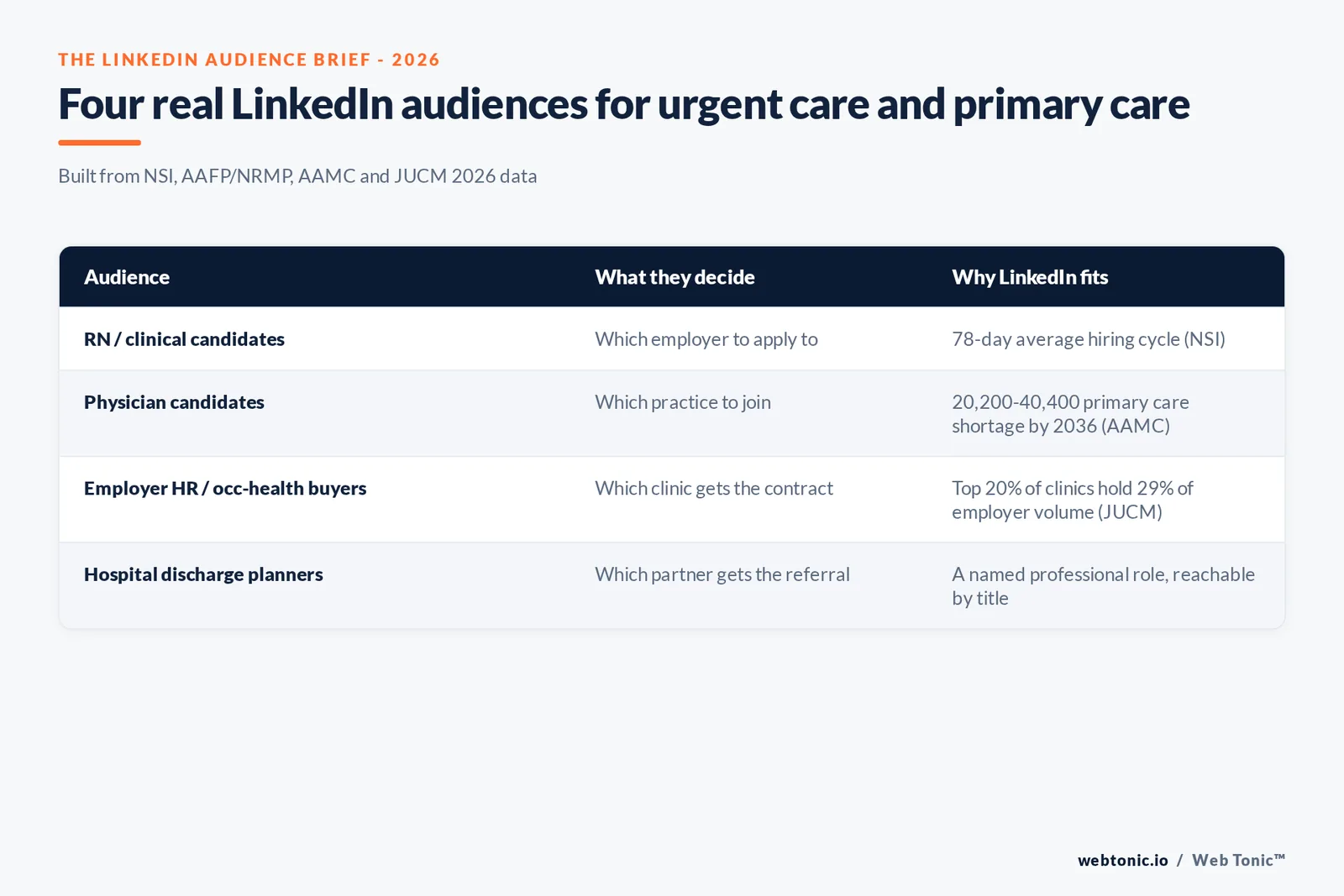
LinkedIn is not where a symptomatic patient chooses an urgent care center or a family picks a pediatrician - that decision happens on Google, Maps, or a recommendation. The realistic buyer on LinkedIn is one of two people: a clinical or administrative candidate for an open role, or a B2B decision-maker at an employer, third-party administrator, or hospital who controls where occupational medicine or discharge referrals go. Framing a LinkedIn budget around either of those is the difference between a channel that works and one that quietly burns spend against the wrong audience.
| LinkedIn audience for this vertical | What they actually decide | Why LinkedIn fits |
|---|---|---|
| RN / clinical staff candidates | Which employer to apply to | 78-day hiring cycle rewards always-on presence |
| Physician / advanced practice candidates | Which practice or system to join | Shrinking primary-care supply raises the stakes per hire |
| Employer HR / occupational health buyers | Which clinic gets the employer contract | B2B decision-maker, reachable by title and company |
| Hospital discharge planners / case managers | Which referral partner to route patients to | A named professional role, not a consumer |
| Patients choosing a same-day or ongoing provider | Where to get care | Not a realistic LinkedIn audience - budget elsewhere |
The staffing numbers that justify a recruiting budget
The 2026 NSI National Health Care Retention & RN Staffing Report, drawn from 527 acute care hospitals across forty states and 262,405 registered nurses, puts the average nurse hiring cycle at 78 days and the average hospital's annual cost of nurse turnover at $5.19 million. Hospitals hired 377,650 nurses in 2025 while 324,090 left, a net gain of only 2.9%, down from 5.6% the year before. The national RN vacancy rate sits at 8.6%, described by NSI as a national shortage of 158,600 registered nurses, with 33.1% of hospitals carrying 10%-plus vacancy.
LinkedIn's own Talent Blog corroborates the demand side: the supply of healthcare workers on LinkedIn is up 35% year over year, and the number of healthcare employers on the platform has grown every year over the same period - meaning the candidate pool is expanding, but so is the competition for it.
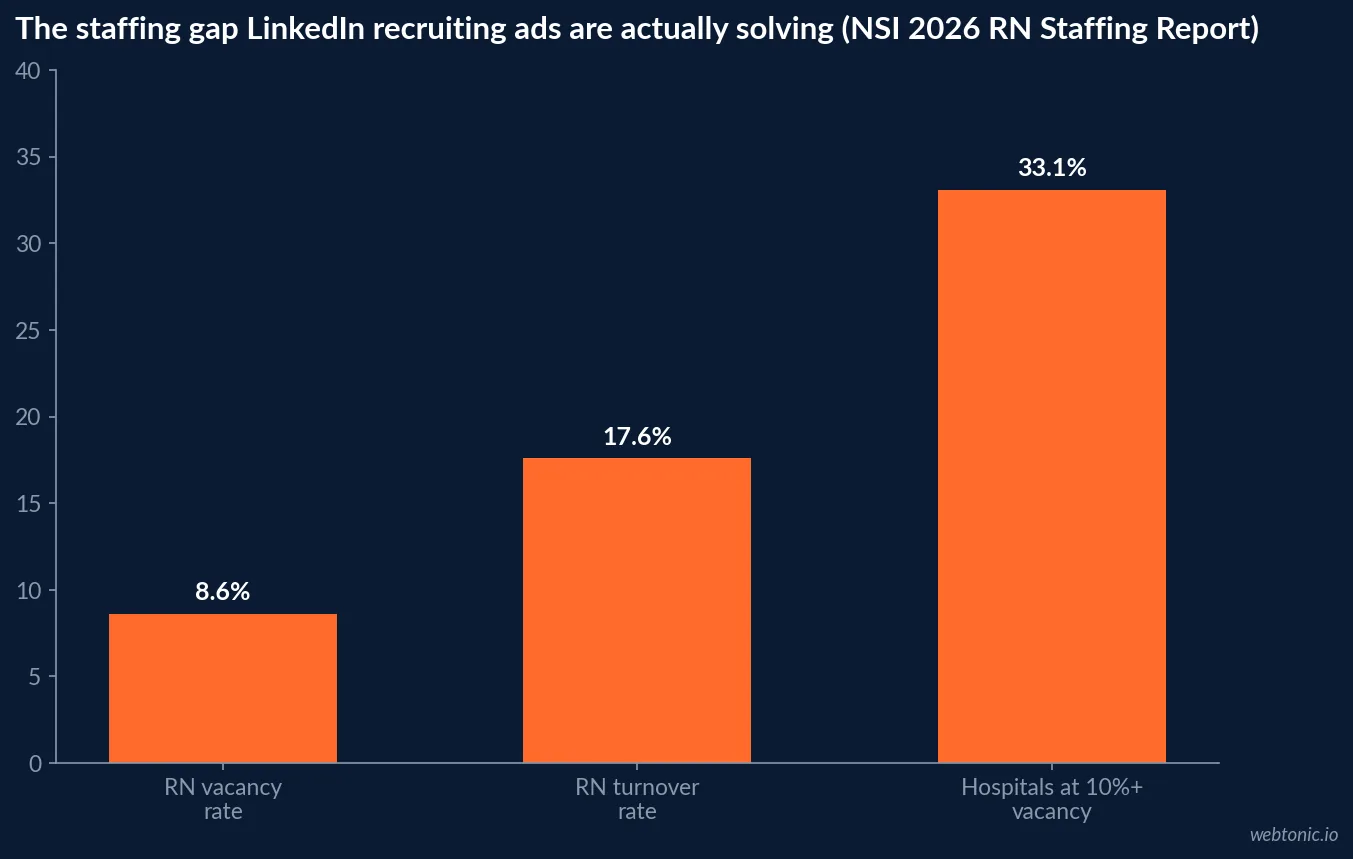
| Staffing metric (NSI, 2026, N=527 hospitals) | Figure |
|---|---|
| Average days to hire one registered nurse | 78 days |
| Average annual cost of nurse turnover per hospital | $5.19 million |
| National RN vacancy rate | 8.6% |
| National RN shortage (NSI estimate) | 158,600 nurses |
| RN turnover rate | 17.6% |
| Hospitals with 10%+ RN vacancy | 33.1% |
The physician pipeline: growing, but not fast enough
On the physician side the 2026 NRMP Main Residency Match and AAFP's own recap report a record 5,512 family medicine residency positions offered across more than 800 programs, with 4,613 filled after the first round and an overall 83.7% fill rate. That is genuine growth in the pipeline. Set against it, AAMC's workforce projections still put the total US physician shortage at up to 86,000 by 2036, including 20,200 to 40,400 in primary care specifically - so the Match records are shrinking the deficit's growth rate, not closing it.
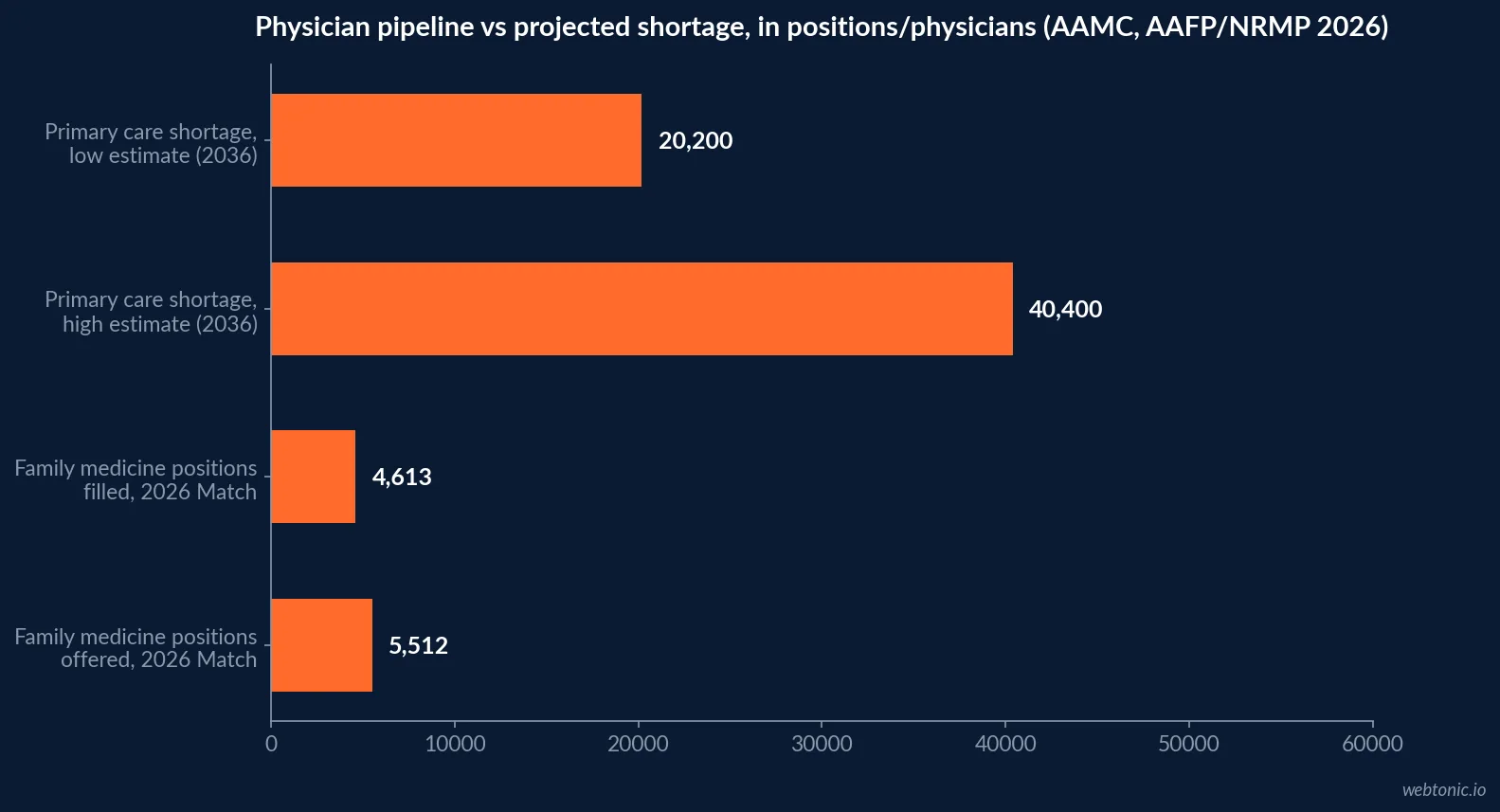
| Physician pipeline fact | Figure | Source |
|---|---|---|
| Family medicine residency positions offered, 2026 | 5,512 | AAFP / NRMP |
| Positions filled, first round | 4,613 | AAFP / NRMP |
| Overall fill rate | 83.7% | AAFP |
| Projected total US physician shortage by 2036 | up to 86,000 | AAMC |
| Projected primary care shortage within that total | 20,200-40,400 | AAMC |
The B2B referral case, separate from recruiting
The second realistic LinkedIn use case is B2B referral development, not hiring. The Journal of Urgent Care Medicine reports occupational medicine revenue in urgent care as structurally concentrated: the top 20% of clinics capture 29% of employer-paid and workers'-compensation visit volume, averaging 12 daily visits, while the bottom 20% average under 1 visit a day from those same payer types. That concentration is driven by which clinics have the B2B sales infrastructure to win employer contracts in the first place - exactly the kind of relationship-building LinkedIn ads, aimed at HR and occupational health decision-makers, are built to support.
Hospital discharge planners and case managers are the parallel relationship on the primary care side: a named professional role making a routing decision, reachable by job title on LinkedIn in a way a patient never is. eMarketer forecasts healthcare and pharma B2B digital ad spend rising 15.2% to $2.63 billion in 2026, a scale signal that this B2B lane, not patient acquisition, is where healthcare ad dollars on professional platforms are actually growing.
What LinkedIn's own platform data shows about the candidate pool
LinkedIn's Talent Blog reports the number of members working in the hospitals and healthcare industry has grown every year for the past five, up 35% year over year in its most recent count, with registered nurse and medical doctor among the five most common job titles in the category. The catch is that the number of healthcare employers on the platform has grown at the same pace, so a bigger candidate pool has not translated into less competition for it.
The same research finds healthcare workers rate inclusivity 17% more important than other talent pools do when choosing a new employer, alongside the near-universal priorities of compensation, work-life balance and flexible arrangements. A recruiting ad that leads with schedule flexibility and workplace culture, not just a salary figure, is closer to what LinkedIn's own survey data says this audience is actually screening for.
| What LinkedIn's healthcare talent data shows | Figure | Source |
|---|---|---|
| Growth in healthcare workers on LinkedIn, year over year | +35% | LinkedIn Talent Blog |
| Members surveyed monthly on job-choice priorities | 15,000+ | LinkedIn Talent Blog |
| Healthcare workers who rate inclusivity higher than other talent pools | +17% | LinkedIn Talent Blog |
| Growth in healthcare employers on LinkedIn | Grew every year, 5-year span | LinkedIn Talent Blog |
Why turnover economics change the budget conversation
NSI's 2026 data reframes recruiting spend as a retention problem as much as a hiring one: hospitals hired 377,650 registered nurses in 2025 while 324,090 left, a net gain of only 2.9%, down from 5.6% the year before, and the average hospital has turned over 102% of its nursing staff over five years. Personal issues, relocation and retirement - now the third most-cited reason for leaving - rank ahead of salary, which sits seventh. A LinkedIn campaign built only around compensation is answering a question this data says is not the one most departing nurses are actually asking.
| Turnover fact (NSI, 2026) | Figure |
|---|---|
| Registered nurses hired in 2025 | 377,650 |
| Registered nurses who left in 2025 | 324,090 |
| Net workforce growth rate | 2.9% (down from 5.6% prior year) |
| 5-year cumulative nursing staff turnover | 102% |
| Rank of retirement among reasons for leaving | 3rd, ahead of salary at 7th |
What a LinkedIn budget should look like here
Split the budget by objective, not by a single "healthcare LinkedIn ads" line: a recruiting stream targeted at RN and physician candidates by title and specialty, and a B2B stream targeted at HR/occupational-health buyers and discharge planners by job function. Neither stream should be measured against a patient-acquisition cost per lead, since neither is trying to book a patient. Our growth marketing practice builds recruiting and referral-partner campaigns as separate tracks with separate KPIs for exactly this reason, and our note on building a channel strategy around a stated objective applies just as directly to a LinkedIn recruiting campaign as it does to search. Talk to us about scoping either track.
Frequently Asked Questions
Should an urgent care or primary care clinic run LinkedIn ads to reach patients?
Generally no. LinkedIn is a professional network, and patients researching a same-day urgent care visit or choosing a family doctor are not making that decision on a B2B platform. The stronger case is staffing and referral partnerships: the 2026 NSI National Health Care Retention & RN Staffing Report puts the average hospital's nurse hiring cycle at 78 days, and LinkedIn's own Talent Blog reports the supply of healthcare workers on the platform up 35% year over year - both point to recruiting, not patient acquisition, as the fit.
How bad is the nursing and physician staffing gap right now?
Wide, and not closing quickly. NSI's 2026 report, drawn from 527 acute care hospitals and 262,405 registered nurses, puts the national RN vacancy rate at 8.6% and the national shortage at 158,600 registered nurses, with a third of hospitals at 10%-plus vacancy. On the physician side, AAMC projects a shortage of up to 86,000 physicians by 2036, including 20,200 to 40,400 in primary care specifically.
Is the family medicine pipeline actually growing?
Yes, on paper - and that is the nuance. The 2026 NRMP Main Residency Match set records with 5,512 family medicine positions offered and 4,613 filled in the first round, an 83.7% overall fill rate. That is genuine growth, but it lands against a demand curve AAMC still projects as widening, so supply growing does not mean the shortage is closing - it means the gap is growing more slowly than it otherwise would.
What is the B2B referral angle, separate from recruiting?
Occupational medicine and hospital discharge relationships are the other real LinkedIn use case. The Journal of Urgent Care Medicine reports occupational medicine as structurally top-heavy: the top 20% of clinics capture 29% of employer-paid and workers'-compensation visit volume, averaging 12 daily visits, while the bottom 20% average under 1. That concentration is a B2B sales relationship (employer contracts, discharge planners) that LinkedIn is built to reach, unlike a same-day patient decision.
What should a clinic's LinkedIn ad budget actually target?
Two audiences: candidates for open clinical roles, and B2B decision-makers at employers, third-party administrators, and hospital case-management teams who control referral volume. NSI's data shows the average hospital loses $5.19 million a year to nurse turnover, which reframes recruiting ad spend as a retention-economics line item rather than a discretionary marketing cost.
Sources
NSI Nursing Solutions - 2026 National Health Care Retention & RN Staffing Report
LinkedIn Talent Blog - Recruiting Healthcare Workers: A Pulse Check with LinkedIn Data
AAFP - 2026 Match sets records for family medicine positions offered and filled
AAMC - Physician Workforce Projections
Journal of Urgent Care Medicine - The Structural Divide in Urgent Care Occupational Medicine
eMarketer - Pharma's digital HCP investment rises as marketers pair ads with rep outreach