Table of contents

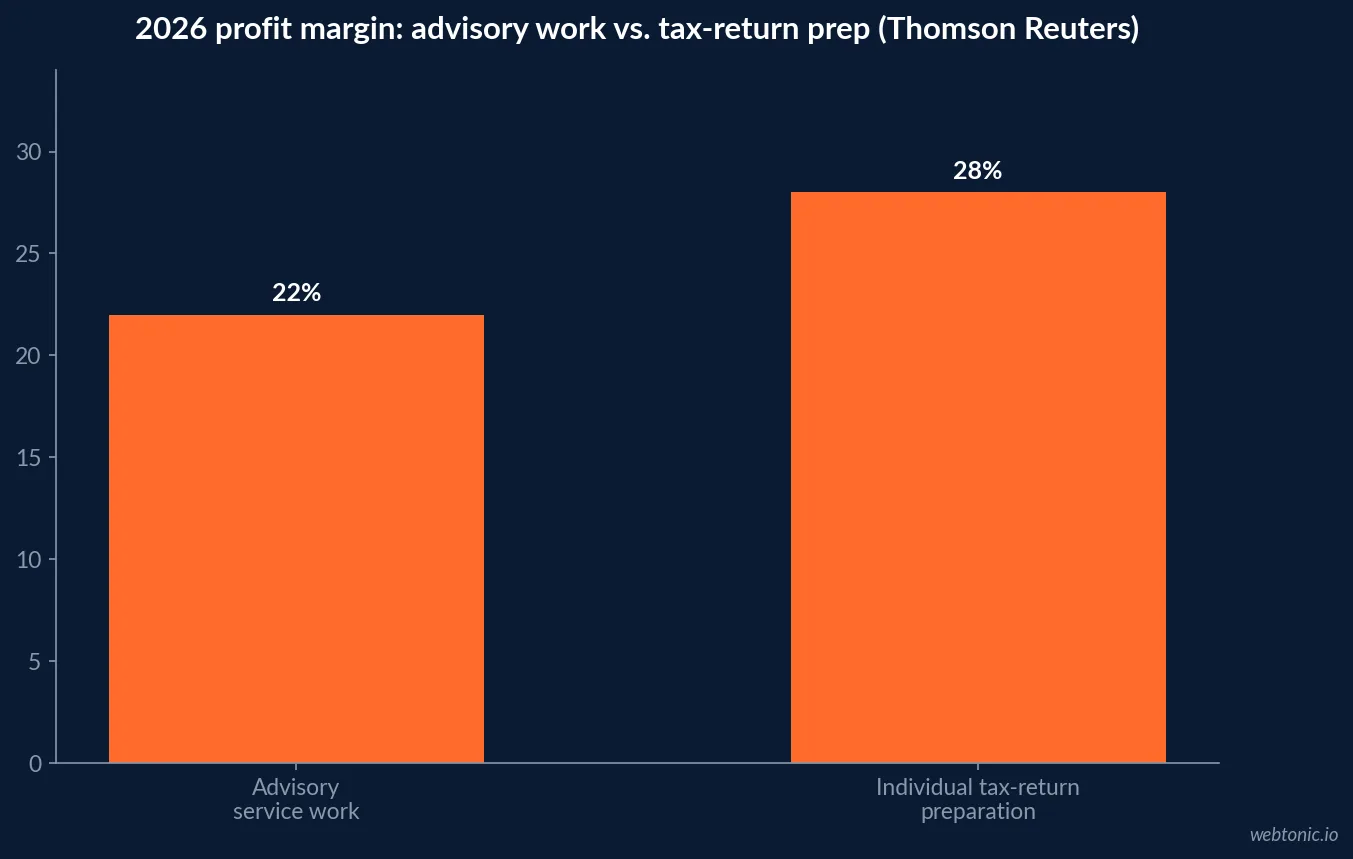
74% of tax professionals say their clients strongly want a trusted advisor, not just a tax preparer - yet advisory work still runs 20% to 24% margins against 28% for compliance work, per Thomson Reuters' 2026 survey of 600 professionals. That underpricing gap, not a lack of demand, is what should size a 2026 client-retention marketing budget in accounting.
Key Takeaways
- 74% of tax professionals say clients strongly want more financial advice beyond tax prep.
- Advisory work margins run only 20% to 24%, against 28% for tax-return prep.
- 78% of firms still bill primarily by the hour, despite advisory demand.
- Fee/rate increases drove 23% of firm revenue growth in the past 12 months.
- Selective new-client acquisition drove another 22% of revenue growth.
- AI is the No. 1 investment priority for 57% of firms, up from 35% two years ago.
- Industry-wide profit margins average 30%, with small firms leading at 41%.
- 65% of firms expect revenue to grow in the coming year.
- Email response-time priority rose 80% from pre-COVID to now, per Karbon.
- Net Promoter Score priority rose 57% over the same period.
- Customer Acquisition Cost tracking rose 20% in priority.
- Client churn-rate tracking rose 11% in priority.
- 50% of professionals cite low-value work as the top barrier to profitability.
- 51% expect partner retirement or promotion to reshape firm leadership within a year.
- Only 49% of firms have an intentional talent-development strategy.
- High-growth accounting firms rely on referrals 34% less than no-growth firms.
- High-growth firms invest 9.0% of revenue in marketing, nearly double no-growth firms' 5%.
| Metric (2026 unless noted) | Figure | Source |
|---|---|---|
| Clients wanting advisor relationship | 74% | Thomson Reuters, 2026 State of Tax Professionals |
| Advisory work margin | 20%-24% | Thomson Reuters |
| Tax-return preparation margin | 28% | Thomson Reuters |
| Firms billing primarily by the hour | 78% | Thomson Reuters |
| Revenue growth from fee increases | 23% | Thomson Reuters |
| Revenue growth from selective acquisition | 22% | Thomson Reuters |
| Rise in email-response-time priority | 80% (pre- to post-COVID) | Karbon Practice Excellence Report |
The margin gap a retention budget should be closing
The 2026 State of Tax Professionals Report from the Thomson Reuters Institute, based on a survey of 600 tax, audit and accounting professionals worldwide, found 74% of respondents say their clients strongly want additional financial advice - a core demand, not a nice-to-have. Yet margins for advisory service work are only 20% to 24%, compared with 28% for individual tax-return preparation. Despite the demand mismatch, 78% of firms still primarily use hourly billing, a pricing model built for compliance hours rather than advisory value.
That gap is the argument for a retention budget aimed specifically at moving existing compliance clients into advisory relationships, rather than spending only on new-client acquisition at compliance-work margins.
What is actually growing firm revenue in 2026
Thomson Reuters' 2026 report found the most significant driver of a firm's revenue change over the past 12 months was fee or rate increases, cited by 23% of respondents, followed by selective new-client acquisition at 22%. Firms have told this survey series in prior years that they want to shed low-margin clients in favor of higher-revenue relationships, and that practice continues to pay off in the form of new clients willing to pay higher rates. The same report found AI is now the No. 1 investment priority for 57% of firms - up sharply from 35% two years earlier - and that industry-wide profit margins average 30%, with small firms leading at 41%.
| Revenue growth driver (past 12 months) | Share of firms citing it | Source |
|---|---|---|
| Fee / rate increases | 23% | Thomson Reuters 2026 |
| Selective new-client acquisition | 22% | Thomson Reuters 2026 |
| Client-side attrition / losses (named separately) | Reported, share not isolated | Thomson Reuters 2026 |
| Referrals / word of mouth | Reported as a driver | Thomson Reuters 2026 |
How retention tracking itself changed since the pandemic
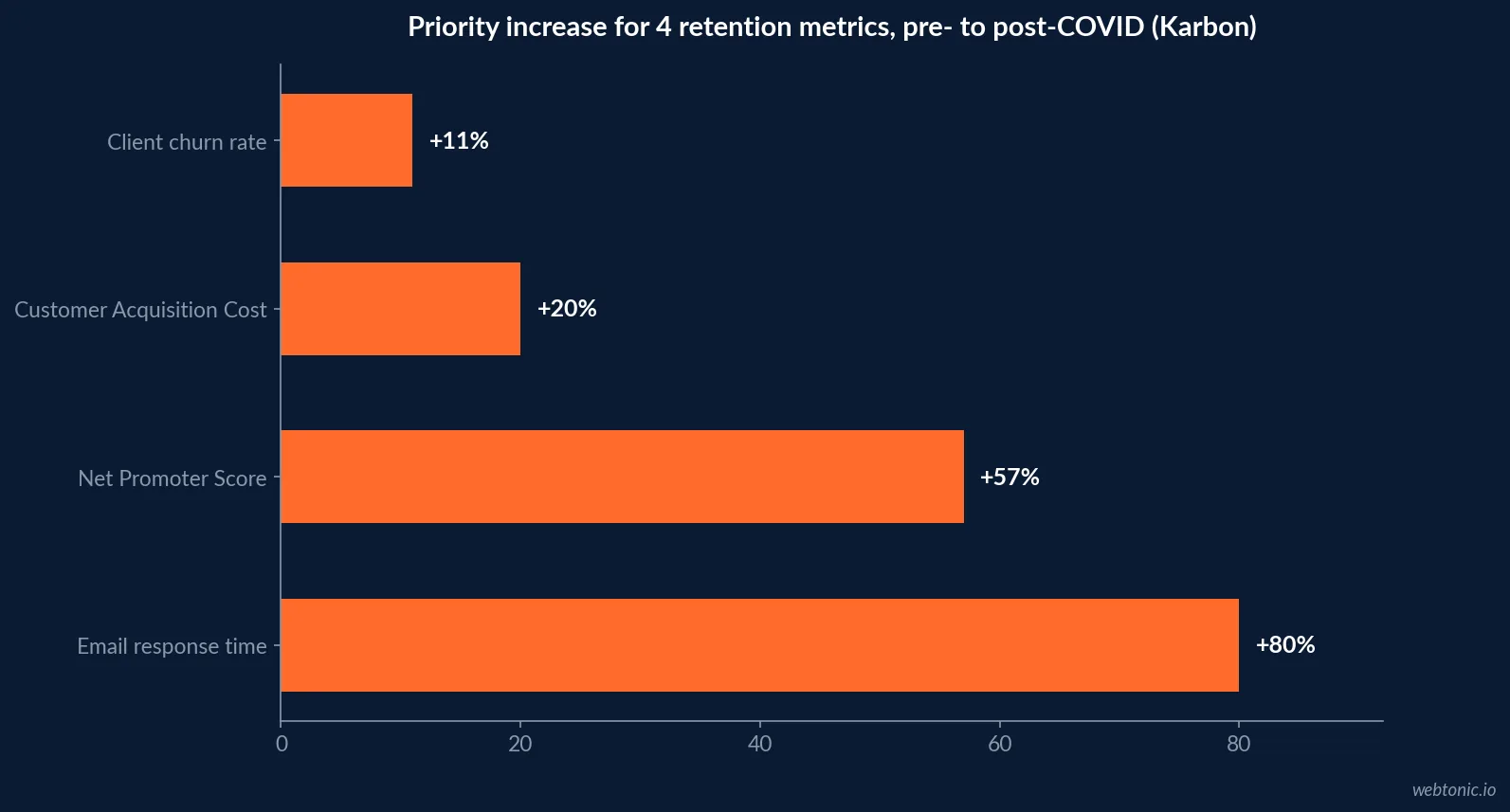
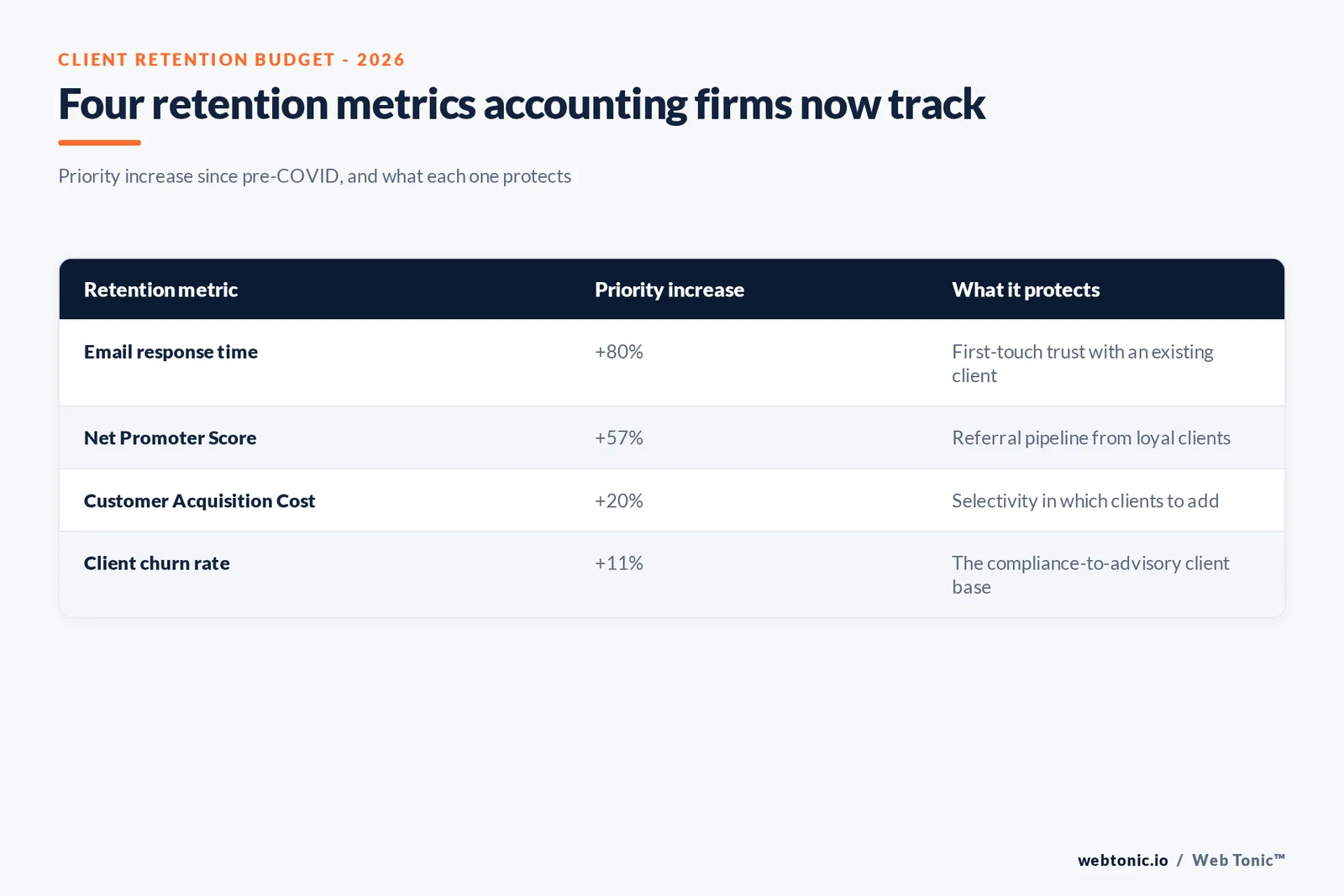
Karbon's Practice Excellence Report, built on multi-year benchmark data across accounting firms, found firms sharply increased how highly they prioritize four specific retention-adjacent metrics. Email response time - a low priority before the pandemic - rose 80% in priority as remote client communication became essential to satisfaction and retention. Net Promoter Score priority rose 57%, as firms began using it as a gauge of client loyalty and referral likelihood. Customer Acquisition Cost tracking rose 20% in priority as firms became more selective about which clients to acquire. Client churn rate, historically monitored but under-emphasized, rose 11% in priority as firms recognized that retaining clients lowers acquisition costs and stabilizes revenue.
| Retention metric | Priority increase, pre- to post-COVID | Why it moved | Source |
|---|---|---|---|
| Email response time | +80% | Remote communication became the default client channel | Karbon |
| Net Promoter Score (NPS) | +57% | Used as a proxy for loyalty and referral likelihood | Karbon |
| Customer Acquisition Cost (CAC) | +20% | Firms became more selective about which clients to add | Karbon |
| Client churn rate | +11% | Recognized as cheaper to prevent than to replace | Karbon |
What clients are actually asking a firm to become
The demand-side data and the pricing-side data point the same direction. Clients want more: 74% strongly want additional financial advice per Thomson Reuters, and Karbon's data shows firms responding by tracking loyalty (NPS +57%) and responsiveness (email response time +80%) far more closely than before. But the same Thomson Reuters report found 50% of professionals cite low-value work as the single biggest barrier to profitability - the retention question is not just keeping a client, it is moving that client's mix of work toward the higher-demand, currently underpriced advisory tier.
Firm succession adds urgency: 51% of respondents say it is likely or highly likely that partners will retire or be promoted in the coming year, and only 49% of firms report an intentional, strategic approach to developing the people who would carry those client relationships forward.
| Client-tenure risk factor (2026) | Figure | Source |
|---|---|---|
| Low-value work cited as top profitability barrier | 50% of respondents | Thomson Reuters |
| Firms expecting partner retirement/promotion within a year | 51% | Thomson Reuters |
| Firms with an intentional talent-development strategy | 49% | Thomson Reuters |
| Firms citing talent constraints as a risk to capability | 40% | Thomson Reuters |
Referrals still dominate, but growth firms lean on them less
Hinge Marketing's 2026 High Growth Study, Accounting & Financial Services Edition, surveying 133 firms representing a combined USD 13.8 billion in revenue, found the industry's median growth rate has fallen from an all-time high of 13% to less than 10% - the lowest point in five years. Referrals remain the No. 1 source of leads for every growth tier, but high-growth firms rely on referrals 34% less than no-growth peers, leaning instead on direct outreach and social visibility. High-growth firms also invest 9.0% of revenue in marketing, nearly double the 5% budget at no-growth firms, and post 37.7% profitability against a 10.0% contraction for the no-growth group.
Read against the Karbon and Thomson Reuters data above, the pattern is consistent: firms that treat retention and referral generation as an instrumented, budgeted program - not a byproduct of good service - are the ones growing fastest and most profitably in 2026.
| Growth tier (Hinge 2026, n=133 firms) | Median growth rate | Marketing spend (% of revenue) | Referral reliance |
|---|---|---|---|
| High-growth | 33.4% | 9.0% | 34% lower than no-growth peers |
| Average-growth | 9.6% | Not isolated | Baseline |
| No-growth | -10.0% | 5.0% | Highest reliance on referrals |
Sizing a 2026 retention-marketing budget from this data
None of the figures above name a fee schedule or a marketing spend amount - they describe survey priorities and margin spreads, which is the honest basis available. The defensible read: with a 4-to-8-point margin gap favoring compliance work over the advisory work clients say they want, and with firms already reporting an 80% jump in how much they prioritize response-time and loyalty metrics, 2026 budget growth should weight toward advisory-client nurture content, NPS-driven referral asks and faster response-time systems rather than pure compliance-client lead generation. Our growth marketing practice and data and analytics practice build that split from a firm's own client mix rather than an industry average.
How this compares with retention data in other lifecycle pages
The advisory-margin gap above is specific to accounting; other recurring-relationship businesses measure the same underlying question differently. See our companion pages on customer retention statistics and customer lifetime value statistics for the cross-industry churn and lifetime-value benchmarks this page applies specifically to tax and accounting firms.
What the succession pressure adds to the retention case
The margin and priority data above assumes the same people keep serving the same clients. That assumption is under real pressure: Thomson Reuters found 51% of respondents expect partner retirement or promotion to reshape firm leadership within the next year, and only 49% report an intentional, strategic approach to developing the staff who would carry those relationships forward. A retention-marketing budget that only targets clients, without a parallel plan for the staff transition behind those relationships, is solving half the problem - a client who loses their point of contact mid-relationship is a churn risk regardless of how well the firm's NPS or email response time scores.
The practical sequence for a 2026 plan: instrument the four Karbon-tracked metrics first, since they are already the ones firms report caring about most; price advisory work closer to its demand rather than its historical hourly rate; and treat the succession risk above as a retention input, not a separate HR problem, since the client relationship and the staff relationship fail together. None of that requires guessing at a number the surveys do not report - the Thomson Reuters and Karbon figures above are specific enough to build a plan around directly.
Frequently Asked Questions
Why should an accounting firm budget separately for client retention marketing?
Because the margin math rewards it. Thomson Reuters' 2026 State of Tax Professionals Report, a survey of 600 tax, audit and accounting professionals, found margins for advisory service work run only 20% to 24%, compared with 28% for individual tax-return preparation - despite 74% of professionals saying their clients strongly want additional financial advice beyond compliance work. Retention marketing is what moves an existing compliance client into that higher-demand, currently underpriced advisory relationship.
What changed in how firms track client retention since the pandemic?
Karbon's Practice Excellence Report, based on multi-year benchmark data from accounting firms, found the priority given to email response time as a retention signal rose 80% from pre-COVID to now, Net Promoter Score priority rose 57%, Customer Acquisition Cost tracking rose 20% in importance, and client churn-rate tracking rose 11% in priority. Firms did not just start caring about retention - they started instrumenting it.
What is actually driving revenue growth at accounting firms right now?
Fee increases and selective client acquisition, not raw volume. Thomson Reuters' 2026 report found the most significant driver of firm revenue change over the past 12 months was fee or rate increases, cited by 23% of respondents, followed by selective new-client acquisition at 22%. Firms have also told prior surveys they want to shed low-margin clients in favor of higher-revenue relationships - a retention strategy aimed at client mix, not client count.
How much do clients actually want from their accountant beyond tax prep?
The demand for more is close to universal. Thomson Reuters found 74% of respondents say their clients strongly want additional financial advice - a core, not occasional, demand. Yet 78% of firms still price primarily by the hour, a model built for compliance work, not for the advisory relationship clients are asking for.
What is the single biggest budget-relevant number for 2026 accounting retention?
The margin spread: 20% to 24% on advisory work against 28% on tax-return preparation, per Thomson Reuters. That 4-to-8-point gap, despite 74% of professionals reporting strong client demand for advisory, is the number that should size how much of a 2026 marketing budget moves from compliance-client acquisition toward advisory-client retention and expansion.
Sources
Thomson Reuters Institute - 2026 State of Tax Professionals Report
Thomson Reuters Institute - 2026 State of Tax Professionals Report (full PDF)
Karbon - Practice Excellence Report, Rising Beyond the Challenge
CPA.com / AICPA PCPS - 2026 Client Advisory Services Benchmark Survey
Hinge Marketing - 2026 High Growth Study, Accounting & Financial Services Edition