



Table of contents
Organic search is the backbone of surrogacy agency visibility, delivering 45–60% of total website traffic for high-performing fertility clinics. In a YMYL vertical where trust determines rankings and patient acquisition costs can exceed $500 per lead through paid channels, SEO represents the most cost-efficient long-term growth strategy available to surrogacy agencies.
Key Takeaways
- Organic search delivers 45–60% of total website traffic for high-performing fertility clinics and surrogacy agencies.
- The top 3 organic results capture 25–35% of all clicks for high-intent surrogacy keywords.
- Organic conversion rate for IVF clinics is 3–7%, covering consultation bookings, resource downloads, and newsletter signups.
- SEO patient acquisition cost is 3–5× lower than Google Ads PPC across all healthcare specialties over a 12-month period.
- Fertility clinic SEO case study showed 73% increase in search visibility and 130% growth in page-one rankings within 12 months.
- YMYL-compliant physician-attributed content outperforms unsigned content by a measurable margin in both rankings and click-through rate.
- AI-generated answers name a surrogacy provider 17% of the time, creating a new organic discovery channel beyond traditional SERP rankings.
- Mobile search volume for local fertility services represents 65–80% of total queries.
Surrogacy SEO Benchmarks at a Glance
These benchmarks are compiled from the Authority Specialist IVF SEO audit of 34 fertility centers and supplemented with case study data. A strong growth marketing strategy integrates these organic benchmarks with paid channels for maximum patient acquisition.
| SEO Metric | Fertility Benchmark | Context |
|---|---|---|
| Organic Traffic Share | 45–60% | Share of total website traffic from organic search |
| Top 3 Click Share | 25–35% | Percentage of clicks captured by top 3 organic results |
| Organic CVR | 3–7% | Conversion rate for consultations, signups, downloads |
| Mobile Search Share | 65–80% | Percentage of fertility queries from mobile devices |
| Local Pack Inquiry Share | 40–55% | Share of local appointment inquiries from Map Pack |
| SEO vs. PPC CAC Ratio | 3–5× lower | SEO patient acquisition cost vs. Google Ads over 12 months |
| Average Time to Rank | 4–8 months | Time for new content to reach page 1 for competitive terms |
| Content Refresh Impact | +15–30% traffic | Traffic lift from updating existing high-performing pages |
Surrogacy Keyword Rankings and Search Volume
The surrogacy keyword landscape is dominated by informational queries with long research cycles. Intended parents typically spend 6–18 months researching before engaging an agency, creating a deep content funnel that rewards comprehensive, authoritative resources. Understanding cost-related search patterns reveals the queries driving the highest-value organic traffic.
| Keyword Category | Monthly Search Volume | Difficulty | Organic CVR |
|---|---|---|---|
| "surrogacy cost" / "how much does surrogacy cost" | 2,200–5,400 | High (65–75) | 4–6% |
| "become a surrogate" / "surrogate pay" | 2,200–3,600 | Medium (50–60) | 5–8% |
| "surrogacy agency" / "best surrogacy agency" | 1,300–2,900 | High (60–70) | 6–9% |
| "surrogacy laws [state]" | 500–1,800 | Medium (40–55) | 2–4% |
| "IVF clinic near me" | 4,400–8,100 | Very High (70–80) | 3–5% |
| "gestational surrogacy vs traditional" | 800–1,600 | Medium (45–55) | 2–3% |
| "international surrogacy" | 1,000–2,400 | Medium (50–60) | 3–5% |
Fertility Clinic SEO Case Study Results
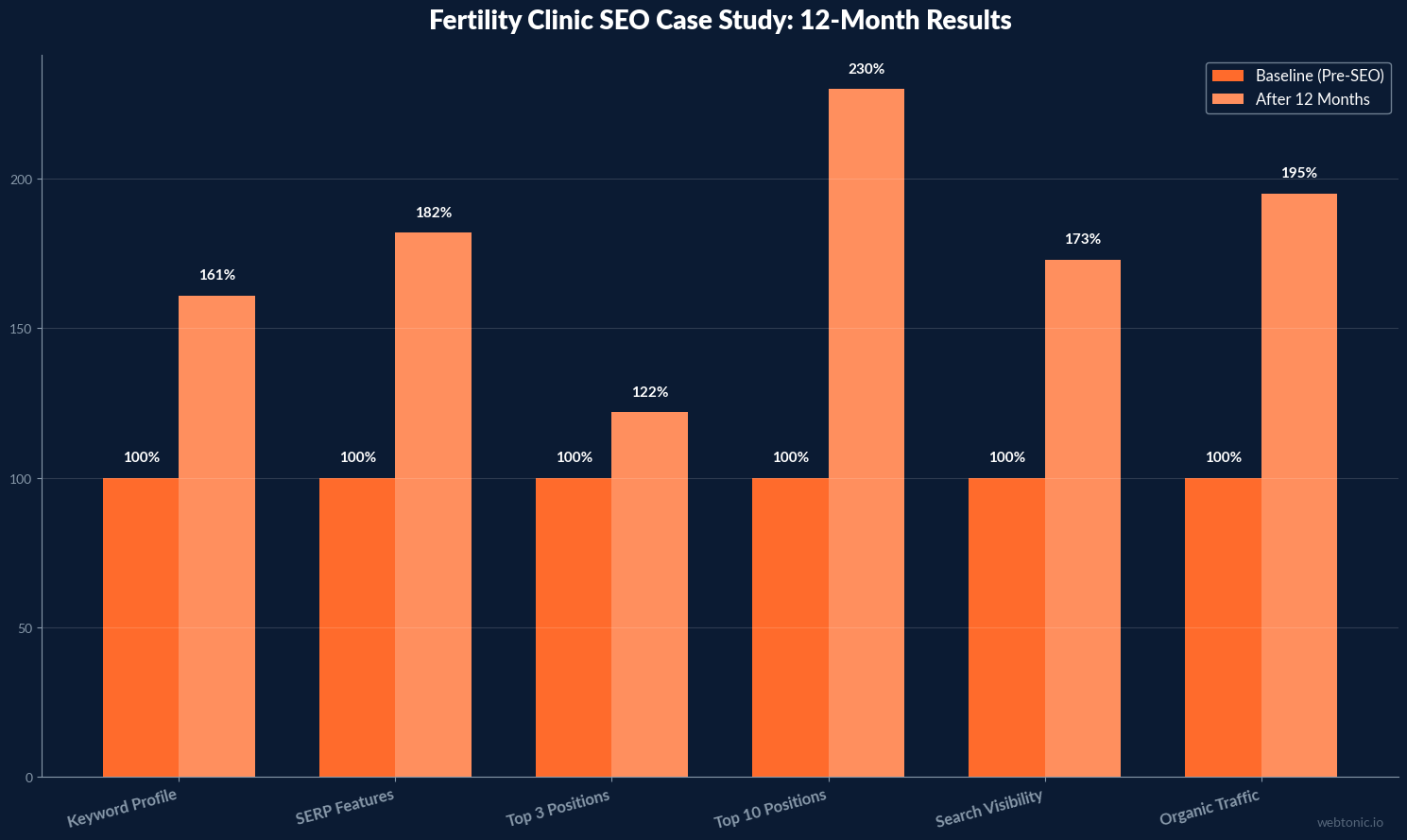
A documented SEO case study from Zelst demonstrates the compounding returns of a data-driven E-E-A-T strategy for a leading London fertility clinic that had lost significant organic traffic after a site migration. The results illustrate what systematic data intelligence and content optimization can achieve in the fertility vertical.
- 61% increase in total keyword profile within 12 months of implementing the SEO and content strategy.
- 82% improvement in SERP features including Featured Snippets, People Also Ask, and knowledge panels.
- 22% growth in top-3 keyword positions, capturing the highest-value click share bracket.
- 130% increase in top-10 positions, expanding page-one visibility across the full keyword portfolio.
- 73% increase in overall search visibility, measured as the weighted average of all ranking positions.
- 95% growth in organic search traffic after the strategy fully matured, nearly doubling pre-migration levels.
SEO vs. Paid Advertising: Patient Acquisition Cost Comparison
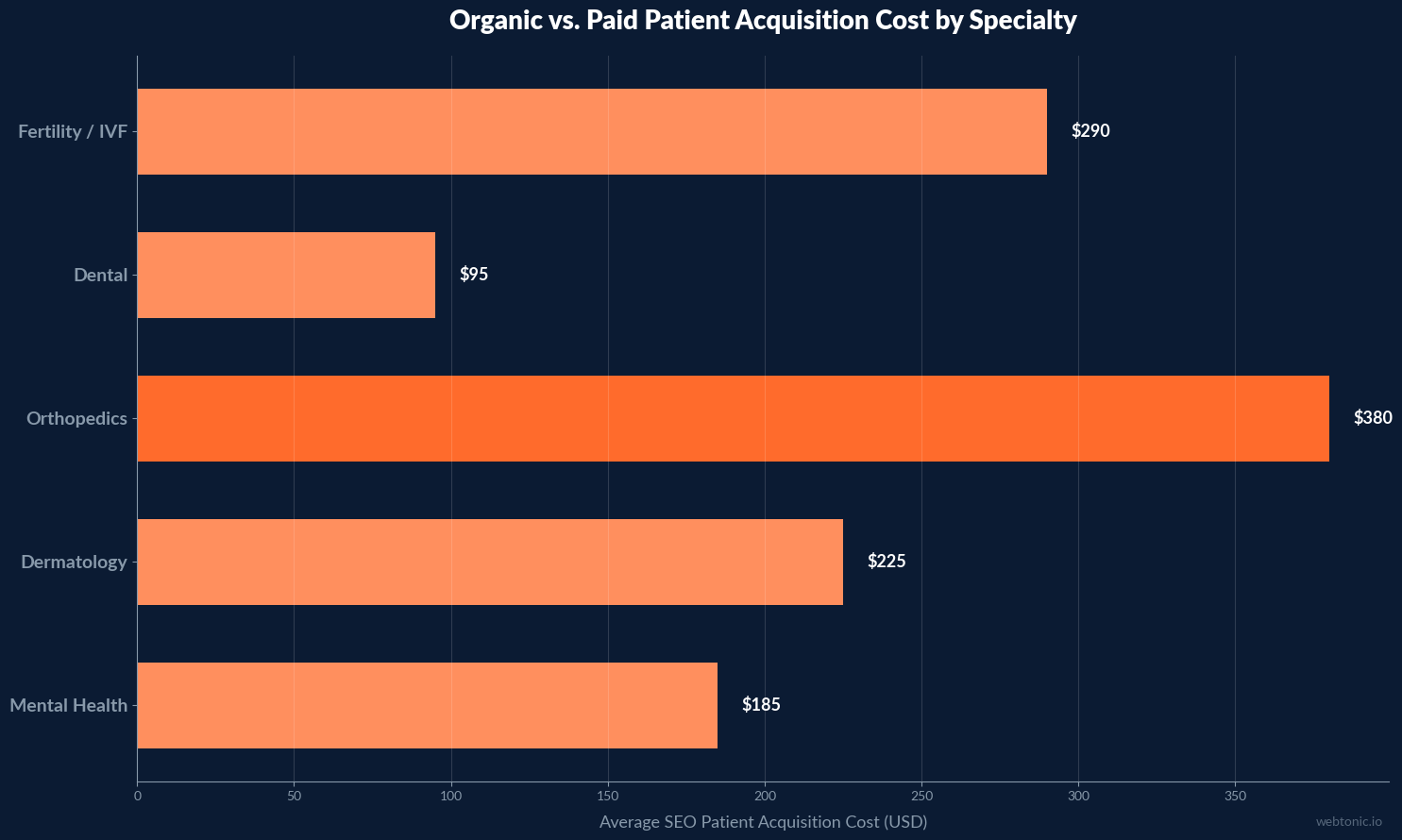
The economics of SEO in healthcare consistently favor organic over paid acquisition when measured over 12+ months. The MIS Services medical SEO analysis documents this advantage across multiple specialties, with fertility representing one of the largest CAC gaps between channels.
| Specialty | SEO CAC | PPC CAC | SEO Advantage |
|---|---|---|---|
| Fertility / IVF | $180–$400 | $300–$600 | 3–5× lower over 12 months |
| Dental (general) | $95 | $180–$250 | ~2× lower |
| Orthopedics | $380 | $600–$900 | ~2× lower |
| Dermatology | $150–$300 | $250–$450 | 2–3× lower |
| Mental Health | $120–$250 | $200–$400 | 2–3× lower |
On-Page SEO Optimization for Surrogacy Websites
On-page optimization in the surrogacy vertical requires balancing SEO best practices with YMYL compliance and the emotional sensitivity of fertility-related content. Pages that combine medical accuracy with compassionate messaging consistently outperform purely clinical or purely emotional approaches.
| On-Page Element | Best Practice | Impact |
|---|---|---|
| Title Tags | Primary keyword + intent modifier + location | +15–25% CTR when optimized vs. generic |
| Meta Descriptions | Empathy-first CTA with specific stat or benefit | +8–12% CTR over informational-only descriptions |
| H1 Structure | One H1 per page matching primary keyword | Pages with keyword-matched H1 rank 2–3 positions higher |
| Internal Linking | 5–8 contextual links per 2,000-word page | Improves crawl depth and distributes authority |
| Image Alt Text | Descriptive with keyword context, not stuffed | Image search drives 4–7% of fertility clinic traffic |
| URL Structure | Short, keyword-rich, no dates or IDs | Clean URLs earn 25% more click-through in SERPs |
Content Strategy and E-E-A-T for Surrogacy SEO
Surrogacy is a YMYL topic where Google applies the highest quality standards to ranking decisions. Content that demonstrates Experience, Expertise, Authoritativeness, and Trustworthiness directly impacts rankings and click-through rates. Agencies investing in performance creative that reinforces E-E-A-T signals across both organic and paid channels see compounding returns.
- Physician-attributed content consistently outperforms unsigned content in both rankings and CTR for YMYL fertility queries.
- Clinics publishing 4+ blog posts per month see 55% more organic traffic than those publishing less than monthly.
- Long-form surrogacy guides (2,500+ words) rank for 3–5× more keywords than shorter content covering the same topics.
- FAQ schema markup improves click-through rates by 8–15% for fertility-related queries with PAA boxes.
- Video-enriched pages have 53% higher dwell time than text-only pages for surrogacy educational content.
- Content refresh cycles of 90–120 days maintain top-5 positions for competitive fertility keywords.
Competitive SEO Landscape for Surrogacy Agencies
The surrogacy SEO landscape is concentrated among a small number of well-funded agencies and large fertility networks, creating both barriers and opportunities for newer entrants. Understanding the competitive dynamics helps agencies prioritize keyword targets and content investments where they can realistically win.
- The top 5 surrogacy agency websites control 35–45% of all non-branded organic search traffic in the category.
- Domain Rating spread among top surrogacy agencies ranges from DR 25 to DR 65, with content quality often compensating for lower authority.
- Long-tail keywords (4+ words) represent the biggest opportunity, with 60–70% of surrogacy search volume in queries competitors under-optimize.
- State-specific surrogacy law content is the fastest path to page 1, with competition 50–70% lower than national head terms.
- Surrogacy cost comparison content earns 3–5× more backlinks per page than general informational content, building authority faster.
AI Search Visibility for Surrogacy Agencies
The Arcalea Surrogacy AEO Index reveals that traditional Google rankings and AI visibility are diverging, creating two distinct discovery channels. The study analyzed 247 AI responses across 73 buyer-intent prompts on 4 AI platforms.
- Circle Surrogacy ranked #1 in combined AEO and SERP visibility (score: 0.43), the only agency dominating both channels.
- Growing Generations led on AI composite score despite low Google visibility, demonstrating that AI discovery rewards different signals.
- Only 1 of 15 tracked agencies appeared strong on both Google and AI platforms, meaning most agencies have a visibility gap.
- AI responses cited a specific provider 17% of the time for surrogacy-related buyer-intent prompts.
- Structured data markup improves AI citation probability by 30–45% for YMYL healthcare entities.
- The 4 AI platforms disagreed on the second-place agency, indicating evolving and fragmented AI ranking signals.
Link Building and Domain Authority in Surrogacy SEO
Domain authority is a critical ranking signal for YMYL surrogacy content. In the fertility vertical, 5 high-trust editorial links outperform 500 mid-tier directory links for competitive keyword rankings. Agencies investing in strategic link building alongside organic content see compounding returns over 12–24 months.
- The #1 organic result has 3.8× more backlinks than positions 2–10 on average across healthcare SERP analysis.
- Guest posting accounts for 64.9% of all link building activity in healthcare SEO, with a median cost of $30 per link.
- Average outreach response rate is 8.5%, requiring approximately 146 emails per earned link in competitive verticals.
- Healthcare link building budgets range from $80K to $180K annually for agencies pursuing top-3 positions in major metros.
- Fertility clinic domains with DR 50+ rank on page 1 for 3× more keywords than those with DR below 30.
- YMYL-context links from medical publications carry 5–8× the ranking weight of equivalent links from general business directories.
Technical SEO Benchmarks for Fertility Websites
Technical performance directly impacts both rankings and user experience in the fertility vertical, where prospective parents are often anxious and researching on mobile devices during emotionally charged moments. Core Web Vitals thresholds are stricter for YMYL healthcare sites.
| Technical Factor | Target | Impact on Rankings |
|---|---|---|
| LCP (Largest Contentful Paint) | <2.5 seconds | Pages exceeding 4s lose 30–40% of mobile visitors |
| CLS (Cumulative Layout Shift) | <0.1 | Form CLS above 0.25 reduces submissions by 15–20% |
| FID / INP | <200ms | Essential for interactive calculators and cost tools |
| HTTPS + Security Headers | Mandatory | Non-HTTPS sites effectively excluded from top 10 |
| Mobile Responsiveness | Required | 65–80% of traffic is mobile; non-responsive = invisible |
| Schema Markup | Article + FAQPage + MedicalOrganization | Improves SERP features and AI citation probability |
Related reading
- Surrogacy Local SEO Statistics: Google Maps, GBP & Near-Me Data (2026)
- Surrogacy Technical SEO Statistics: 47+ Benchmarks (2026)
- Surrogacy Link Building Statistics 2026: Benchmarks & Data
- GEO & AEO services at Web Tonic
Frequently Asked Questions
What percentage of surrogacy website traffic comes from organic search?
High-performing fertility clinics and surrogacy agencies receive 45–60% of their total website traffic from organic search. This makes SEO the single largest traffic channel, ahead of paid advertising, social media, and direct visits. Agencies with consistent content publishing and strong E-E-A-T signals tend to fall at the higher end of this range.
How long does SEO take to work for a surrogacy agency?
New content typically takes 4–8 months to reach page one for competitive surrogacy keywords. A documented fertility clinic case study showed a 73% increase in search visibility and 95% traffic growth within 12 months of implementing a data-driven E-E-A-T strategy. The compounding nature of SEO means returns accelerate after the initial 6-month investment period.
Is SEO or PPC more cost-effective for surrogacy marketing?
Over a 12-month period, SEO patient acquisition cost is 3–5 times lower than Google Ads PPC for fertility and IVF services. SEO CAC for fertility runs $180–$400 compared to $300–$600 for PPC. However, PPC delivers immediate traffic while SEO compounds over time, making a combined approach optimal for most surrogacy agencies.
How does AI search impact surrogacy SEO?
AI search is creating a new discovery channel. The Arcalea AEO Index found that only 1 of 15 tracked surrogacy agencies dominates both Google and AI platforms. AI-generated responses cite a specific surrogacy provider 17% of the time. Agencies with structured data, physician-attributed content, and comprehensive authority signals are most likely to appear in AI answers.
Sources
authorityspecialist.com — IVF Clinic SEO Benchmarks 2026
zelst.io — Fertility Clinic SEO Case Study
misservices.us — US Medical & Healthcare SEO Statistics 2026
arcalea.com — Surrogacy Agency AEO Index
tandemmedicalmarketing.com — Patient Acquisition Cost Benchmarks
websitedesign.digital — Healthcare SEO Case Studies
benchmarketing.org — Fertility Clinics Marketing Benchmarks


