



Table of contents

Link building for surrogacy agencies sits at the intersection of healthcare YMYL compliance and one of the most emotionally sensitive verticals in digital marketing. With the #1 Google result having 3.8× more backlinks than positions 2–10 and Google's own internal documents confirming links remain a core ranking signal, surrogacy agencies that build authoritative backlink profiles gain a compounding organic advantage. Here is the data shaping surrogacy link building in 2026.
Key Takeaways
- The #1 Google result has 3.8× more backlinks than positions #2–#10, making link building one of the strongest ranking signals for surrogacy keywords.
- 64.9% of link builders use guest posting as their primary tactic, though healthcare requires significantly higher quality thresholds than other verticals.
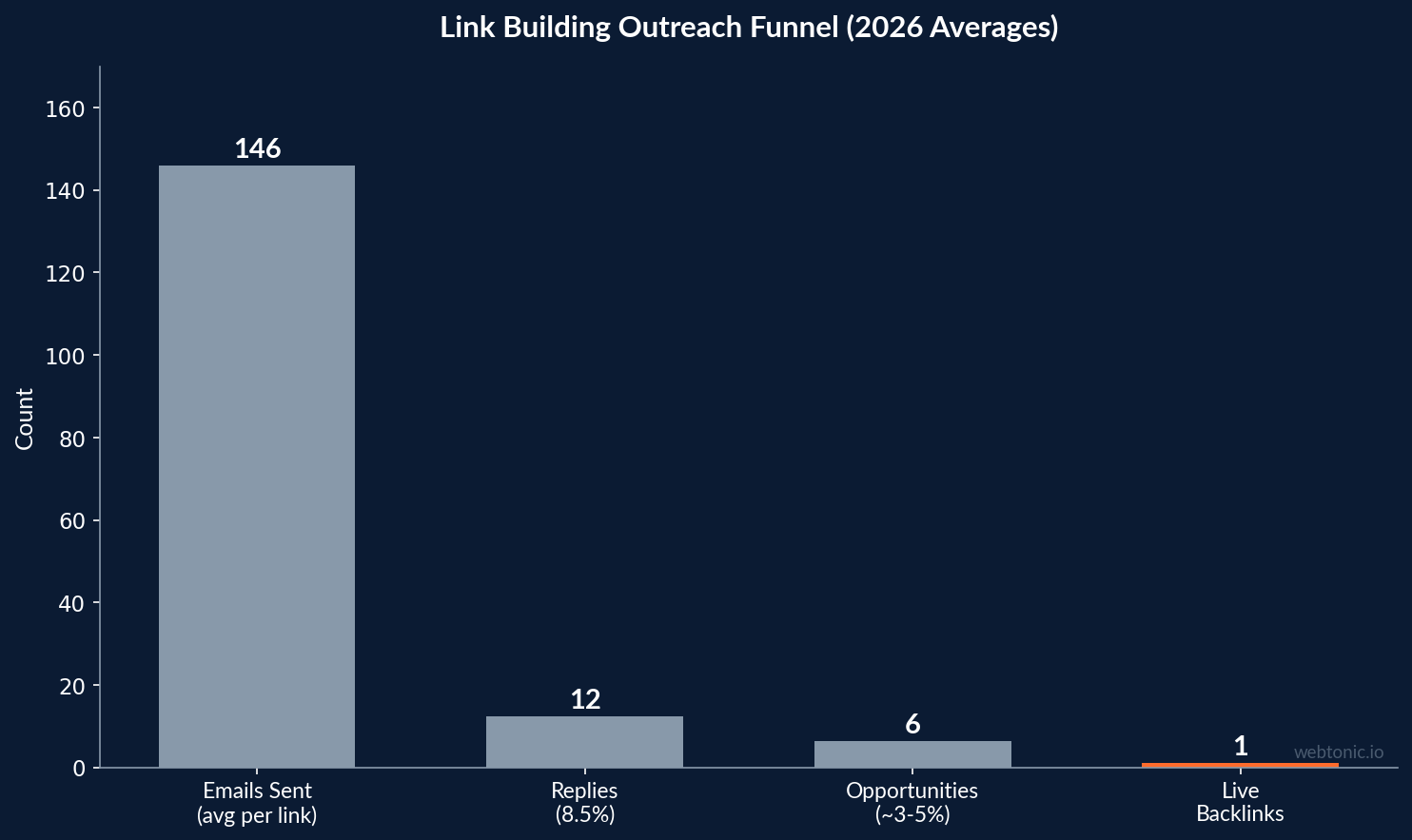
- Only 8.5% of cold outreach emails receive a reply, requiring an average of 146 emails to earn a single backlink through manual outreach.
- Less than 5% of guest post sites meet basic quality thresholds of DR 71+ and 50K+ monthly organic traffic.
- 5 high-trust links outperform 500 mid-tier links for healthcare YMYL sites — volume strategies actively harm surrogacy sites.
- Organic search accounts for 45–60% of total traffic for high-performing fertility clinics.
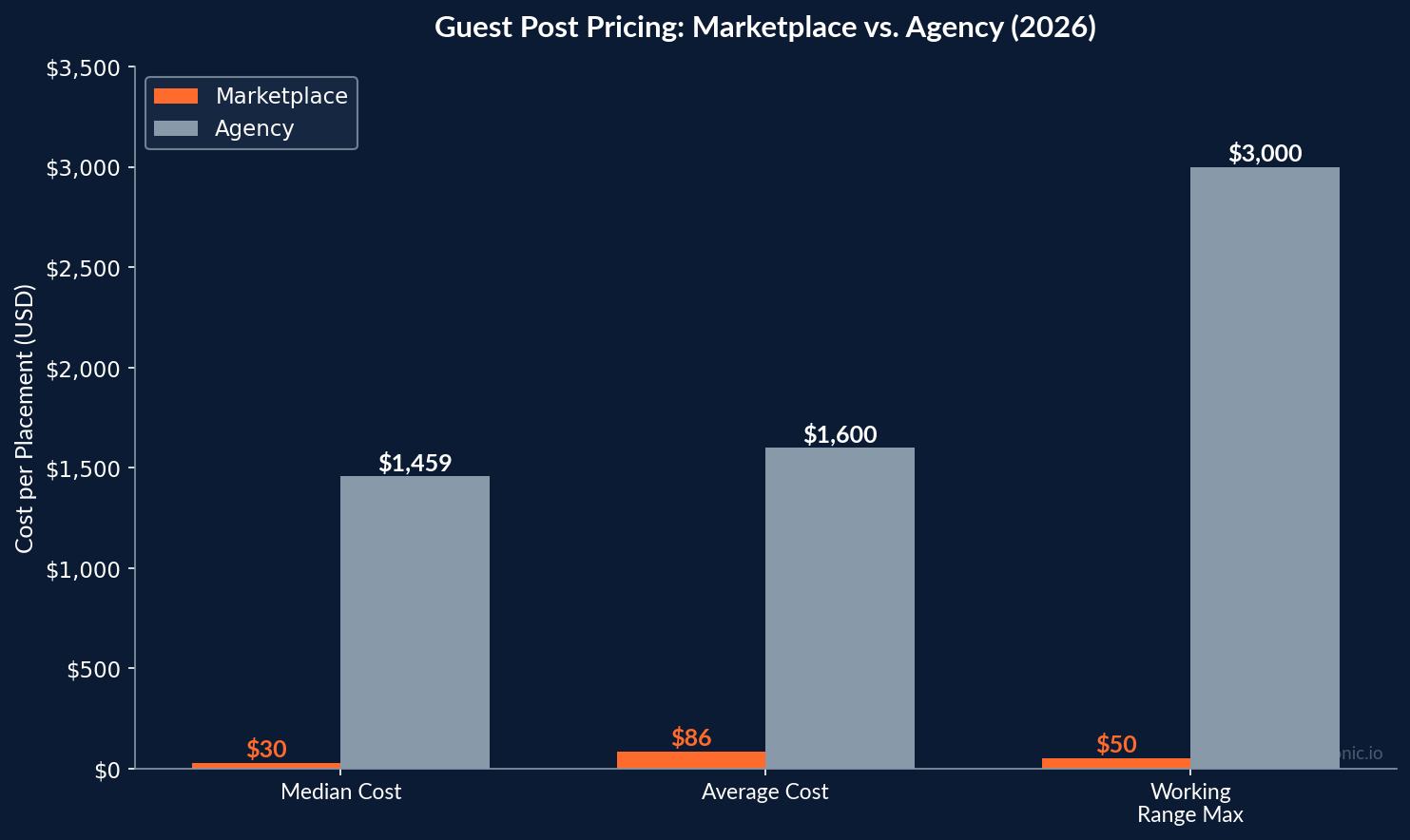
- The median guest post costs $30, but agencies charge an average of $1,459 per placement — a 49× markup over marketplace pricing.
- Healthcare link building budgets range from £80,000–£180,000 per year for mid-sized clinical groups with credentialed in-house teams.
Link Building Benchmarks for Surrogacy SEO
These benchmarks combine general link building data with healthcare-specific YMYL requirements and fertility clinic competitive analysis. For surrogacy agencies investing in organic growth as part of a broader growth marketing strategy, link building is the primary lever for long-term ranking improvement.
| Metric | General SEO | Healthcare / Surrogacy |
|---|---|---|
| #1 result backlink advantage | 3.8× more than #2–#10 | Same — links remain core signal |
| Guest post adoption rate | 64.9% of link builders | High, but quality bar much higher |
| Cold outreach reply rate | 8.5% | Lower for YMYL health topics |
| Emails per backlink (avg) | 146 | 200+ for healthcare placements |
| Quality threshold sites | <5% meet DR 71+/50K traffic | Even fewer in health verticals |
| Median guest post cost | $30 (marketplace) | $86 average, $1,459 via agencies |
| Organic traffic share | 40–55% | 45–60% (top fertility clinics) |
| AI citation rate for providers | — | 17% of AI responses name specific providers |
YMYL and E-E-A-T: Why Healthcare Link Building Is Different
Surrogacy content falls squarely under Google's Your Money or Your Life (YMYL) classification. This means standard link building tactics that work in SaaS, e-commerce, or general business fail in healthcare because they lack source credibility. Google holds medical content to a higher standard of accountability, and link profiles that mimic misinformation patterns are actively suppressed.
- 5 high-trust links are worth more than 500 mid-tier links for healthcare sites. A high volume of low-quality links can trigger a "Helpful Content" suppression because it mimics the pattern of medical misinformation sites (LinqBuilder).
- The context of the link matters more than domain strength — a DR 45 link from a medical journal outweighs a DR 80 link from a lifestyle blog for YMYL content. Google evaluates topical relevance and editorial authority, not just raw domain metrics.
- "Medical-Grade" links are the only currency that moves the needle: links from peer-reviewed publications, professional medical directories, university profiles, and health news sites.
- Every piece of content should have an "Author Bio" and "Reviewed By" section with schema markup linking to the expert's LinkedIn or professional biography — a direct E-E-A-T signal that search engines verify.
- Google is increasingly sensitive to "commercial bias" in healthcare links — if your backlink profile is dominated by sites that also link to unverified treatments or supplement companies, your site risks Helpful Content suppression.
- Medical Review Board members with established digital footprints create the highest-value link opportunities. When credentialed doctors link from their university profiles or practice websites, those links carry both domain authority and E-E-A-T schema signals.
Guest Post Economics and Outreach Data
Guest posting remains the most widely used link building tactic at 64.9% adoption, but the economics vary dramatically between marketplace self-service and agency-managed campaigns. The gap between what marketplaces charge and what agencies charge represents one of the largest markups in digital marketing.
| Cost Metric | Marketplace (Self-Serve) | Agency-Managed | Notes |
|---|---|---|---|
| Median placement cost | $30 | $1,459 | 49× markup for full-service |
| Average placement cost | $86 | $1,200–$2,000 | Includes outreach and content |
| Working price range | $25–$50 (53% of listings) | $500–$3,000+ | Budget vs. premium tiers |
| Cold outreach reply rate | 8.5% | 12–18% (warm relationships) | 146 emails per link on average |
| Quality threshold sites | <5% | Agency-curated network | DR 71+, 50K+ organic traffic |
| Time from outreach to live link | 3–14 days (marketplace) | 2–8 weeks (editorial) | Quality placements take longer |
Guest posts represent 81.6% of marketplace inventory, with link insertions (10.9%), press releases (6.1%), and banner ads (2.4%) making up the rest (Adbassador). For healthcare, HARO (Help A Reporter Out) provides a high-value alternative — expert commentary for health journalists often lands on high-authority news sites like CNN Health or WebMD that carry immense YMYL weight and cannot be purchased through standard outreach. Additionally, 79.7% of SEOs consider link building an important part of their overall strategy, confirming that organic authority building remains a core competitive lever even as search evolves.
Surrogacy Agency Competitive Landscape
The competitive dynamics of surrogacy SEO reveal a sharp divide between agencies investing in organic authority and those relying solely on paid acquisition. Agencies that build link profiles now establish a compounding advantage that paid-only competitors cannot replicate.
- Organic search drives 45–60% of total traffic for high-performing fertility clinics, making SEO the largest single acquisition channel and the most cost-effective on a per-lead basis (Authority Specialist).
- The top 3 organic results for high-intent fertility keywords capture 25–35% of all clicks, meaning ranking improvements from 4th to 3rd position can double organic lead volume.
- Circle Surrogacy is the top-ranked surrogacy agency in AI search, driven by strong entity signals across platforms, answer-first content that AI engines extract easily, and organic mentions across third-party sources (Arcalea AEO Index).
- AI models rarely name specific healthcare providers, doing so in only 17% of responses on average. Agencies with strong backlink profiles and entity signals are far more likely to be cited in AI-generated answers.
- A surrogacy agency SEO case study showed organic traffic doubled within two months through a combination of on-page optimization, programmatic SEO, and white-hat link building (Website Design Digital).
- AI search visibility now impacts 15–25% of top-level informational fertility queries, creating a new competitive dimension where backlink-driven entity authority determines which agencies are referenced in AI results.
Link Building Strategies That Work for Surrogacy
- Claim all professional citations — ensure links from every medical board, fertility association, insurance directory, and professional organization relevant to your services. These are foundational links that competitors often neglect.
- Pursue scholarship link building — offering a scholarship to medical, nursing, or social work students earns high-value .edu links from university financial aid pages that are nearly impossible to replicate through other methods.
- Leverage HARO and journalist requests — provide expert commentary on surrogacy, fertility law, family-building, and reproductive technology topics for health journalists at high-authority news outlets. These editorial links carry maximum YMYL weight.
- Build relationships with Medical Review Boards — credentialed reviewers who link from their university profiles or medical practice sites create high-trust backlinks with schema-supported E-E-A-T signals that Google verifies.
- Create linkable data assets — original research on surrogacy costs by state, success rate comparisons, or regional surrogacy law guides attracts natural editorial links from journalists, researchers, and advocacy organizations.
- Target niche-relevant directories and communities — LGBTQ+ family building resources, intended parent communities, fertility advocacy organizations, and legal directories provide contextually relevant links that signal topical authority.
- Avoid volume-first strategies entirely — 500 mid-tier links risk a Helpful Content suppression, while 5 high-trust medical links produce measurable ranking movement. Quality over quantity is not a platitude in healthcare SEO — it is a strategic imperative backed by data.
- Track AI citation frequency as an emerging link building ROI metric — the agencies appearing in AI-generated search answers are those with the strongest entity signals and third-party mentions.
Measuring Link Building ROI for Surrogacy Agencies
Link building ROI in the surrogacy vertical should be measured across multiple dimensions, not just referral traffic from backlinks. The true value of link building compounds over time through improved organic rankings, increased brand authority, and emerging AI search visibility. Working with data intelligence tools that connect backlink acquisition to organic ranking changes provides the clearest ROI picture.
- Domain Rating (DR) growth — tracks the cumulative authority effect of link acquisition over time and serves as a competitive benchmarking metric against other surrogacy agencies.
- Keyword position changes for target terms — surrogacy cost, agency reviews, and process-related keywords should show movement within 3–6 months of consistent link building activity.
- Organic traffic growth — the surrogacy case study documented a 100% increase in organic traffic within two months of implementing a structured link building strategy alongside on-page optimization.
- AI citation frequency — with AI search impacting 15–25% of top-level fertility queries, tracking whether your agency is named in AI responses (ChatGPT, Claude, Gemini) is an emerging and increasingly important ROI metric.
- Referral traffic quality from backlinks — direct visitors from authoritative health sites signal both link quality and brand awareness. Links from fertility-relevant publications send more qualified traffic than generic high-DR domains.
- Indexed backlink count and velocity — a steady acquisition pace of 2–5 quality links per month signals natural growth to search engines and avoids triggering link spam filters.
What the Data Means for Surrogacy Marketers
The benchmarks and trends covered in this analysis point to a clear direction for surrogacy agencies in 2026. The competitive landscape is intensifying as more agencies enter digital marketing channels, but the fundamental economics remain strongly favorable for well-structured campaigns. Agencies that invest in proper segmentation, measurement infrastructure, and quality execution will continue to see returns that justify premium acquisition costs in this high-LTV vertical.
What the Data Means for Surrogacy Marketers
The benchmarks and trends covered in this analysis point to a clear direction for surrogacy agencies in 2026. The competitive landscape is intensifying as more agencies enter digital marketing channels, but the fundamental economics remain strongly favorable for well-structured campaigns. Agencies that invest in proper segmentation, measurement infrastructure, and quality execution will continue to see returns that justify premium acquisition costs in this high-LTV vertical.
Related reading
- Link Building in the Painting Industry: 2026 Statistics Roundup
- Pest Control Link Building Statistics: Authority & Citation Benchmarks (2026)
- Plumbing Link Building Statistics: Backlink Benchmarks & SEO Authority Data
- Link Building Services services at Web Tonic
FAQ
How many backlinks does a surrogacy agency need to rank on page 1?
There is no fixed number, but data shows the #1 Google result has 3.8× more backlinks than positions #2–#10. For surrogacy keywords, focus on quality over quantity: 5 high-trust medical links outperform 500 mid-tier links. Aim for 2–5 authoritative links per month from healthcare-relevant sources to build sustainable organic authority.
How much does link building cost for a surrogacy agency?
Self-serve marketplace placements start at a median of $30 (average $86), while agency-managed campaigns cost $1,200–$2,000+ per placement. Mid-sized healthcare organizations budget £80,000–£180,000 annually for comprehensive programs. For smaller surrogacy agencies, $2,000–$5,000/month covers a meaningful outreach and content program.
Is guest posting still effective for surrogacy SEO in 2026?
Guest posting remains the most popular link building tactic with 64.9% adoption. However, for healthcare YMYL content, fewer than 5% of guest post sites meet quality thresholds (DR 71+, 50K+ organic traffic). Focus on medical publications, fertility media, and family-building platforms rather than general lifestyle or business blogs.
What types of backlinks are most valuable for surrogacy websites?
Medical-grade links from peer-reviewed publications, professional directories, university profiles, fertility associations, and health news sites carry the most YMYL weight. Links from LGBTQ+ family-building resources and intended parent communities provide contextual relevance. Every piece of content should include author bios and "Reviewed By" sections with schema markup.
How does AI search change link building for surrogacy agencies?
AI models only name specific healthcare providers in 17% of responses. Agencies with strong backlink profiles, entity signals, and third-party mentions are far more likely to be cited in AI-generated answers. Circle Surrogacy leads Arcalea's AEO Index specifically because of its strong organic mentions and answer-first content that AI engines can extract.
Sources
adbassador.com — State of Guest Posting 2026
linqbuilder.com — Healthcare YMYL Link Building Strategies 2026
authorityspecialist.com — IVF Clinic SEO Benchmarks 2026
arcalea.com — Surrogacy Agency AEO Index
websitedesign.digital — Surrogacy Agency SEO Case Study
serpsgrowth.com — Link Building Strategies for Fertility Clinics
tandemmedicalmarketing.com — SEO for Fertility Clinics
linkbuildingjournal.co.uk — Link Building for Health & Medical Sites


