Table of contents
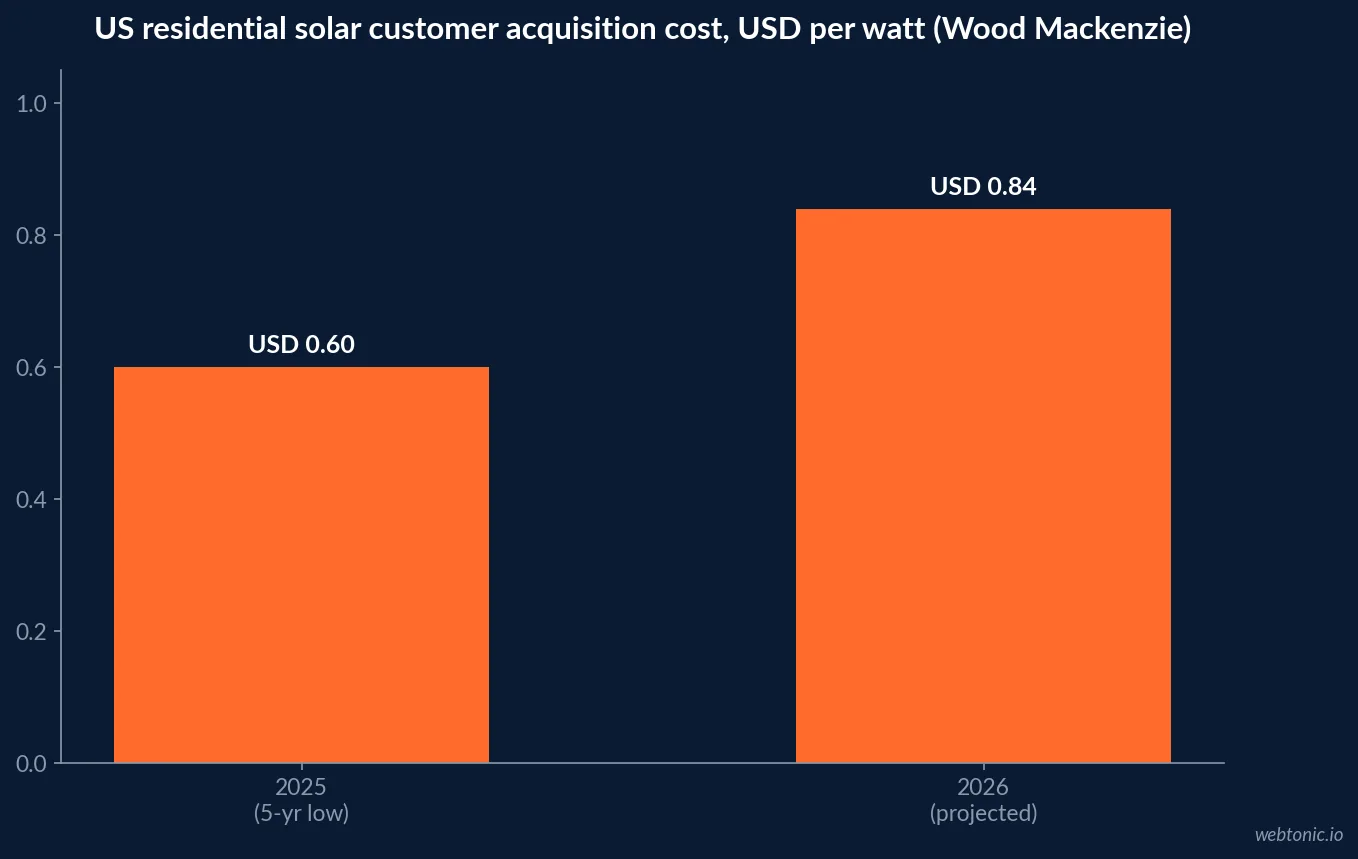
Residential solar customer acquisition costs are projected to jump 40% to USD 0.84 per watt in 2026, according to Wood Mackenzie's latest outlook - a cost backdrop that puts more weight on the post-install relationship, around referrals, monitoring and upsells instead of treating the installation as the end of the sale.
Key Takeaways
- Residential solar CAC is projected to rise 40% to USD 0.84/W in 2026.
- CAC had fallen to a five-year low of USD 0.60/W in 2025.
- The residential solar market is expected to contract 19% after the ITC sunset.
- Community solar acquisition costs fell 12% to USD 69/kW in 2025 - the opposite trend.
- A typical solar referral costs an installer about USD 500, per SEIA.
- Generous referral fees reach USD 1,000 at the high end.
- Other-channel acquisition runs USD 2,000 to USD 4,000 per customer.
- EnergySage saw a 205% year-over-year jump in active installer engagements, H2 2025.
- Most installers reached annual capacity by October 2025, per EnergySage.
- Solar system prices rose just 0.4% to USD 2.49/W despite the demand surge.
- Storage prices rose 3.6% to USD 1,074/kWh in the same period.
- Installers are shifting from one-time sales to CLV-based models, per Wood Mackenzie.
- CLV investment raises near-term CAC before paying off after 2027.
- Panel wattage mix shifted as availability outweighed preference during the 2025 rush.
- Solar panels post an average Net Promoter Score of 63 among adopters, per NREL.
- Solar installers post a lower average NPS of 52 - a 9-point recommendation gap.
| Metric (2025-2026) | Figure | Source |
|---|---|---|
| Residential solar CAC, 2025 | USD 0.60/W (5-year low) | Wood Mackenzie |
| Residential solar CAC, 2026 projection | USD 0.84/W (+40%) | Wood Mackenzie |
| Residential market size change, 2026 | -19% (post-ITC sunset) | Wood Mackenzie |
| Community solar CAC, 2025 | USD 69/kW (-12%) | Wood Mackenzie |
| Typical referral fee | ~USD 500 (up to USD 1,000) | SEIA |
| Other-channel acquisition cost | USD 2,000-4,000 per customer | SEIA |
| YoY increase in active installer engagements, H2 2025 | 205% | EnergySage |
Why 2026 forces the lifecycle question
Wood Mackenzie's US Distributed Solar Customer Acquisition Cost Outlook 2026 found residential solar CAC reached a five-year low of USD 0.60 per watt in 2025, an anomaly caused by the looming expiration of the Section 25D investment tax credit pulling demand forward. That relief is reversing: Wood Mackenzie projects CAC will surge 40% to USD 0.84 per watt in 2026 as the residential market contracts 19% and installers compete more aggressively for a shrinking customer pool. Community solar is the exception - subscriber acquisition costs fell 12% to USD 69 per kilowatt in 2025 as that segment matured, a reminder that not every solar business model faces the same 2026 cost curve.
The demand surge that created today's post-install cohort
The 22nd EnergySage Intel: Home Electrification Marketplace Report, which analyzes millions of transaction-level data points from homeowners shopping on EnergySage between July and December 2025, found a 205% year-over-year increase in homeowners actively working with installers, with most installers reaching annual capacity by October 2025 as buyers rushed to beat the federal tax credit deadline. Even under that demand surge, solar prices rose just 0.4% to USD 2.49 per watt and storage prices rose 3.6% to USD 1,074 per kWh - EnergySage attributes the restraint to marketplace price transparency. Equipment mix shifted too: the previously dominant 450-460 W panel range fell from 33% to 26% of quotes as installers prioritized available inventory.
That surge means an unusually large number of households entered the post-install relationship in the second half of 2025 at once - a concentrated cohort for monitoring, referral and upsell outreach timed to their first service anniversary.
| H2 2025 marketplace shift (EnergySage, 22nd edition) | Figure |
|---|---|
| YoY increase in active installer engagements | +205% |
| Installers at annual capacity by | October 2025 |
| Solar price change | +0.4% to USD 2.49/W |
| Storage price change | +3.6% to USD 1,074/kWh |
| 450-460W panel share of quotes | 33% -> 26% |
| Leading panel brand share (REC) | 43% -> 20% |
Referrals: the cheapest acquisition channel installers under-use
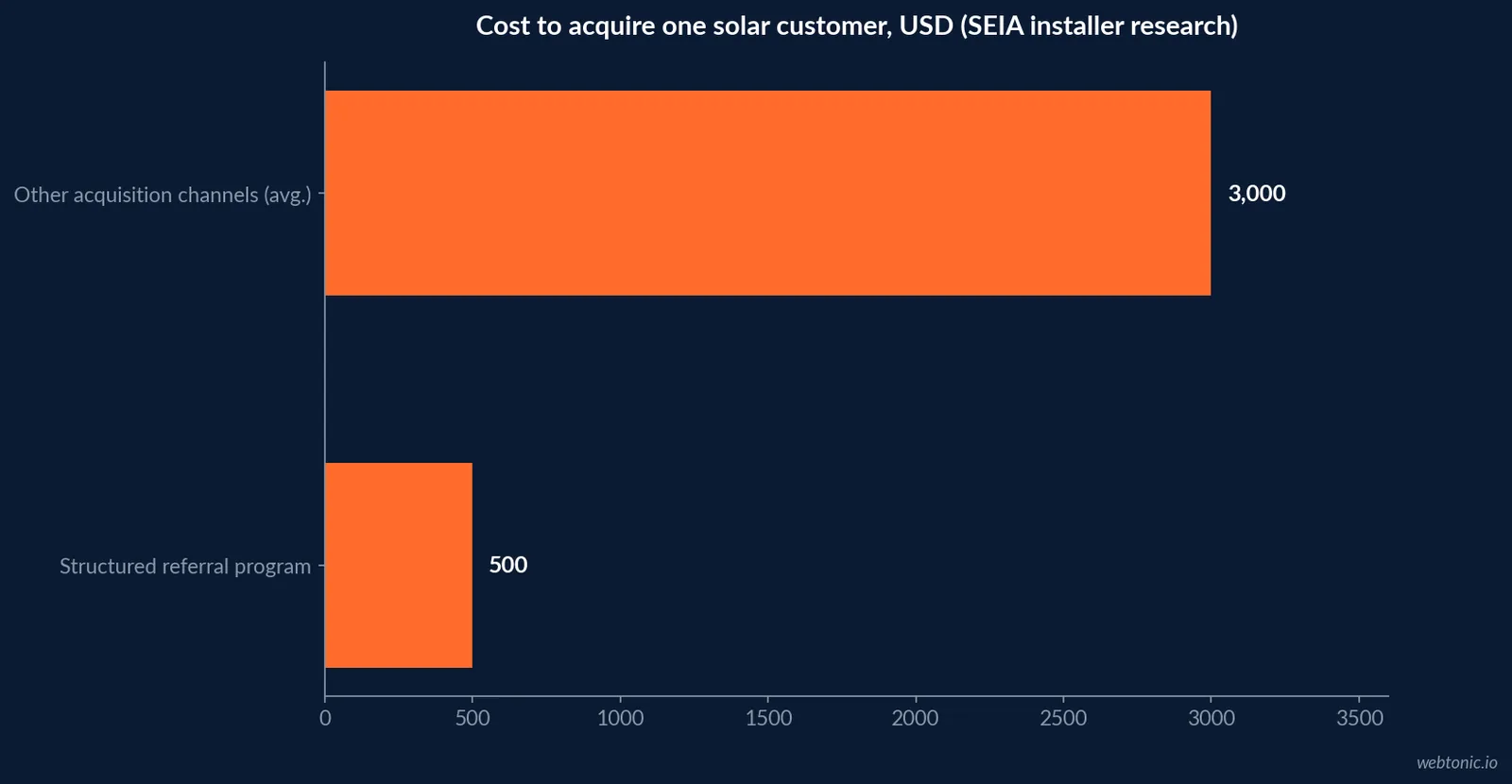
SEIA's own installer-facing research puts a typical solar referral fee at about USD 500 - give or take a few hundred dollars - with generous programs reaching USD 1,000. Compare that against an average customer acquisition cost of USD 2,000 to USD 4,000 through other channels, and even a generous referral fee is a fraction of the alternative. SEIA's diagnosis of why referrals still under-perform is not the fee, it is execution: many sales reps either do not ask for referrals or ask so passively - "let me know if you hear of anyone" - that it produces nothing. SEIA also flags losing contact with past customers as a second, related mistake, since a past customer is one of an installer's best marketing resources if the relationship is maintained.
Why installers, not just panels, need the loyalty work
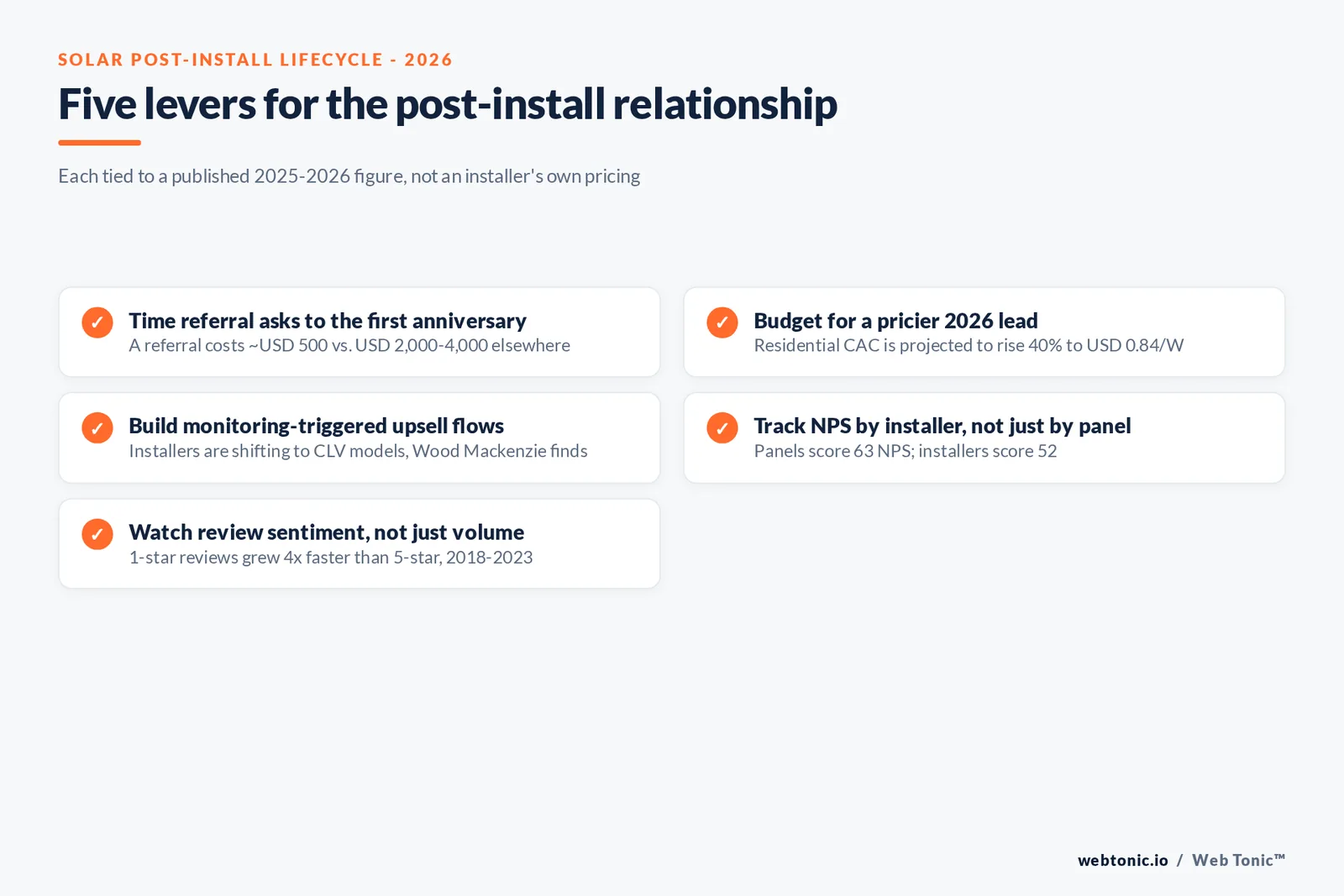
A National Renewable Energy Laboratory-funded study - a USD 2.3 million research effort surveying 1,662 solar adopters, summarized by the National Laboratory research hub - ran a Net Promoter Score analysis and found the average NPS for solar panels is 63, against 52 for solar installers. Both scores are well above the 50-point threshold widely considered excellent, but the 9-point gap means customers are more willing to recommend the technology than the specific company that installed it - the referral program has to earn that gap back, not assume it away.
Separately, SolarReviews' own analysis of more than 35,000 consumer reviews submitted between 2018 and 2023 found satisfaction skewing positive overall, but also an over 1,000% increase in 1-star reviews against a 260% increase in 5-star reviews across the same period - a widening spread that makes review monitoring, not just review collection, part of the post-install lifecycle job.
The shift from one-time sale to customer lifetime value
Wood Mackenzie's research frames the strategic response directly: in the post-25D environment, forward-thinking installers are abandoning the traditional one-time, solar-only sales model in favor of customer lifetime value (CLV) approaches - building multi-product ecosystems designed to generate referrals, storage upsells and repeat purchases at acquisition costs lower than cold lead generation. Wood Mackenzie is candid that this shift adds to near-term acquisition costs as installers invest in engagement platforms and referral engines, with the payoff arriving after 2027 once those systems mature. The same shift favors vertically integrated installers with in-house sales teams, who own the customer relationship and data and can amortize acquisition costs across multiple products rather than depending on purchased leads.
| Post-install lifecycle lever | What it does | Timing per Wood Mackenzie / SEIA |
|---|---|---|
| Monitoring-app engagement | Keeps the account visible for upsell and referral timing | Ongoing, from day one post-install |
| Storage / battery upsell | Extends revenue per customer beyond the original install | Where CLV models are being built now |
| Structured referral ask | Converts a satisfied customer into new-lead flow at ~USD 500 vs. USD 2,000-4,000 | Immediately actionable, per SEIA |
| Past-customer contact cadence | Prevents losing the installer's cheapest lead source | Ongoing; SEIA flags its absence as a common mistake |
| Vertically integrated sales/service | Owns the data needed to run the above at scale | Structural shift underway per Wood Mackenzie |
Where this differs from a pre-install acquisition page
Everything above describes what happens after the panels go on the roof - referrals, monitoring, storage upsells and the CLV model installers are building around them. It deliberately does not repeat the pre-install CAC-per-watt story on its own; that figure appears here only as the reason the post-install relationship now carries more marketing weight than it used to.
Sizing a post-install marketing line for 2026
None of the sources above price a specific marketing program - they describe acquisition-cost trends and referral economics industry-wide. The defensible read: with other-channel acquisition projected at USD 0.84/W in 2026 against a roughly USD 500 referral cost, a 2026 budget should weight meaningfully toward monitoring-triggered referral asks and storage upsell campaigns for the large H2 2025 install cohort, rather than funding new-lead acquisition alone. Our growth marketing practice and data and analytics practice build that split from an installer's own install-date and monitoring data rather than an industry average.
How this fits the broader lifecycle picture
Solar's post-install lifecycle is unusually concentrated around one moment - the tax-credit-driven installation surge of H2 2025 - rather than spread evenly across a customer base. For the general cross-industry churn and loyalty benchmarks this page applies specifically to solar, see our companion pages on customer retention statistics and loyalty program statistics.
| Solar acquisition channel | Approx. cost per customer | Source |
|---|---|---|
| Structured referral program | ~USD 500 (up to USD 1,000) | SEIA |
| Other paid channels (installer-reported average) | USD 2,000-4,000 per customer | SEIA |
| Community solar subscriber acquisition | USD 69/kW (-12% YoY) | Wood Mackenzie |
What the equipment-mix shift signals about 2026 planning
The panel-brand fragmentation EnergySage documented in H2 2025 - the leading brand's share falling from 43% to 20% as installers diversified for availability - is itself a lifecycle signal. A homeowner whose system uses less-established equipment has a stronger reason to value an installer's own post-install support and warranty service over a generic manufacturer relationship, which raises the stakes on the installer-specific NPS gap noted above. Post-install communication that reinforces who backs the system, not just how it performs, is doing retention work that the equipment brand itself cannot.
Every figure in this page traces to an installer research body, a marketplace operator or a federal laboratory study rather than an anonymized "industry average," which is the level of sourcing a 2026 post-install budget decision should demand before it gets built around a single acquisition-cost number.
Frequently Asked Questions
Why does solar's post-install lifecycle matter more in 2026 than before?
Because acquisition just got structurally more expensive. Wood Mackenzie's US Distributed Solar Customer Acquisition Cost Outlook 2026 projects residential solar customer acquisition costs will surge 40% to USD 0.84 per watt in 2026, after falling to a five-year low of USD 0.60/W in 2025, driven by the Section 25D federal tax credit expiration and a market Wood Mackenzie expects to contract 19%. Every dollar spent keeping an installed customer engaged now competes against a materially pricier new-customer dollar.
What is a solar referral actually worth to an installer?
Cheap relative to the alternative, and under-used. SEIA's own installer-facing research puts typical referral fees at around USD 500 per referral - occasionally up to USD 1,000 - against an average customer acquisition cost of USD 2,000 to USD 4,000 for other channels. The gap is not the referral fee; SEIA's finding is that too few sales reps ask for referrals seriously enough to generate them at scale.
Are installers changing their business model around this?
Yes - toward customer lifetime value. Wood Mackenzie reports that in the post-25D environment, forward-thinking installers are abandoning the one-time, solar-only sales model in favor of CLV approaches: building multi-product ecosystems designed to generate referrals, storage upsells and repeat purchases at a lower acquisition cost than cold lead generation, even though those systems add to near-term acquisition costs before they pay off after 2027.
What does the demand environment look like heading into the post-install relationship?
Unusually compressed. EnergySage's 22nd Home Electrification Marketplace Report found a 205% year-over-year increase in homeowners actively working with installers in H2 2025, driven by the rush to beat the federal tax credit deadline, with most installers reaching annual capacity by October 2025. That surge means a large cohort of newly installed customers is entering the post-install lifecycle stage at the same time - a concentrated opportunity for coordinated monitoring and referral outreach.
Is there a cheaper acquisition model anywhere in solar right now?
Community solar, which is moving the opposite direction from residential. Wood Mackenzie found community solar subscriber acquisition costs fell 12% in 2025 to an average of USD 69 per kilowatt, as developers refined acquisition strategies and the segment matured - a reminder that acquisition-cost trends are not uniform across every solar business model.
Sources
Wood Mackenzie - US residential solar customer acquisition costs set to spike 40% in 2026
EnergySage - 22nd Home Electrification Marketplace Report
SEIA - Seven common mistakes that keep solar customers away
National Laboratory research hub - How to improve the solar customer experience and get more referrals (NREL/SunShot study)
SolarReviews - Rooftop solar industry timeline, concerns and data (35,000+ reviews, 2018-2023)