



Table of contents
No study publishes an organic CPL, CTR or conversion rate for solar installers. This page gives the numbers that do exist, each labelled: market volumes from SEIA, scale from Sunrun's filings, price data from EnergySage, and paid search CPL and conversion rates as the only priced comparators.
Key Takeaways
- US residential solar installed 1,179 MWdc in Q1 2026, up 6% year on year (SEIA).
- Total US solar installs fell 27% year on year to 7.8 GWdc in Q1 2026.
- Solar and storage made up 91% of new US generating capacity in Q1 2026.
- Sunrun reported 1,165,686 customers at the end of 2025.
- Its subscribers grew 12% to 997,280.
- EnergySage's median quoted price was USD 2.49/W in H2 2025, up just 0.4%.
- Paid Home and Home Improvement leads averaged USD 90.92 (WordStream 2025).
- 25.4% of Utilities-sector searches triggered an AI Overview (Conductor).
- No public study reports an organic solar CPL, CTR or conversion rate.
Solar enterprise SEO benchmarks at a glance
| Benchmark | Value | Label | Source |
|---|---|---|---|
| Organic CPL, solar | Not published | Gap | No study found |
| Organic CTR, solar | Not published | Gap | No study found |
| Paid CPL, Home and Home Improvement | USD 90.92 | Paid proxy | WordStream 2025 |
| Paid conversion rate, same category | 7.33% | Paid proxy | WordStream 2025 |
| Paid CTR, same category | 6.37% | Paid proxy | WordStream 2025 |
| Position 1 CTR change with AI Overview | -58% | Organic, cross-industry | Ahrefs, Dec 2025 data |
| AI Overview rate, Utilities sector | 25.4% | Sector proxy | Conductor 2026 |
A contracting market with fewer, bigger players
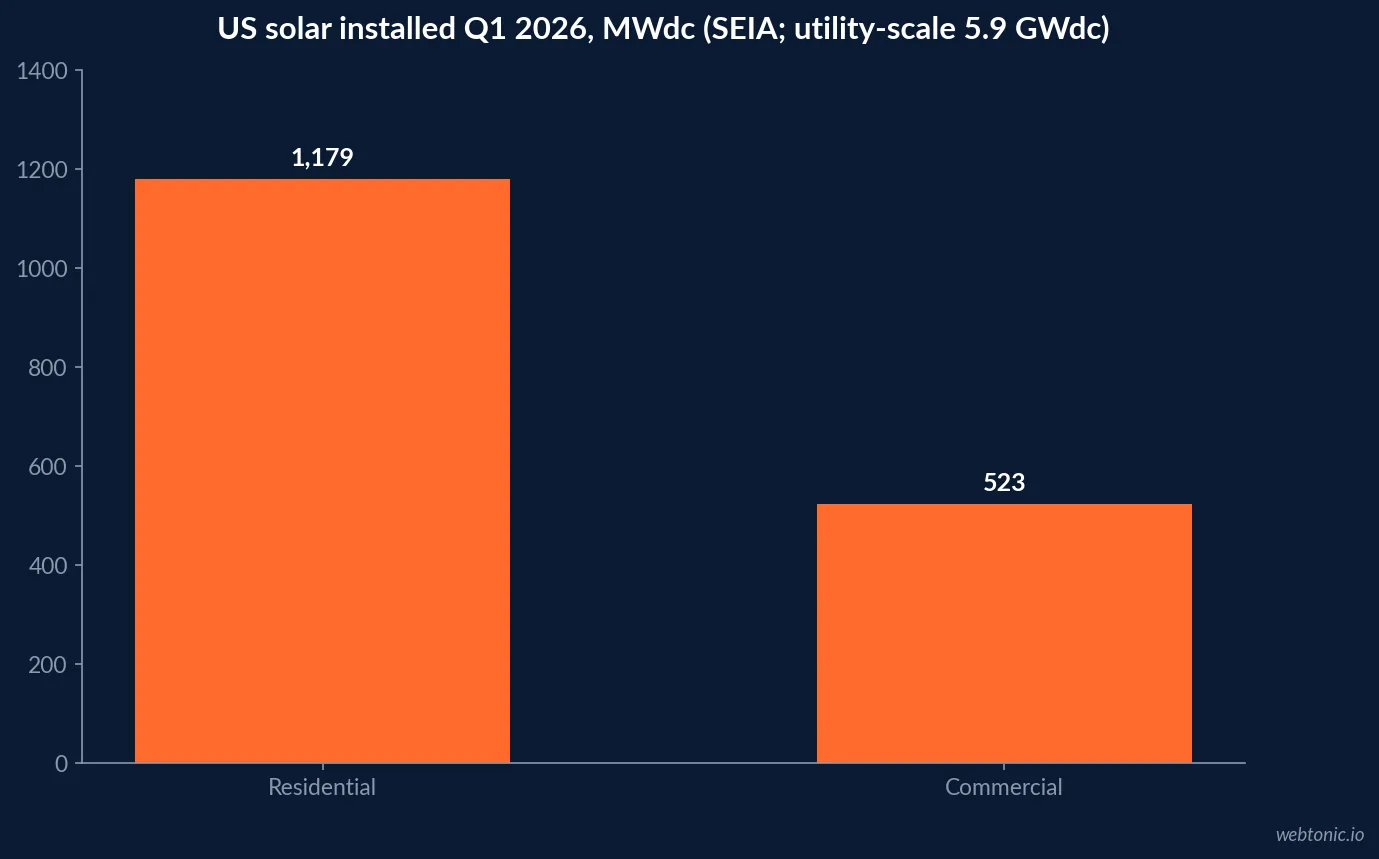
The SEIA and Wood Mackenzie Solar Market Insight Q2 2026 report shows a market in transition. The US installed 7.8 GWdc in Q1 2026, down 27% year on year and 42% from Q4 2025. Residential held up better at 1,179 MWdc, up 6% year on year but down 15% quarter on quarter, buoyed by installs started before the Section 25D credit expired.
The report also cites "the bankruptcy of the second largest national installer" and constraints in tax equity, and it expects a residential contraction in 2026 before growth of about 6% a year from 2027 to 2031. For search, that means brand exits, acquisitions and orphaned domains: the classic enterprise SEO problems.
| SEIA segment, Q1 2026 | Installed | Year on year | Quarter on quarter |
|---|---|---|---|
| Residential | 1,179 MWdc | +6% | -15% |
| Commercial | 523 MWdc | -4% | -25% |
| Utility-scale | 5.9 GWdc | -34% | -45% |
| All segments | 7.8 GWdc | -27% | -42% |
What national scale looks like: Sunrun
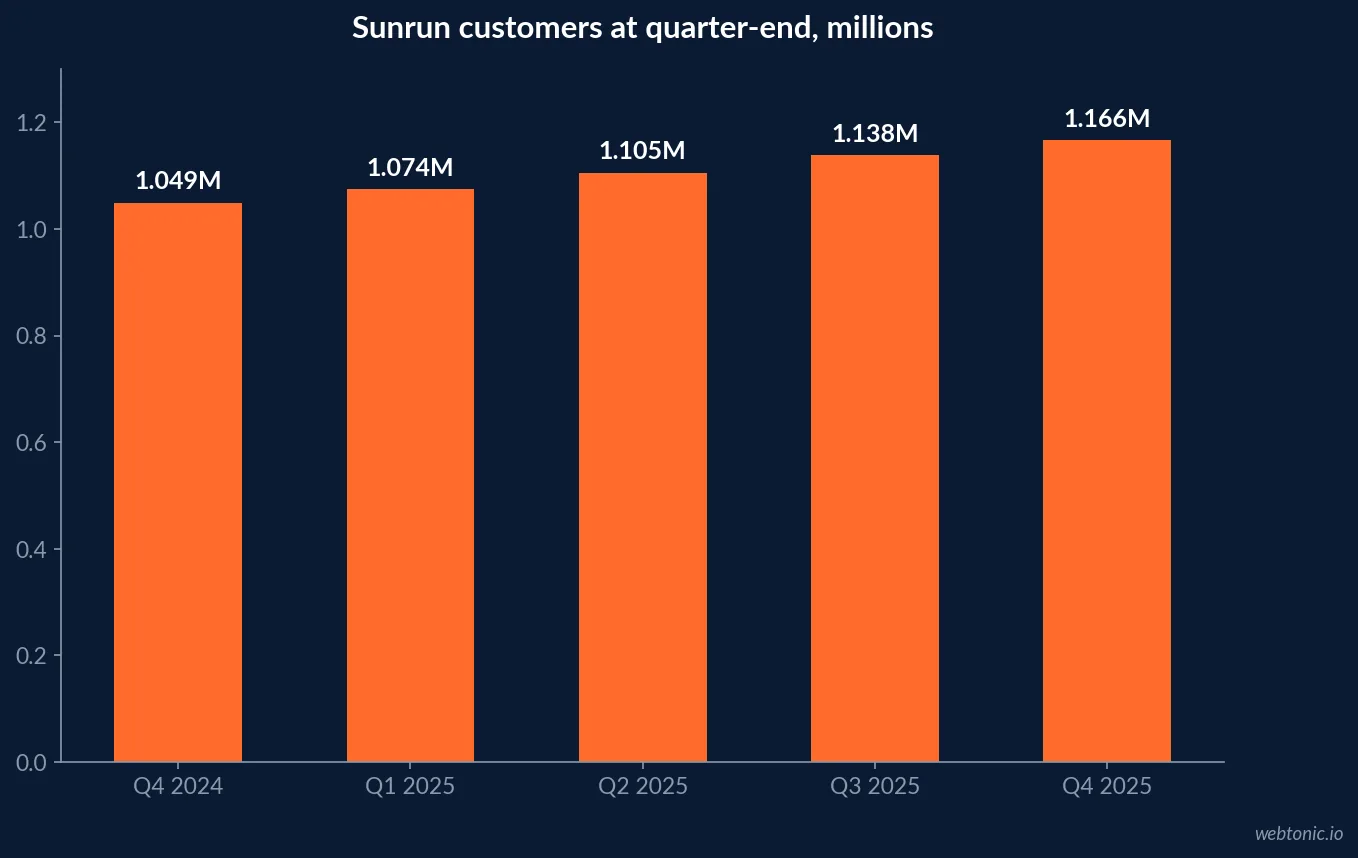
Sunrun's fourth-quarter 2025 results give the clearest public view of an enterprise residential brand. It reported 1,165,686 customers and 997,280 subscribers at December 31, 2025, with subscribers up 12% on a year earlier. Fourth-quarter subscriber additions were 25,475, down 17%.
Sunrun does not disclose search metrics. What its numbers show is that a national brand's SEO job is mostly about demand it already owns: branded search, service and monitoring queries from existing customers, and local pages in every state it sells in.
| Sunrun quarter-end | Customers | Subscribers |
|---|---|---|
| Q4 2024 | 1,048,842 | 889,186 |
| Q1 2025 | 1,074,270 | 912,878 |
| Q2 2025 | 1,105,080 | 941,701 |
| Q3 2025 | 1,137,913 | 971,805 |
| Q4 2025 | 1,165,686 | 997,280 |
Price data is the content searchers want
Solar buyers search for cost. EnergySage's H2 2025 marketplace data shows median quoted prices rose just 0.4% to USD 2.49/W, touched an all-time low of USD 2.47/W in Q3 and ticked up to USD 2.50/W in Q4. The spread between high and low quotes widened from USD 0.58/W to USD 0.72/W, about USD 8,500 on an average-sized system.
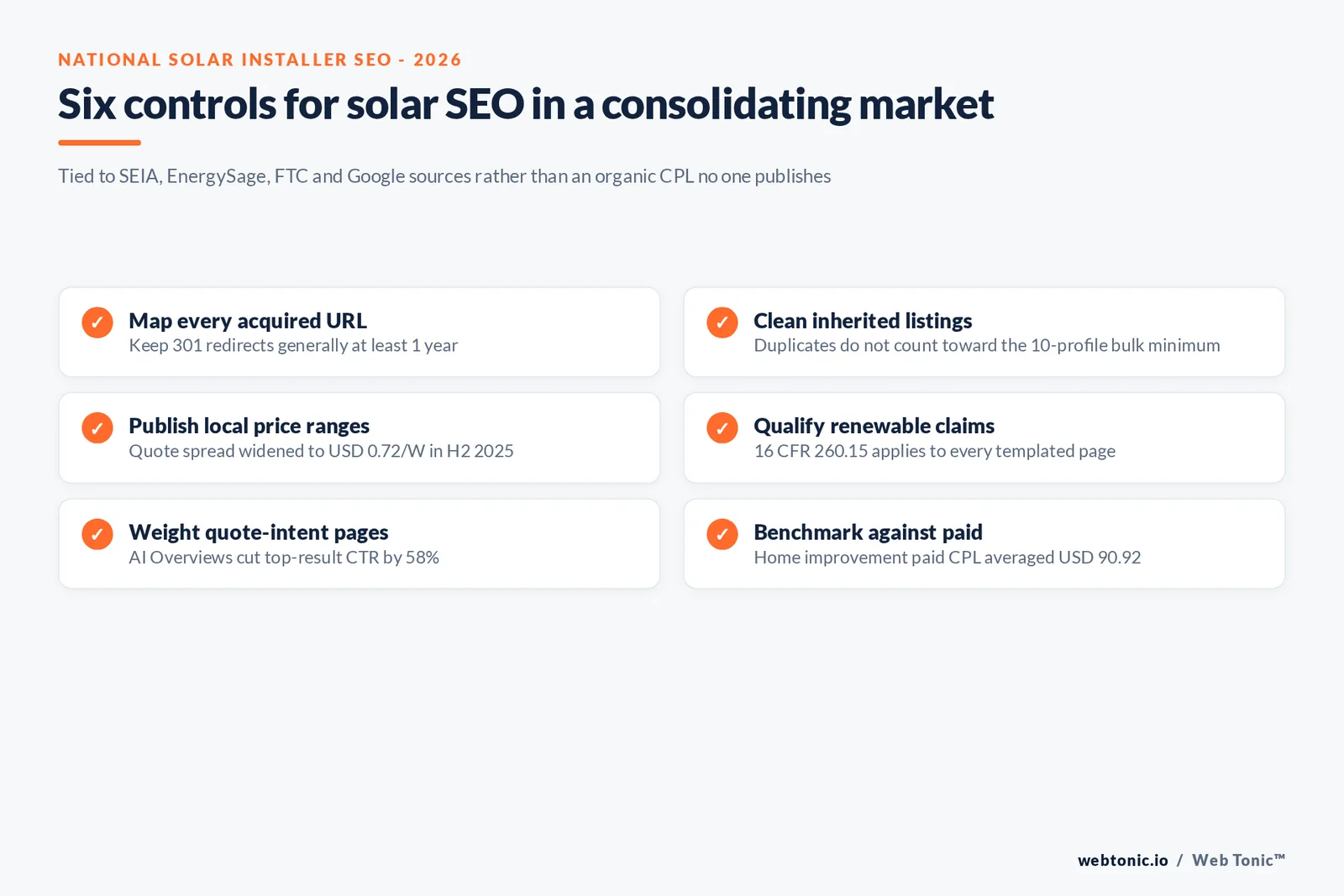
An installer with thousands of state and city pages can publish its own local price ranges and financing terms. That is the kind of specific, first-party fact that separates a real location page from a template and that AI answers quote.
| EnergySage price point | Value | Period |
|---|---|---|
| Median quoted price | USD 2.49/W | H2 2025 |
| Change vs H1 2025 | +0.4% | H2 2025 |
| All-time low median | USD 2.47/W | Q3 2025 |
| Q4 median | USD 2.50/W | Q4 2025 |
| High-low quote spread | USD 0.58/W to 0.72/W | H1 to H2 2025 |
| Spread on an average system | About USD 8,500 | H2 2025 |
Paid CPL and conversion rate as comparators
WordStream's 2025 Google Ads benchmarks (16,000+ US campaigns, April 2024 to March 2025) do not list solar. Its Home and Home Improvement category, the closest fit, averaged a 6.37% CTR, USD 7.85 cost per click, 7.33% conversion rate and USD 90.92 cost per lead, against USD 70.11 per lead and a 7.52% conversion rate across all industries. A solar lead is a far larger ticket than a typical home-improvement job, so treat these as a floor for comparison, not a solar benchmark.
Our guide to what Google Ads costs explains the auction mechanics behind those averages.
AI answers and clicks on energy queries
Conductor's 2026 benchmarks found 25.11% of 21.9 million searches triggered an AI Overview, with its Utilities sector at 25.4%, and Gemini supplying 21% of AI referral traffic to Utilities. Ahrefs measured a 58% lower top-result CTR when an AI Overview appears, and Pew Research found users clicked a traditional result on 8% of visits with an AI summary against 15% without one (March 2025).
"Do solar panels work in winter" is the query AI answers absorb. "Solar installer quote in Phoenix" is the query that still sends a click. Enterprise solar content should weight the second.
Green Guides: claims across thousands of pages
The FTC's Green Guides, 16 CFR 260.15, say a marketer should not make unqualified renewable energy claims if fossil fuel, or electricity derived from fossil fuel, is used to manufacture any part of the advertised item. At enterprise scale, one unqualified claim in a location template repeats on every city page. Savings and tax-credit claims need the same discipline, especially after the 25D deadline at the end of 2025.
| Claim type on a solar page | Risk | Safer practice |
|---|---|---|
| Unqualified 100% renewable | 16 CFR 260.15 qualification | State what is renewable and how |
| Guaranteed savings | Unsupported outcome claim | Show assumptions and ranges |
| Expired tax credit | Outdated after 2025 | Date every incentive statement |
| National price on local pages | Misleading by location | Local ranges from your own quotes |
Consolidation means site moves and profile clean-ups
When an installer buys a failed rival's book or rebrands, Google's site move guide applies: map old URLs to new ones, use 301 or 308 redirects, avoid chains and keep redirects generally at least 1 year. On the local side, Google Business Profile bulk verification is available at 10 or more locations, and duplicate or suspended profiles do not count, so inherited listings must be merged or removed before the bulk upload.
State and city pages without doorway risk
National installers typically publish a page per state and many per city, because solar economics really do vary by place: utility rates, net-metering rules, permitting timelines and incentives differ. That makes solar one of the few industries where location pages have genuine local substance to carry. The risk is the shortcut. Google's spam policies describe doorway abuse as "multiple domain names or pages targeted at specific regions or cities that funnel users to one page," and "substantially similar pages that are closer to search results than a clearly defined, browseable hierarchy."
A city page that states the local utility, typical permitting time, the installer's own median quote range in that area and reviews from nearby customers passes the usefulness test. A page that repeats the national savings claim with a new city name does not, and it multiplies the Green Guides exposure at the same time. In a market SEIA expects to contract in 2026, pruning weak city pages into stronger state hubs is often the better investment than adding more.
Crawl scale and structured data for installer networks
Most installer sites are nowhere near the size where crawl budget matters. Google's crawl budget guide is written for large sites with 1 million+ unique pages changing about weekly, or 10,000+ pages changing daily. The exception is a national brand that generates pages per ZIP code or per utility tariff; at that point Search Console's "Discovered - currently not indexed" count is the warning sign to watch.
Structured data is more useful day to day. Google's LocalBusiness documentation supports business hours and separate departments with their own hours or phone numbers, which fits an installer whose sales office, service desk and monitoring support keep different schedules.
| Google rule | Threshold or wording | Solar network application |
|---|---|---|
| Crawl budget guide | 1 million+ pages, or 10,000+ changing daily | Only ZIP or tariff page generators |
| Doorway abuse | City pages that funnel users to one page | Every city page carries local facts |
| LocalBusiness departments | Departments can carry their own hours | Sales, service and monitoring desks |
| Bulk profile verification | 10 or more locations | Offices and warehouses per state |
| Site moves | Redirects generally at least 1 year | Acquired or rebranded installers |
Computing your own solar CPL, CTR and conversion rate
- Split branded, service and non-branded queries in Search Console before reading CTR.
- Tag organic quote requests separately from paid and marketplace leads.
- Report conversion rate from quote request to signed contract, not just to form fill.
- Divide SEO cost by organic signed contracts and compare with paid cost per lead.
Solar sales cycles run for weeks between first visit and signed contract, so attribute on a window long enough to capture it, and keep marketplace leads (bought from comparison sites) in a separate column. Mixing them into organic flatters SEO; leaving organic assists out of the model undervalues it. Report both views side by side for each state.
Our growth marketing team builds this for multi-state service brands. For context, see the enterprise SEO statistics hub and our solar CTV advertising data.
Frequently Asked Questions
What is the organic cost per lead for solar companies?
No published study reports one. The nearest priced figure is paid: WordStream's 2025 benchmarks put Home and Home Improvement at USD 90.92 per lead, with a 7.33% conversion rate and a USD 7.85 cost per click, across campaigns run from April 2024 to March 2025. Solar is not listed as its own category, so even that is a proxy. An installer's organic CPL has to be computed from its own SEO cost and organic-attributed leads.
What click-through rate should a solar page expect?
There is no solar-specific organic CTR study. Cross-industry, Ahrefs found the top-ranking page's CTR is 58% lower when an AI Overview appears (December 2025 data), and Conductor found 25.4% of searches in its Utilities sector triggered an AI Overview. Residential solar is not the utilities sector, so use both only as context for your own Search Console numbers.
Why does enterprise SEO matter more in solar right now?
Because the market is consolidating. SEIA's Q2 2026 report cites the bankruptcy of the second largest national installer and forecasts a residential contraction in 2026 before about 6% annual growth from 2027 to 2031. When brands fail or merge, their sites, reviews and rankings are either migrated with redirects or lost, and fewer installers compete for each search.
Are there rules on solar marketing claims?
Yes. The FTC Green Guides, 16 CFR 260.15, say a marketer should not make unqualified renewable energy claims if fossil fuel, or electricity derived from it, is used to manufacture any part of the advertised item. Claims about savings and tax credits also need current, accurate support, especially after the Section 25D credit deadline at the end of 2025.
How large is the biggest residential solar brand?
Sunrun reported 1,165,686 customers and 997,280 subscribers at December 31, 2025, with subscribers up 12% year on year. That is enterprise scale in a market where SEIA counted 1,179 MWdc of residential installs in Q1 2026.
Sources
SEIA and Wood Mackenzie - Solar Market Insight Q2 2026
Sunrun - Q4 and full-year 2025 results
EnergySage - H2 2025 home energy market highlights
eCFR - 16 CFR 260.15, renewable energy claims
WordStream - 2025 Google Ads benchmarks
Conductor - 2026 AEO and GEO benchmarks report
Ahrefs - AI Overviews reduce clicks update
Pew Research Center - AI summaries and clicks, 2025
Google Search Central - site moves with URL changes
Google Business Profile Help - verify profiles in bulk
Google Search Central - spam policies
Google Search Central - crawl budget management


