Table of contents
Solar stopped being a product story in 2026 and became a policy story. X sells a click into that argument for $0.74 while a residential search click costs $15 to $50 - but X converts lead-gen traffic at 0.77% and skews urban, male and under 35. Here is where the numbers still work.
Key Takeaways
- X has roughly 611 million monthly and 259 million daily active users in 2026.
- US users number 95.4 million, about 15.6% of global monthly actives.
- Average CPC is $0.74 within a $0.27-$1.95 range.
- Average CPM is $5.65, against $8.15 Instagram, $9.10 LinkedIn and $4.10 TikTok.
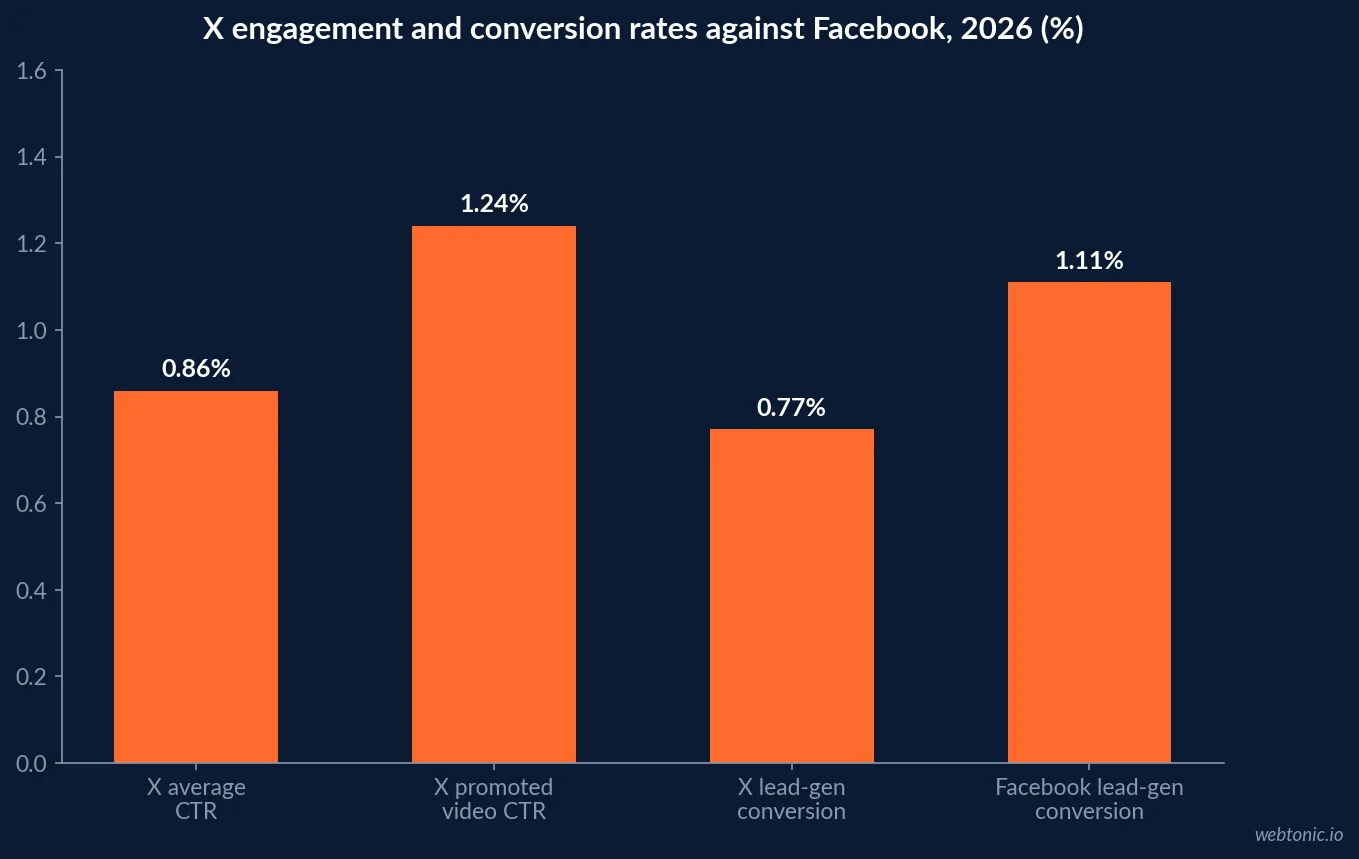
- Average CTR is 0.86%; promoted video leads at 1.24%.
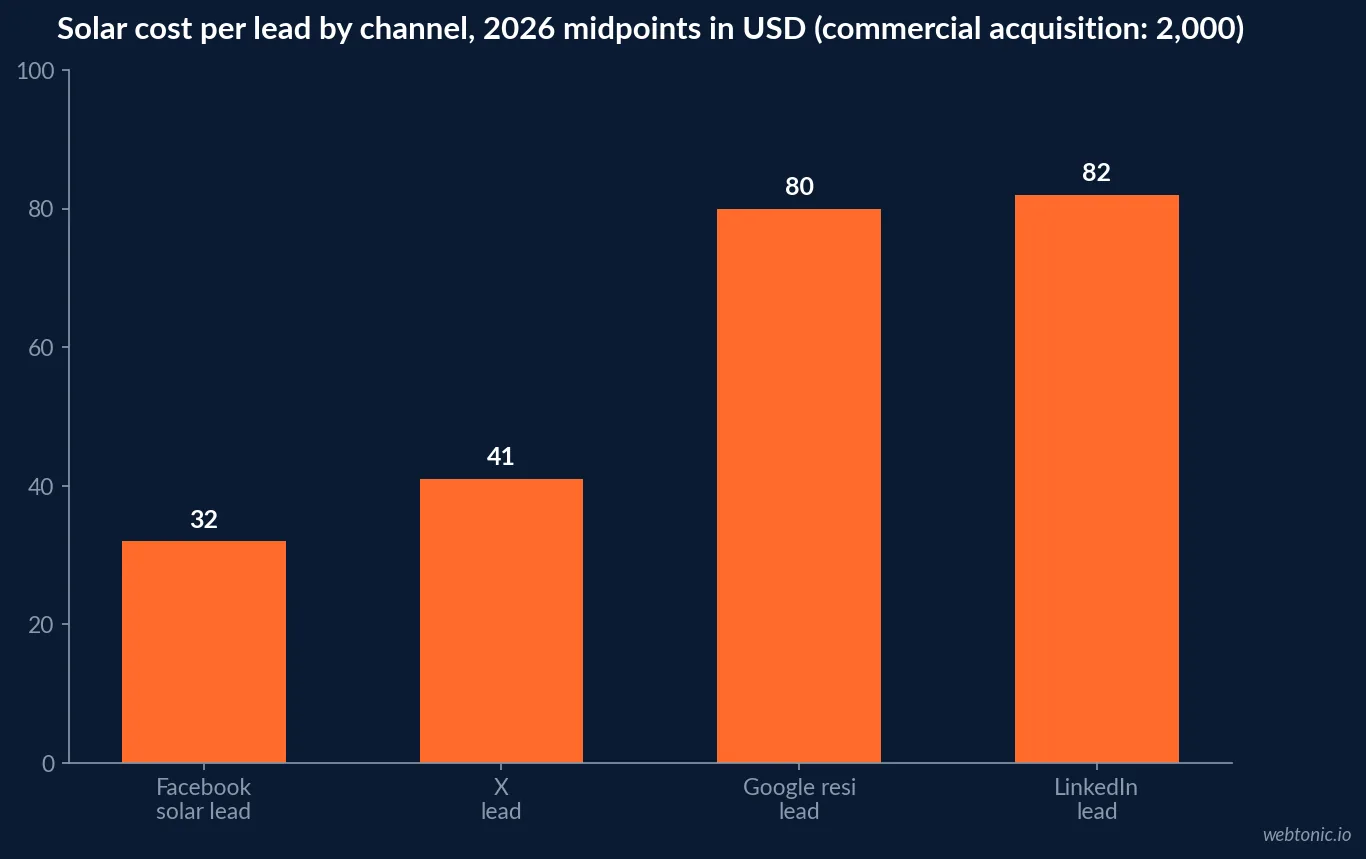
- Average cost per lead is $41, against $82 LinkedIn and $24 Facebook.
- Lead-generation conversion averages 0.77%, against 1.11% on Facebook.
- Reported lead quality runs about 34% below LinkedIn.
- The audience is 60.9% male and largest at 25-34 (29.6%).
- 68% of users are urban, the highest share of any major platform.
- 42% are college-educated and 34% work in the knowledge economy.
- Keyword targeting delivers about 31% higher CTR than interest targeting.
- Vertical video performs roughly 28% better than horizontal on the platform.
- About 45% of Grok citations are X posts - 34% organic, 11% verified-only.
- Posts above 50,000 likes are cited by Grok at 11.2x baseline probability.
- US residential solar is forecast to contract about 21% in 2026 after the Section 25D sunset.
- Residential customer acquisition cost is set to spike about 40% in 2026, having reached roughly $0.85 per watt.
- Payback periods moved from 7.4 years in Q3 2025 to 10.4 years in Q4.
- Commercial and industrial solar projects run $200,000 to $5 million-plus with 6-to-18-month sales cycles.
- Commercial acquisition cost runs $1,000 to $3,000 per customer, about $0.43 per watt.
X Ads benchmarks with the solar comparison attached
Platform figures come from 2026 X audience and advertising statistics, X advertising benchmarks and audited platform filings. The solar column is what the same money buys in the channels installers actually run.
| Metric | X average | Solar comparison | What it means |
|---|---|---|---|
| CPC | $0.74 | $15-$50 residential search click | Cheap attention, no purchase intent |
| CPM | $5.65 | $5.84 Snapchat, $9.10 LinkedIn | Second-cheapest major platform |
| CTR | 0.86% | 1.24% promoted video | Video is the only format worth running |
| Cost per lead | $41 | $40-$120 Google, $15-$50 Facebook | Cheap per lead, weak per qualified lead |
| Lead-gen conversion | 0.77% | 1.11% Facebook | Expect a third fewer conversions per click |
| Lead quality | About 34% below LinkedIn | LinkedIn is the C&I benchmark | Manual screening required |
| Keyword vs interest CTR | +31% keyword | - | Policy keywords are the whole strategy |
The audience mismatch, stated plainly
A residential solar buyer owns a south-facing roof, has a utility bill worth attacking and is usually well into middle age. The median US homeowner is 54, and homeowners aged 40-69 drive about 65% of renovation activity. X peaks at 25-34, is 60.9% male and 68% urban. Urban density and roof ownership move in opposite directions - the denser the user base, the fewer rooftops it controls.
| Audience attribute | X | Residential solar buyer | Match |
|---|---|---|---|
| Median or peak age | 25-34 (29.6%) | 54 median homeowner | Poor |
| Gender split | 60.9% male | Mixed, often jointly decided | Poor |
| Geography | 68% urban | Suburban and exurban | Poor |
| Property control | Largely renters in dense metros | Owner-occupied roof required | Poor |
| Education | 42% college-educated | Mixed | Neutral |
| Occupation | 34% knowledge economy | Broad | Strong for C&I buyers |
| Platform behaviour | News, policy, real-time | Reactive to rate and credit news | Strong in policy windows |
The last two rows are why this article is not simply a no. The knowledge-economy skew is the facility manager, the sustainability director and the CFO who signs a $200,000 to $5 million commercial project. The real-time skew is the reason the policy window below exists at all.
Case one: the policy and rate-news window
The 30% Section 25D residential credit expired on 31 December 2025. Wood Mackenzie forecasts a 21% residential contraction and a 40% acquisition-cost spike in 2026 after a 10% fall in 2025, and SEIA logged 43.2 GW installed in 2025, down 14% while still supplying 54% of new US generating capacity. Every one of those numbers is argued in public on X, in the same feed as the rate cases, net-metering dockets and tariff votes that decide whether a system pencils in a given state.
That is the one thing X is genuinely good at: a metro-level conversation spike within minutes of a decision, priced at $0.74 a click while search auctions for the same terms reprice upward. Keyword targeting - not interest targeting - captures it, at roughly 31% higher CTR.
| Policy moment | Typical window | X action | Why it works |
|---|---|---|---|
| State rate case decision | 24-72 hours | Keyword campaign on utility and docket names | Bill-shock intent spikes before search volume catches up |
| Net-metering change vote | 1-2 weeks | Promoted video explaining the new payback math | Video CTR 1.24% against 0.86% average |
| Federal credit or tariff news | 3-7 days | Thread plus promoted post, no lead form | Cheap reach against a national spike |
| Utility rate increase filing | 48 hours | Metro-bounded keyword targeting | Highest-intent moment a solar advertiser gets for free |
| Community solar programme launch | 2-4 weeks | Subscription offer, not rooftop offer | Community CAC is $69 per kW, down 12% |
Case two: commercial and industrial buyers
Commercial solar is where X's audience shape stops being a liability. Projects run $200,000 to $5 million-plus, lead-to-deal conversion runs 5% to 10%, cycles take 6 to 18 months and acquisition cost lands at $1,000 to $3,000 per customer, or about $0.43 per watt - roughly half the $0.85 per watt residential figure. At $5.65 CPM, a year of light, continuous presence in front of a few thousand facility and energy managers costs less than one commercial trade-show booth.
| C&I economics | 2026 figure | X implication |
|---|---|---|
| Project value | $200,000-$5,000,000+ | One win pays for years of $5.65 CPM presence |
| Lead-to-deal rate | 5%-10% | Volume is irrelevant; named-account reach is not |
| Sales cycle | 6-18 months | Continuous low-cost presence beats bursts |
| Acquisition cost | $1,000-$3,000 ($0.43/W) | Cheap CPMs materially move blended CAC |
| Search CPC (commercial terms) | $15-$50 | X clicks cost about 2% of that |
| Best ICP filter | Utility rate above $0.12/kWh, 50k+ sq ft owned roof | Use follower and keyword proxies |
Run it as a named-account layer, not a lead engine: follow and engage the utility, REIT, logistics and municipal accounts in your service territory, promote the two or three posts that carry real numbers, and route everything else to the channel built for this - see our solar LinkedIn Ads benchmarks for the CPL comparison.
Case three: the Grok citation footprint
Roughly 45% of Grok citations are X posts - about 34% organic and 11% verified-only - and posts above 50,000 likes are cited at 11.2 times baseline probability, according to 2026 Grok citation research and most-cited-source analysis. No regional installer reaches that like count. What is reachable is being the account that publishes real interconnection timelines, verified production data and honest payback math for one state, so that narrow queries surface it.
This is the same play as the Reddit answer-engine footprint - cheap, slow, non-attributable - and it belongs in the same budget line. Our solar Reddit Ads data covers the other half of that AI-visibility argument.
Where X sits among the cheap-reach channels
Judge X against the other sub-$6 CPM options rather than against search. On price it wins or ties; on audience fit for a rooftop it loses to every platform with a suburban skew.
| Channel | CPC | CPM | Best solar use | Residential fit |
|---|---|---|---|---|
| X | $0.74 | $5.65 | Policy moments, C&I presence, Grok footprint | Poor |
| TikTok | $0.62 | $4.10 | Objection handling on payback | Weak |
| Snapchat | $0.84 | $5.84 | Recruiting canvassers, pre-warming a metro | Poor |
| $1.47 | 30%-50% below Meta | Answer-engine citations, research-stage | Moderate | |
| Meta | $3.20 | Benchmark | Volume residential lead generation | Strong |
| Google Search | $15-$50 | - | Bottom-funnel intent | Strongest |
Budget framing for a solar X test
Scale the test to the acquisition maths, not to platform enthusiasm. With residential CAC near $0.85 per watt - close to $10,000 on a large system - and referrals closing at 29% to 33% against 5% to 10% for paid social leads, X money should come out of experimental budget, never out of the channels that close.
| Company stage | Monthly X budget | What it buys | Success measure |
|---|---|---|---|
| Under $5M revenue, residential only | $0 | Nothing worth having | Skip the channel |
| Residential, active in a rate-case state | $300-$800 | Policy-window keyword bursts | Cost per site visit under $1.50 |
| Mixed residential and commercial | $800-$2,000 | C&I named-account presence plus policy bursts | Named-account reach and meetings booked |
| Commercial-led developer | $2,000-$5,000 | Continuous presence across a 6-18 month cycle | Pipeline influenced, not leads |
| National installer | $5,000+ | Policy share of voice and Grok footprint | Branded search lift |
The monthly scorecard
Because X will never win on last-click, decide in advance which numbers count. Anything that requires form-fill volume to look good will fail here on purpose.
| Metric | Target | Comment |
|---|---|---|
| CPC | Under $1.00 | Above the $0.74 average means weak creative or too-narrow keywords |
| CTR | Above 0.86% | Promoted video should clear 1.2% |
| Cost per policy-window visit | Under $1.50 | The one efficiency number that matters |
| Assisted C&I meetings | 1+ per quarter | Self-reported source is acceptable evidence |
| Branded search lift | Positive after 90 days | The realistic residential payoff |
| Lead-form volume | Ignore | 0.77% conversion makes it a vanity trap |
Feed those numbers into the same reporting stack as the rest of the mix - our solar dashboards benchmarks cover how installers actually wire this up, and our growth marketing team runs the equivalent tests across channels.
What a solar X account should never do
Most wasted solar spend on this platform comes from importing a Meta playbook wholesale. The audience data says the following do not work.
| Do not | Why | Do instead |
|---|---|---|
| Run "free solar quote" lead forms | 0.77% lead-gen conversion, 34% weaker quality than LinkedIn | Send policy traffic to a real explainer page |
| Buy interest targeting | Keyword targeting outperforms it by about 31% CTR | Target utility, docket and tariff terms |
| Post horizontal video | Vertical outperforms by roughly 28% | Cut vertical, captioned, under 30 seconds |
| Chase national reach | 68% urban audience owns few roofs | Bound targeting to your service territory |
| Argue with critics in replies | Reply volume is not reach and screenshots travel | Publish data, ignore the bait |
| Judge on last-click CPA | Assisted, long-cycle channel | Score on scorecard metrics above |
Verdict
For a residential-only installer in 2026, X is a $0.74 distraction from a market that just lost a 30% credit and gained a 40% CAC increase. For a commercial developer, or an installer operating in a state whose rate structure is being rewritten in public, it is the cheapest continuous presence money can buy - provided nobody promises it will produce leads. Brand strength, not clicks, is what carries a solar company through the post-25D market; the solar branding data makes that case in numbers.
Frequently Asked Questions
Should solar companies advertise on X (Twitter)?
Not for residential lead generation. X converts lead-gen traffic at 0.77% against 1.11% on Facebook, and its audience is urban, male and peaks at 25-34 - the opposite of a rooftop owner. Three narrow cases justify budget: commercial and industrial targeting where one project is worth $200,000 to $5 million, policy and utility-rate news moments after the Section 25D sunset, and building the post footprint that Grok cites.
What do X ads cost a solar advertiser in 2026?
Average CPC is $0.74 within a $0.27 to $1.95 range and average CPM is $5.65, against $8.15 on Instagram, $9.10 on LinkedIn and $4.10 on TikTok. Average CTR is 0.86% and promoted video leads at 1.24%. Cost per lead averages $41. For comparison, solar residential search clicks run $15 to $50 in competitive metros and Google residential leads cost $40 to $120, with commercial acquisition reaching $1,000 to $3,000.
Is X's audience a fit for solar?
Badly matched for residential, usable for commercial. X is 60.9% male, peaks at 25-34 (29.6% of users) and is 68% urban - the highest urban concentration of any major platform. The median US homeowner is 54, and homeowners aged 40-69 drive about 65% of renovation activity. Dense urban users mostly do not own the roof. Facility, energy and finance managers, however, are exactly the urban knowledge-economy profile the platform over-indexes on: 42% are college-educated and 34% work in the knowledge economy.
Does policy news make X worth buying for solar?
It is the strongest paid case on the channel. The 30% Section 25D residential credit expired on 31 December 2025, Wood Mackenzie forecasts a 21% residential contraction and a 40% customer-acquisition-cost spike in 2026, and payback periods moved from 7.4 years to 10.4 years in a single quarter. Those are argued in real time on X - rate cases, net-metering dockets, tariff votes - and keyword targeting delivers roughly 31% higher CTR than interest targeting, at $0.74 a click while search inventory reprices.
Do X posts help solar companies get cited by AI?
Inside Grok, measurably. About 45% of Grok citations are X posts - roughly 34% organic and 11% verified-only - and posts above 50,000 likes are cited at 11.2 times baseline probability. A local installer will never hit that reach, but a technically credible account posting utility-rate math, interconnection timelines and real production data can surface for narrow queries. Treat it as a cheap AI-visibility play, not a lead channel.
Sources
X (Twitter) Statistics 2026
X Ads Benchmarks Guide
X Platform Statistics 2026 (Audited)
Twitter/X Statistics
Grok Citation Patterns 2026
Most Cited Websites in Grok
Wood Mackenzie - Residential Solar CAC to Spike 40% in 2026
SEIA - Solar Market Insight Report Q2 2026
SurgePV - Commercial Solar Sales Cycle
Daly Advertising - Solar Marketing Benchmarks 2026