Table of contents
Snapchat is the cheapest reach in the 2026 solar mix and the worst-matched audience in it: $0.84 a click, but only about 17% of users are 35 or older. That gap has two profitable answers, and neither of them is a residential lead form.
Key Takeaways
- Snapchat reached 850M monthly and 443M daily active users in Q1 2026, including roughly 108M US daily users.
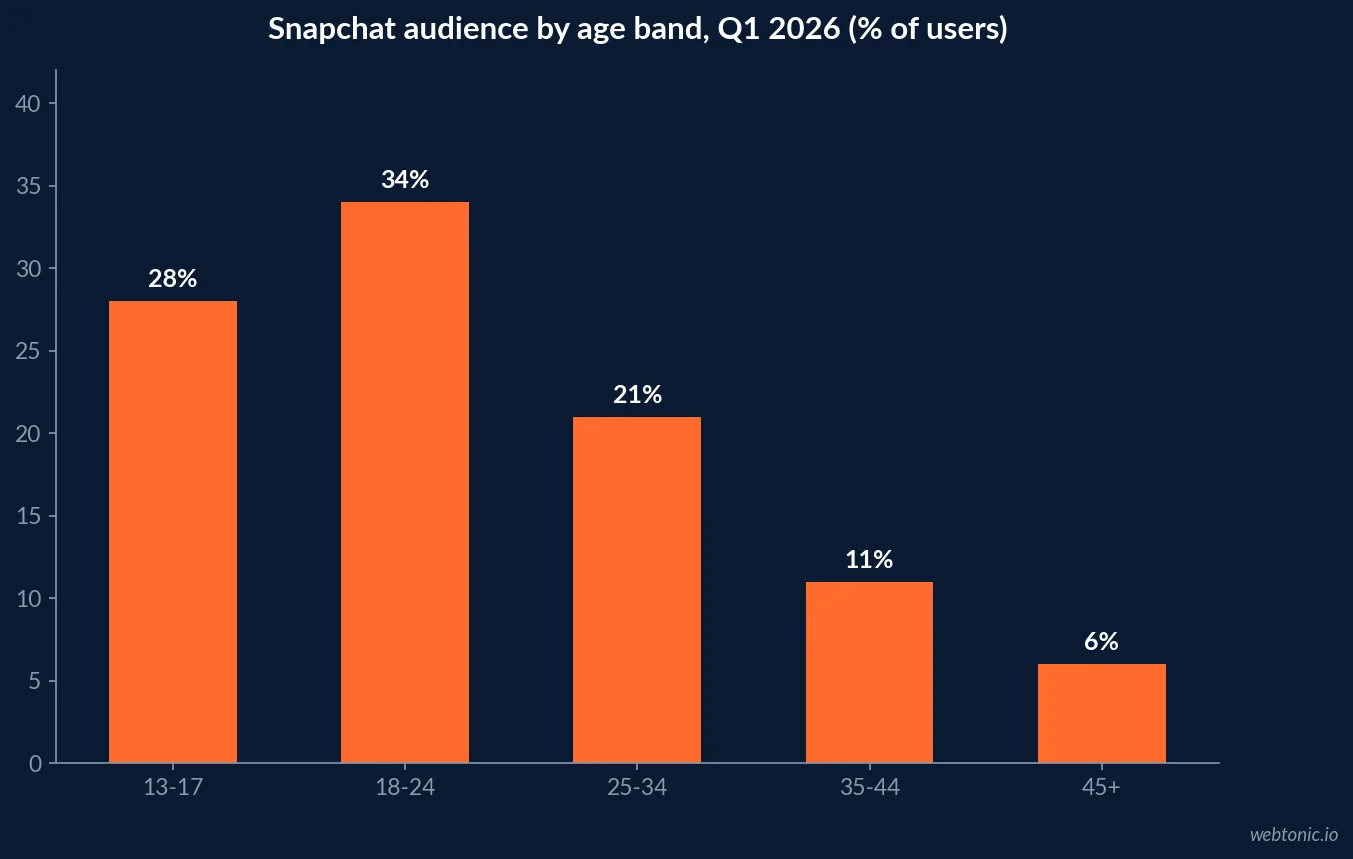
- The age split is 28% aged 13-17, 34% 18-24, 21% 25-34, 11% 35-44 and 6% 45+ - about 17% aged 35 or over.
- The 25-34 cohort grew 22% year over year, the platform's fastest-growing band.
- The median US homeowner is 54, and first-time buyers now average 40.
- Homeowners aged 40-69 account for about 65% of renovation activity.
- Median Snapchat CPC is $0.84 (IQR $0.51-$1.34) against $15-$50 for a commercial solar search click.
- Median CTR is 1.04%, rising to 1.36% on Spotlight and 0.94% on Story Ads.
- CPMs run $5.84 awareness, $24.80 lead gen and $27.10 conversions.
- Awareness inventory is roughly 30-40% cheaper than Meta; conversion inventory is comparable.
- On-Demand Geofilters cost about $5-$20 a day versus $50-$150 for equivalent Meta local reach.
- The average user opens the app 40 times a day for 30+ minutes; Spotlight passed 450M monthly users.
- The 30% Section 25D residential credit expired on 31 December 2025, and Wood Mackenzie expects residential volumes to contract about 21% in 2026.
- Residential customer acquisition cost is forecast to spike about 40% this year after falling 10% in 2025.
- Social and aggregator solar leads close at 5-10% against 29.2% for referrals and 15% for Google paid.
- Door-to-door drives 30-40% of residential solar sales with 60-80% rep turnover and a loaded cost of $1,200-$2,000 per deal.
Snapchat cost benchmarks against the rest of the solar mix
The pricing case is not subtle. Solar buys some of the most expensive clicks in any local industry - $40 to $120 per residential Google lead and $15 to $50 per click in the commercial segment - while Snapchat prices attention like a reach network.
| Channel | Typical cost | Buyer intent | Best solar job |
|---|---|---|---|
| Snapchat Ads | $0.84 CPC / $5.84 awareness CPM | None | Recruiting, metro pre-warm |
| Meta Ads | $15-$50 CPL | Low | Volume residential leads |
| Google Search (resi) | $40-$120 CPL | High | In-market residential |
| Google Search (C&I) | $15-$50 CPC | High | Commercial rooftop |
| Local Services Ads | $30-$80 CPL | High | Local residential |
| Shared aggregator | $20-$60 per lead | Mixed | Filling installer downtime |
| Referral program | $500-$1,500 payout | Very high | Core growth engine |
Read that table with the close rates attached. Referrals close at 29.2%, Solarize-style community programs at 33%, Yelp at 23.5%, inbound phone at 17%, Google paid at 15%, and social or aggregator traffic at 5-10%. A $0.84 click is only cheap if you are buying something other than a lead.

The age gap is the whole story
Q1 2026 platform data puts 62% of Snapchat users under 25. Solar is sold to people who own a roof, hold a utility bill in their own name and can carry a 20-year agreement.
| Age band | Share of users | Owns a roof? | Value to a solar installer |
|---|---|---|---|
| 13-17 | 28% | No | None - exclude |
| 18-24 | 34% | Rarely | Canvasser and installer recruiting |
| 25-34 | 21% (+22% YoY) | Increasingly | First-time buyers averaging 40 |
| 35-44 | 11% | Mostly | Prime retrofit band |
| 45+ | 6% | Yes | Highest intent, thinnest inventory |
The usable buyer inventory is that bottom 17%. Bid it deliberately, and accept that you are buying a narrow slice of a large network rather than a homeowner audience.
Job one: recruiting the crew that sells 30-40% of residential solar
Door-to-door still drives 30-40% of US residential solar sales, with rep turnover of 60-80% a year and a loaded cost of $1,200-$2,000 per closed deal. Hiring is not a seasonal project; it is a standing budget line - and its target audience is exactly Snapchat's core.
| Recruiting asset | Snapchat cost | Alternative cost | Notes |
|---|---|---|---|
| Canvasser click | $0.84 | $4-$8 on LinkedIn | 18-24 band is the canvasser pool |
| Trade-school geofence | $5-$20 a day | $50-$150 on Meta | On-Demand Geofilter |
| Job-fair takeover | $5-$20 a day | Booth fee plus staff | Same-day setup |
| Apprentice campaign | $24.80 lead-gen CPM | $300+ per agency hire | Route to an ATS form |
| Retention content | Organic Spotlight | n/a | Spotlight CTR 1.36% |
Score it against the cost of a bad hire, not a cost per lead. If Snapchat fills two canvasser seats a month at a few hundred dollars, it has outperformed the same spend chasing 17% of impressions that might own a roof.
Job two: pre-warming the metro before the truck rolls
Pre-warming a canvassing territory cuts acquisition cost 20-30%. That matters more in 2026 than in any prior year, because residential CAC is forecast to rise about 40% after the expiry of the 30% federal credit.
| Week | Snapchat activity | Field activity | Metric to watch |
|---|---|---|---|
| Week 1-2 | Awareness flight at $5.84 CPM | None | Reach and frequency in ZIP |
| Week 3 | Geofilter on the target ZIPs | Crew briefing | Filter uses per day |
| Week 4-6 | Story Ads with a local install | Knocking begins | Doors to appointment rate |
| Week 7-8 | Retarget filter users | Second pass | Appointment to sit rate |
| Week 9-12 | Sustain at low frequency | Referral push | Cost per signed watt |
Creative that survives a 30-minute session
The average user opens Snapchat 40 times a day and spends 30-plus minutes in it, almost entirely vertically and with sound. Solar has strong native material: panel-lift timelapses, the meter spinning backwards, a real utility bill before and after.
- Shoot vertical 9:16 first; repurposed landscape footage collapses performance on every short-form platform.
- Lead with the bill, not the panel - published pricing converts 15-25% higher in solar.
- Put the crew on camera; 88% of buyers read reviews and people are the trust asset.
- Use Spotlight placements where CTR reaches 1.36% against 0.94% on Story Ads.
- Never claim the expired 30% federal credit - it lapsed on 31 December 2025.
- Cap frequency: awareness is cheap enough that fatigue arrives before the budget does.
Measurement: cost per watt, not cost per lead
Solar attribution is structurally hostile to platform dashboards. Sales cycles run 3 to 9 months residentially and 6 to 18 months commercially, roughly 40% of home-services phone leads carry no recorded source, and only about 52% of CRM users fill the lead-source field at all.
| Metric | Why Snapchat looks bad on it | What to use instead |
|---|---|---|
| Platform conversions | Awareness clicks rarely convert same-session | Geo holdout lift |
| Cost per lead | Lead is not the unit sold | Cost per signed watt |
| Last-click revenue | Misallocates 40-60% of credit | Blended CAC by metro |
| Form fills | Phone converts 46% vs 1.7% for forms | Tracked call volume |
| 30-day ROAS | Payback is now 10.4 years, cycle is months | 90-day cohort close rate |
The cleanest setup is a dedicated tracking number per campaign feeding a CRM that reports on cost per signed watt. Build it the way our solar attribution benchmarks and solar dashboard data lay out, and read Snapchat inside that model rather than inside Ads Manager.
Budget: what a defensible Snapchat line looks like
Year-one solar brand budgets run $25k-$80k, while an established $20M installer spends $100k-$300k a year on brand. Snapchat should be a small, purposeful slice of that - never the residential lead engine.
| Installer stage | Monthly Snapchat spend | Primary objective | Success signal |
|---|---|---|---|
| Pre-$2M revenue | $0 | None | Spend on referrals and search first |
| $2M-$5M | $500-$1,500 | Recruiting | Cost per canvasser hired |
| $5M-$20M | $1,500-$4,000 | Recruiting plus pre-warm | Doors-to-appointment lift |
| $20M+ | $4,000-$10,000 | Metro brand support | Blended CAC per watt |
| Commercial-only | $0-$1,000 | Employer brand | Applications per month |
Where Snapchat fits in the solar calendar
Solar demand is seasonal in a way that cheap reach can exploit. Quoting activity peaks in spring and again after summer utility bills land, while installation crews are busiest in late summer. Recruiting has to run roughly a quarter ahead of the install peak, which is exactly the window in which Snapchat inventory is at its cheapest relative to search.
| Quarter | Demand signal | Snapchat objective | Budget weighting |
|---|---|---|---|
| Q1 | Quote research restarts, incentive questions | Awareness in target ZIPs | 20% |
| Q2 | Spring buying peak, canvassing ramps | Recruiting plus pre-warm | 35% |
| Q3 | Summer bill shock drives enquiries | Pre-warm and retargeting | 30% |
| Q4 | Deadline urgency, crew retention | Employer brand | 15% |
| Year round | Referrals close at 29.2% | Support, never replace | n/a |
Notice what the weighting is not: an even monthly spend. Cheap reach only earns its place when it lands ahead of the crew and ahead of the search query, not alongside them. Spend against the calendar and the $5.84 awareness CPM becomes a scheduling tool rather than a vanity metric.
What not to do
- Do not run residential lead-gen forms to the 13-24 audience - 62% of users are under 25 and cannot sign.
- Do not judge the channel on $27.10 conversion CPMs when awareness sells at $5.84.
- Do not advertise the expired 30% residential credit; state-level incentives only.
- Do not buy shared aggregator leads with the same budget and call it a channel test - those close at 5-10%.
- Do not skip call tracking; phone leads convert 46% against 1.7% for forms in home services.
- Do not ignore the recruiting pipeline while turnover runs 60-80%.
Verdict: a recruiting and pre-warm channel, not a lead source
In the first year without the federal residential credit, with volumes forecast down 21% and CAC up 40%, cheap reach has a role - but only where the audience matches the job. Snapchat matches the crew you need to hire and the neighbourhood you need to warm, not the homeowner signing a $25,000-$35,000 system. Fund it as a small line, measure it with real attribution, and compare it against the solar brand benchmarks rather than a dashboard conversion count. Our growth team builds those tests around cost per signed watt.
Frequently Asked Questions
Do Snapchat ads work for solar companies?
Not as a primary lead source for residential systems. Only about 17% of Snapchat users are 35 or older while the median US homeowner is 54, so the majority of impressions land on people who cannot sign a 20-year asset agreement. Where the channel does work is recruiting - solar door-to-door teams run 60-80% annual rep turnover and Snapchat sells the click at roughly $0.84 - and pre-warming a metro with cheap awareness before canvassers arrive, which cuts customer acquisition cost by 20-30%.
What do Snapchat ads cost a solar installer in 2026?
Median CPC is about $0.84 with an interquartile range of $0.51 to $1.34. CPMs run roughly $5.84 for awareness, $24.80 for lead generation and $27.10 for conversions. Awareness inventory is around 30-40% cheaper than matched Meta placements, while conversion inventory is comparable. On-Demand Geofilters cost about $5 to $20 a day against $50 to $150 for equivalent local reach on Meta.
Is Snapchat's audience old enough to buy solar?
Mostly no, but the tail is real and growing. The age split is roughly 28% aged 13-17, 34% 18-24, 21% 25-34, 11% 35-44 and 6% 45 and over. The 25-34 band grew 22% year over year and first-time US home buyers now average 40 years old, so a slice of the audience is entering ownership. Homeowners aged 40-69 still account for about 65% of renovation activity, which is where solar demand actually lives.
How should a solar company measure a Snapchat test?
Not on platform-reported conversions. Solar closes over 3 to 9 months, referrals convert at 29.2% while social and aggregator leads convert at 5-10%, and roughly 40% of home-services phone leads arrive with no recorded source. Use a dedicated call-tracking number per campaign, a geo holdout market, and cost per signed kilowatt rather than cost per lead. Against a median marketplace price of $2.49 per watt on an 11.8 kW system, the only number that matters is acquisition cost per watt.
What is the strongest solar use case for Snapchat in 2026?
Recruiting canvassers and installers. A loaded door-to-door rep costs $1,200 to $2,000 per closed deal and turnover runs 60-80%, so hiring is a permanent line item. Snapchat's core 18-34 audience is exactly the canvasser and apprentice-installer pool, clicks cost about $0.84, and Geofilters can fence a trade school or a job fair for $5 to $20 a day. Pair it with awareness flights that pre-warm the neighbourhoods the crew will knock the following month.
Sources
AdLiftr - Snapchat Ads Cost Benchmarks 2026
SearchLab - Snapchat Statistics 2026
Business of Apps - Snapchat Statistics
Hackceleration - Snapchat Pricing Analysis
Sagum - The Geofilter Arbitrage
PearlScore - First-Time Home Buyer Statistics
HIRI - Home Improvement by Generation
Wood Mackenzie - Residential Solar CAC Set to Spike 40%
SurgePV - Building a Solar Brand Identity
Daly Advertising - Solar Marketing Benchmarks
SEIA - Solar Market Insight Q2 2026