



Table of contents
SEO tracking is the process of monitoring keyword rankings, organic traffic, and technical performance to measure whether your search engine optimization efforts are working. Without it, you are guessing. The right SEO tracking setup turns raw data into decisions.
Key Takeaways
- Rank tracking tools achieve 90%+ accuracy for most searches, but results vary by 1–2 positions based on location, device, and personalization (Semrush).
- Google Search Console is the only free tool that shows your actual impressions, clicks, CTR, and average position directly from Google's index.
- Track SEO performance weekly for rankings, monthly for traffic trends, and quarterly for ROI — different metrics require different cadences.
- The top 5 SEO metrics to track are organic traffic, keyword rankings, click-through rate, conversion rate, and Core Web Vitals scores.
- Connecting Google Search Console to GA4 unlocks organic query data alongside conversion tracking in a single dashboard.
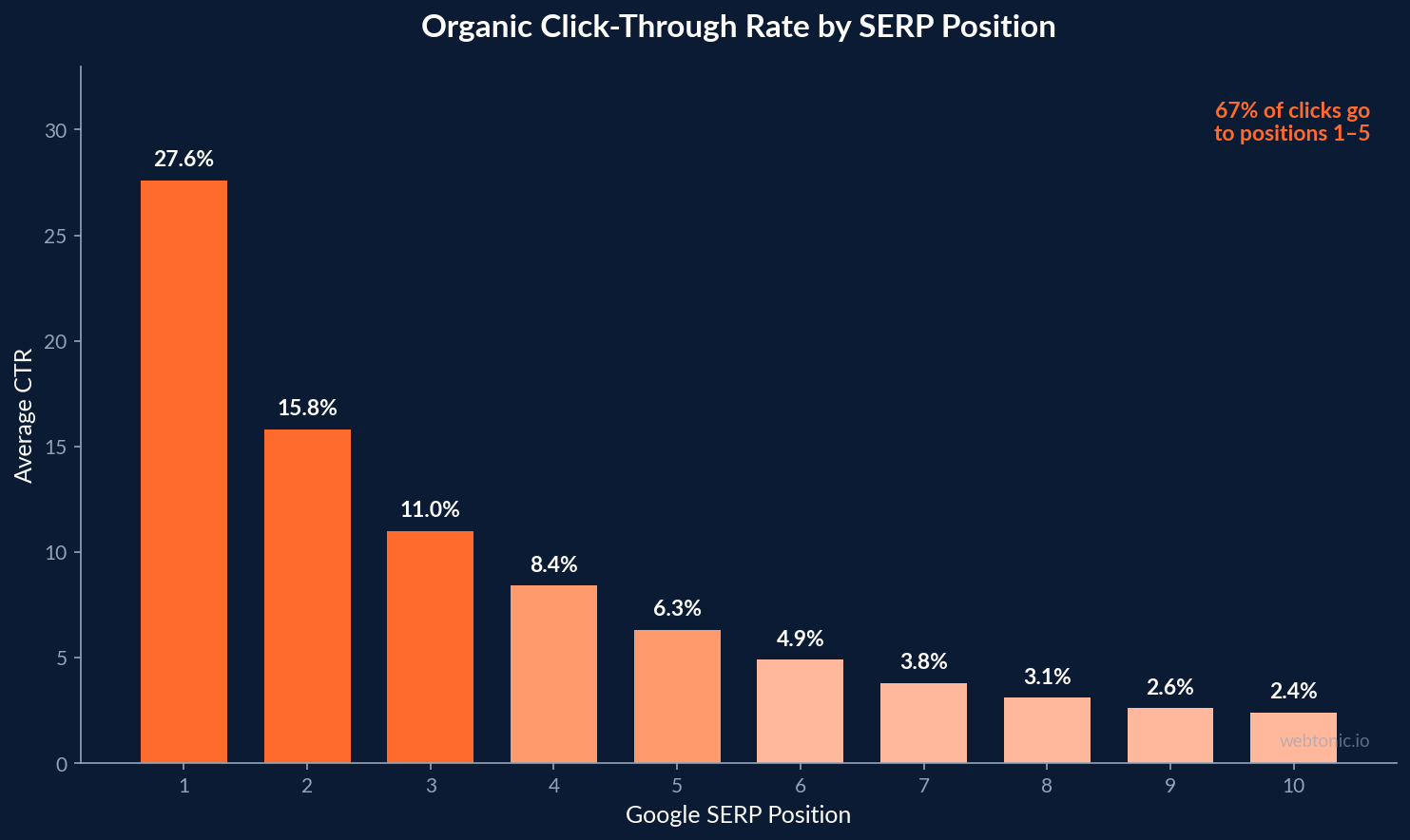
- 67% of clicks go to the top 5 organic results — tracking your position within the top 10 is essential for predicting traffic changes.
- AI-powered rank trackers now monitor LLM citations from Google AI Overviews, Perplexity, and Gemini in addition to traditional SERP positions.
- Monthly SEO reports should include 8–12 core KPIs tied to business outcomes, not just vanity metrics like total impressions.
- Technical SEO tracking via Core Web Vitals directly impacts rankings — only 47% of mobile sites pass all three CWV thresholds.
- Backlink tracking catches negative SEO attacks and identifies when high-authority links are lost, both of which can cause ranking drops within days.
- Share of Voice (SOV) is the most underused SEO metric — it measures your visibility across all target keywords relative to competitors, revealing market position beyond individual rankings.
- Automated rank tracking saves 4–6 hours per week compared to manual SERP checks, and catches ranking changes within 24 hours of algorithm updates.
What Is SEO Tracking?
SEO tracking is the systematic monitoring of search engine performance data to evaluate and improve your website's visibility in organic search results. It encompasses keyword ranking monitoring, organic traffic analysis, technical site health checks, backlink surveillance, and conversion attribution — everything you need to understand whether your SEO strategy is producing results.
Most businesses approach SEO tracking wrong. They check rankings occasionally, celebrate when a keyword moves up, and panic when it moves down — without understanding why. Effective SEO tracking connects search performance data to business outcomes: revenue, leads, and customer acquisition cost. It answers not just "where do we rank?" but "is our ranking position actually generating profit?"
The core components of a complete SEO tracking system include:
- Rank tracking — monitoring keyword positions in search engine results pages (SERPs) across devices and locations
- Traffic analysis — measuring organic search traffic volume, trends, and quality via Google Analytics 4
- Technical monitoring — tracking Core Web Vitals, crawl errors, indexation status, and site speed
- Backlink tracking — monitoring new and lost referring domains, anchor text distribution, and link quality
- Conversion tracking — connecting organic traffic to revenue, leads, and other business outcomes
Essential SEO Metrics to Track
Not all SEO metrics deserve equal attention. The metrics that matter are the ones tied to business outcomes — traffic that converts, rankings that drive clicks, and technical scores that affect both. Here are the KPIs every SEO tracking setup should monitor:
| Metric | What It Measures | Tracking Cadence | Primary Tool |
|---|---|---|---|
| Organic Traffic | Total visits from organic search results | Weekly / Monthly | Google Analytics 4 |
| Keyword Rankings | Position in SERPs for target keywords | Weekly | Rank Tracker (Ahrefs, Semrush, SE Ranking) |
| Click-Through Rate | % of impressions that result in clicks | Monthly | Google Search Console |
| Organic Conversions | Leads or sales from organic traffic | Monthly | GA4 + CRM |
| Core Web Vitals | LCP, INP, CLS performance scores | Monthly | Google Search Console / PageSpeed |
| Backlink Profile | Referring domains, new/lost links, DR | Monthly | Ahrefs / Moz |
| Indexation Coverage | Pages indexed vs. submitted in sitemap | Weekly | Google Search Console |
| Share of Voice | Visibility across all target keywords vs. competitors | Monthly | Ahrefs / SE Ranking |
The most important metric for most businesses is organic conversions — not rankings, not traffic. A keyword ranking #1 that generates zero conversions is worth less than a keyword ranking #6 that drives 20 leads per month. Build your SEO tracking dashboard around conversion data first, then layer ranking and traffic metrics as diagnostic signals.
Google Search Console for SEO Tracking
Google Search Console (GSC) is the foundation of every SEO tracking setup. It is the only tool that provides first-party data directly from Google's index — every other rank tracker estimates positions by scraping SERPs, but GSC shows you your actual average position, impressions, clicks, and CTR from Google's own systems.
Key GSC Reports for SEO Performance
- Performance report — shows queries, pages, countries, and devices with impressions, clicks, CTR, and position data for the last 16 months
- Coverage/Indexing report — reveals which pages are indexed, which are excluded (and why), and flags crawl errors that block visibility
- Core Web Vitals report — groups URLs by CWV status (good, needs improvement, poor) using field data from real Chrome users
- Links report — shows top linking sites, most-linked pages, and anchor text distribution for your backlink profile
- Removals report — tracks temporarily removed URLs and outdated content requests
The Performance report is where most SEO tracking begins. Filter by query to see how individual keywords perform over time, or filter by page to understand which content drives the most search traffic. The CTR data is particularly valuable: if a page has high impressions but low CTR, your title tag and meta description need optimization — growth marketing teams often recover 15–30% more clicks from existing rankings by improving SERP snippets alone.

Connecting GSC to Google Analytics 4
Linking Google Search Console to GA4 creates the most powerful free SEO tracking setup available. Once connected, you can see organic search queries alongside on-site behavior (bounce rate, pages per session, conversion rate) in a single interface. This connection answers the question every marketer asks: "which keywords actually generate revenue?"
Best SEO Tracking Tools
Beyond Google's free tools, dedicated SEO tracking tools offer daily rank tracking, competitor analysis, site auditing, and automated reporting. Here is how the leading platforms compare in 2026:
| Tool | Best For | Starting Price | Daily Rank Checks |
|---|---|---|---|
| Ahrefs | Backlink analysis + rank tracking combined | $129/mo | 750 keywords |
| Semrush | All-in-one SEO + PPC + content platform | $139/mo | 500 keywords |
| SE Ranking | Agencies needing white label reports | $65/mo | 750 keywords |
| Nightwatch | Local SEO + geo-grid rank tracking | $39/mo | 250 keywords |
| Google Search Console | Free first-party Google data | Free | Unlimited (avg position) |
| Screaming Frog SEO Spider | Technical SEO crawling and audits | £199/yr | N/A (crawl-based) |
For most small-to-mid businesses, a combination of Google Search Console (free) + one paid rank tracker covers all essential SEO tracking needs. Agencies managing multiple client sites benefit from tools with white label reporting like SE Ranking, which lets you brand reports and dashboards with your agency's logo.

SEO Reporting Best Practices
Effective SEO reporting connects tracking data to business decisions. The most common mistake is overwhelming stakeholders with raw data — 50-page reports full of keyword rankings that nobody reads. Instead, structure your SEO reports around three questions:
- Are we growing? (organic traffic trend, keyword visibility, Share of Voice)
- What is working? (top-performing pages, winning keywords, successful content)
- What needs attention? (declining keywords, technical issues, lost backlinks, competitor movements)
Reporting Cadence by Metric
- Weekly — keyword rankings, indexation status, crawl errors (flag urgent drops immediately)
- Monthly — organic traffic, CTR, conversions, backlink changes, Core Web Vitals, competitive positioning
- Quarterly — ROI analysis, content performance audit, strategy review, budget justification
Monthly reports should include 8–12 core KPIs presented visually, a narrative summary of wins and losses, and 3–5 specific action items for the next period. The best SEO reports tell a story: "We gained 12 positions across 8 target keywords this month, driving 340 more organic visits that converted into 18 leads worth $54,000 in pipeline."

AI and the Future of SEO Tracking
AI is transforming how SEO tracking works in two ways: AI-powered tracking tools are becoming smarter at detecting patterns and predicting ranking changes, and the rise of AI search features (Google AI Overviews, Perplexity, Gemini) is creating entirely new metrics to track.
- AI-powered rank trackers now monitor LLM citations — tracking whether your brand appears in AI-generated answers from Google's AI Overviews, Perplexity, and ChatGPT search.
- Predictive ranking alerts use machine learning to warn you about potential ranking drops before they happen, based on competitor activity and algorithm update patterns.
- Automated anomaly detection flags unusual traffic or ranking changes within hours, eliminating the need for manual daily checks.
- Natural language reporting — AI tools can generate written SEO reports from raw data, saving analysts hours of report writing time each month.
The emergence of AI Overviews in search results has created a new tracking challenge: your website might be cited in an AI Overview without receiving a traditional organic click. Forward-looking SEO tracking tools are adding AI citation tracking alongside traditional rank monitoring. For businesses investing in data intelligence, monitoring both traditional rankings and AI visibility is now essential.
Common SEO Tracking Mistakes
Even experienced marketers make tracking errors that lead to bad decisions. Avoid these pitfalls:
- Tracking vanity metrics only — total impressions and page views mean nothing without conversion context. A page with 10,000 visits and zero conversions is not a success.
- Checking rankings too frequently — daily rank fluctuations are normal (±1–3 positions). Reacting to every small movement wastes time and causes unnecessary strategic pivots.
- Ignoring mobile vs. desktop differences — rankings often differ by 2–5 positions between mobile and desktop. Track both, especially since 63% of organic visits come from mobile.
- Not filtering branded vs. non-branded traffic — branded search traffic (people searching your company name) inflates organic numbers. Separate branded and non-branded to see true SEO performance.
- Skipping competitor tracking — your rankings exist relative to competitors. If you are not tracking competitor visibility alongside your own, you are missing half the picture.
Research shows that 82% of SEO professionals who use automated tracking report making faster, more confident optimization decisions. The fix for all these mistakes is the same: build your SEO tracking dashboard around business outcomes first. Start with revenue and leads from organic traffic, then layer diagnostic metrics (rankings, technical health, backlinks) to explain why results are changing. Visit our blog for more frameworks on connecting SEO data to business performance.
Related reading
- SEO for B2B: A Practical Growth Playbook
- Podcast SEO: What It Is & How to Use It
- Pagination SEO: What It Is & How to Use It
- GEO & AEO services at Web Tonic
FAQ
What are the most important SEO metrics to track?
The five most important SEO metrics are organic traffic, keyword rankings, click-through rate, organic conversions, and Core Web Vitals. Organic conversions (leads or sales from search traffic) should be your primary KPI because it directly ties SEO to business revenue. Rankings and traffic are diagnostic metrics that explain conversion trends.
How often should I track SEO performance?
Track keyword rankings weekly, organic traffic and conversions monthly, and conduct a full ROI analysis quarterly. Avoid checking rankings daily — fluctuations of 1–3 positions are normal and do not warrant strategic changes. Set up automated alerts for significant ranking drops (5+ positions) so you catch real problems without manual monitoring.
Is Google Search Console enough for SEO tracking?
Google Search Console is excellent for first-party search data but has limitations: it shows average positions rather than exact daily rankings, data is delayed by 1–3 days, and it lacks competitor analysis. For comprehensive SEO tracking, combine GSC with a paid rank tracker (like Ahrefs or SE Ranking) and Google Analytics 4 for conversion data.
What is the best free SEO tracking tool?
Google Search Console is the best free SEO tracking tool — it provides actual impression, click, CTR, and position data directly from Google's index. Combined with Google Analytics 4 (also free), you get a complete view of organic search performance and user behavior. No paid tool can replicate GSC's first-party accuracy.
How do I track SEO for local businesses?
Local SEO tracking requires monitoring Google Business Profile insights (searches, views, actions), local pack rankings (top 3 map results), and location-specific keyword positions. Use a rank tracker with geo-grid capabilities (like Nightwatch or BrightLocal) to see how your rankings vary across different locations within your service area. Track phone calls, direction requests, and website visits from your GBP as primary conversion metrics.
Sources
HubSpot — KPI in SEO: The Metrics That Actually Matter
Ahrefs — SEO Metrics to Track
Google — Search Console Performance Report
Google — Connect Search Console to GA4
SEO Agency USA — Best Rank Tracker Tools 2026
Ooty — SEO Reporting Guide
Nightwatch — SEO Tracking
seoClarity — SEO Metrics


