



Table of contents
Key Takeaways
- NLP algorithms like BERT and MUM have fundamentally changed how Google understands content, making semantic relevance and topical authority more important than keyword density.
- Entity-based optimization—structuring content around clearly defined concepts and their relationships—is essential for visibility in modern search and AI systems.
- Voice search optimization and NLP SEO are deeply interconnected; content formatted for conversational queries gains advantages across both channels.
- E-E-A-T signals are now machine-evaluated through NLP analysis, making genuine expertise demonstration a technical ranking factor, not just a quality guideline.
- Organizations seeking to maximize search visibility should consider partnering with specialists who understand both the technical implementation and content strategy dimensions of NLP optimization.
What Is NLP SEO?
Natural Language Processing (NLP) SEO changes how search engines interpret and rank content. Modern search systems no longer rely solely on keyword matching. Instead, they use machine learning models to understand the meaning of words, context, and search intent behind both user queries and web content.
According to research from the Stanford University Natural Language Processing Group, NLP encompasses algorithms that allow computers to process, generate, and understand human languages through computational linguistics and machine learning. These capabilities enable Google to interpret complex, conversational queries and match them with content that satisfies user intent, even when specific keywords don't appear on the page. This semantic analysis goes far beyond simple keyword matching.
For mid-market and enterprise businesses, understanding NLP SEO has become essential to any effective SEO strategy. Google's NLP-based algorithms began with RankBrain in 2015, expanded with BERT in 2019, and accelerated with MUM in 2021. Organizations aligning content strategies with these semantic systems gain visibility advantages in search engine results. Those still focused primarily on keyword stuffing find themselves losing ground in search engine rankings.
Core NLP Technologies Powering Modern Search
Google's path toward semantic SEO includes several landmark algorithm implementations. Each builds on its predecessors to create increasingly sophisticated language understanding.

BERT: The Foundation of Modern Search Understanding
BERT (Bidirectional Encoder Representations from Transformers) launched in October 2019. Google called it "the biggest leap forward in the past five years, and one of the biggest leaps forward in the history of Search." Previous language models processed text sequentially. BERT analyzes words in relation to all other words in a sentence simultaneously, enabling contextual understanding that was previously impossible.
According to Google's research publication, BERT achieved state-of-the-art results on eleven natural language processing tasks. The model pushed the GLUE benchmark score to 80.5% (a 7.7% absolute improvement) and achieved 93.2% F1 score on the Stanford Question Answering Dataset, surpassing human-level performance of 91.2%. The bidirectional training approach allows BERT to understand that in the search query "2019 brazil traveller to usa need a visa," the word "to" completely changes the meaning. The query is about a Brazilian travelling to the U.S., not Americans travelling to Brazil.
By October 2020, Google confirmed that almost every single English-based query was being processed by a BERT model. The technology now extends to over 70 languages globally, delivering more accurate results for users worldwide.
MUM: Multimodal Understanding at Scale
Google's Multitask Unified Model (MUM) launched in 2021 and extends NLP capabilities across multiple content formats and languages simultaneously. Built on T5 (Text-to-Text Transfer Transformer) architecture, MUM processes text, images, video, and audio within a single query. According to Google, MUM is approximately 1,000 times more powerful than BERT and transfers knowledge across 75 languages.
The digital marketing implications are significant. MUM enables Google to understand complex queries that previously required multiple searches, synthesize information from diverse content formats, surface relevant content regardless of language barriers, and identify relationships between related topics across the entire web ecosystem.
NLP Algorithm Comparison
| Feature | RankBrain (2015) | BERT (2019) | MUM (2021) |
|---|---|---|---|
| Primary Function | Query interpretation | Context understanding | Multimodal comprehension |
| Content Types | Text only | Text only | Text, images, video, audio |
| Language Support | Limited | 70+ languages | 75+ languages |
| Processing Approach | Machine learning signals | Bidirectional transformers | Multitask unified model |
| SEO Impact | Intent matching | Contextual relevance | Comprehensive authority |
Practical NLP SEO Optimization Strategies
Understanding NLP theory is valuable. Implementing effective optimization strategies requires specific, actionable approaches aligned with search engine optimization best practices. The following techniques align content with how modern search algorithms evaluate semantic relevance and topical authority.
Entity-Based Optimization
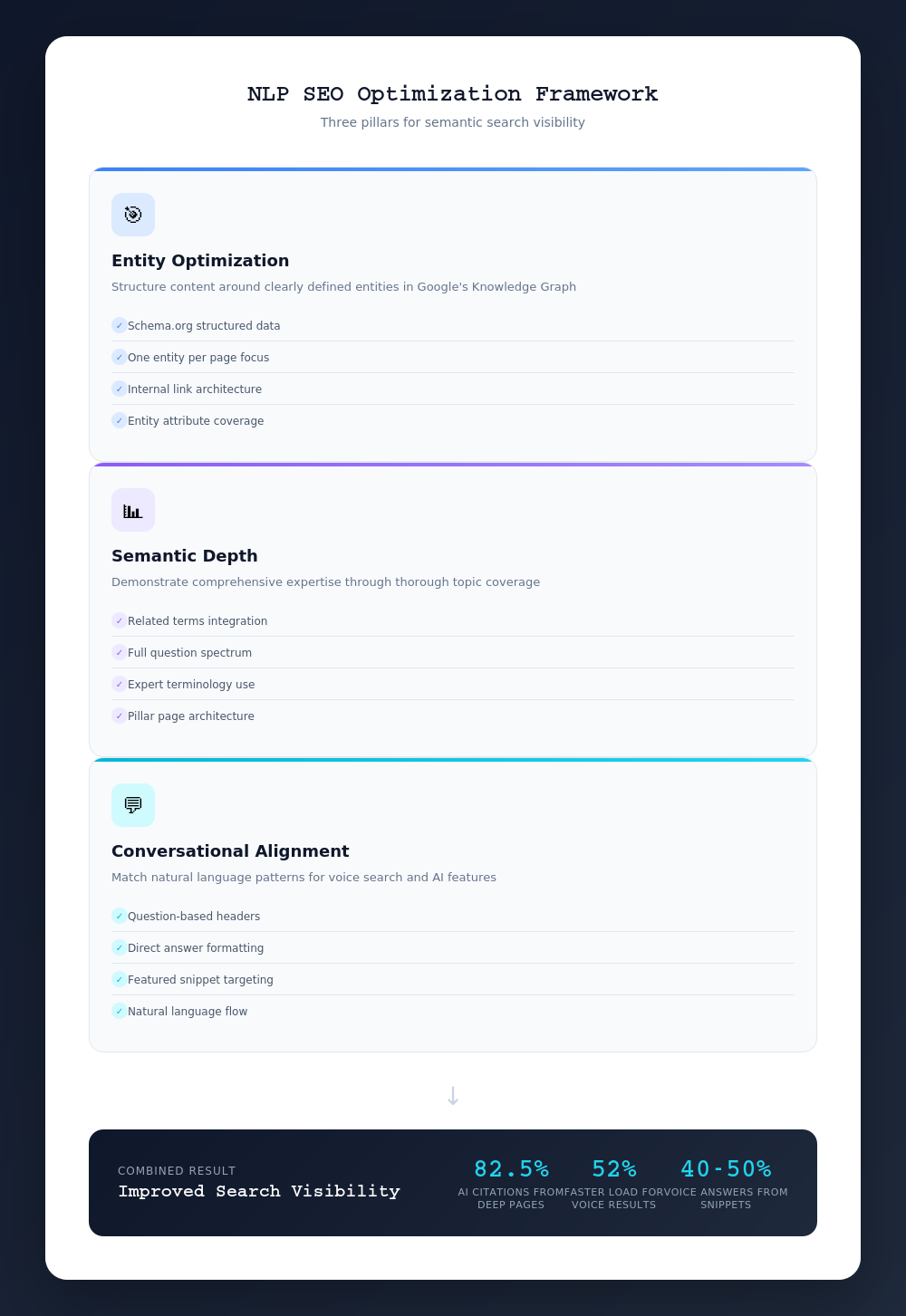
Entities are the people, places, concepts, and things that form the foundation of Google's Knowledge Graph. They have become central to how search engines understand content relationships. According to Search Engine Land's entity SEO guide, optimization requires focusing on three pillars.
Precision means each page should be unambiguously about one canonical entity, with title, H1, and schema markup pointing to the same concept. Coverage requires your entire site to collectively represent the entities and sub-topics that define your niche through well-structured pillar pages and supporting content. Connectivity involves establishing clear relationships between related entities through internal links and contextual references.
Practical implementation includes structured data markup through Schema.org to explicitly identify entities, content that thoroughly covers entity attributes and relationships, internal linking structures that reinforce entity connections, and external references through authoritative citations. This approach helps Google surface your content in rich results and rich snippets.
Semantic Content Architecture
Modern NLP systems evaluate content for semantic depth: the degree to which content demonstrates comprehensive coverage, expertise, and topical authority. According to BrightEdge research cited by Search Engine Land, approximately 82.5% of AI Overview citations point to "deep pages" with substantial, specialized content rather than surface-level summaries.
Building semantic depth requires structuring content to address the full spectrum of user questions on a topic. Include related terms and semantic keywords that experts would naturally discuss. Provide specific examples, data, and evidence that demonstrate expertise. Organize information in logical hierarchies that help both users and algorithms understand relationships. Some practitioners still reference latent semantic indexing as a conceptual framework, though Google's current systems use far more sophisticated approaches.
Conversational Query Optimization
Voice search and AI assistants have accelerated the shift toward conversational queries. According to DemandSage's voice search statistics, approximately 20.5% of internet users globally now use voice search. Around 80% of voice queries use natural, conversational language. More than 80% of Google Assistant voice search answers come from the top three search results.
Pros of conversational optimization:
Aligning content with natural question patterns increases eligibility for featured snippets (approximately 40-50% of voice search answers come from featured snippets). Long-tail keyword visibility improves with less competitive targeting. Content becomes prepared for AI-powered search features like Google's AI Overviews. User experience improves when content directly answers the questions people actually ask.
Cons of conversational optimization:
Existing sites require significant content restructuring. Traditional keyword research approaches may need updating to capture conversational phrases. Ongoing monitoring is necessary as conversational patterns evolve.
Common Misconceptions About NLP SEO
Misconception 1: NLP Makes Keywords Irrelevant
Keywords remain essential signals. They've been contextualized within broader semantic understanding. Google's systems still use keyword matching as one input among many. The difference: exact-match obsession has given way to semantic relevance. Content that naturally incorporates related keywords while thoroughly covering a topic outperforms both keyword-stuffed content and content that ignores terminology entirely.
Misconception 2: You Can't Optimize for NLP Algorithms
When Google released BERT, official statements suggested that "you can't optimize for BERT." This has been misinterpreted. The accurate interpretation: there are no tricks or shortcuts. Optimization requires genuinely creating comprehensive, well-structured content that satisfies user intent. This is still optimization. It simply requires focusing on content quality rather than technical manipulation. Tools like Google's Natural Language API can analyze how algorithms identify entities and sentiment in your content.
Misconception 3: NLP Only Affects Long-Tail Queries
NLP algorithms were initially most impactful on complex, conversational queries. Their influence has expanded dramatically. Google has stated that BERT now processes virtually all English queries. MUM's capabilities extend across all query types. Even short, seemingly simple searches benefit from contextual understanding. Google interprets "apple" differently based on search history, location, and accompanying signals to determine whether the user wants information about the fruit or the technology company. Related searches and People Also Ask boxes now reflect this semantic understanding.
Why Featured Snippets Matter More Than Ever for NLP Optimization
The relationship between featured snippets and NLP optimization reveals something many organizations overlook. Research shows that over 80% of Google Assistant voice search answers come from the top three search results. Approximately 40-50% pull directly from featured snippets. This creates a winner-take-most dynamic where content formatted for NLP comprehension (clear definitions, direct answers, structured data) gains disproportionate visibility.
The compounding effect makes this significant. Content that earns featured snippets signals to Google's NLP systems that it provides clear, authoritative answers. This reinforces its position for related queries. Organizations that systematically structure content to capture snippets often find overall domain authority improves as Google's systems recognize their content as consistently valuable for semantic understanding. Snippet wins compound: each one reinforces your domain's authority for related queries. Pages that rank for voice search also load 52% faster than average pages, according to Backlinko research, indicating that technical performance and NLP optimization work synergistically. Don't forget to optimize meta descriptions as well, since they influence click-through rates even when snippets are present.
The Hidden Connection Between E-E-A-T and Machine Learning Evaluation
Google's emphasis on Experience, Expertise, Authoritativeness, and Trustworthiness (E-E-A-T) is often discussed as a content quality framework. Its deeper connection to NLP algorithms is frequently underappreciated. Modern machine learning systems assess signals that indicate genuine expertise versus surface-level treatment.
According to analysis of Google's December 2025 core update, search systems have become significantly more sophisticated at distinguishing substantive content with unique insights from generic content repackaging existing information. This evaluation happens through NLP analysis of language patterns. Does the content use terminology that experts naturally employ? Does it address nuances and edge cases that only practitioners would know? Does it provide specific examples and data rather than generic observations?
The update enhanced what Google calls an "authenticity score" evaluating whether content demonstrates genuine expertise and experience. Language patterns indicating first-hand experience ("in my testing," "when I tried," "our research found"), specificity markers (exact measurements, unique details, proprietary data), and citation patterns all contribute to this score. E-E-A-T functions as a direct input into machine learning evaluation systems that determine rankings.
Real-World Examples and Case Studies
Eventbrite: NLP-Optimized Structured Data
Eventbrite's implementation of NLP-aligned structured data demonstrates the practical impact of semantic optimization. According to a case study published by WordLift, the company experienced 100% growth in organic traffic from Google Search to event listing pages after implementing comprehensive schema markup and entity-based content structure. "Within two or three weeks we started seeing a visual difference in our event search results on Google," noted an Eventbrite product manager. The implementation made entities (events, venues, performers) machine-readable through structured data while maintaining natural language content that satisfies user intent.
Enterprise Site Migration with BERT-Based Optimization
A documented case study from Vertify Agency shows how NLP understanding solves complex SEO challenges. During a major site migration, the team used a pre-trained BERT model to automatically predict optimal redirect mappings by analyzing semantic similarity between old and new page content. Rather than manually mapping thousands of URLs based on URL structure or titles alone, the NLP approach evaluated actual content meaning.
The result: organic non-branded traffic recovered completely from the migration and significantly exceeded pre-migration levels, even when accounting for seasonality. The project won multiple European and Global Search Awards, demonstrating that NLP tools provide competitive advantages beyond content optimization.
Frequently Asked Questions
What is the difference between NLP SEO and traditional SEO?
Traditional SEO focuses primarily on keyword optimization, backlink building, and technical factors. NLP SEO encompasses these elements but adds emphasis on semantic relevance, entity relationships, content comprehensiveness, and alignment with how machine learning algorithms understand language. The practical difference: shifting focus from "does this page contain the right keywords?" to "does this page thoroughly satisfy user intent and demonstrate expertise on this topic?"
How do I know if my content is optimized for NLP algorithms?
Several indicators suggest NLP alignment. Your content ranks for semantically related queries beyond your target keywords. You earn featured snippets for question-based searches. Your pages appear in Google's "People Also Ask" sections. Engagement metrics show users find comprehensive answers without returning to search results. Tools like Google's Natural Language API can analyze how algorithms identify entities and sentiment in your content.
Does NLP SEO require technical implementation or just content changes?
Effective NLP SEO requires both. Content changes involve writing comprehensively, using natural language, and structuring information logically. Technical implementation includes structured data markup through Schema.org, internal linking architecture that reinforces entity relationships, and page speed optimization (voice search results load approximately 52% faster than average pages). The most successful strategies integrate content and technical approaches.
How does voice search relate to NLP SEO?
Voice search and NLP SEO are deeply interconnected. Voice queries are typically longer and more conversational than typed searches, aligning directly with NLP systems designed to understand natural language. Optimizing for voice search through question-based headers, concise direct answers, and content structured for featured snippets simultaneously improves NLP alignment. With over 8 billion voice assistants in use globally and approximately 153 million U.S. users, voice optimization has become a practical priority.
Will AI-generated content rank well with NLP algorithms?
Google's algorithms don't inherently penalize AI-generated content. They evaluate whether content demonstrates genuine expertise and provides unique value. Recent core updates enhanced detection of generic AI patterns and content created without expert oversight. AI can assist content creation, but successful NLP optimization requires human expertise to ensure accuracy, add unique insights, and maintain E-E-A-T signals that algorithms increasingly prioritize.
Web Tonic works across paid search and paid social, and you can book a consultation to talk through your own plan.


