



Table of contents
Key Takeaways
- Local SEO tools have become essential as 98% of consumers now search online for local businesses, with Google Business Profile optimization representing the single most valuable local SEO activity according to industry marketers
- GeoGrid rank tracking reveals geographic ranking variations that traditional single-point tracking misses entirely, making it critical for understanding true local visibility across service areas
- Quality citations from authoritative sources outweigh quantity significantly, with research suggesting ten high-authority citations provide more ranking benefit than fifty low-quality directory listings
- AI search visibility has emerged as a distinct ranking factor requiring different optimization approaches, with citation and mention signals becoming critical for appearing in AI-generated answers
- The best tool choice depends on specific needs: comprehensive platforms like BrightLocal suit agencies managing multiple clients, while specialized tools like Local Falcon excel at specific functions like visual rank tracking
- Businesses managing complex local SEO campaigns across multiple locations may benefit from working with experienced local search specialists who can integrate these tools into coherent optimization strategies
What are local SEO tools?
Local SEO tools are software platforms that help business owners show up in local search results on Google Maps and other search engines. Simple concept, but the execution gets complicated fast.
Consider the numbers: 98% of potential customers now search online for nearby companies. That makes local search optimization non-negotiable for any business with a physical location or defined service area. The problem? Managing your online presence across dozens of directories, tracking local rank changes that shift by zip code, monitoring customer reviews, building citations, and watching what competitors are doing. Doing all of this manually is a full-time job.
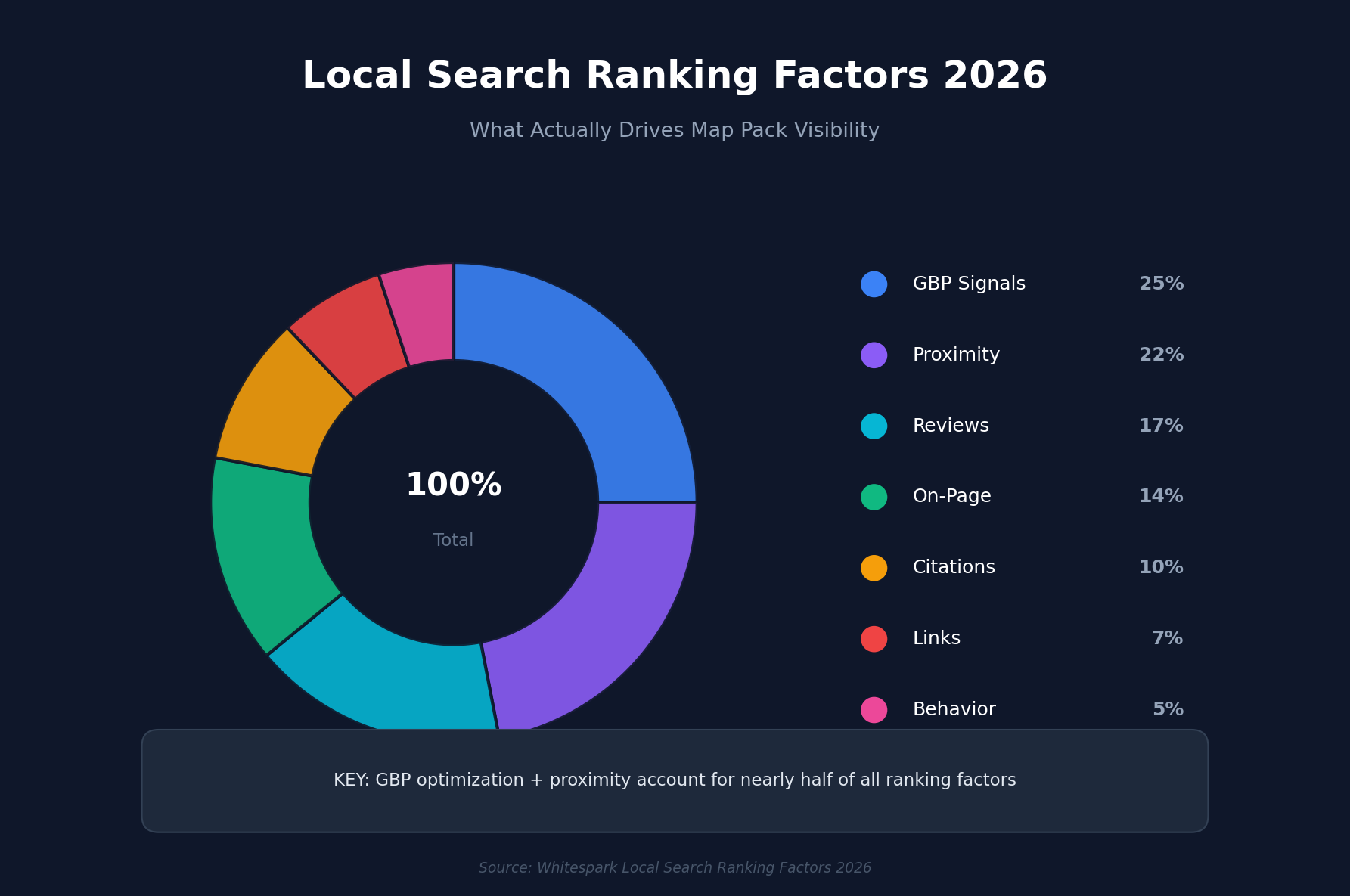
That's where local SEO software comes in. According to BrightLocal's research, 76% of marketers rank Google My Business management as the most valuable local SEO service. Not surprising when you look at the data from Whitespark's 2026 Local Search Ranking Factors report, which found that GBP signals account for roughly 25% of map pack visibility. For mid-market and enterprise businesses juggling specific locations across markets, the complexity makes specialized software less of a luxury and more of a requirement.
The 10 best local SEO tools for 2026
The right tool depends on what you actually need. An agency managing 50 clients has different requirements than a single-location plumber. Some platforms try to do everything; others specialize. Here's how the leading options stack up.
Quick comparison
| Tool | Best For | Key Strength | Starting Price |
|---|---|---|---|
| BrightLocal | Agencies & SMBs | All-in-one local SEO | $39/month |
| Semrush Local | Enterprise visibility | AI + traditional SEO integration | $30/month per location |
| Whitespark | Citation building | Local ranking research | $33/month |
| Moz Local | Listing management | Directory distribution | $16/month |
| Local Falcon | GeoGrid tracking | Visual rank mapping | Credit-based |
| Yext | Multi-location brands | Automated sync | $199/year per location |
| SE Ranking | Budget-conscious teams | Value for money | $52/month |
| Synup | Marketing agencies | White-label platform | $79/month |
| Local Viking | GBP management | Posting automation | $39/month |
| Places Scout | Lead generation | Audit reports | Custom pricing |
1. BrightLocal
BrightLocal is the default recommendation for agencies and SMBs, and for good reason. The platform pulls local rank tracking, citation management, and online reputation monitoring into one dashboard. No juggling multiple subscriptions.
The Local Search Grid shows exactly where your business ranks across Google Maps, which matters when a client asks why they dominate downtown but disappear in the suburbs. Citation Tracker catches NAP inconsistencies (business name, phone number, address) before they cause problems. The platform also handles GBP audits, automated review generation requests, and white-label reporting for agencies.
Plans run $39/month for Track, scaling to $79/month for Grow (which adds full reputation management). Citation building is pay-as-you-go at about $2 per site. The interface is beginner-friendly, the research and resources are industry-leading, and there are no long-term contracts. On the downside, some citation directories still require manual updates, and the reporting customization could go deeper.
2. Semrush Local
Semrush added serious local SEO capabilities in 2025-2026. The platform now offers Map Rank Tracker with GeoGrid visualization, business listings management, online reviews monitoring, and AI Visibility tracking for local queries. The real advantage? Everything integrates with Semrush's keyword research and competitive analysis tools.
The Local Toolkit runs $30/month per location. Semrush One bundles (starting at $199/month) combine traditional SEO and AI visibility tools. The integration with broader local SEO efforts is seamless, and the AI search tracking is ahead of most competitors. But the pricing gets complex when you stack multiple toolkits, and new users face a steeper learning curve than with simpler platforms.
3. Whitespark
Whitespark built its name on citation discovery and publishes the industry's most comprehensive Local Search Ranking Factors report annually. The Local Citation Finder doesn't just check the usual directories. It scans the entire internet for mention opportunities your competitors have that you're missing, helping improve your local presence and business ranks.
Unlike BrightLocal, Whitespark uses modular pricing. You pick only what you need. Citation Finder costs $33-$149/month depending on search volume. Reputation Builder runs $79/month per location. Local Platform starts at just $1/month per location. The citation discovery is unmatched, and the manual citation building service (done by humans, not automated) ensures quality. The trade-off: you're managing separate subscriptions for different tools, and the interface feels dated compared to newer platforms.
4. Moz Local
Moz Local keeps things simple. The platform focuses on listing management and online reputation monitoring, distributing your business information to 90+ directories including Google, Facebook, and Apple Maps. Automatic duplicate suppression handles one of the more annoying local SEO problems, and sentiment analysis helps you understand what customer feedback actually means.
Three pricing tiers: Lite at $16/month, Preferred at $24/month, Elite at $33/month per location. Annual billing gets you a discount. The interface is clean, the educational resources are solid for beginners, and the entry price is hard to beat. The limitations show up when you need advanced features. The citation network is smaller than some competitors, and the platform doesn't try to be a comprehensive SEO suite.
5. Local Falcon
Local Falcon invented GeoGrid local rank tracking. Instead of checking your position from one location (usually a city center), the platform scans Google Maps rankings from dozens or hundreds of geographic points across your service area. The visual output shows exactly where online visibility drops off and reveals your true Google Maps visibility across local customers in different neighbourhoods.
The credit-based system lets you scale usage to your needs. Plans range from Starter to Enterprise (with API access). Credits get consumed based on grid size and scan frequency. Local Falcon was first to market with Apple Maps tracking, and the AI-powered analysis (Falcon AI and Falcon Assist) provides actionable recommendations. The limitation is focus. This is a local rank tracker tool, not a management platform. And the credit system requires attention to avoid surprise overages.
6. Yext
Yext targets enterprise and multi-location brands. The platform's Knowledge Graph technology pushes updates across 175+ publisher sites in near real-time. Duplicate suppression and listing verification are built in, and the PowerListings+ network covers major directories.
Annual pricing starts at $199/year for Emerging, $449/year for Essential, and $999/year for Complete (per location). Enterprise packages use custom pricing. The directory network is the largest available, and updates propagate almost instantly. But the costs add up fast at scale. Worth noting: if you cancel, listings revert to an unmanaged state. Some users also report that accurate listings alone don't always translate to ranking improvements.
7. SE Ranking
SE Ranking competes on value. The platform offers local keywords tracking, site audits, backlink monitoring, and local search tools at prices well below Semrush or Ahrefs. The Local Marketing module includes GeoGrid tracking for Google Maps rankings and citation monitoring.
Essential starts at $52/month. Pro ($95.20/month) offers better value for agencies. Local SEO features are available as add-ons with tiered location pricing. The savings compared to major competitors are significant, and the 14-day free trial requires no credit card. The trade-offs: local SEO features cost extra, the keyword database is smaller than market leaders, and some users report data accuracy issues.
8. Synup
Synup positions itself as an operating system for marketing agencies. Listing management, review sites monitoring, and social media publishing combine into a white-label platform built for reselling to SMB clients. Client churn forecasting uses health scores to flag at-risk accounts.
Pricing starts around $79/month per location, with volume discounts for agencies. The AI-powered automation handles review responses and content creation. Team members can collaborate on client accounts, and reporting works well for client communication. The interface can overwhelm new users, some integrations are finicky, and reporting customization has limits. But for agencies specifically, the workflow fits.
9. Local Viking
Local Viking merges GeoGrid local rank tracking with GBP management. Visualize Google Maps rankings and post updates from the same dashboard. Automated posting, new reviews management, and white-label reports round out the feature set.
Plans run $39/month (Single) to $200/month (Enterprise). The combined tracking and management functionality delivers strong value. GBP integration means you can act on ranking data immediately. No free trial, though there's a 7-day money-back guarantee.
10. Places Scout
Places Scout specializes in audit-style reporting. Lead generation agencies use it to quickly demonstrate local SEO opportunities to prospects. The platform produces clean PDF reports showing local search results positioning, citation issues, and competitor comparisons for local search performance.
Custom pricing based on volume. The reports look professional and are ready for client presentations. Several free tools are available for basic audits. The tool does what it does well, but it's built for sales, not ongoing execution. Management features are limited.
Common misconceptions about local SEO tools
Misconception 1: Listing accuracy alone guarantees rankings
Accurate business listings across directories helps, but it's not enough on its own. The 2026 Whitespark report shows that citations now account for a smaller share of ranking factors than in previous years. GBP optimization, review signals, and on-page content have all gained importance. Getting your NAP right is table stakes. Winning the map pack takes more.
Misconception 2: More citations always mean better rankings
The instinct to accumulate as many citations as possible is understandable but misguided. Ten citations from authoritative, industry-relevant sources deliver more ranking benefit than fifty from low-quality directories. Google evaluates citation quality and relevance, not just quantity. Chasing volume wastes time and can actually create cleanup headaches later.
Misconception 3: Local SEO tools work on autopilot
Automation handles a lot. But tools track business ranks and maintain listing accuracy; they don't create content, generate genuine customer reviews, or engage with local customers. Negative reviews still need human responses. The businesses that get results use these platforms to inform strategy, not replace it. Set-it-and-forget-it doesn't work here.
The proximity paradox: why location matters more than perfect optimization
Here's something counterintuitive about Google search for local businesses. Physical proximity to the searcher often overrides other ranking factors entirely.
A 2025 Search Atlas study analyzed 3,269 businesses and found that proximity influences 55% of local ranking decisions for positions 1-21. Distance is the single most powerful factor. A business can rank #1 right around its location and drop to #10 just a few miles away, regardless of how well everything else is optimized.
What does this mean practically? Chasing online visibility across an entire metro area is often a losing game. The smarter approach targets specific high-value neighbourhoods, develops location-specific content, and in some cases, considers whether additional physical locations make strategic sense. GeoGrid tracking tools exist precisely because they reveal these geographic variations in organic search results that single-point rank checkers miss completely.
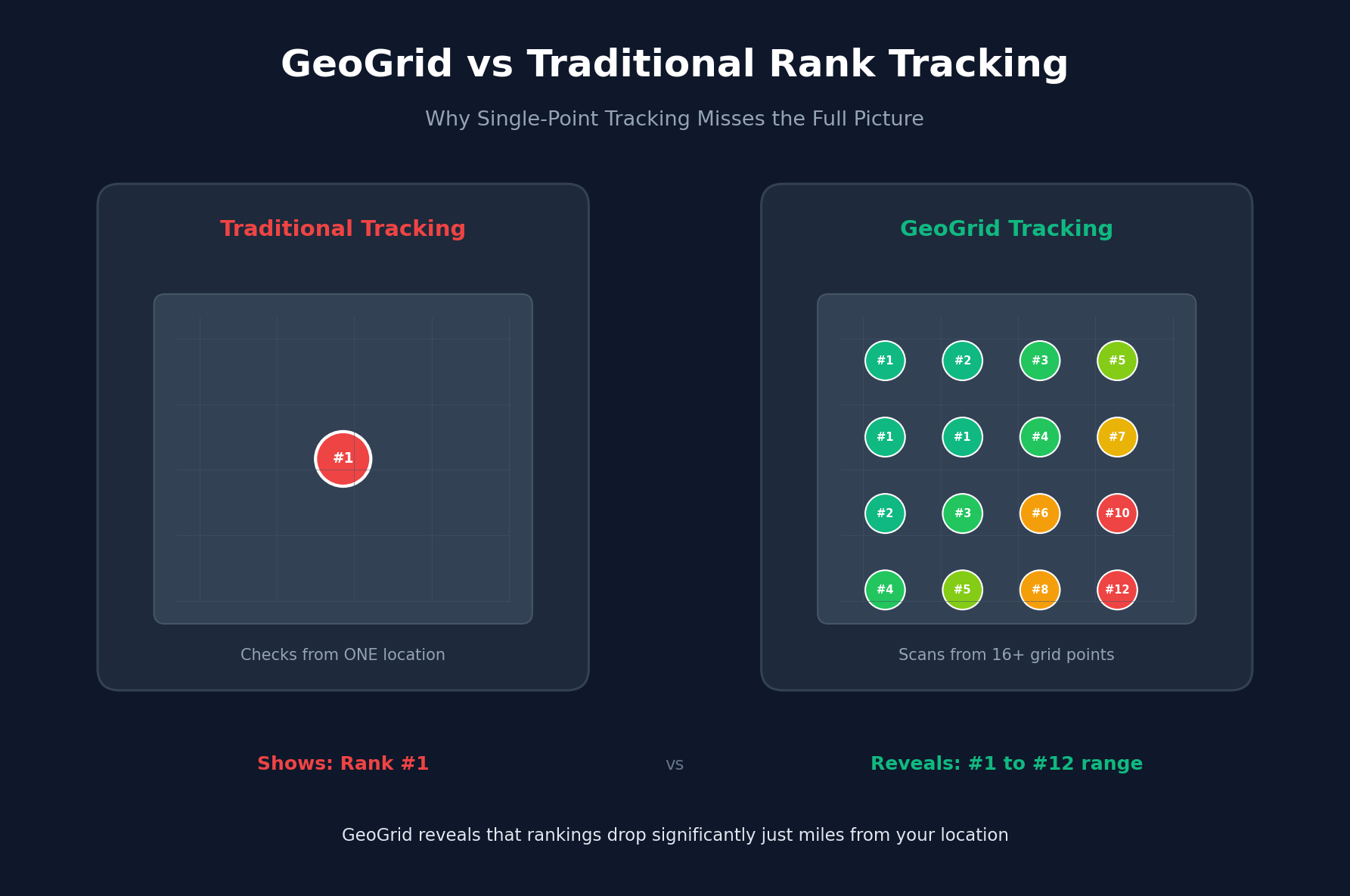
For service-area businesses, the implication is clear. Visibility tapers with distance from your address. Focus optimization on the geographic zones that matter most to your bottom line rather than trying to rank everywhere.
How AI is reshaping local search visibility
AI Overviews and conversational search have changed the game. Whitespark's 2026 survey of 47 industry experts identifies AI search visibility as a distinct ranking category now, separate from traditional local pack optimization.
The factors that drive AI visibility differ from traditional signals. Three of the top five relate to citations and mentions: presence on authoritative "best of" lists, prominence on industry-relevant domains, and quality of unstructured citations (newspaper articles, blog posts, association websites). Businesses that appear in AI-generated answers get trust signals that influence purchasing decisions, often without users clicking through to any website.
The practical takeaway? Local SEO strategies now need to optimize for two things simultaneously: traditional rankings and AI citation worthiness. Content should include clear, factual statements that AI systems can confidently cite. Business information needs to be consistent and structured across platforms. And tracking tools need to monitor visibility in both traditional search results and AI-generated responses. Semrush's heavy investment in AI visibility tracking reflects where the industry is heading.
Real-world examples and case studies
Multi-location restaurant chain: GeoGrid-driven optimization
A regional restaurant chain with 23 locations had a problem: inconsistent Google Maps visibility despite accurate listings everywhere. GeoGrid local rank tracking through Local Falcon revealed the issue. Rankings dropped in specific neighbourhoods because of undetected duplicate listings that standard citation audits missed.
Whitespark's citation cleanup service addressed the duplicates. Location-specific posting schedules maintained ongoing GBP activity. Within 90 days, locations that had been ranking outside the top 10 moved into the map pack.
Professional services firm: Review-centric strategy
A law firm with three metropolitan offices implemented systematic review requests through BrightLocal's reputation management tools. They started with fewer than 15 Google reviews per location.
Six months later, each location had accumulated over 50 reviews while maintaining average ratings above 4.7 stars. Call volume from Google Business Profile increased in parallel with review growth. The software investment paid for itself within the first quarter through increased client inquiries.
Frequently asked questions
What is the best local SEO tool for small businesses just getting started?
Moz Local or BrightLocal's Track plan. Both provide essential listing management and rank tracking at $16-39/month. They include educational resources that help new users understand local search fundamentals. Start with core functionality. Add advanced tools later as needs grow.
How do GeoGrid rank tracking tools differ from traditional rank trackers?
Traditional local rank trackers check your position from a single location, usually a city center. GeoGrid tools (Local Falcon, Local Viking, BrightLocal's Local Search Grid) check Google Maps rankings from dozens or hundreds of points across your service area. The difference matters because local rankings can shift dramatically within a few miles based on proximity factors.
Are enterprise listing platforms like Yext worth the higher cost?
For businesses managing 50+ locations, yes. Centralized management, automated sync across 175+ directories, and advanced analytics create real efficiency gains. For smaller businesses, more affordable alternatives like BrightLocal or Whitespark deliver comparable results. The decision comes down to location count, internal resources, and whether real-time sync across an extensive publisher network justifies the premium.
How often should I run local ranking reports?
Weekly works for most businesses. It provides enough data to spot trends without generating overwhelming noise. Businesses in competitive markets or actively testing optimization changes might benefit from twice-weekly scans. Monthly is too infrequent. Competitive positioning can shift faster than that.
Do I need separate tools for Google Business Profile management and rank tracking?
Not necessarily. BrightLocal, Semrush Local, and Local Viking combine both. But specialists like Local Falcon offer superior GeoGrid visualization if tracking is your primary focus, while dedicated GBP tools provide deeper posting and engagement features. The choice depends on whether you want a comprehensive platform or prefer best-in-class tools for specific functions.


