Table of contents
meta-titre: SEO for Startups: Complete Playbook for 2026
Meta-description: Stop burning cash on ads. Scale organic traffic efficiently with our proven SEO for startups playbook designed to drive sustainable growth in 2026.
Every founder eventually asks the same question: will paid ads or search engine optimization get us to our next round faster? Ads buy visibility for as long as the budget lasts. SEO buys an asset. Once a page ranks for the right query, it keeps bringing in organic traffic with almost no incremental spend, which is exactly the kind of efficiency an early-stage startup needs.
SEO for startups is the practice of building that asset deliberately: technical groundwork, a content marketing engine built around keywords your target audience actually searches, and enough high-quality backlinks to earn Google's trust. The right moment to start is usually around product-market fit, not months after. This playbook covers what actually moves the needle in the first year, and what can wait.
Key Takeaways
- SEO delivers up to 700 percent ROI over 1-3 years, and organic leads close at 14.6 percent versus just 1.7 percent for traditional outbound, making it one of the most capital-efficient channels available to a startup.
- Startups should prioritize low-competition keywords over high-volume head terms early on, since a young website has almost no chance of outranking established competitors for broad queries.
- Technical SEO fundamentals (page speed, Core Web Vitals, clean CSS and CMS setup) need to be right before content and link building can compound.
- High-quality backlinks for early-stage startups tend to come from guest content, community mentions, product launch PR, and review platforms like G2 and Capterra, not from buying links.
- Meaningful organic traffic growth typically takes 6 to 12 months to show up in Google Search Console, so SEO needs to start well before a startup depends on it for revenue.
- A Google Business Profile is worth claiming even for startups without a physical location, since it supports brand search and local credibility signals.
What Is SEO for Startups?
SEO for startups is the process of optimizing a young company's website so it earns visibility in Google search results without relying primarily on paid acquisition. The mechanics are the same as any general SEO strategy: technical health, relevant content, and authority signals from other sites. What changes is the constraint. Startups are optimizing under limited budget, limited domain history, and pressure to show results before the next funding conversation, often before ARR even justifies a dedicated marketing hire.
That constraint is exactly why sequencing matters more here than at a mature company. A startup will waste months chasing keywords it can't realistically win, or publishing content before the technical foundation can support it. Getting the order right, foundation first, then content, then links, is most of the difference between a startup that builds durable organic traffic and one that gives up on SEO after six unproductive months.
Why Startups Choose SEO Over Paid Acquisition
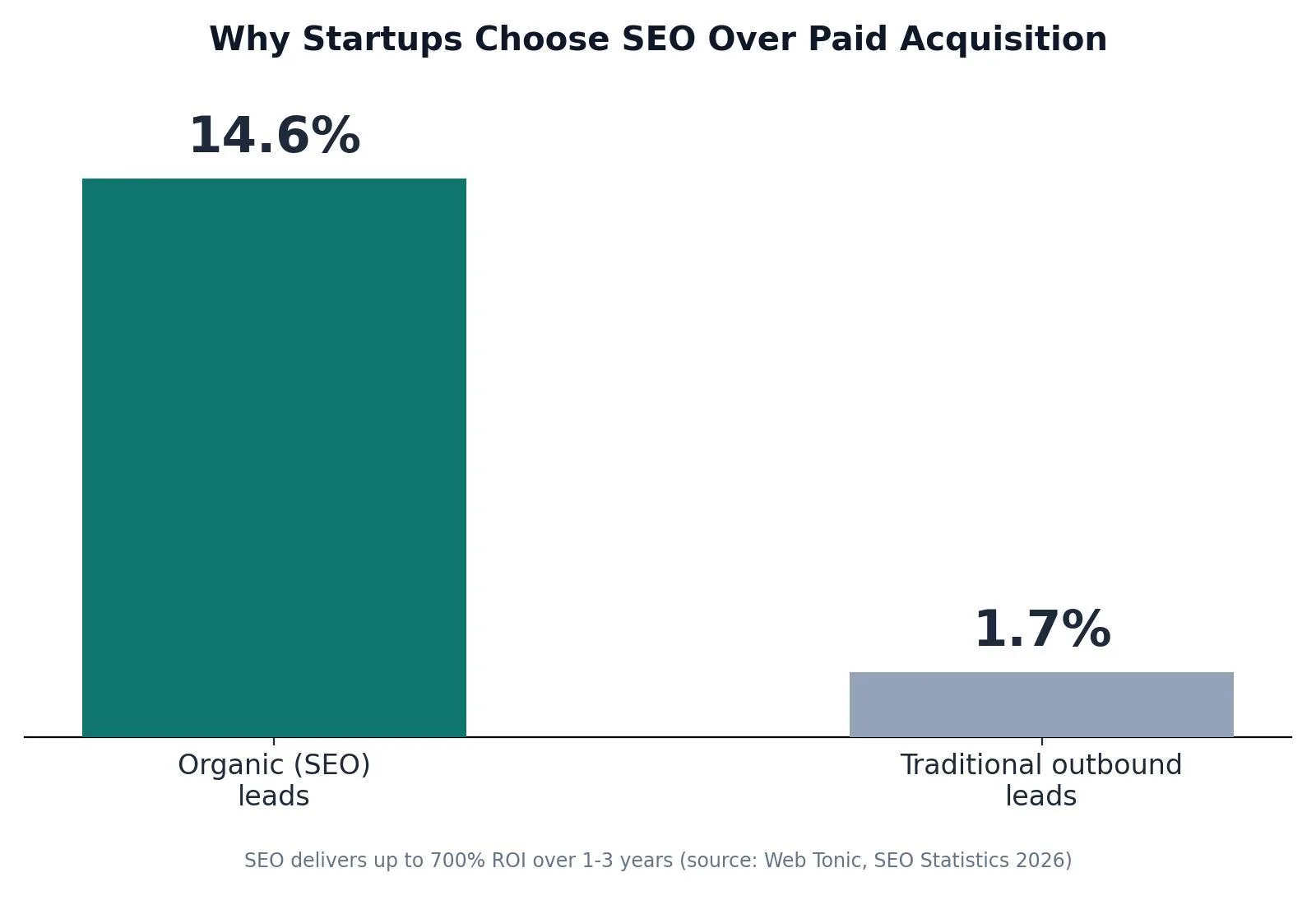
The economics favor organic more than most founders expect. Web Tonic's 2026 SEO statistics roundup found that SEO delivers up to 700 percent ROI over 1-3 years, with organic leads achieving a 14.6 percent close rate compared to just 1.7 percent for traditional outbound marketing.
That gap compounds. Paid acquisition costs reset to zero the moment the budget stops. A well-built page keeps ranking, and keeps converting, long after the work that built it is finished. For a startup watching every dollar of runway, that difference in durability is often more valuable than the traffic itself.
SEO vs. Paid Search for Startups
| Factor | SEO (organic) | Paid search (PPC) |
|---|---|---|
| Cost model | Upfront time and content investment | Ongoing cost per click |
| Time to results | Typically 6-12 months | Immediate |
| Long-term value | Compounds, keeps ranking after publication | Stops the moment spend stops |
| Best startup stage | Pre-seed through Series A, building for the long term | Post-launch, testing demand or hitting a short-term target |
| Lead close rate | Around 14.6 percent | Comparable to outbound at roughly 1.7 percent for cold channels |
| Budget needed to start | Time-intensive, lower cash cost | Scales directly with ad spend |
Most startups need both eventually. The practical sequencing is to use PPC for immediate validation and demand testing, while SEO builds in parallel as the channel that will still be working a year from now.
The Startup SEO Roadmap
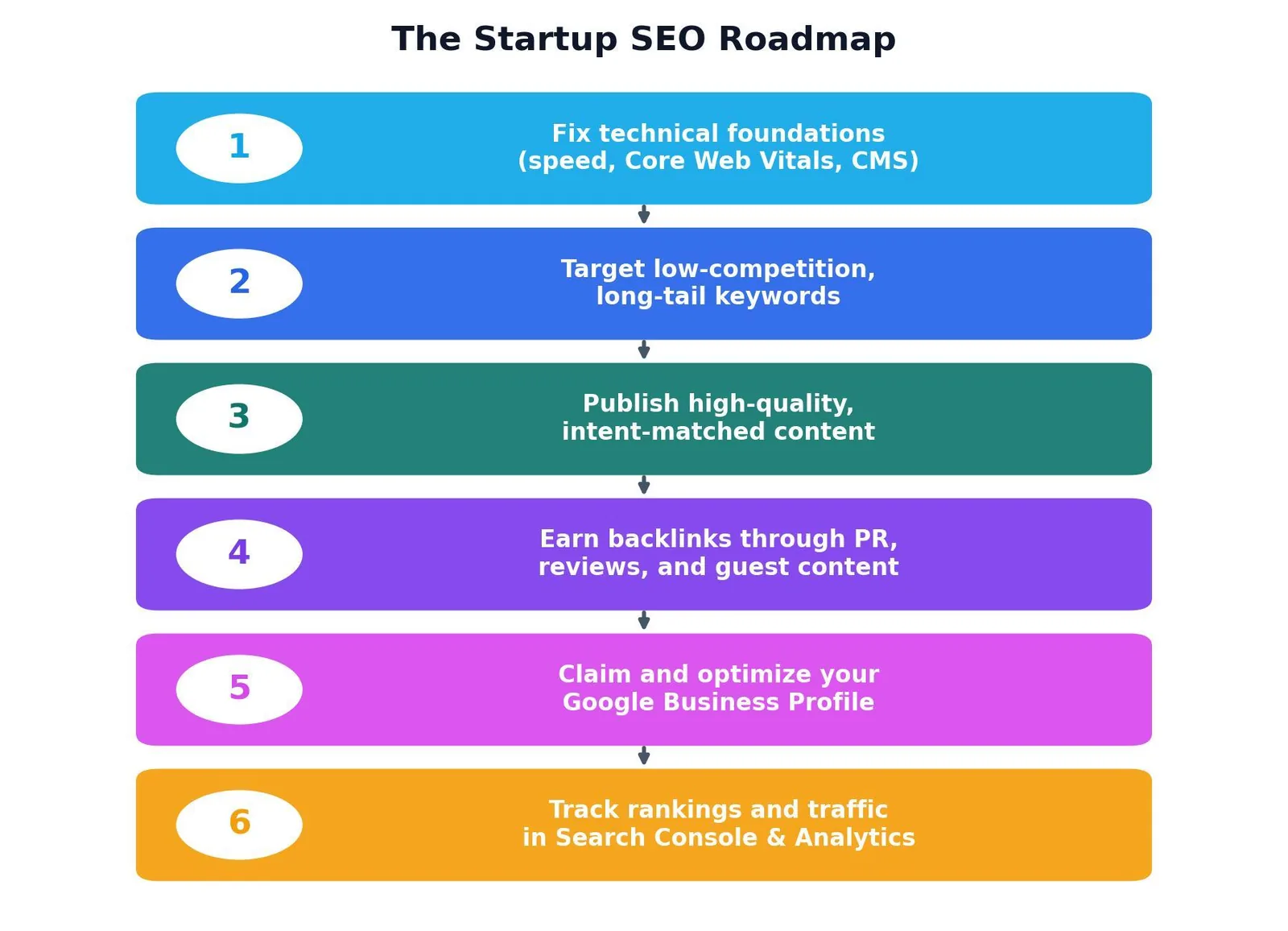
Step 1: Fix technical foundations first
Page speed, Core Web Vitals, mobile responsiveness, and a clean CSS and CMS setup form the base everything else sits on. Google's own Search Central documentation confirms that Core Web Vitals, loading speed, responsiveness, and visual stability, are metrics its core ranking systems use to reward good page experience, which is why this groundwork needs to happen before content and links can compound. A fast, crawlable site also helps search engines index new content quickly, which matters when every week of delay costs a startup momentum.
Step 2: Target low-competition, long-tail keywords
Broad terms like "project management software" are dominated by companies with a decade of domain authority. Long-tail keywords, more specific, lower-volume phrases, give a new site an actual chance to rank while still building toward the head terms over time.
Step 3: Publish high-quality content matched to search intent
Volume doesn't win here. High-quality content that directly answers what your target audience wants, at the right depth for that search intent, with a clear CTA (call-to-action) guiding the reader to the next step, consistently outperforms thin pages published purely to hit a content calendar quota.
Step 4: Earn backlinks through PR, reviews, and guest content
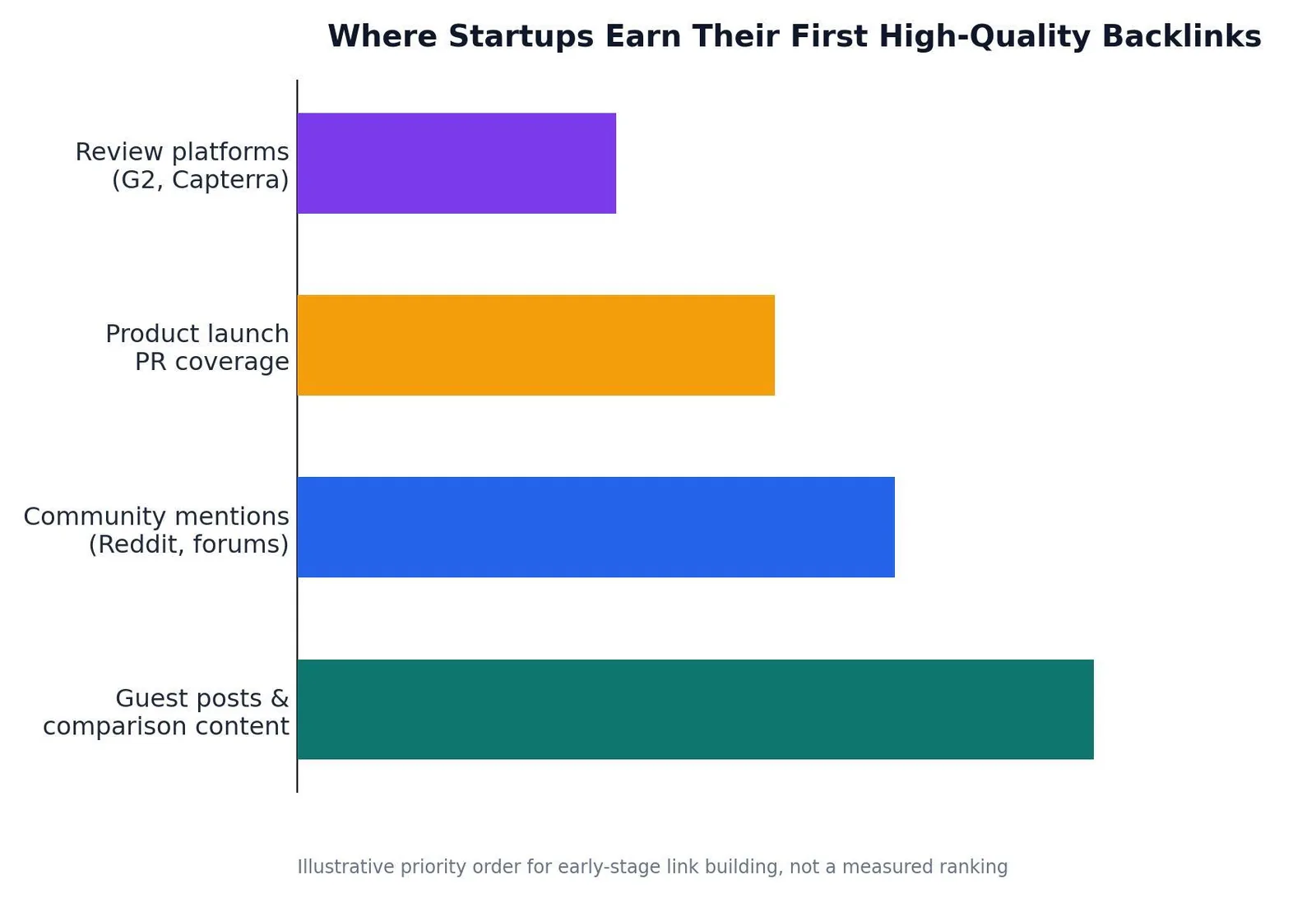
Early-stage link building rarely comes from cold outreach alone. Product launch coverage, genuine mentions in communities like Reddit, guest posts and comparison content, and reviews on platforms like G2 and Capterra are where most startups earn their first high-quality backlinks. Amplifying that same content on social media won't build backlinks directly, but it puts the content in front of the people who end up linking to it.
Step 5: Claim and optimize your Google Business Profile
Even startups without a storefront benefit from a complete Google Business Profile. Google's own guidelines confirm that a business without a storefront can still register as a service-area business, which keeps a startup eligible for a profile even when it operates entirely online. That profile reinforces brand search results and signals legitimacy, which matters when potential customers or investors search the company name directly.
Step 6: Track everything in Search Console and Analytics
Google Search Console and Google Analytics are non-negotiable from day one. Without them, there's no way to tell whether rankings are actually moving or whether that new landing page is converting the traffic it earns.
Startup SEO tool
Is your startup ready to invest in SEO?
Check off what's already true for your team. Your score updates as you go.
0 of 5
Check off items above to see if now is the right time to invest.
What to Expect: SEO Timeline for Startups
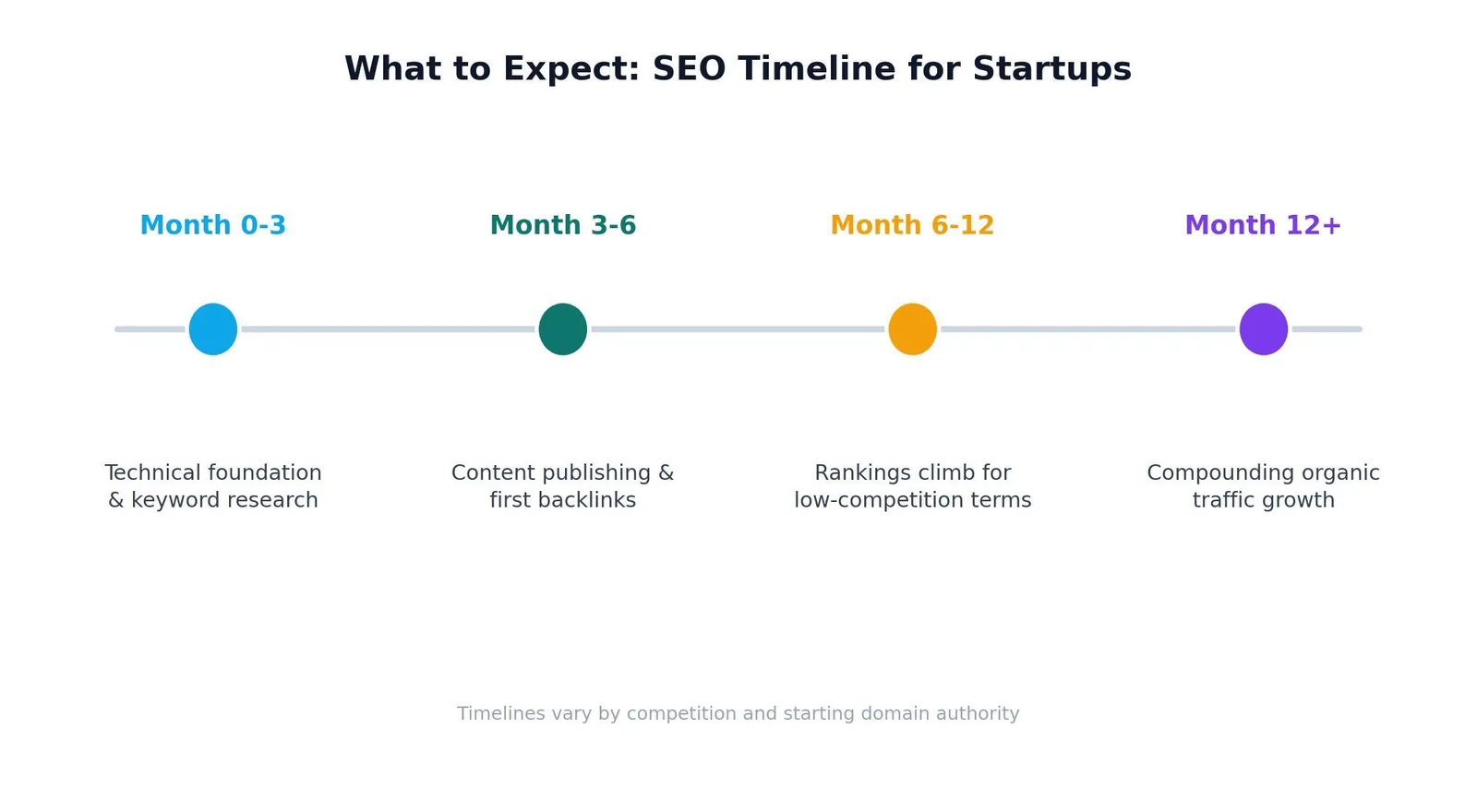
The first three months go almost entirely into technical work and keyword research, not visible growth. Months three through six are when content starts publishing and the first backlinks arrive, though rankings are still mostly invisible outside of Search Console. Startups and newer domains typically need 6 to 12 months before seeing consistent organic traffic growth, according to a 2026 analysis of SEO timelines for new websites, and that's specifically because a young domain has no backlink history yet for Google to trust. A separate 2026 Ahrefs study of newly published pages found that only 1.74 percent of new pages reach the top 10 within their first year, a useful number for any founder tempted to expect a quick payoff. Past month twelve, the effect compounds: more ranking pages, more internal links, more accumulated authority, and organic traffic that grows without a proportional increase in effort.
Founders under pressure to show fast results often kill SEO right before it would have paid off, usually around month four or five. Budgeting for a full year before judging results is the single most common fix for that mistake.
SEO Tools Every Startup Needs
Three tools cover the essentials without a large budget. Google Search Console is free and shows exactly which queries already bring traffic, which pages are indexed, and where technical errors are blocking crawlers. Google Analytics tracks what happens after someone lands on the site, which pages convert and which ones lose visitors immediately. Ahrefs (or a comparable paid tool) adds competitive keyword and backlink data once the budget allows for it, letting a team see what's already working for competitors before committing content resources to a topic.
None of this requires an enterprise budget. A CMO or founder can run all three effectively with a few hours a week once the initial setup is done. Most U.S. startups outsource this work to specialized SEO services once the team grows past that founder-led stage, though plenty of technical founders run it in-house successfully for years.
Common SEO Mistakes Startups Make
The most common one is targeting broad, high-competition keywords before the site has any authority to compete for them, which wastes months that could have gone toward winnable terms.
Publishing content before fixing technical issues is a close second. Even great writing sits on pages that load too slowly or don't get crawled properly, which caps how well anything can rank regardless of quality.
A short-term mindset causes just as much damage. Many startups treat SEO as a campaign to run for a quarter rather than a long-term asset, and abandon it right around the point it would have started paying off.
And skipping Google Business Profile setup because the company has no physical office overlooks its value for brand search, even for fully remote or online-only businesses.
Frequently Asked Questions
How much should a startup budget for SEO?
It depends heavily on stage and whether the work is done in-house or through outside SEO services, so an exact figure isn't something to take from a general guide. As a rough planning frame, many early-stage teams start with a founder or CMO-led effort covering the technical basics and keyword research, then bring in paid tools or outside help once ARR justifies the spend. Get a quote specific to your situation before committing the budget.
When should a startup start investing in SEO?
As early as possible, ideally right around product-market fit and before there's urgent pressure to show results. Since meaningful organic traffic growth typically takes 6 to 12 months to materialize, starting early gives the channel time to compound before the business needs to lean on it.
Can a small team really compete with established companies on SEO?
Yes, by targeting low-competition keywords and specific niches larger competitors haven't prioritized, rather than competing head-on for the broadest terms. Startups with limited resources consistently outrank larger sites on specific, well-answered questions.
Does SEO work for B2B SaaS startups specifically?
Yes, and often especially well. B2B buyers research extensively before purchasing, which means well-targeted SEO content addressing a specific target audience's pain points can influence a purchase decision long before a sales conversation ever starts. Gartner's 2026 research found that 67 percent of B2B buyers now prefer a rep-free buying experience, doing the bulk of their vetting independently before a salesperson ever gets involved, which is the gap organic content is positioned to fill.
Do search engines other than Google matter for startup SEO?
Google should still come first, since it drives the large majority of organic traffic for most startups. That said, Bing and legacy players like Yahoo still send meaningful referral traffic in some markets, and most of the same technical and content fundamentals apply across all of them.
The Bottom Line on SEO for Startups
SEO rewards startups that treat it as infrastructure rather than a marketing tactic to switch on and off. Fix the technical foundation, write for the terms you can actually win today, earn links the way real companies do, and give the whole system 6 to 12 months before judging it. What comes out the other side is a channel that keeps generating organic traffic long after the content budget that built it has moved on to the next project.
Start with a technical audit and one week of keyword research targeting terms your competitors haven't bothered with. That's a realistic starting point for any team, regardless of size or budget.
Ready to Build Your Startup's SEO Foundation?
Getting this right without in-house expertise is where a lot of startups burn months they don't have. Web Tonic's growth marketing team handles the technical SEO, content, and link-building work covered in this playbook as part of a full-funnel approach that also connects it to paid acquisition and attribution, so nothing runs in a silo while your team stays focused on the product.
More from Web Tonic: growth marketing services, data & analytics.
Sources: developers.google.com · support.google.com · viral-impact.com · ahrefs.com · gartner.com