Table of contents
Someone in Texas searches "youth mentorship organization near me," ready to volunteer or donate. Whether they find your nonprofit or a better-optimized one down the road depends almost entirely on work you can do for free. That's the quiet advantage nonprofits have over most businesses: Google funds a huge chunk of the visibility budget, if you know how to use it.
SEO for nonprofits combines two things most organizations underuse: organic search engine optimization and the Google Grant program, which hands eligible NGOs up to $10,000 a month in free search advertising. This guide covers how to actually use both.
Key Takeaways
- Eligible 501(c)(3) nonprofits can receive up to $10,000 per month in free Google Ads through the Google Ad Grant program, capped at roughly $329 per day, search ads only.
- The average unmanaged Ad Grant account spends only $300 of that $10,000, while well-managed accounts spend closer to $8,650, meaning most nonprofits are leaving free advertising unused.
- Ad Grant campaigns cap cost-per-click at $2.00 (unless using Maximize Conversions bidding), which makes organic SEO essential for keywords too competitive to win through the grant alone.
- A topic clusters strategy, one pillar page per mission area supported by related content, helps search engines understand your organization's expertise and authority.
- Eligibility requires current 501(c)(3) status, registration with Google for Nonprofits, a high-quality website, and an active SSL certificate.
- Long tail keywords tied to your specific mission and city, like "food bank volunteer Atlanta," face far less competition than broad terms and reach people ready to act.
What Is SEO for Nonprofits?
SEO for nonprofits is the practice of optimizing an organization's website so it ranks in search results for the causes, programs, and locations it serves, while pairing that organic work with the free advertising available through Google's nonprofit programs. It follows the same search engine optimization fundamentals as any other website: technical health, quality content, and backlinks earned through genuine outreach. It's standard marketing work, just aimed at helping the right people find your mission rather than a product.
That funding advantage matters because nonprofit budgets rarely stretch to match commercial marketing spend. The Google Grant, part of Google for Nonprofits, exists specifically to close that gap for NGOs with the standing and the website quality to qualify.
Most Nonprofits Leave Ad Grant Money on the Table
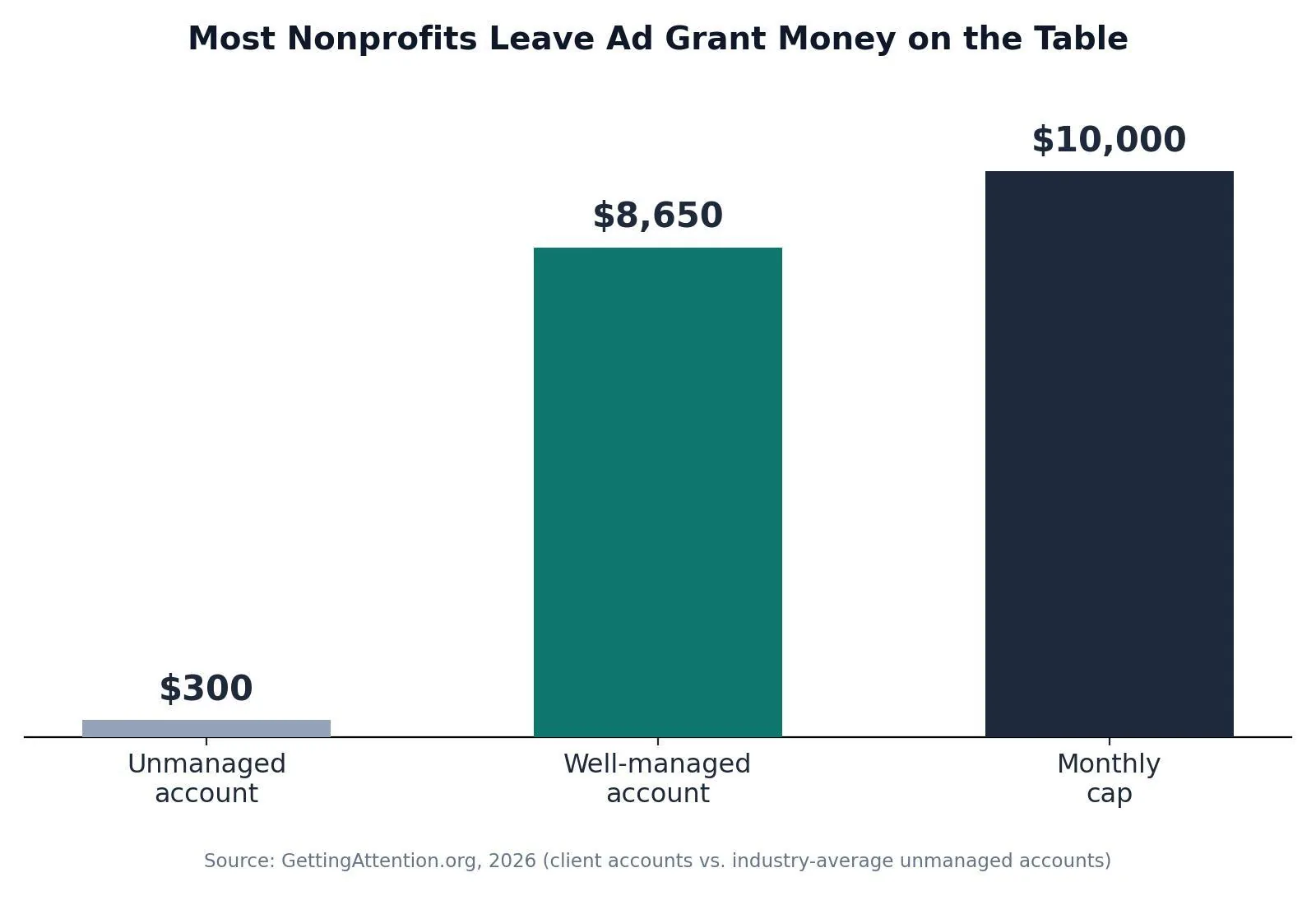
The program is generous, but most organizations barely touch it. According to GettingAttention.org's 2026 analysis, the average unmanaged Ad Grant account spends only about $300 of the available $10,000 monthly credit, while actively managed accounts in their own client base averaged $8,650 in monthly spend, with 68 percent exceeding $9,000. The gap isn't about eligibility. It's about ongoing account management: keyword relevance, landing page alignment, and conversion tracking all directly affect how much of that free budget actually gets used.
Google Ad Grant Eligibility Checklist
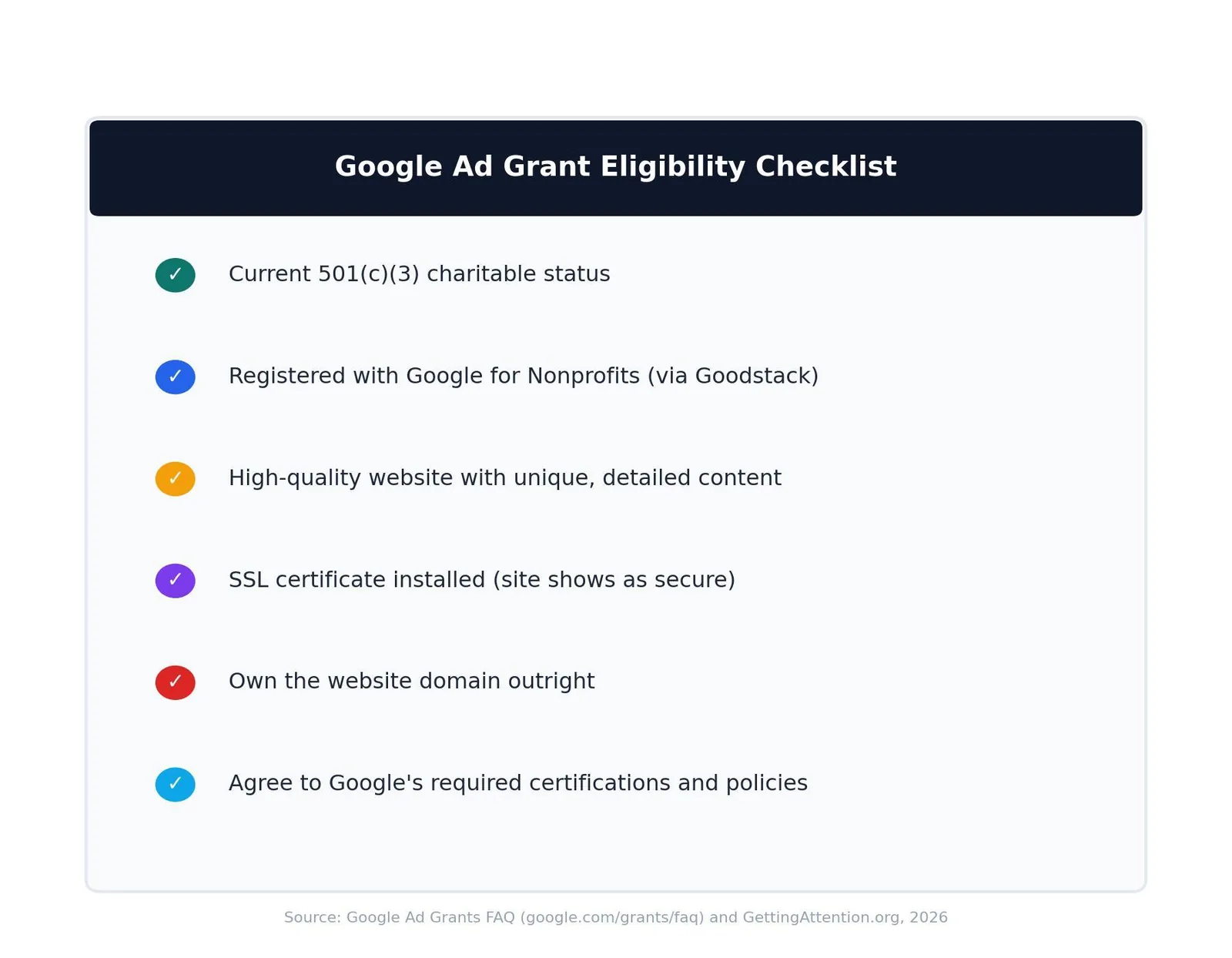
Before applying, confirm your organization meets Google's core requirements. According to Google's own Ad Grants FAQ, your organization needs current 501(c)(3) charitable status, registration with Google for Nonprofits (verified through Goodstack), a high-quality website with unique, detailed content about your mission, an active SSL certificate, and outright ownership of your website domain.
Don't Forget Local SEO and Google Business Profile
Organic SEO and the Ad Grant cover national and issue-based visibility, but many nonprofits also have a physical presence: a food bank, a shelter, a thrift store, a community center. For those organizations, local SEO matters just as much as it does for any local business. A claimed, complete Google Business Profile with accurate hours, an address that shows correctly on Google Maps, and a few recent photos helps people physically find your location, not just your website. It's a five-minute setup that most small nonprofits never get around to, and it costs nothing.
Nonprofit SEO tool
Is your nonprofit ready for a Google Ad Grant?
Check off what's already true for your organization. Your score updates as you go.
0 of 5
Check off items above to see how close you are to Ad Grant eligibility.
SEO vs. Google Ad Grant: How They Work Together
| Factor | Organic SEO | Google Ad Grant |
|---|---|---|
| Cost | Time and content investment | Free (up to $10,000/month) |
| Time to results | Typically 6-12 months | Immediate once approved |
| Keyword reach | Any keyword you can rank for | Limited to $2.00 max CPC, search only |
| Longevity | Compounds, keeps working after publication | Resets monthly, stops if compliance lapses |
| Best for | Long-term mission authority, donor trust content | Fast visibility for time-sensitive campaigns |
Neither replaces the other. The grant is powerful for immediate, keyword-specific visibility, but its $2.00 cost-per-click cap means many valuable, competitive terms are only reachable through organic SEO strategy built over time.
Topic Cluster Strategy for a Nonprofit Website
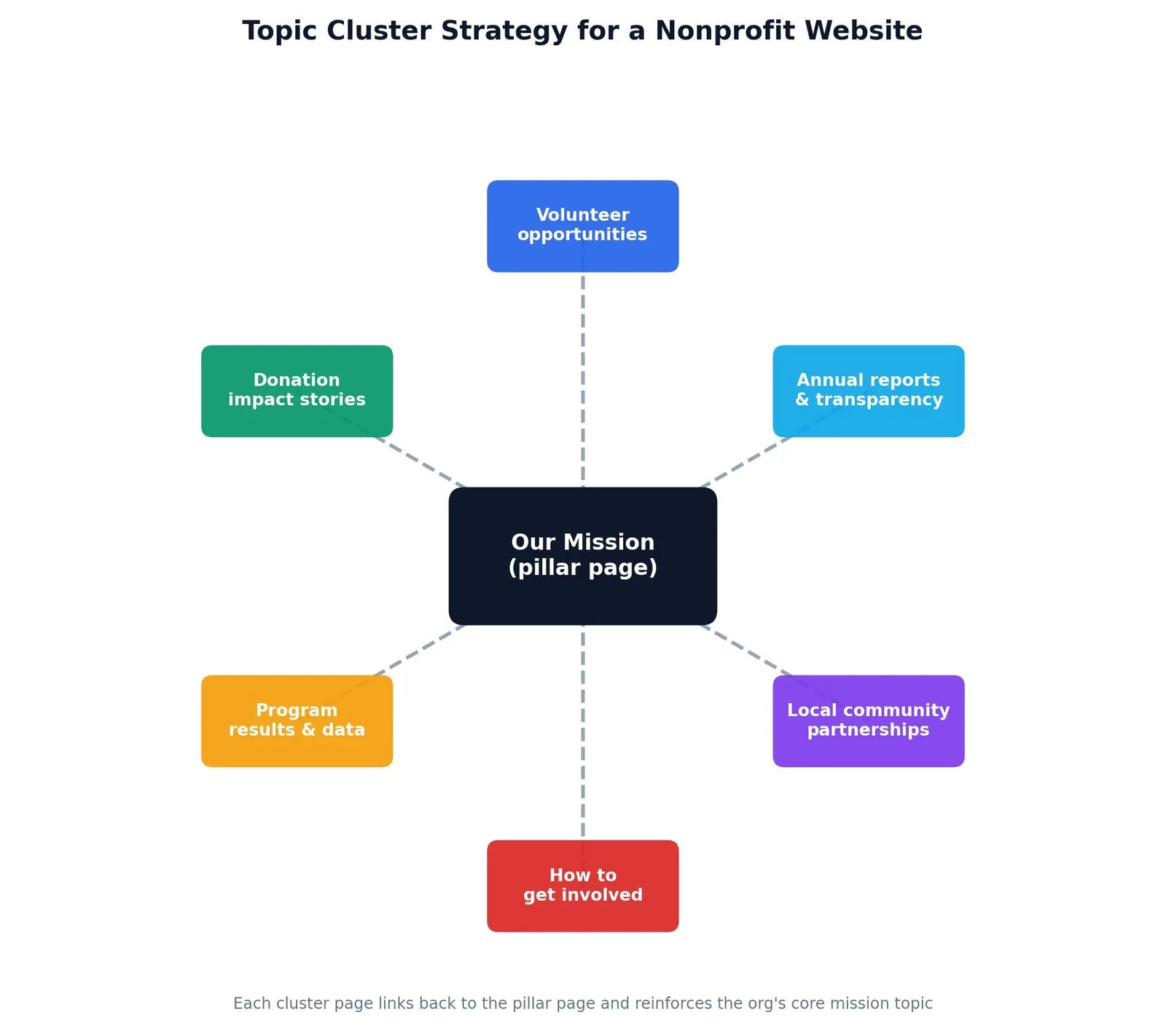
A topic clusters strategy organizes a nonprofit's content around one central mission page, with supporting pages on volunteer opportunities, donation impact, program results, and community partnerships all linking back to it. This structure helps search engines understand the full scope of your organization's work, not just isolated pages. HubSpot's own research on the topic cluster model found that the internal linking between a pillar page and its cluster pages is what signals topical authority to search engines, which is why the structure supports both organic traffic and search engine rankings over time.
The Nonprofit SEO Roadmap
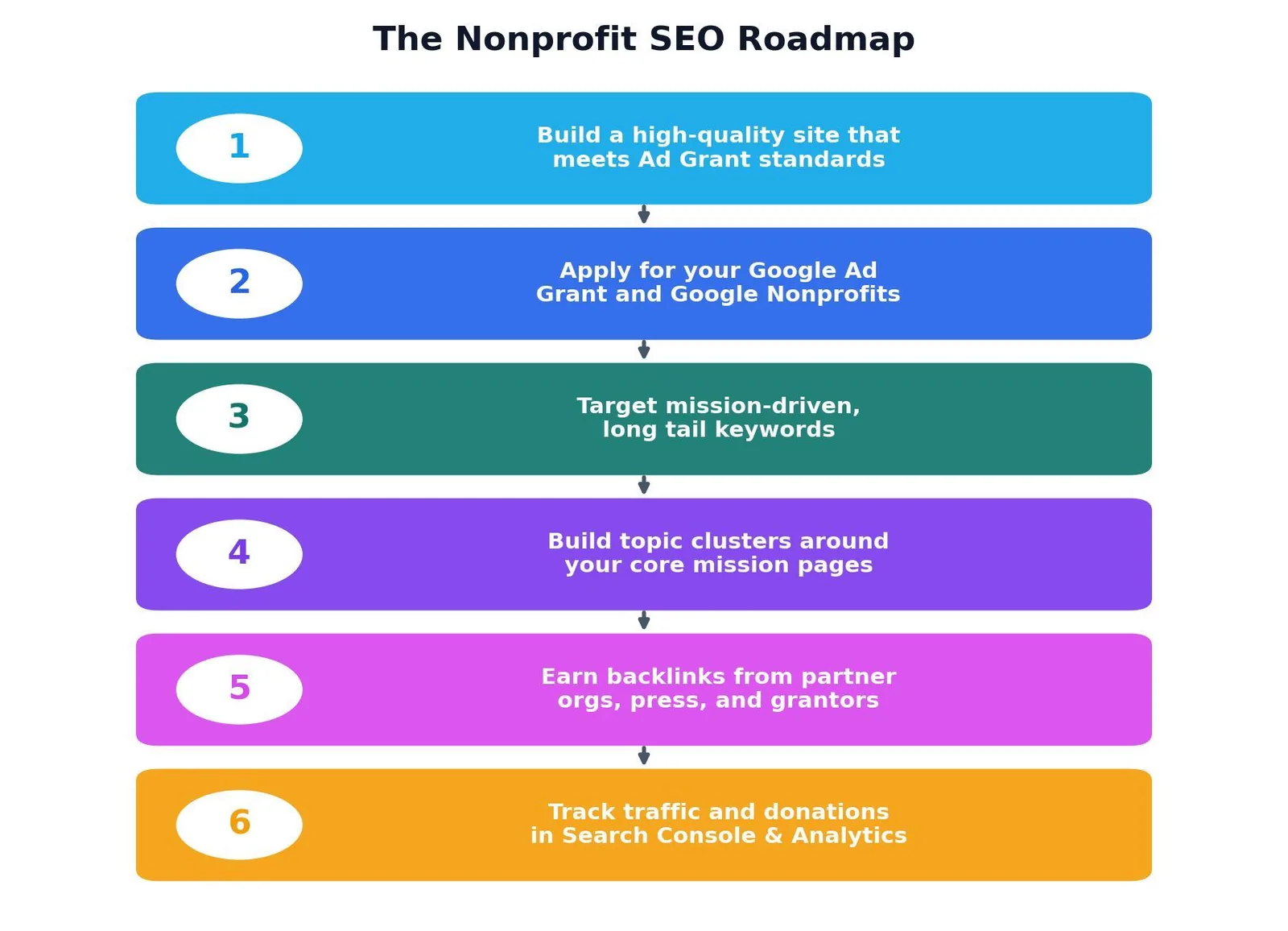
Step 1: Build a high-quality site that meets Ad Grant standards
Detailed, unique content about your mission and programs isn't just good for user experience, it's a direct eligibility requirement for the Google Grant. Search engines and Google's own reviewers check the same basics: descriptive alt text on images, clean title tags and meta descriptions on every page, and structured data marking up your organization's details. A thin or generic website risks both poor rankings and application rejection.
Step 2: Apply for your Google Ad Grant and Google for Nonprofits
Registration happens through Google for Nonprofits, verified via Goodstack. Approval typically takes anywhere from a few days to several weeks depending on how compliant your site already is.
Step 3: Target mission-driven, long tail keywords
Broad terms like "charity" are dominated by large national organizations. Long tail keywords combining your specific cause and location reach people with real, actionable intent and far less competition. Free tools like Google Keyword Planner show real search volume behind mission-specific terms, so you're not guessing which long tail keywords are worth building content around.
Step 4: Build topic clusters around your core mission pages
Structure content so every supporting page reinforces one of your organization's core pillar topics, rather than publishing disconnected posts with no internal linking strategy behind them.
Step 5: Earn backlinks from partner organizations, press, and grantors
Link building for nonprofits often comes from natural sources other sectors don't have: partner organizations, local press covering community impact, and grant-making bodies that link to grantee websites.
Step 6: Track traffic and donations in Search Console and Analytics
Google Search Console and Google Analytics show which content actually drives organic traffic and, more importantly, which pages convert visitors into donors or volunteers.
Common Nonprofit SEO Mistakes to Avoid
The most common one is applying for the Google Ad Grant before the website is actually ready, which risks both rejection and a wasted application cycle.
A close second is letting an approved account sit unmanaged. Unmanaged accounts spend only a small fraction of the $10,000 monthly cap on average, so approval alone doesn't accomplish much without ongoing attention.
Content often gets published without any topic cluster structure behind it, which leaves pages competing with each other instead of reinforcing a shared mission topic and weakening overall authority.
And technical basics like Core Web Vitals and mobile performance get overlooked more often than they should, undercutting both organic rankings and Ad Grant landing page quality scores at the same time.
And technical basics like Core Web Vitals and mobile performance get overlooked more often than they should. Google's own Search Central documentation confirms that loading speed, responsiveness, and visual stability are metrics its core ranking systems use to reward strong page experience, and neglecting them undercuts both organic rankings and Ad Grant landing page quality scores at the same time.
Frequently Asked Questions
How is SEO for nonprofits different from SEO for a regular business?
The core mechanics are the same: technical health, quality content, and link building. What's different is the funding layer. Nonprofits can access the Google Grant, up to $10,000 a month in free search ads, which no commercial business qualifies for, making the SEO and paid channels unusually complementary for NGOs. Social media plays a bigger supporting role too, since donor trust often builds through ongoing visibility on platforms nonprofits already use for community engagement, not through search alone.
Can a nonprofit lose its Google Ad Grant?
Yes. According to Google's own Ad Grants account management policy, accounts can be suspended for policy violations, including falling below a 5 percent click-through rate for two consecutive months, using single-word keywords, or missing conversion tracking. Staying compliant requires ongoing account management, not just initial approval.
Do we need an SEO agency, or can our team manage this in-house?
Steps 1, 2, and 3 are realistic for an in-house team or a motivated volunteer to handle directly. Ongoing Ad Grant compliance and technical SEO work are where many nonprofits benefit from SEO services, particularly since account suspension risk makes ongoing management worth the investment for larger grant amounts.
How much should a nonprofit budget for SEO if the Ad Grant is free?
It depends on organizational size and how much of the work is handled in-house versus outsourced, so there's no single figure that fits every case. Get a quote specific to your organization before committing budget, and remember that even a fully free Ad Grant benefits from paid strategic support to actually use the full $10,000 each month.
The Bottom Line on SEO for Nonprofits
Nonprofits have an advantage most organizations don't: a genuine path to free advertising that most competitors in the commercial world will never have access to. The catch is that the grant alone doesn't work without a website and content strategy solid enough to use it well. Combine organic SEO's long-term compounding value with active Ad Grant management, and a mission-driven organization can out-visibility competitors with far bigger budgets.
Start by confirming your eligibility checklist this week. Every unmanaged month is $10,000 in free advertising quietly going unused.
Ready to Put Your Google Grant to Work?
Web Tonic runs a dedicated digital marketing program for nonprofits and NGOs, built around exactly this combination: SEO optimization for local, mission-driven searches, targeted advertising through Google Grants, and content that turns visitors into donors and volunteers. If your organization is ready to stop leaving grant dollars unused, that's exactly the kind of work this program handles.
More from Web Tonic: growth marketing services, data & analytics.
Sources: gettingattention.org · google.com · blog.hubspot.com · developers.google.com · support.google.com