Table of contents

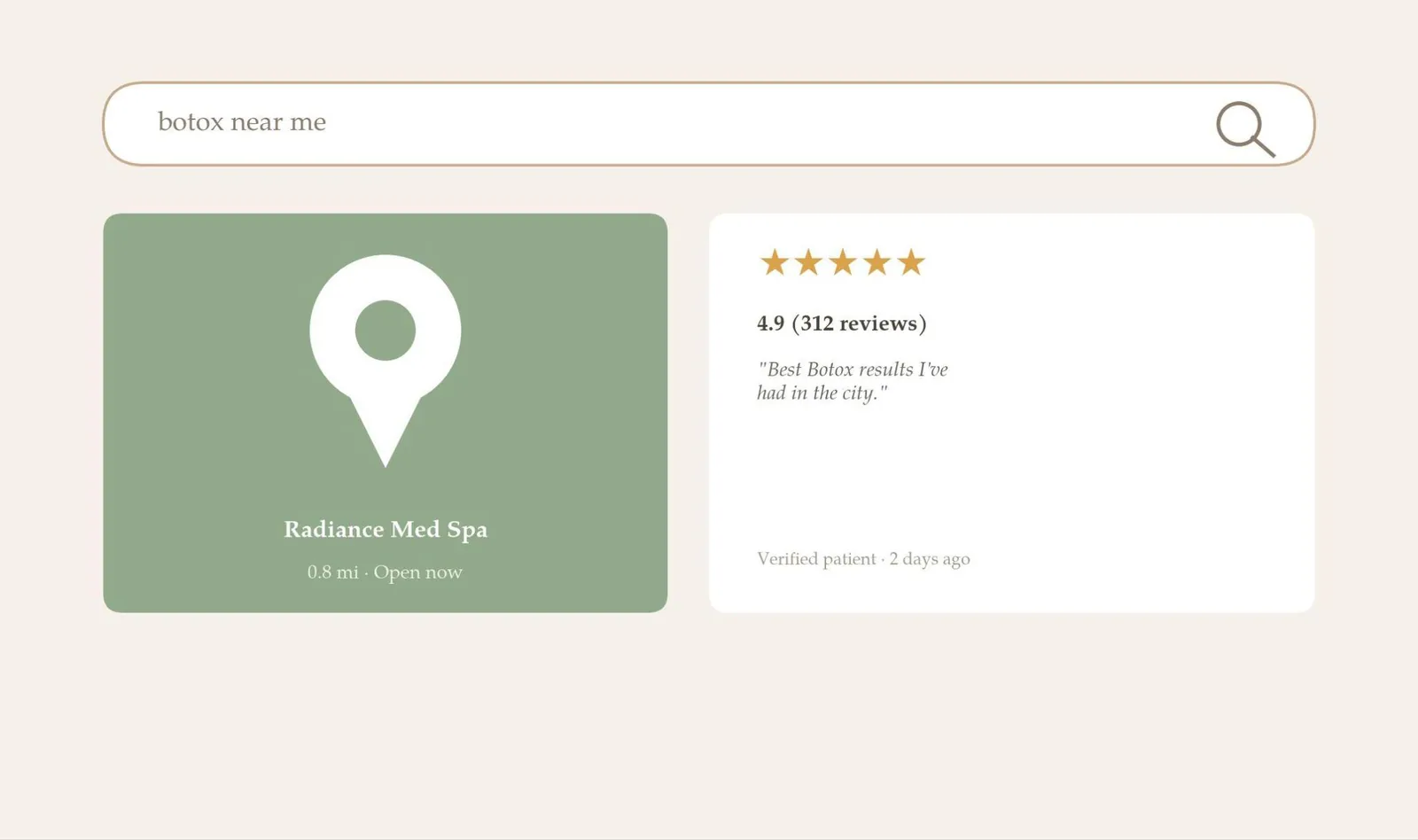
A med spa client has to physically walk through the door. Unlike an e-commerce brand that can sell to anyone with a shipping address, every client a spa acquires through search is someone within driving distance. That single fact makes local SEO the highest-leverage marketing channel a medical spa has. This playbook covers what actually drives bookings for med spas in 2026: Google Business Profile optimization, review strategy, treatment-specific content, and the compliance considerations that come with running a healthcare-adjacent business.
Whether the goal is dominating a single neighborhood or competing across a market like Dallas, Chicago, Atlanta, or Manhattan, the same fundamentals apply.
Key Takeaways
- The Map Pack (the top 3 local listings) captures roughly 40% to 44% of all local search clicks. A med spa outside those top three is competing for what's left over, not the majority of searchers.
- 76% of people who search for something nearby on their phone visit or call a business within 24 hours, which puts local search among the most immediately actionable channels a med spa has.
- 83% of consumers use Google reviews to evaluate a local business, and 71% won't consider one rated under 3 stars. Review strategy is not optional for a medical spa.
- Google Business Profile ranks listings on relevance, distance, and prominence. Distance can't be optimized away, but relevance and prominence are entirely within a spa's control.
- The HIPAA tracking-pixel restrictions many marketers still worry about were significantly narrowed by a 2024 federal court ruling. Standard analytics tools can generally be used on public marketing pages, though patient portals remain restricted — more on this below.**
- Each treatment needs its own dedicated page. A single services page listing twelve treatments cannot rank specifically for Botox, laser hair removal, or any other individual service.
What Is SEO for Med Spas?
SEO for med spas is the practice of optimizing a medical spa's website, Google Business Profile, and content so it ranks for the local searches that drive bookings — the local search engine optimization (SEO) discipline applied to a highly specific, high-trust vertical. It combines standard local SEO — Google Maps visibility, review management, on-page optimization — with a layer of healthcare-adjacent compliance that a hair salon or restaurant never has to think about.
The business case is straightforward. A med spa's clients come from a defined geographic radius, so ranking locally isn't one channel among many. It's closer to the primary channel, with PPC and social media filling in around it. That's a digital marketing setup where online presence and physical proximity work together rather than competing, which is unusual outside of local business categories like this one.
Why Local SEO Is the Dominant Channel for Med Spas
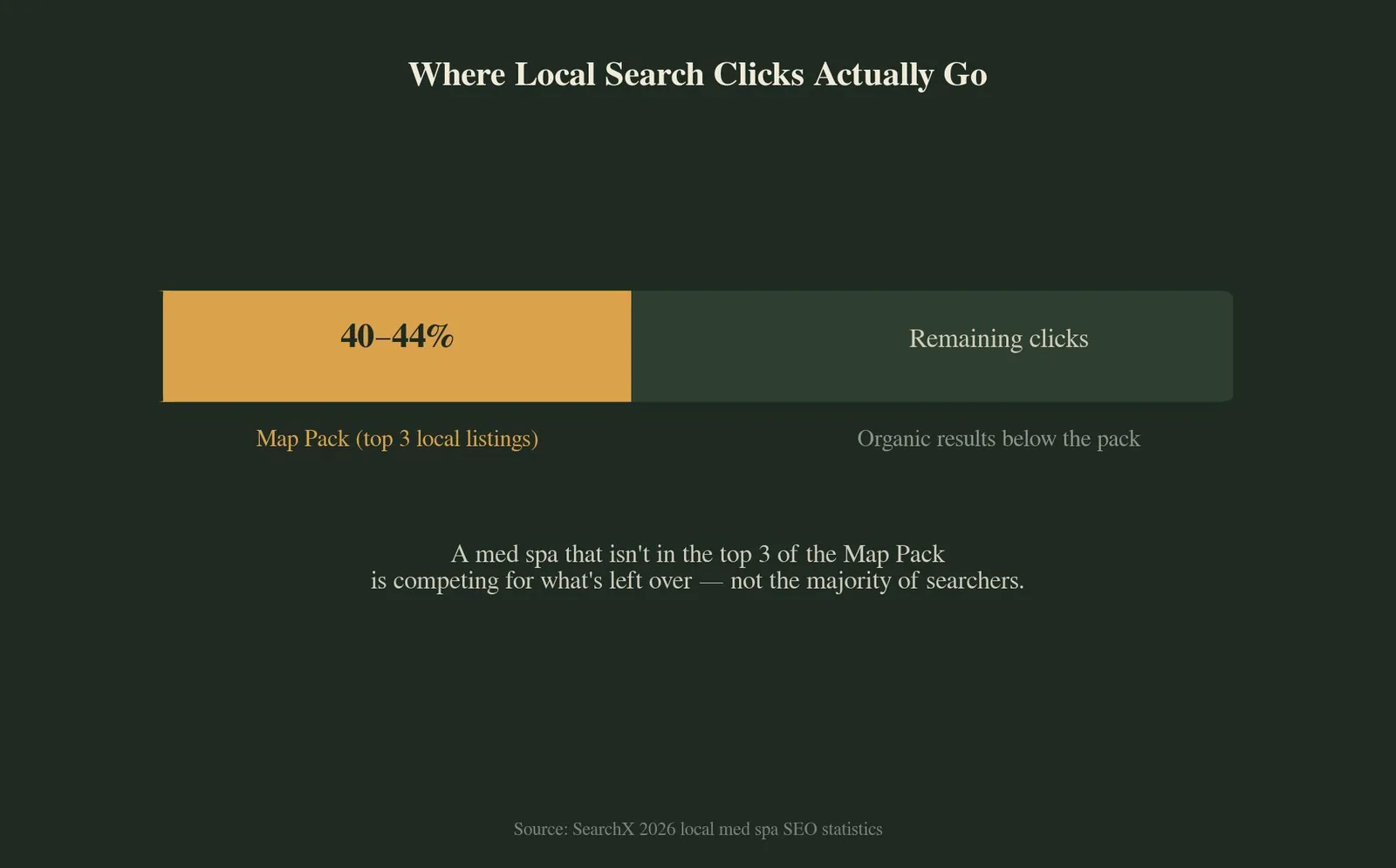
The Map Pack drives roughly 40% to 44% of all local search clicks, sitting above the regular website results entirely. Someone searching "medical spa near me" on their phone sees three listings with a map, star ratings, and contact details before they see a single blue link.
The behavior backing that visibility is what makes it valuable. Google's own research found that 76% of people who search for something nearby on their phone visit or call a business within 24 hours, and a meaningful share of those searches convert same-day. This pattern holds specifically in the United States, where med spa client acquisition is almost entirely geographically tied, unlike e-commerce or SaaS businesses that can serve a customer anywhere. For a medical spa, that geographic tie is the difference between a competitor getting found first and someone booking a consultation this afternoon.
The Three Signals Behind Every Map Pack Ranking
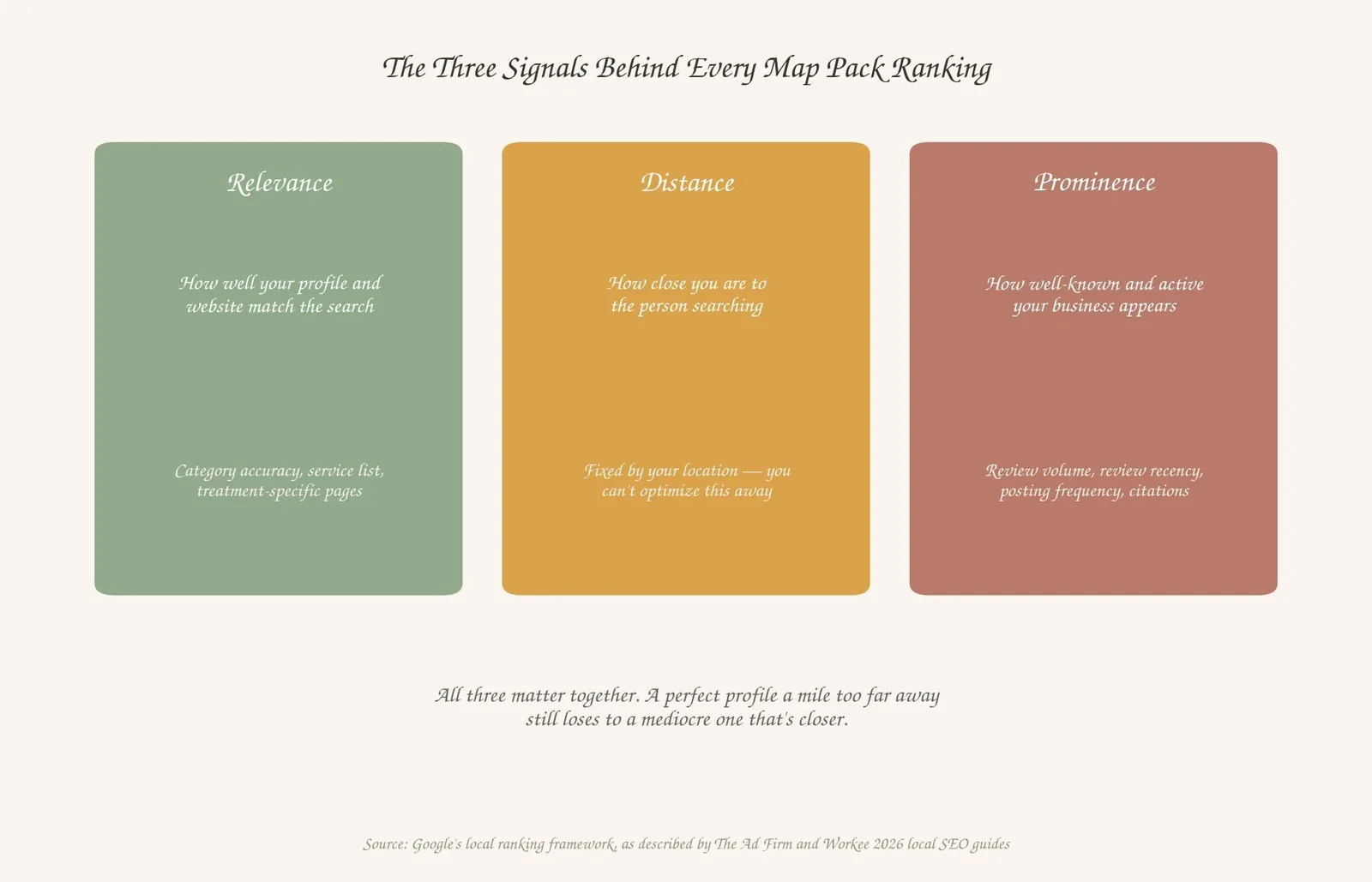
Google Business Profile ranks local listings on three factors: relevance, distance, and prominence. Distance is fixed. A spa two miles from the searcher has a structural advantage over one ten miles away, and no amount of content changes that.
Relevance and prominence are entirely within a med spa's control, though. Relevance comes from an accurate primary category ("Medical spa," not "Day spa"), a complete and specific service list, and website content that backs up what the profile claims. Category accuracy and a detailed service list directly affect which treatment keywords a profile can even appear for — a vague "Day Spa" category costs a med spa visibility it never gets a chance to compete for. Prominence comes from consistent reviews, accurate citations across directories, and regular profile activity: fresh photos, posts, and updates that signal the business is active.
Reviews: The Trust Signal That Decides Bookings
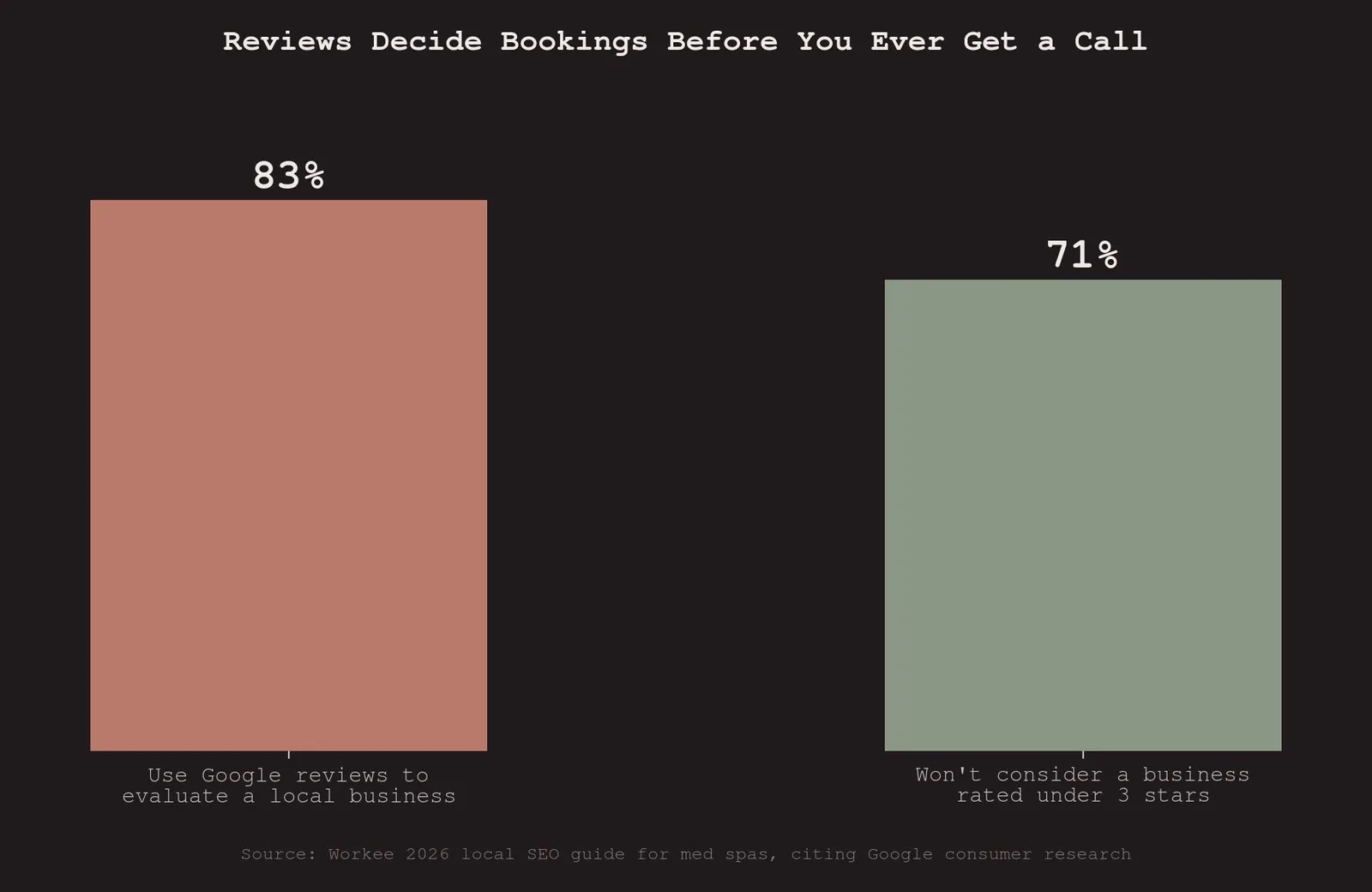
83% of consumers use Google to evaluate local businesses before visiting, and 71% won't consider one rated under 3 stars. The service is elective and the trust bar sits higher than most local businesses, so review volume and recency function as a direct lever on booking rate for a medical spa, not just a vanity metric.
A steady cadence beats a large but stagnant number. A consistent flow of 8 to 12 new reviews each month tends to outperform a profile with more total reviews but no recent activity, since Google weighs recency alongside volume and rating. Photo volume and recency work as their own prominence signal, separate from review count — a profile that hasn't added a new photo in months reads as inactive to the same algorithm that rewards a steady review cadence, which makes photo uploads as much a strategy decision as reviews are. Automating review requests to go out within 48 hours of a visit, and responding to every review within 24 hours, keeps that cadence running without manual follow-up.
HIPAA and Med Spa Marketing: What Actually Applies**
Med spas sit in a genuinely more sensitive compliance category than most local businesses. It's worth being precise about what current rules actually require rather than carrying forward outdated caution.
For several years, guidance from HHS's Office for Civil Rights (OCR) warned that combining a website visitor's IP address with a visit to an unauthenticated public page about specific health conditions or providers could count as protected health information under HIPAA. That put standard tools like Google Analytics and Meta Pixel in a legal gray zone on public marketing pages. A federal court in the Northern District of Texas vacated that specific portion of the guidance in June 2024, ruling that OCR had exceeded its authority. HHS withdrew its appeal in August 2024, finalizing the ruling.
In practice, standard analytics and ad tracking tools can generally be used on a med spa's public-facing marketing pages without that specific combination automatically constituting a violation. What the ruling didn't change: tracking technology on authenticated pages, like a patient portal or scheduling login, still falls under standard HIPAA restrictions, and other privacy laws — state statutes, FTC enforcement — can still apply. Penalties for confirmed violations remain real. The 2026 civil penalty schedule sets the top tier, for willful neglect not corrected, at a minimum of $73,011 per violation. Standard tracking on public pages sits on firmer ground than it did two years ago, but patient portals, before-and-after photo consent, and review-response language still deserve a compliance-first approach.
AI Search and AEO: The Next Local Ranking Surface
Answer engine optimization (AEO) is becoming a second track a med spa has to run alongside traditional local SEO, not a replacement for it. AI systems pull from the same Google Business Profile data, schema markup, and treatment-specific content that already supports Map Pack rankings. A spa that's done the local SEO work correctly is most of the way to being AI-search-ready too.
The practical additions are small. FAQPage schema on treatment pages helps AI systems extract direct answers to questions like "how long does Botox last." That's a different thing from the FAQ rich result that used to show as an expandable dropdown directly in Google Search — that specific SERP feature was deprecated in May 2026. The schema itself is still valid and still read by AI systems; it just no longer produces that visible dropdown. Structured data covering services, location, hours, and reviews gives AI Overviews a verifiable source to cite even in zero-click scenarios where the user never visits the site. None of this replaces the underlying work of building treatment pages and earning reviews. It extends that same work to a newer surface.
Comparative Table: SEO vs. PPC for Med Spas
Most med spas eventually need both channels, but they serve different purposes:
| Factor | SEO (organic + local) | PPC (paid search) |
|---|---|---|
| Cost model | Time and content investment upfront | Ongoing cost per click |
| Time to results | Typically 2 to 6 months for local visibility | Immediate |
| Best for | Building durable Map Pack and organic presence | Filling calendar gaps, launching a new location fast |
| Compounding value | Keeps ranking and converting after the work is done | Stops the moment ad spend stops |
| Typical monthly investment (USD) | Roughly $800–$2,500 for a single-location spa, higher in competitive markets like New York or Los Angeles | Scales directly with ad spend and market competitiveness |
⚠️ Pricing note: the SEO investment range above is a single-source estimate from one industry guide, not a universal benchmark. Actual costs vary significantly by market competitiveness and agency scope — treat it as a planning reference, not a quote, and verify against current market rates before it goes out under a client-facing figure.
Building Treatment-Specific Pages
Botox and other high-search-volume treatments compete differently than a niche service does. "Botox near me" is one of the most contested local searches in the U.S. aesthetics industry, typically dominated by established multi-location clinics in any given city. A newer or smaller spa often has a real shot at less competitive, more specific searches instead: a particular treatment combined with a neighborhood, or a comparison query like "Botox vs. Dysport," which demonstrates clinical expertise while it ranks.
The structural rule underneath all of this: each treatment needs its own URL, title tag, and content. A single page listing fifteen services can't rank specifically for any of them. It's a bigger production lift than one long services page, but it's the difference between showing up for individual treatment searches and being invisible to all of them.
Tools Worth Using
Google Search Console and Google Analytics cover the technical and behavioral basics for free: indexing status, which queries bring traffic, and what happens after someone lands on the site. Google Business Profile itself works as a management tool as much as a listing. Beyond Google's own tools, practice management platforms like Tebra (formerly PatientPop) bundle website, local SEO, and patient communication features built specifically for healthcare providers, which can consolidate several of these workflows for a spa that doesn't want to manage them separately.
None of these tools replace the underlying work of building out treatment pages and earning reviews consistently. They make that work faster to execute and easier to measure.
Try It Yourself: Med Spa Local SEO Checklist
Check off what's already true for your Google Business Profile and see how ready your local presence really is.
Med Spa Local SEO Check
Is your Google Business Profile actually working?
Check off what's already true for your med spa. Your score updates as you go.
Google Business Profile
Reviews & reputation
Website & content
0 of 10
Check off items above to see how ready your local presence really is.
Common Mistakes in Med Spa SEO
Listing every treatment on a single crowded services page instead of giving each one its own dedicated page caps how well any individual treatment can rank, regardless of how genuinely high quality the content itself is.
Letting review requests lapse after the first few months creates a stale-looking profile even with a strong star rating. Google weighs recency alongside volume.
Stuffing the Google Business Profile name field with services and city names — "Glow Med Spa - Botox Filler Laser Scottsdale" instead of just "Glow Med Spa" — is a policy violation that risks profile suspension. It's not a ranking hack anymore, even though it once worked as one.
And treating every review response the same way, without considering that a friendly "thanks for visiting" can confirm a patient relationship in a way that matters for compliance, overlooks a real risk specific to operating in a sensitive category.
Frequently Asked Questions
How long does it take for a med spa to rank locally?
Map Pack visibility in a moderately competitive market typically shows up within 60 to 90 days of consistent work, with stronger positioning by month four to six. Highly competitive markets can take 9 to 12 months for dominant positioning.
Does a med spa need a separate page for every treatment?
Yes. A single page listing many treatments can't rank specifically for any of them. Each major service needs its own URL, title tag, and dedicated content.
Is it still risky to use Google Analytics on a med spa website because of HIPAA?
The specific risk most marketers heard about — tracking an IP address on a public, unauthenticated page — was significantly narrowed by a 2024 federal court ruling. Patient portals and authenticated pages remain more tightly restricted. Consult qualified counsel for a specific compliance determination.
How many Google reviews does a med spa need to rank well?
There's no fixed threshold, but a consistent monthly flow — roughly 8 to 12 new reviews — tends to outperform a larger but inactive review base, since recency factors into ranking alongside volume and rating.
Should a med spa prioritize SEO or PPC first?
SEO takes longer to show results but compounds and keeps working after the initial investment. PPC delivers immediate visibility. Most established med spas eventually run both, with PPC filling gaps while SEO builds durable Map Pack presence.
Turning Local Visibility Into Booked Consultations
SEO for med spas rewards the same fundamentals as any local business, with a compliance layer on top that can't be treated as optional. Get the Google Business Profile category and name right. Build a review cadence that doesn't stall out. Give every treatment its own page. Handle the healthcare-adjacent parts of the business — patient consent, review-response language, tracking on authenticated pages — with the seriousness they actually require. Do that consistently, and the Map Pack stops being a competitive long shot. It becomes where new patients actually find the practice.
**Disclaimer: This section is provided for general informational purposes only and does not constitute legal advice. HIPAA and related regulatory guidance are subject to change, including through ongoing litigation and future agency action. Web Tonic and the authors of this article make no representation as to the completeness, accuracy, or current applicability of the information presented here, and accept no liability for actions taken or not taken based on it. Readers should consult a qualified healthcare compliance attorney regarding their specific situation before relying on any statement in this section.
More from Web Tonic: growth marketing services, data & analytics.
Sources: searchxpro.com · workee.ai · rankalley.com · theadfirm.net · hklaw.com · aha.org · accountablehq.com