



Table of contents
International SEO pays for a med spa only where foreign or non-English-speaking clients already exist: tourist destinations, multilingual cities and multi-country brands, against a global backdrop of close to 38 million aesthetic procedures in 2024. No source measures the share of med spa clients who travel from abroad, so this page sizes the visitor market and the search landscape instead.
Key Takeaways
- ISAPS counted close to 38 million aesthetic procedures in 2024.
- 17.4 million were surgical and 20.5 million non-surgical.
- The US led with over 6.1 million procedures; Brazil followed with 3.1 million.
- Procedures rose 42.5% over four years, per ISAPS.
- 46.4 million international air travelers visited the US in 2025 (NTTO).
- 34.3 million of them were overseas visitors.
- 81% of US med spas are single-location (AmSpa, 2023 data).
- The US counted 10,488 med spas in 2023, up from 8,899.
- Naver held 43.06% of Korean search in September 2026 (Statcounter).
- English is on 49.5% of websites with a known language (W3Techs).
- 76% of shoppers prefer information in their own language (CSA Research, 2020).
Who international SEO is for in aesthetics
The American Med Spa Association's 2024 State of the Industry executive summary counted 10,488 US med spas in 2023, up from 8,899 in 2022, with 81% operating a single location and multi-location operators averaging nine sites. A single-location clinic in a suburb serves its suburb. The clinics for whom international SEO is real fall into three groups: those in tourist cities, those in multilingual neighbourhoods, and brands with clinics in more than one country.
| Clinic profile | International SEO job | Evidence base | Priority |
|---|---|---|---|
| Single-location suburban med spa | Usually none beyond local SEO | AmSpa: 81% single-location | Low |
| Clinic in a tourist city | Visitor-language landing pages | NTTO inbound travel data | Medium |
| Clinic in a multilingual metro | Spanish or other-language service pages | Census home-language data | Medium to high |
| Multi-country aesthetics brand | Country and language versions with hreflang | Company data only | High |
| Destination clinic abroad | Acquisition pages for foreign patients | ISAPS foreign-patient ranking | High, competitive |
The global procedure picture
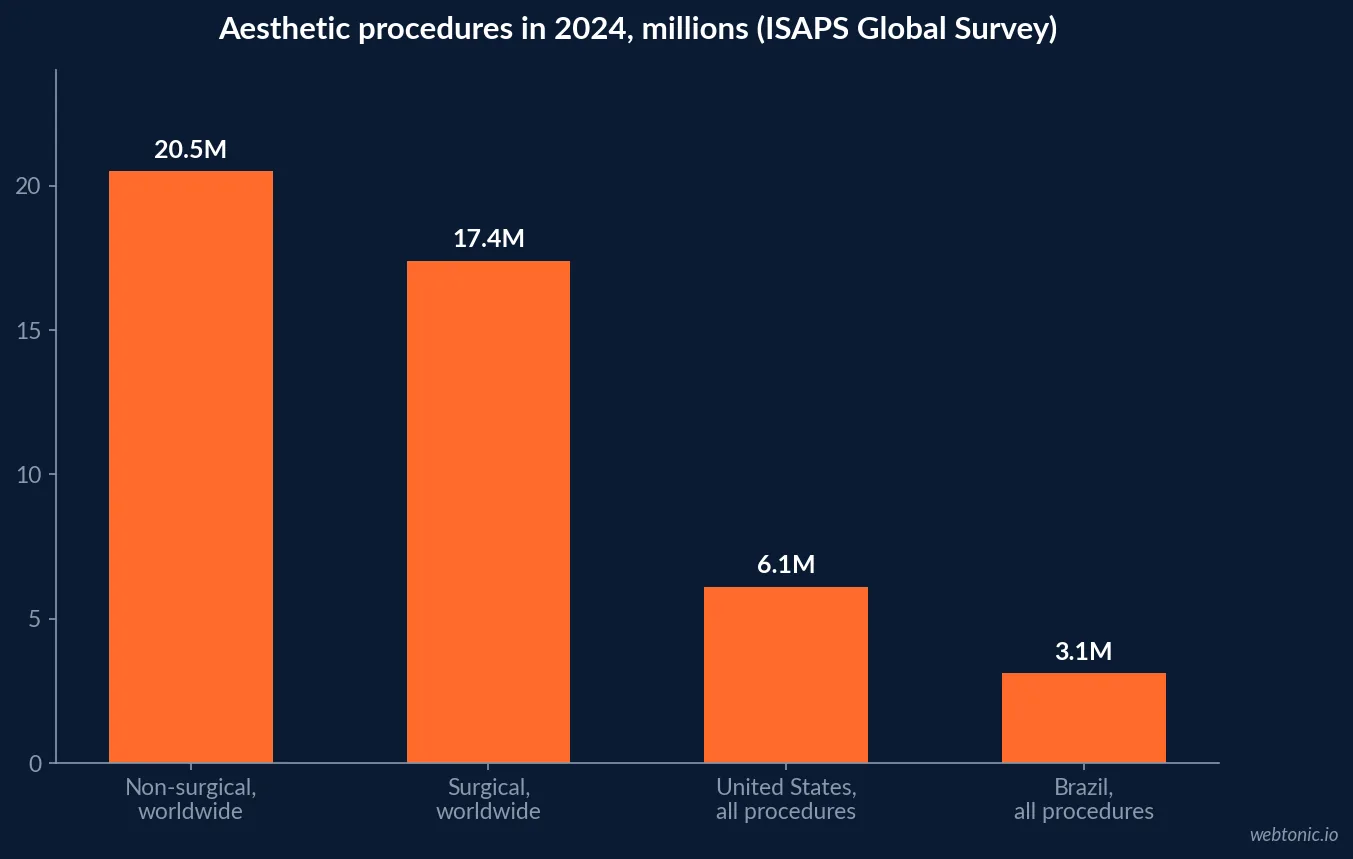
ISAPS's Global Survey 2024, released in June 2025, reported more than 17.4 million surgical and 20.5 million non-surgical procedures, with total volume up 42.5% over the last four years. The US performed the most procedures at over 6.1 million, followed by Brazil at 3.1 million, which leads in surgical procedures with 2.3 million, and Japan. ISAPS surveys plastic surgeons, so injectables and laser treatments delivered in med spas by non-surgeons are not fully captured.
| ISAPS Global Survey 2024 measure | Value | What it tells a med spa |
|---|---|---|
| Total aesthetic procedures | Close to 38 million | Global demand context, surgeon-reported |
| Surgical procedures | 17.4 million+ | Surgery tourism competes with domestic clinics |
| Non-surgical procedures | 20.5 million | The med spa category, partly captured |
| Four-year growth | 42.5% | Demand is rising globally |
| United States volume | 6.1 million+ | Largest single market |
| Brazil volume | 3.1 million | Second-largest, first in surgery |
Where foreign patients go
ISAPS adds one line that matters for international SEO: on average, the countries seeing the highest proportion of foreign patients are Tunisia, the UAE, Colombia and Turkiye. That is the competitive set a US clinic faces when it tries to attract travelling patients, and those destinations market heavily in English, French, Arabic and German. ISAPS does not publish counts of medical tourists, and we found no primary source that does reliably, so we publish none.
Visitors already in the United States
The tourist demand that a US med spa can realistically reach is the visitor already in town. The National Travel and Tourism Office's 2025 Survey of International Air Travelers reports 46.4 million international inbound air travelers from Canada, Mexico and overseas in 2025, including 34.3 million overseas visitor arrivals. The average overseas visitor decided on the trip 104 days before travelling and booked a flight 79 days ahead, which leaves a planning window in which a visitor-language page can be found.
| NTTO inbound measure (2025) | Value | Implication |
|---|---|---|
| International inbound air travelers | 46.4 million | Includes Canada and Mexico |
| Overseas visitor arrivals | 34.3 million | Excludes Canada and Mexico |
| Trip decision lead time | 104 days | Visitors research months ahead |
| Airline booking lead time | 79 days | Content must rank before booking |
Search engines in aesthetic hubs
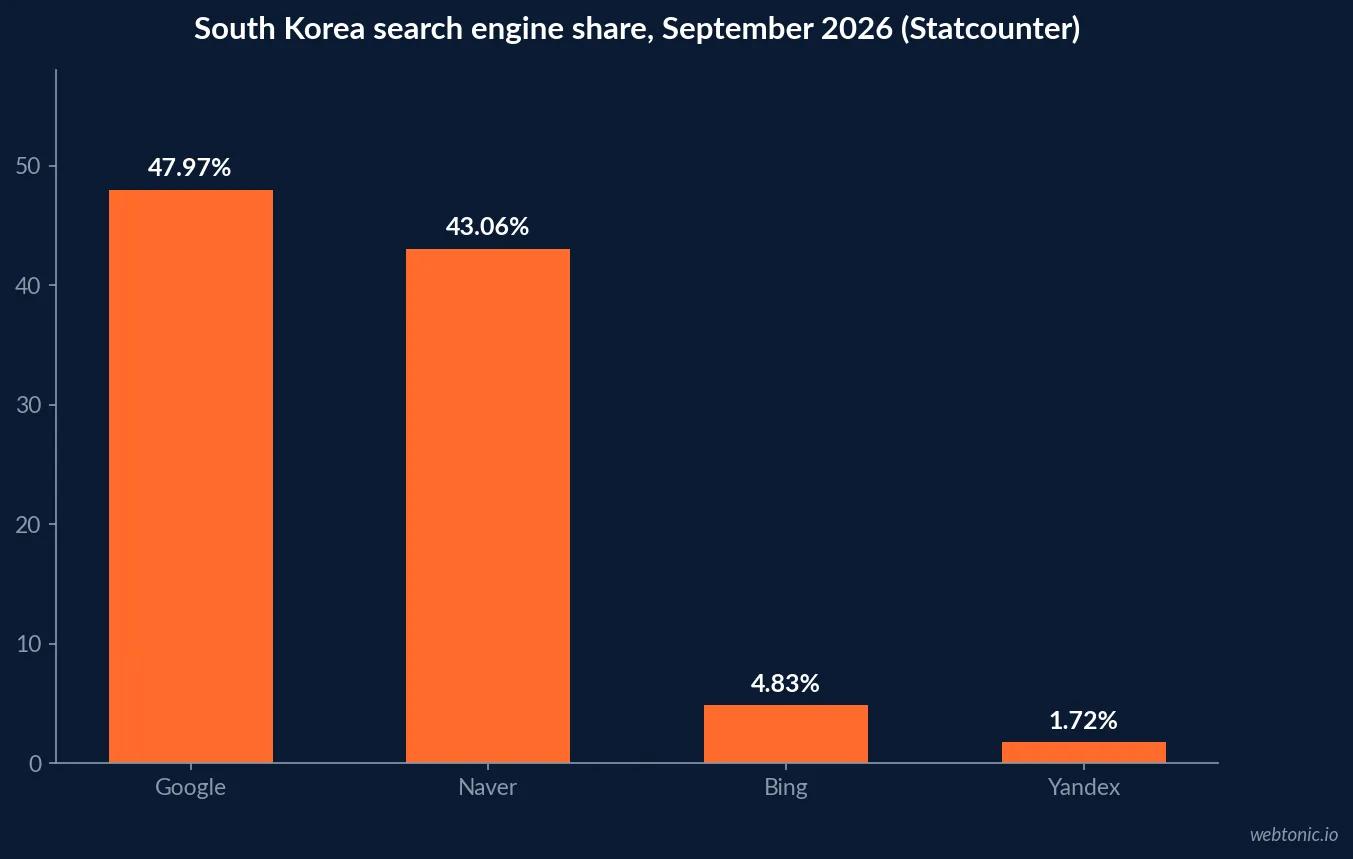
South Korea is the clearest case where Google-only SEO misses half the market. Statcounter put Google at 47.97% and Naver at 43.06% of South Korean search in September 2026, with Bing at 4.83%; Korean domestic measurement services place Naver ahead. In the Americas the picture is simple: Google held 86.1% of US search in August 2026, so Spanish and Portuguese pages compete on Google.
| Market (Statcounter) | Month | Leading engine | Runner-up |
|---|---|---|---|
| South Korea | September 2026 | Google 47.97% | Naver 43.06% |
| United States | August 2026 | Google 86.1% | Bing |
| South Korea, Bing | September 2026 | 4.83% | Small but non-zero |
| South Korea, Daum | September 2026 | 0.73% | Legacy portal |
The language of the web and of buyers
W3Techs reports English on 49.5% of websites whose content language it knows, followed by Spanish at 6.0%, German at 5.9% and Japanese at 4.9%, as of September 2026. Buyers, though, prefer their own language: CSA Research's 2020 survey of 8,709 consumers in 29 countries found 76% prefer products with information in their native language, rising to 89% among those with no English. For elective, high-trust treatments, that gap matters.
At home, the Census Bureau found 21.7% of US residents aged 5 and over speak a language other than English at home, 61.1% of them Spanish. In many metros, a Spanish med spa page reaches more people than any tourist campaign.
Which visitor languages care most about translation
CSA Research's country split is the most useful number for choosing visitor languages. In its 2020 B2C survey, the share preferring products with information in their own language was highest in Taiwan at 94%, Korea and China at 92%, Japan at 90% and Indonesia at 88%. The most tolerant market was Romania, where 48% were satisfied with information in English. For a clinic courting Asian visitors, an English-only site starts at a disadvantage that no amount of link building fixes.
| Country (CSA Research 2020) | Prefer own-language product information | Med spa takeaway |
|---|---|---|
| Taiwan | 94% | Traditional Chinese pages for Taiwanese visitors |
| Korea | 92% | Korean pages plus a Naver presence |
| China | 92% | Simplified Chinese; Google is not the main engine there |
| Japan | 90% | Japanese pages for a large aesthetics market |
| Indonesia | 88% | Bahasa Indonesia for South-East Asian visitors |
| All 29 countries | 76% | Own-language content is the default expectation |
| Content language (W3Techs, Sep 2026) | Share of websites | Competition signal |
|---|---|---|
| English | 49.5% | Crowded; hardest to stand out |
| Spanish | 6.0% | Thinner field, large US audience |
| German | 5.9% | Relevant for European visitors |
| Japanese | 4.9% | High preference, modest supply |
| French | 4.5% | Canadian and European visitors |
| Korean | 0.9% | Very thin supply for a high-preference market |
Supply and preference point the same way. Korean is the language of 0.9% of websites, yet 92% of Korean respondents prefer own-language information; Japanese has 4.9% of websites against a 90% preference. A clinic that publishes careful treatment pages in those languages faces far fewer competing pages than it would in English. The catch is operational: someone has to answer enquiries in that language, explain aftercare, and handle complications after the visitor flies home. Without that, translated pages create bookings the clinic cannot serve safely.
Spanish deserves separate treatment because it is both a visitor language and a resident language. Mexico and the rest of Latin America send large numbers of travellers north, and Spanish is also spoken at home by millions of US residents, so a Spanish treatment page does double duty in a way that a Korean or Japanese page cannot. For most US clinics it is the first language to add, and the only one many will ever need. Clinics in Miami, Los Angeles, Houston or New York can test it against booking data within a single quarter and decide on further languages from evidence rather than assumption.
Claims rules travel with the translation
The FTC's Health Products Compliance Guidance states that claims about the health benefits or safety of health-related products require substantiation in the form of competent and reliable scientific evidence, and it defines advertising to include internet marketing broadly. Translated pages fall under the same standard. A visitor-language page promising results that the English page would not is a liability, not a growth lever.
Technical setup for visitor languages
Google's localized versions documentation says
hreflang can be declared in HTML, HTTP headers or a sitemap, that pages must link to each other or the
annotations are ignored, and that an x-default fallback helps unmatched languages. For a
clinic, that means one URL per treatment per language, with a visible language switch rather than an
automatic redirect.
Where to start
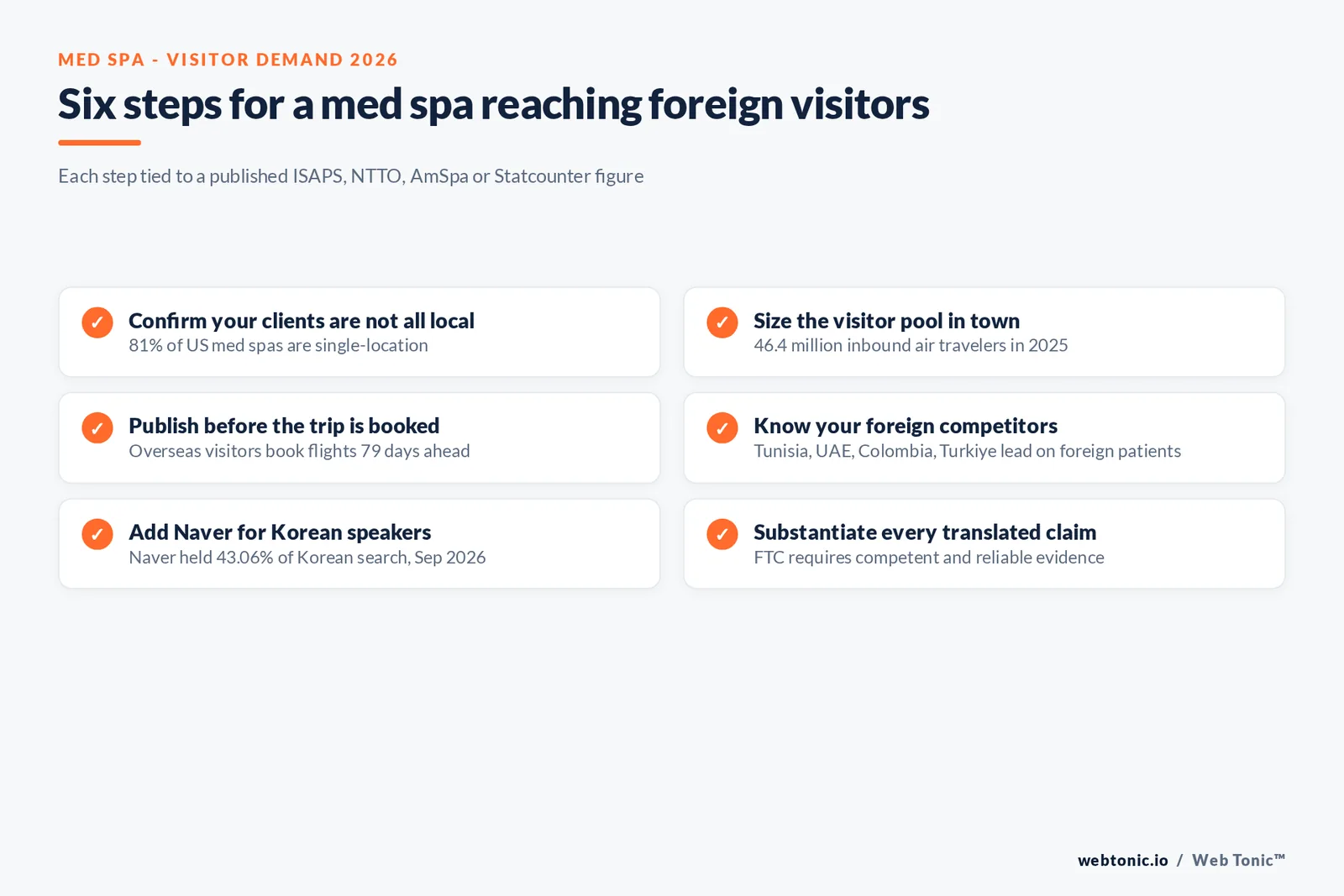
- Check your client base first: with 81% of med spas single-location, most demand is local.
- Add Spanish before tourist languages where Census data shows a large Spanish-speaking area.
- Target visitors on their planning window, roughly 79 to 104 days before travel.
- Add Naver only for Korean-speaking audiences.
- Substantiate every claim in every language, per FTC guidance.
- Measure by language in analytics; there is no med spa benchmark to compare against.
Multi-location operators can compare notes with our med spa enterprise SEO data and the enterprise SEO overview. Our growth marketing team can plan the build, or contact us.
What remains unmeasured
No public study reports med spa hreflang adoption, foreign-visitor booking share, or multilingual conversion rates. The AmSpa statistics page sizes the industry at more than USD 17 billion and growing by more than USD 1 billion a year, but does not break out international clients. Treat any vendor claim of a med spa "international traffic share" with suspicion, and set up language-level tracking with our data team.
Frequently Asked Questions
Do med spas need international SEO?
Most do not need it in the export sense. AmSpa's 2024 report found 81% of US med spas operate a single location, serving a local market. International SEO matters for clinics in tourist destinations, clinics serving large non-English-speaking communities, and multi-location brands abroad. No study reports what share of med spa clients are foreign visitors.
How big is the global aesthetics market by procedure volume?
ISAPS reported close to 38 million aesthetic procedures in 2024: more than 17.4 million surgical procedures by plastic surgeons and 20.5 million non-surgical procedures. The US performed the most, over 6.1 million, followed by Brazil with 3.1 million. These are surgeon-reported figures and undercount med spa treatments performed by non-surgeons.
Which countries attract the most foreign aesthetic patients?
ISAPS's 2024 Global Survey says the countries seeing the highest proportion of foreign patients, on average, are Tunisia, the UAE, Colombia and Turkiye. The survey reports proportions, not visitor counts, so it identifies competition rather than sizing traffic.
Is Google enough for aesthetics SEO in Korea?
No. Statcounter put Google at 47.97% and Naver at 43.06% of South Korean search in September 2026, and Korean domestic measures place Naver higher still. A clinic targeting Korean patients needs a Naver strategy as well as Google.
Can a med spa make the same claims in every language?
Only claims it can substantiate. The FTC's Health Products Compliance Guidance says health benefit and safety claims require competent and reliable scientific evidence, and translated pages are advertising too. A before-and-after claim that is unsupported in English is unsupported in Spanish.
Sources
ISAPS - Global Survey 2024 (Jun 2025)
NTTO / trade.gov - 2025 Survey of International Air Travelers
AmSpa - 2024 State of the Industry executive summary
AmSpa - Med spa statistics
FTC - Health Products Compliance Guidance
Statcounter - Search engine market share, South Korea (Sep 2026)
W3Techs - Content languages for websites (Sep 2026)
CSA Research - Can't Read, Won't Buy B2C (2020)
Google Search Central - Localized versions
US Census Bureau - Language spoken at home, ACS 2018-2022 (Dec 2023)


