Table of contents
Meta Title
SEO for Interior Designers: Complete Playbook for 2026
Meta Description
Stop relying on referrals alone. Master SEO for interior designers to rank your portfolio, attract high-end clients, and dominate local search results.
URL
/blog/seo-for-interior-designers
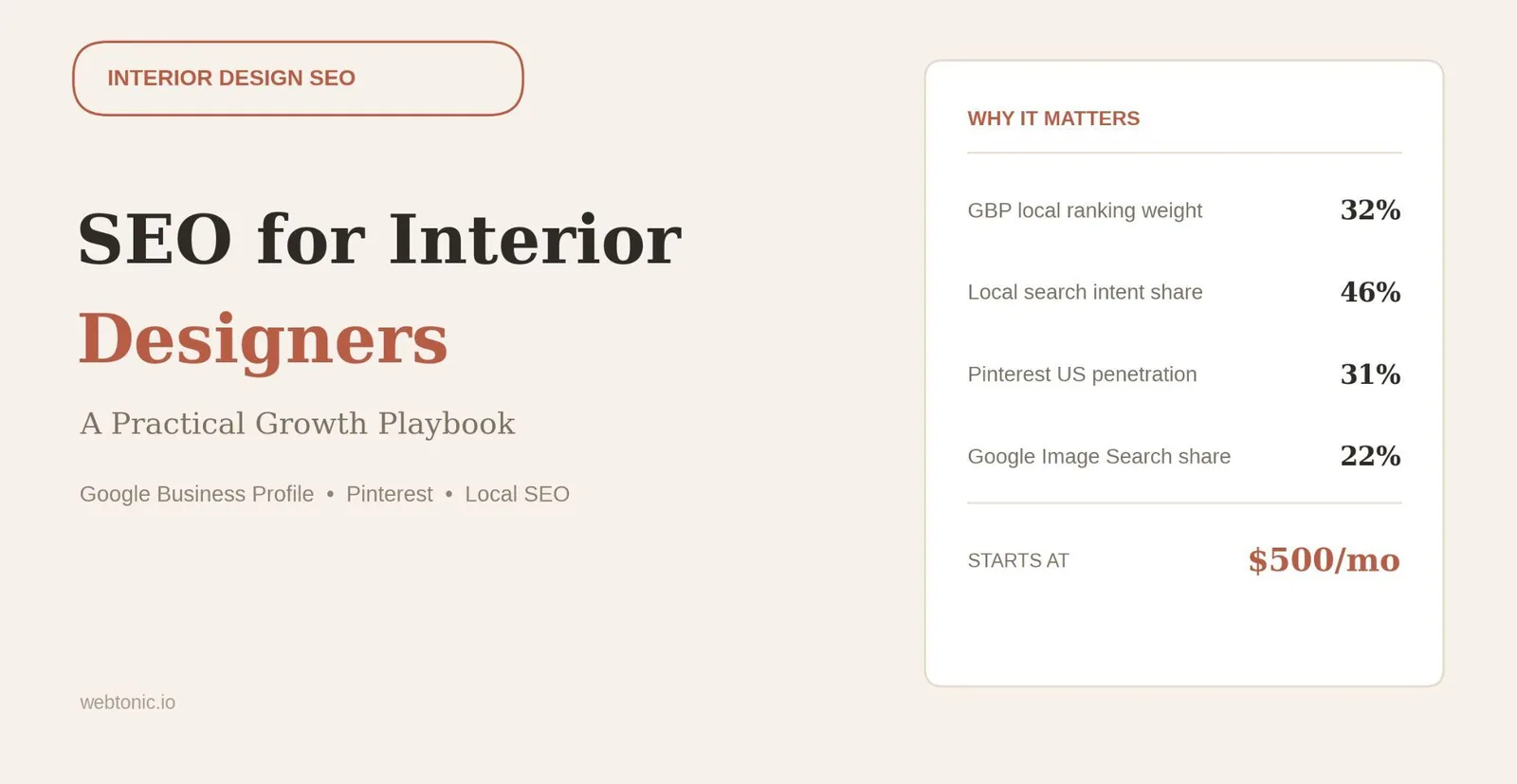
Most interior design businesses are built on referrals, a good Instagram feed, and word of mouth. That works, right up until it doesn't. One widely cited industry survey found that roughly 8 out of 10 designers do little to no structured marketing beyond relying on word-of-mouth referrals, which means the moment referrals slow down, so does the pipeline.
Search engine optimization for interior designers fixes that gap. Done well, an SEO strategy turns your portfolio into a 24/7 lead generator: potential clients searching Google for "interior designer" plus their city find you before they find your competitor, already sold on your aesthetic. This playbook walks through exactly how to build that strategy — from your Google Business Profile to Pinterest to the technical details that make a photo-heavy website rank.
Key Takeaways
- Google Business Profile signals carry the single heaviest weight in local search rankings — more than any other individual ranking-factor category.
- Image and alt text optimization matters more for interior designers than almost any other industry, since your entire portfolio is visual content Google needs to interpret.
- Pinterest functions as a search engine for home decor, not just a social network, and belongs in your SEO strategy alongside Google.
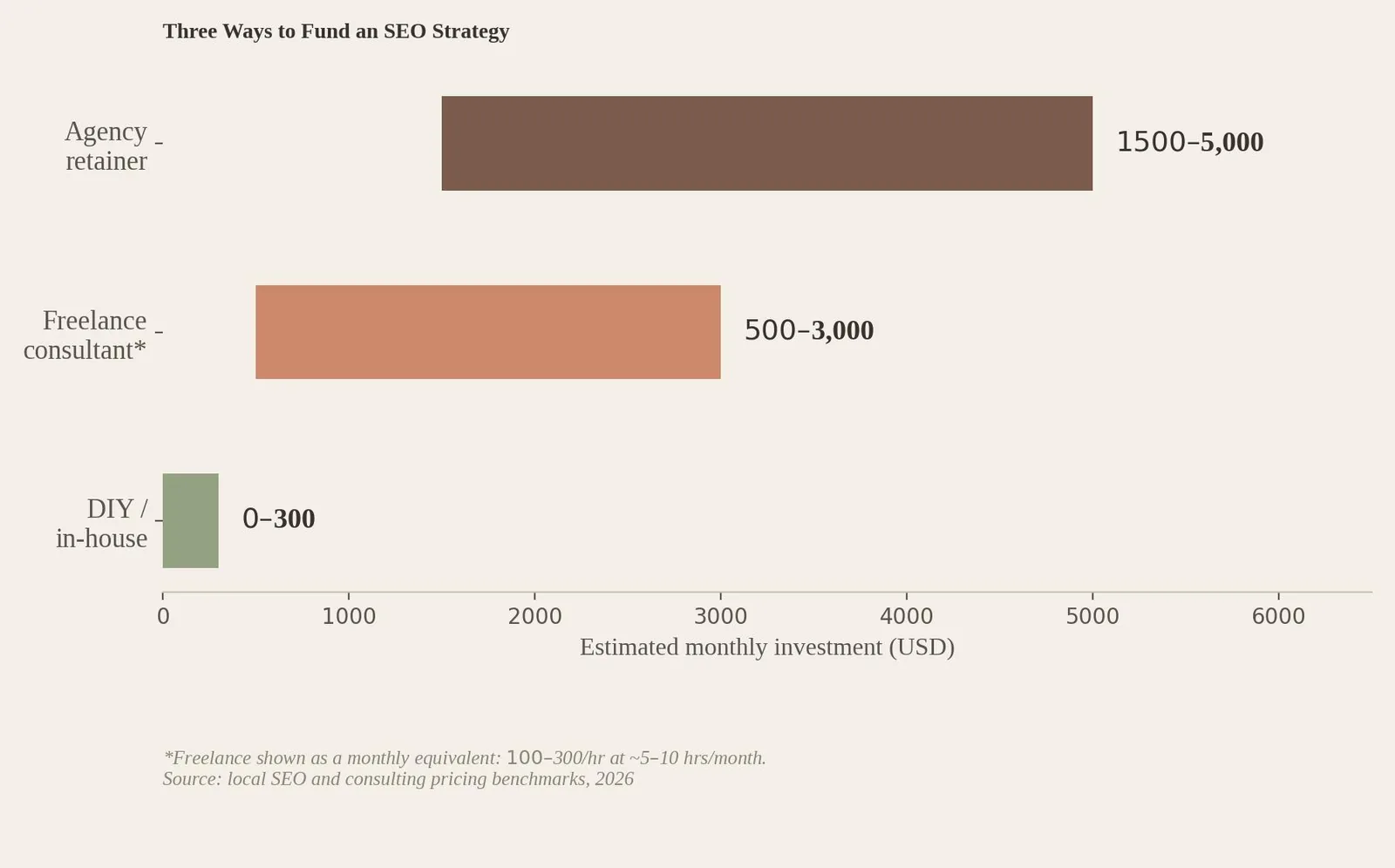
- A comparative SEO investment ranges from $0 (DIY) to $5,000+/month (full agency retainer) — the right tier depends on how much execution capacity you have in-house.
- Local SEO and content SEO are not optional add-ons to referrals — they're the channel that keeps working when referrals slow down.
Why interior designers need a different SEO playbook
Generic SEO advice tells you to write blog posts and build links. That's not wrong, but it misses what makes an interior design business different from, say, a plumbing company. Your buying decision is emotional, visual, and slow. A potential client doesn't search once and convert — they browse, save, compare, and revisit a portfolio multiple times before booking a consultation.
That changes what "ranking" actually means for a design business. You're not just competing for clicks on a search engine result page; you're competing for a spot in someone's mental shortlist of designers whose aesthetic they trust. An SEO strategy for interior designers has to account for three realities at once: the business is highly visual, most demand is local, and the sales cycle runs through inspiration platforms like Pinterest and Instagram just as much as through Google search.
This is also why a broad interior design SEO plan built for a national furniture retailer or an ecommerce site won't transfer well. Your site probably has far fewer pages, far more images per page, and a much smaller local search volume to work with — which means every optimization has to work harder.
Building an SEO strategy interior designers can actually execute
Before touching your website, get clear on what people are actually typing into Google. Interior design search terms generally split into three buckets:
- Local intent — "interior designer in Austin," "interior design services near me." These searches convert fastest because the person is ready to hire.
- Style or room intent — "modern living room design ideas," "small kitchen interior design." These searches build traffic and topical authority but convert more slowly.
- Informational intent — "how much does an interior designer cost," "interior designer vs interior decorator." These build trust and often lead to a saved bookmark, not an instant inquiry.
A workable strategy for interior designers covers all three, but weights effort toward local intent first, since that's where the fastest return sits. Keyword research tools will surface the exact phrasing local buyers use in your market, but the pattern holds broadly: pair your core service ("interior design," "interior designer") with your city or neighborhood, and build a service page for each meaningful combination rather than one generic "services" page trying to rank for everything.
Search engine optimization for interior designers also means thinking in named entities Google already associates with your topic: Google Business Profile, Google Maps, Google Analytics, and Google Search Console all recur across top-ranking content in this space, which tells you Google expects a design business's SEO content to touch on measurement and local presence, not just aesthetics.
Google Business Profile: the highest-leverage local SEO move
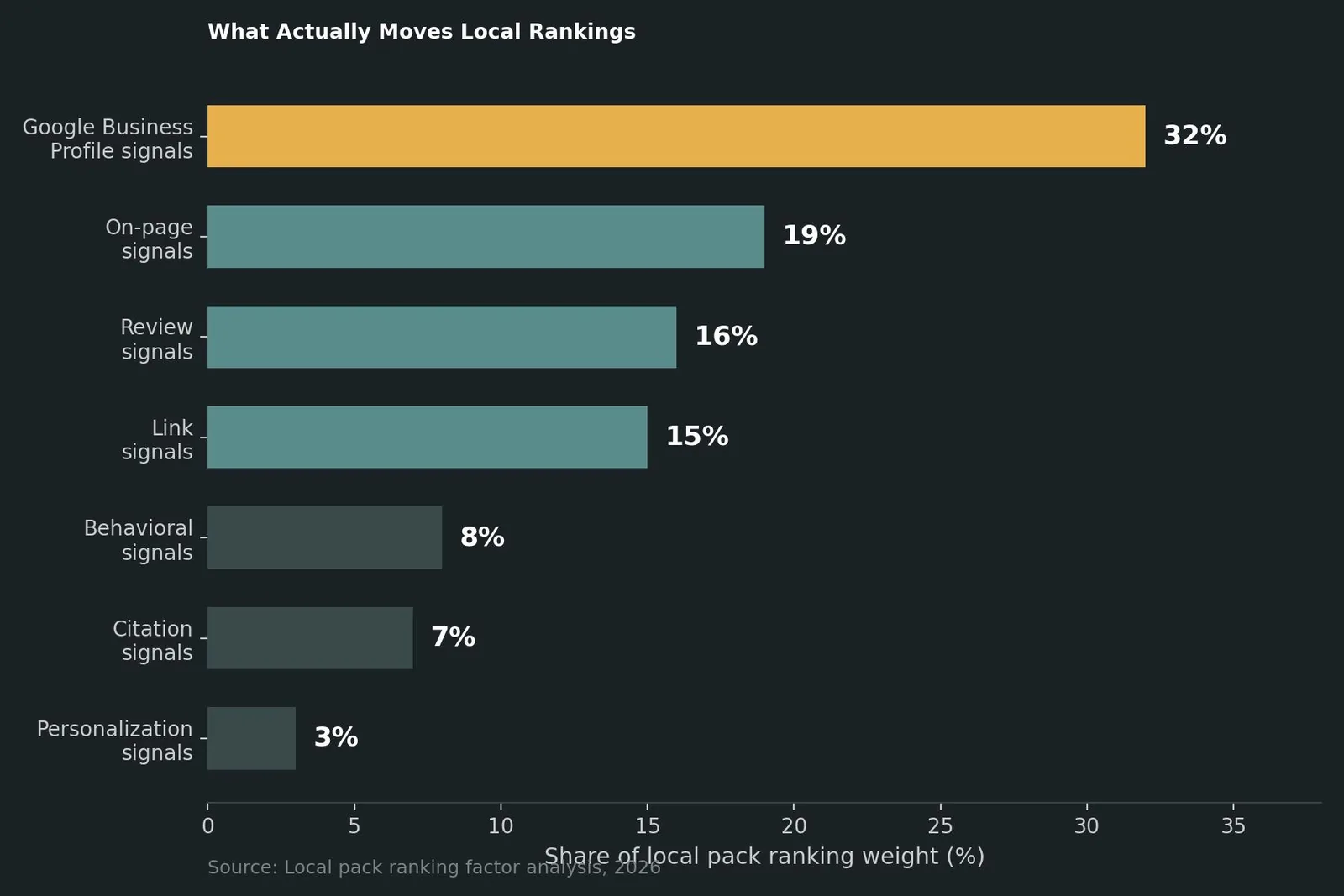
If there's one thing to fix before anything else, it's your Google Business Profile. Local pack ranking research attributes roughly 32% of local ranking weight to Google Business Profile signals — more than any other single ranking-factor category, with on-page signals, reviews, and links all individually carrying less weight. For a visual business competing in local search, that single profile is often worth more than a website redesign.
A few things move the needle fastest:
- Complete every field. Complete Google Business Profiles earn roughly seven times more clicks than incomplete listings, and pages ranking in the top three local positions average around 250 photos, compared with fewer than 200 for listings ranking four through ten.
- Upload real project photos regularly. Stock images or a sparse gallery send a weak signal, both to Google and to a potential client deciding whether to trust you with their home.
- Choose your primary category carefully. "Interior designer" and "interior decorator" are treated differently by Google's local algorithm, so pick the one that matches how your ideal client searches.
- Keep your business profile verified and consistent. Verified Google Business Profiles have climbed to around 82% of all listings globally — an unverified or duplicate listing is now the exception, not the norm, and it quietly caps everything else you do.
None of this requires a developer or a big budget. It requires consistency, which is exactly why so many design businesses skip it and lose local visibility to competitors who don't.
On-page and technical SEO for a visual portfolio
Most SEO checklists assume a text-heavy website. Yours isn't one, and that's precisely why on-page SEO deserves extra attention here.
Alt text is not optional. Every portfolio image needs descriptive alt text — not "IMG_4521.jpg," but something like "modern living room interior design with neutral linen sofa, Austin." Google can't see a photo the way a human can; alt text and file names are how a search engine understands what's actually in the image, and they're also how your work surfaces in Google Images and Google Lens results, which is a meaningful discovery channel for a visual industry.
Compress before you upload. A portfolio site loaded with uncompressed, full-resolution photography will load slowly, and slow-loading sites lose visitors and rankings before a single design is ever seen. Export web-optimized JPEGs, use modern formats where your CMS supports them, and lazy-load anything below the fold.
Track what's actually working. Connect Google Analytics and Google Search Console to your site from day one. Analytics tells you which pages potential clients spend time on before booking a consultation; Search Console tells you which search queries already bring people to your site, which is often the fastest way to find your next content idea.
Build local landing pages, not one generic services page. If you serve multiple neighborhoods or nearby cities, a dedicated page for each — with unique photography and copy, not duplicated text — gives Google far more to work with than a single page trying to rank everywhere at once.
Content and link building for design businesses
Content marketing for an interior design business works best as project storytelling, not generic advice blogging. A before-and-after case study, a "how we sourced this material" breakdown, or a room-by-room walkthrough of a completed project does double duty: it's genuinely interesting to a potential client, and it gives Google fresh, specific content tied to your name and your city.
Link building follows the same logic. Rather than chasing generic backlinks, target the sources that already carry authority in your industry:
- Local business directories and Chamber of Commerce listings
- Design publications and local lifestyle magazines that accept project submissions
- Guest posts on complementary business sites — architects, real estate agents, home stagers, furniture retailers
- Supplier and manufacturer pages that list dealers or featured designers
A single relevant link from a design publication tends to do more for your search engine result visibility than a dozen low-quality directory links, and it's far less likely to draw an algorithmic penalty down the line.
Whether you handle this yourself, hire a freelancer, or bring in an agency depends mostly on how much time you have to execute consistently:
| p style="padding:0;margin:0;color:#000000;font-size:11pt;font-family:"Arial";line-height:1.15;orphans:2;widows:2;text-align:center">Approach/p> | p style="padding:0;margin:0;color:#000000;font-size:11pt;font-family:"Arial";line-height:1.15;orphans:2;widows:2;text-align:center">Typical Cost/p> | p style="padding:0;margin:0;color:#000000;font-size:11pt;font-family:"Arial";line-height:1.15;orphans:2;widows:2;text-align:center">What It Usually Covers/p> | p style="padding:0;margin:0;color:#000000;font-size:11pt;font-family:"Arial";line-height:1.15;orphans:2;widows:2;text-align:center">Best For/p> |
|---|---|---|---|
| p style="padding:0;margin:0;color:#000000;font-size:11pt;font-family:"Arial";line-height:1.15;orphans:2;widows:2;text-align:left">DIY / in-house/p> | p style="padding:0;margin:0;color:#000000;font-size:11pt;font-family:"Arial";line-height:1.15;orphans:2;widows:2;text-align:left">$0–$300/month (tools only)/p> | p style="padding:0;margin:0;color:#000000;font-size:11pt;font-family:"Arial";line-height:1.15;orphans:2;widows:2;text-align:left">Google Business Profile updates, your own photography and captions, occasional blog posts/p> | p style="padding:0;margin:0;color:#000000;font-size:11pt;font-family:"Arial";line-height:1.15;orphans:2;widows:2;text-align:left">Solo designers early in growth, comfortable with hands-on marketing/p> |
| p style="padding:0;margin:0;color:#000000;font-size:11pt;font-family:"Arial";line-height:1.15;orphans:2;widows:2;text-align:left">Freelance SEO consultant/p> | p style="padding:0;margin:0;color:#000000;font-size:11pt;font-family:"Arial";line-height:1.15;orphans:2;widows:2;text-align:left">$100–$300/hour, often billed in 5–10 hour blocks/p> | p style="padding:0;margin:0;color:#000000;font-size:11pt;font-family:"Arial";line-height:1.15;orphans:2;widows:2;text-align:left">Strategy, technical audits, Google Business Profile fixes, keyword research/p> | p style="padding:0;margin:0;color:#000000;font-size:11pt;font-family:"Arial";line-height:1.15;orphans:2;widows:2;text-align:left">Designers with in-house capacity to execute the recommendations/p> |
| p style="padding:0;margin:0;color:#000000;font-size:11pt;font-family:"Arial";line-height:1.15;orphans:2;widows:2;text-align:left">Full-service agency retainer/p> | p style="padding:0;margin:0;color:#000000;font-size:11pt;font-family:"Arial";line-height:1.15;orphans:2;widows:2;text-align:left">$1,500–$5,000+/month/p> | p style="padding:0;margin:0;color:#000000;font-size:11pt;font-family:"Arial";line-height:1.15;orphans:2;widows:2;text-align:left">Ongoing content, link building, technical fixes, Google Business Profile management, reporting/p> | p style="padding:0;margin:0;color:#000000;font-size:11pt;font-family:"Arial";line-height:1.15;orphans:2;widows:2;text-align:left">Growing studios that want hands-off, ongoing execution/p> |
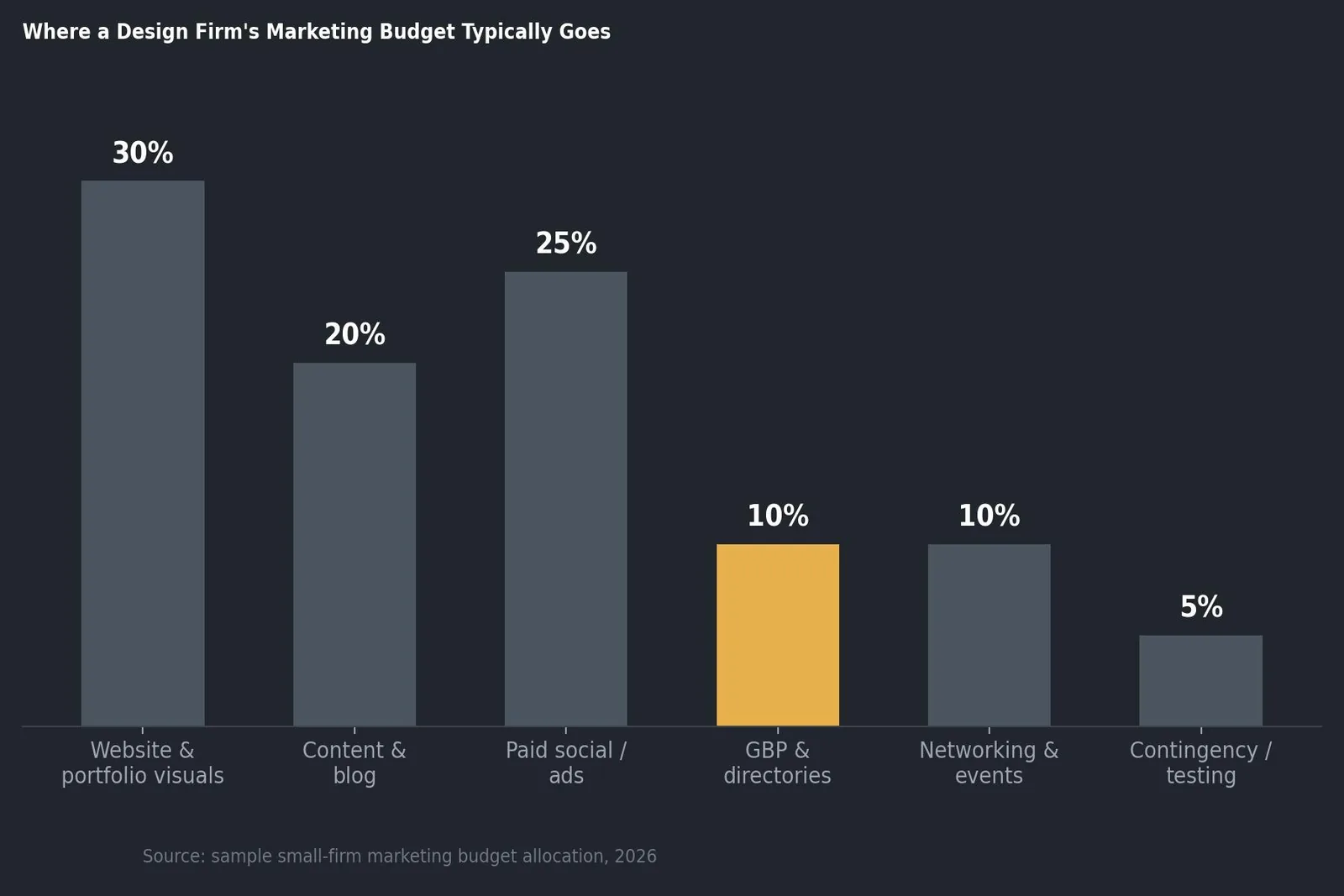
Local SEO investment for small businesses generally falls between $500 and $5,000 per month depending on scope and competition, while hourly consulting from an experienced provider typically runs $100 to $300 per hour. The entry-tier options cover maintenance and basic fixes; the features that actually move local rankings — ongoing Google Business Profile management, consistent content, and link building — generally require the mid-to-upper tier of that range.
Pinterest and visual search: the off-page channel interior designers can't ignore
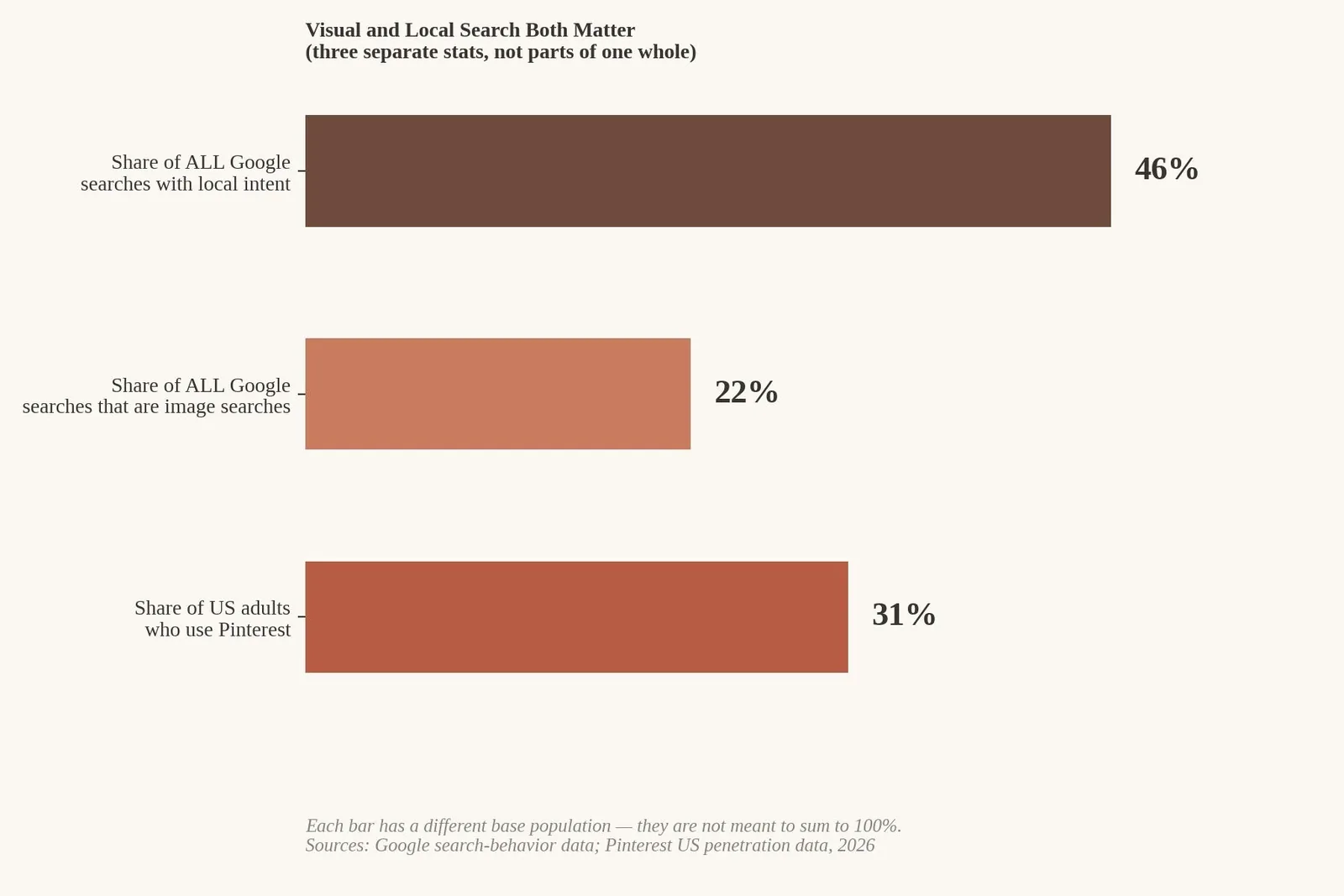
For most industries, Pinterest is a nice-to-have social channel. For interior design, it functions closer to a second search engine. "Living room ideas" is one of the most-searched terms on Pinterest in the US, and interior design searches on the platform rise roughly 180% every fall — a seasonal pattern worth planning content around. With Pinterest reaching about 31% of US adults, second only to YouTube, Facebook, and Instagram among American social platforms, it's a discovery channel design businesses can't treat as an afterthought.
The SEO principles carry over directly: descriptive pin titles, keyword-rich descriptions, and consistent boards organized by room or style all help your work surface in Pinterest's own search. Every pin should link back to the matching project or service page on your website, turning visual discovery into qualified website traffic rather than engagement that stays trapped on the platform.
Google Images and Google Lens follow the same logic on the Google side. Google Image Search accounts for roughly 22% of all searches, and for a portfolio-driven business, that's a meaningful share of potential clients who are searching visually rather than typing a text query at all.
Interactive tool: where does your SEO actually stand?
SEO Readiness Calculator
Check what already applies to your interior design business, then see where the biggest gap sits.
Google Business Profile
On-Page & Technical
Content
Off-Page & Visual Search
Use the calculator above to score your current setup across Google Business Profile completeness, on-page basics, content, and off-page presence. It won't replace a full audit, but it will tell you where the biggest gap sits — which is usually the fastest place to start.
Common mistakes to avoid
The most common one is neglecting the Google Business Profile while investing heavily in the website, when the profile carries more local ranking weight than the site itself.
Uploading portfolio photos without alt text is a close second. It leaves Google unable to understand or surface your best work in image search, no matter how strong the photography actually is.
Publishing generic room-design blog posts with no local or project-specific angle causes just as much wasted effort. It puts a small design business in direct competition with national sites that have far more domain authority to spare.
Treating Pinterest as a portfolio mirror rather than an SEO channel is another common gap, skipping keyword-rich titles and descriptions that would otherwise help pins surface in the platform's own search.
Chasing link volume from low-quality directories instead of a handful of relevant design-industry or local links tends to backfire, either producing no ranking benefit or, in the worst cases, drawing an algorithmic penalty.
And ignoring page speed on a site loaded with uncompressed, full-resolution photography quietly costs both rankings and impatient visitors before they ever see the work that was supposed to win them over.
Frequently asked questions
How long does SEO take to show results for an interior design business? Most local SEO efforts, especially Google Business Profile optimization, show early movement within 4–8 weeks. Content and link building tend to take 3–6 months to meaningfully affect rankings, with results compounding well beyond that.
Do I need a blog if most of my marketing happens on Instagram and Pinterest? Yes, in a supporting role. Social platforms drive discovery, but a blog on your own website is what search engines index and rank, and it's the asset you fully own regardless of platform algorithm changes.
Is local SEO or Pinterest more important for a new design business? Start with your Google Business Profile and local pages — they convert fastest since local searchers are closer to hiring. Pinterest builds discovery and brand awareness over a longer timeline.
Turning visibility into booked consultations
SEO for interior designers isn't a replacement for referrals and a strong portfolio — it's what keeps the pipeline full when referrals slow down, and it's the only channel where a potential client can find you before they've ever heard your name from someone else. Start with the highest-leverage, lowest-cost move: a fully completed, regularly updated Google Business Profile. Layer in alt text and local landing pages next, then build out content and Pinterest presence as bandwidth allows. None of it needs to happen at once, but all of it compounds — and unlike a referral, it keeps working while you sleep.
More from Web Tonic: growth marketing services, data & analytics, performance creative.
Sources: thepearlcollective.com · digitalapplied.com · nadernejadmedia.com · sqmagazine.co.uk · arc4.com · boulderseomarketing.com · searchlab.nl · colorlib.com