



Table of contents
Local search visibility determines whether a rehab facility receives the inquiry or never appears at all — 88% of consumers who search for local healthcare services discover providers through search engines, and the map pack captures the vast majority of those clicks.
Key Takeaways
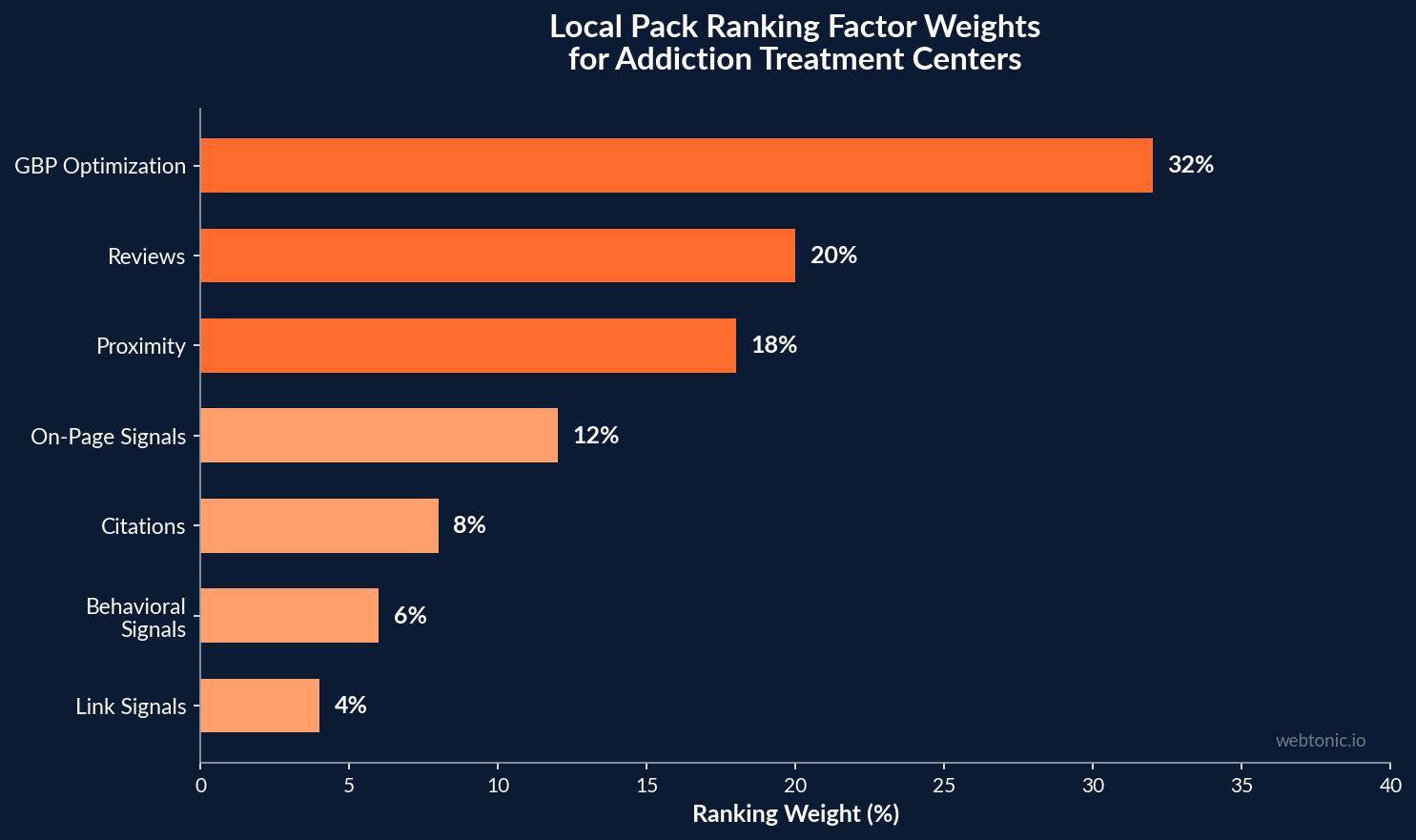
- GBP optimization drives 32% of local pack ranking weight, making it the single most influential local ranking factor for treatment centers (Webserv, 2026).
- Businesses with consistent NAP data are 40% more likely to appear in the local pack — citation accuracy directly controls map visibility (Webserv, 2026).
- 72.4% of addiction treatment traffic arrives on mobile devices, where "near me" and voice-style queries dominate search behavior (CUFinder, 2026).
- Treatment center organic traffic converts at 3–7%, with phone calls converting 40–60% higher than form fills (Netvisits / Authority Specialist, 2026).
- Reviews account for 20% of local pack ranking signals, yet most facilities lack a systematic review acquisition workflow (Webserv, 2026).
- 74% of facilities with NAP inconsistencies are excluded from AI-generated local results and Google's AI Mode summaries (MIS Services, 2026).
- Local SEO yields 3.5× higher conversion rates than non-local organic traffic for behavioral health providers (Prosperity Health BH, 2026).
Rehab Local SEO Benchmarks at a Glance
| Metric | Industry Average | Top Performers | Source |
|---|---|---|---|
| GBP Ranking Weight | 32% of local pack signal | — | Webserv, 2026 |
| Review Weight | 20% of local pack signal | — | Webserv, 2026 |
| NAP Consistency Impact | 40% more likely in local pack | — | Webserv, 2026 |
| Mobile Traffic Share | 72.4% | 78%+ | CUFinder, 2026 |
| Organic CVR (Local) | 3–7% | 8–12% | Authority Specialist, 2026 |
| Phone Call CVR | 40–60% higher than forms | — | Webserv, 2026 |
| AI Mode Exclusion (NAP Issues) | 74% excluded | — | MIS Services, 2026 |
| Avg Time to Rank (Local) | 9–12 months | 4–6 months | Prosperity Health BH, 2026 |
How Local Search Drives Treatment Center Admissions
88% of healthcare consumers who visit a local provider found them through an online search (MIS Services). In behavioral health, this statistic carries even more weight because the decision to seek treatment is often time-sensitive — a family member searching "detox center near me" at 2:00 AM needs immediate results, not a list of national providers.
Google's map pack (the three-listing block with star ratings, distance, and call buttons) captures the majority of clicks in local healthcare queries. Treatment facilities that do not appear in the local pack functionally do not exist for searchers in crisis moments. The decision about which center receives the inquiry happens in seconds, driven by proximity, ratings, and whether the listing looks credible.
52.6 million Americans aged 12 or older needed substance use treatment in 2024, while only 10.2 million received it (IMMWIT). The gap underscores the demand available for facilities that achieve local visibility. Across 15,953 licensed substance use treatment facilities in the U.S., the competition for local search real estate is fierce but inconsistent — most centers underinvest in systematic local optimization.
Google Business Profile Optimization Benchmarks
GBP optimization is responsible for 32% of local pack ranking weight, making it the highest-leverage local ranking signal for addiction treatment centers (Webserv). A fully optimized profile consistently outperforms facilities with stronger backlink profiles but neglected GBP listings.
Key optimization signals include:
- Complete profile fields — facilities that fill every available GBP field (categories, services, attributes, insurance accepted, hours) rank higher than those with partial profiles.
- Photo volume and recency — regular photo uploads of facilities, staff, and program environments signal activity to Google's algorithm. Centers with 100+ photos see 520% more calls than those with fewer than 10 (Pro Digital Healthcare).
- Insurance attributes — families filter by coverage. Profiles listing accepted insurers (Aetna, Cigna, BlueCross) surface for insurance-modified queries that competitors miss.
- GBP Posts — weekly posts about program highlights, community events, and recovery milestones keep the profile active. Consistency matters more than production value.
In a Lead to Recovery case study, a Pennsylvania treatment center generated 502 total GBP engagements including 336 website clicks and 214 phone calls after systematic GBP optimization — establishing local visibility for a facility that had been effectively invisible in search.
NAP Consistency and Citation Impact
Facilities with consistent NAP (Name, Address, Phone) data across directories are 40% more likely to appear in the local pack than those with inconsistencies (Webserv). In behavioral health, where multi-location operators, name changes, and facility acquisitions are common, NAP fragmentation is one of the most frequent ranking barriers.
| Citation Factor | Impact | Priority |
|---|---|---|
| NAP Consistency | 40% higher local pack probability | Critical |
| SAMHSA Locator Listing | Stronger authority baseline | High |
| State Licensing Registry | Trust signal + organic citations | High |
| Healthcare-Specific Directories | Relevance boost for local queries | Medium |
| General Business Directories | Baseline authority support | Low-Medium |
74% of AI-mode exclusions in healthcare correlate with NAP inconsistencies — as Google's AI Overviews and AI Mode increasingly synthesize local provider data, clean structured data becomes a prerequisite for visibility in both traditional and AI-generated results (MIS Services).
Treatment facilities listed on SAMHSA's treatment locator and their state's licensing registry tend to have stronger local authority baselines than those relying primarily on general business directories (Authority Specialist). Multi-facility operators face additional complexity: each location needs its own GBP profile, unique phone number, and distinct citation set.
Review Signals and Patient Trust Metrics
Reviews account for approximately 20% of local pack ranking signals (Webserv), making them the second most important factor behind GBP optimization itself. Beyond algorithmic weight, reviews drive click-through decisions — prospective patients and their families compare star ratings, review volume, and recency before choosing which listing to contact.
Key review benchmarks for treatment centers:
- Responding to reviews within 24–48 hours correlates with higher engagement rates and signals profile activity to Google (Pro Digital Healthcare).
- Review velocity matters more than total count — a center earning 3–5 new reviews per month outranks one with 200 stale reviews from 2021.
- HIPAA-compliant review workflows are essential: facilities cannot solicit reviews that reveal protected health information. Best practices involve general satisfaction surveys with optional public review prompts after discharge.
Positive reviews improve SERP placement, click-through rates, and inquiry-to-admission success rates. Negative sentiment, when unaddressed, permanently drives leads to competitor facilities.
Mobile and Voice Search Behavior in Addiction Treatment
72.4% of addiction treatment website traffic arrives on mobile devices (CUFinder), a figure that reflects the urgency of treatment searches. Patients and family members search during moments of crisis, often outside business hours, on whatever device is immediately available.
Mobile-specific search patterns for rehab facilities:
- "Near me" queries have grown substantially year over year, with voice-style phrasing like "detox center near me open now" increasingly replacing typed keyword searches (Authority Specialist).
- Click-to-call from map pack listings accounts for the majority of mobile conversions — mobile users bypass forms almost entirely in favor of direct phone calls.
- Page speed directly affects mobile rankings: treatment center websites with load times under 3 seconds see measurably higher local pack positions than slower competitors.
This mobile-dominant behavior has direct implications for website architecture: click-to-call buttons must be above the fold, forms should require 4 fields or fewer, and page speed optimization is non-negotiable for facilities competing in local search (Webserv).
Local Organic Search vs. Paid Search Performance
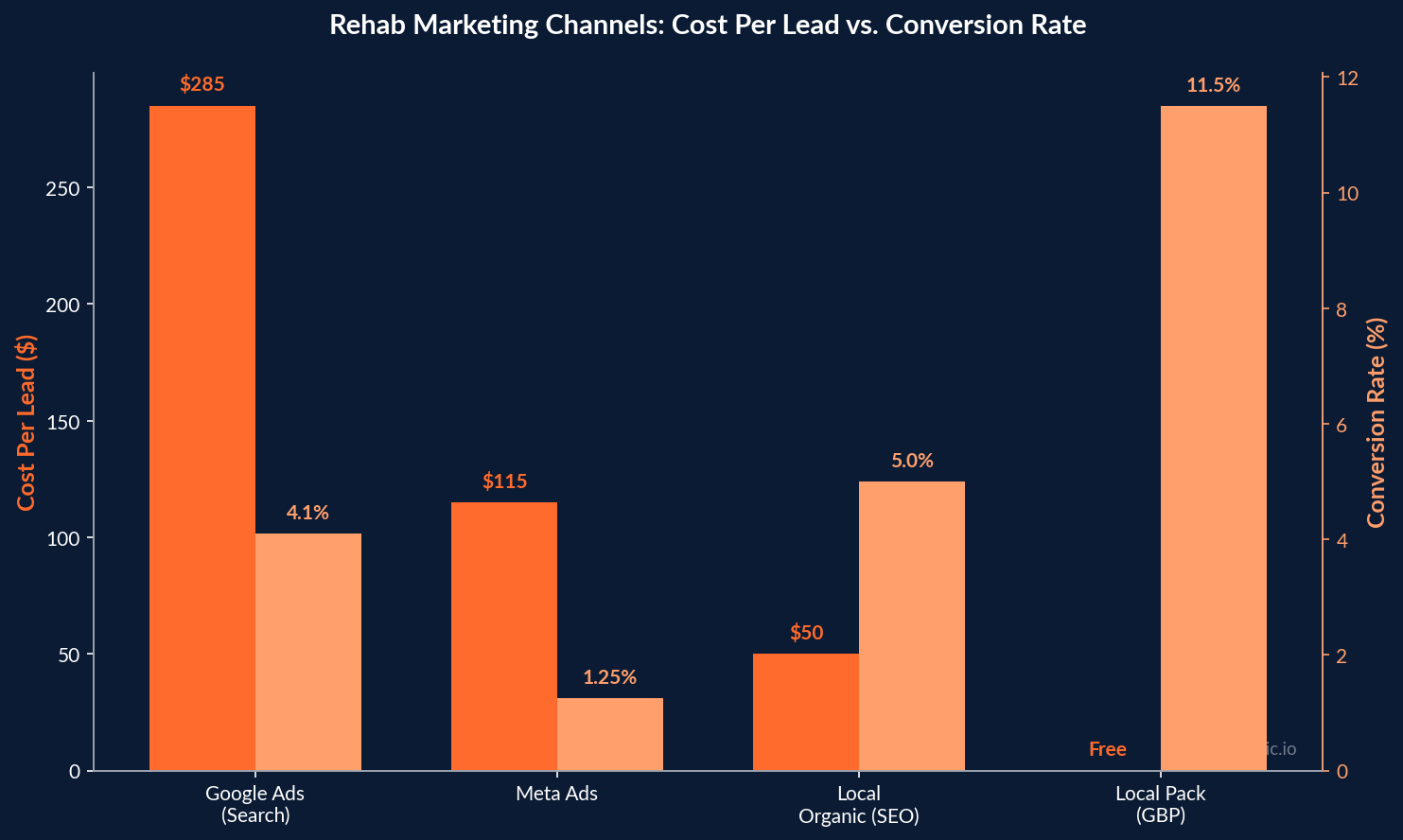
Treatment centers that invest in local organic visibility achieve fundamentally different unit economics than those relying solely on paid channels. Google Ads CPC for addiction treatment keywords averages $94.50, with cost per lead at $285 and cost per admission ranging from $2,500 to $8,000 (see our breakdown of Google Ads pricing for 2026) (CUFinder).
| Channel | Avg CPL | Avg CVR | Lead Quality |
|---|---|---|---|
| Google Ads (Search) | $285 | 4.10% | High (intent-driven) |
| Meta Ads (see our Meta Ads cost guide) | $115 | 1.25% | Medium (awareness) |
| Local Organic (SEO) | $35–$65* | 3–7% | High (long-term) |
| Local Pack (GBP) | $0 (organic) | 8–15% | Very High (crisis intent) |
*Amortized content + optimization cost over 12 months
Local SEO delivers 3.5× higher conversion rates than non-local organic traffic for behavioral health providers (Prosperity Health BH). While paid search delivers immediate visibility, the compounding nature of local organic rankings means facilities that invest consistently build a permanent acquisition channel with declining marginal cost per admission over time. For treatment centers exploring integrated paid and organic strategies, growth marketing services can accelerate the timeline to local visibility while SEO compounds.
Multi-Location SEO for Treatment Center Networks
Multi-facility treatment operators face exponential local optimization complexity. Each location requires its own GBP profile, unique local phone number, dedicated location page, and independent citation set (Authority Specialist). Shared phone numbers, consolidated "locations" pages, or duplicate content across facility listings actively suppress local rankings.
Best practices for multi-location treatment center networks:
- Separate GBP profiles per facility with unique categories, photos, and service descriptions tailored to each location's specialties.
- Dedicated location landing pages with unique, substantive content (1,000+ words) covering the specific services, staff, insurance accepted, and community context for each facility.
- Location-specific schema markup (LocalBusiness → MedicalBusiness) embedded on each page with structured data for address, geo-coordinates, accepted insurance, and services offered.
- Independent review acquisition workflows per location — consolidating reviews under a corporate profile dilutes the local signal for individual facilities.
The proximity paradox adds another layer: outpatient centers (where patients visit regularly) benefit heavily from tight geographic targeting, while residential facilities (where patients stay for 30–90 days) can target broader regions because proximity to home matters less than program quality. This distinction should inform keyword strategy, GBP category selection, and ad targeting radius.
AI Search Visibility for Treatment Centers
AI-generated search results are reshaping how patients discover treatment providers. AI models rarely name specific healthcare providers, doing so in only 17% of responses on average across ChatGPT, Claude, and Gemini (Authority Specialist, 2026).
However, the AI Recommendation Index for rehab centers sits at 51.1% — meaning AI assistants advise users to "hire a professional" (seek treatment) in over half of substance use-related queries, 6.9 percentage points above the 14-industry average. This creates substantial downstream demand for facilities that are visible when users transition from AI chat to a local search.
Key AI visibility statistics by model:
- ChatGPT: 60% hire-a-pro recommendation rate
- Claude: 53% hire-a-pro recommendation rate
- Gemini: 40% hire-a-pro recommendation rate
Facilities with clean structured data, strong review profiles, and authoritative content are better positioned to appear in AI-generated overviews and featured snippets — the gateway to the next generation of local treatment search. Tracking these emerging visibility channels requires robust data intelligence infrastructure to attribute admissions accurately across touchpoints.
Actionable Local SEO Checklist for Treatment Centers
- Claim and fully optimize your GBP listing — complete every field, add 50+ facility photos, post weekly updates, and respond to every review within 48 hours.
- Audit NAP consistency across all directories — SAMHSA locator, state licensing registry, Psychology Today, healthcare aggregators, and general directories must match exactly.
- Build dedicated location pages with 1,000+ words of unique, locally relevant content per facility.
- Implement LocalBusiness schema markup with structured data for services, insurance, geo-coordinates, and operating hours.
- Establish a HIPAA-compliant review acquisition workflow with post-discharge satisfaction surveys that include optional review prompts.
- Optimize for mobile-first — click-to-call above the fold, sub-3-second page loads, simplified intake forms (4 fields max).
- Pursue behavioral health ecosystem links — partnerships with local hospitals, community organizations, and HIPAA-compliant content collaborations build topical authority.
- Track local pack positions, GBP insights, and call-to-admission rates separately from general organic traffic to measure true local SEO ROI.
Frequently Asked Questions
How long does it take for local SEO to produce results for a treatment center?
Most treatment facilities see measurable improvements in local pack visibility within 9–12 months of consistent optimization, with top performers achieving results in 4–6 months. The timeline depends on competitive density, starting domain authority, and the consistency of GBP activity, review acquisition, and content publication. Unlike paid search, local SEO compounds over time — facilities that maintain their optimization see declining cost per admission as organic visibility grows.
What is the most important ranking factor for the local map pack in addiction treatment?
Google Business Profile optimization accounts for approximately 32% of local pack ranking weight, making it the single most influential factor. Within GBP optimization, the most impactful signals are category selection accuracy, review volume and recency, photo quantity, and attribute completeness (including accepted insurance providers). Proximity to the searcher is also a major factor but cannot be controlled.
How do multi-location treatment centers avoid cannibalizing their own local rankings?
Each facility needs a completely independent local presence: separate GBP profile, unique local phone number, dedicated location page with 1,000+ words of unique content, and an independent citation and review set. Shared phone numbers, duplicate facility descriptions, or consolidated location pages actively suppress rankings for individual locations. Outpatient centers should target tighter geographic keywords, while residential programs can target broader regional terms.
Does LegitScript certification affect local SEO rankings for rehab centers?
LegitScript certification is primarily an ad eligibility requirement (Google Ads mandates it for addiction treatment advertisers), but it also functions as an indirect trust signal for organic search. Certified facilities demonstrate regulatory compliance that aligns with Google's YMYL quality standards. While certification alone does not directly boost rankings, the operational credibility it represents correlates with stronger E-E-A-T signals across the site.
How important are reviews for rehab center local SEO compared to other industries?
Reviews carry approximately 20% of local pack ranking weight, which is consistent with other healthcare verticals. However, the trust differential is disproportionately large in addiction treatment because prospective patients and families face high emotional stakes. A facility with 50 reviews averaging 4.7 stars will significantly outperform a competitor with 10 reviews at 4.9 — volume and recency matter more than perfect scores.
Sources
webserv.io/resources/blog/local-seo-for-rehab-centers/
authorityspecialist.com/industry/health/rehab-center/seo-statistics
immwit.com/drug-rehab-seo/2026-u-s-drug-rehab-seo-visibility-trust-report/
cufinder.io/blog/benchmarks/addiction-treatment/
misservices.us/medical-healthcare-seo-statistics-2026
prosperityhealthbh.com/behavioral-health-seo-statistics
prodigitalhealthcare.com/google-business-profile-ranking-strategies-addiction-treatment-mental-health-2026/
leadtorecovery.com/case-studies/pa-addiction-mental-health-treatment-center/


