Table of contents

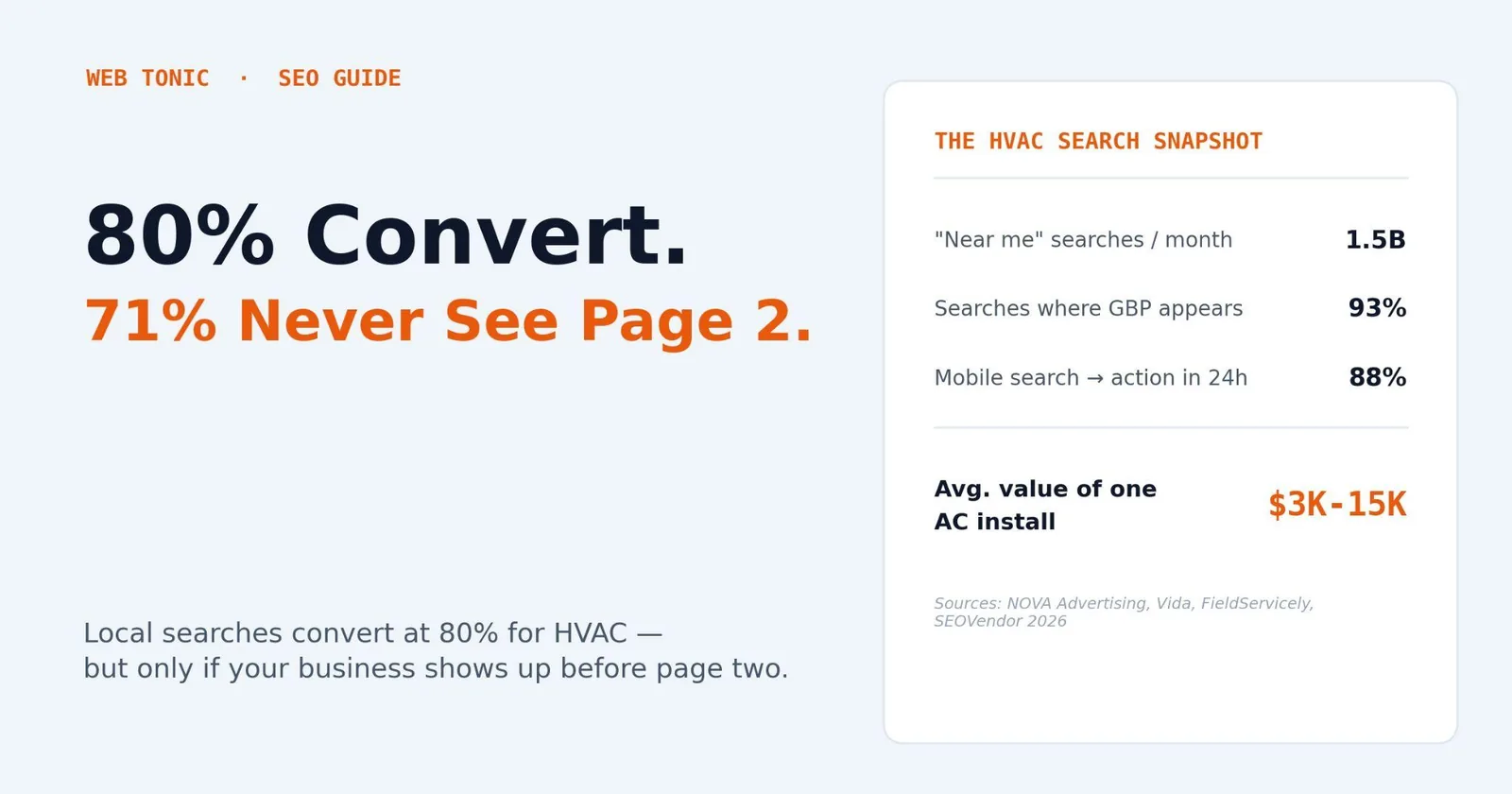
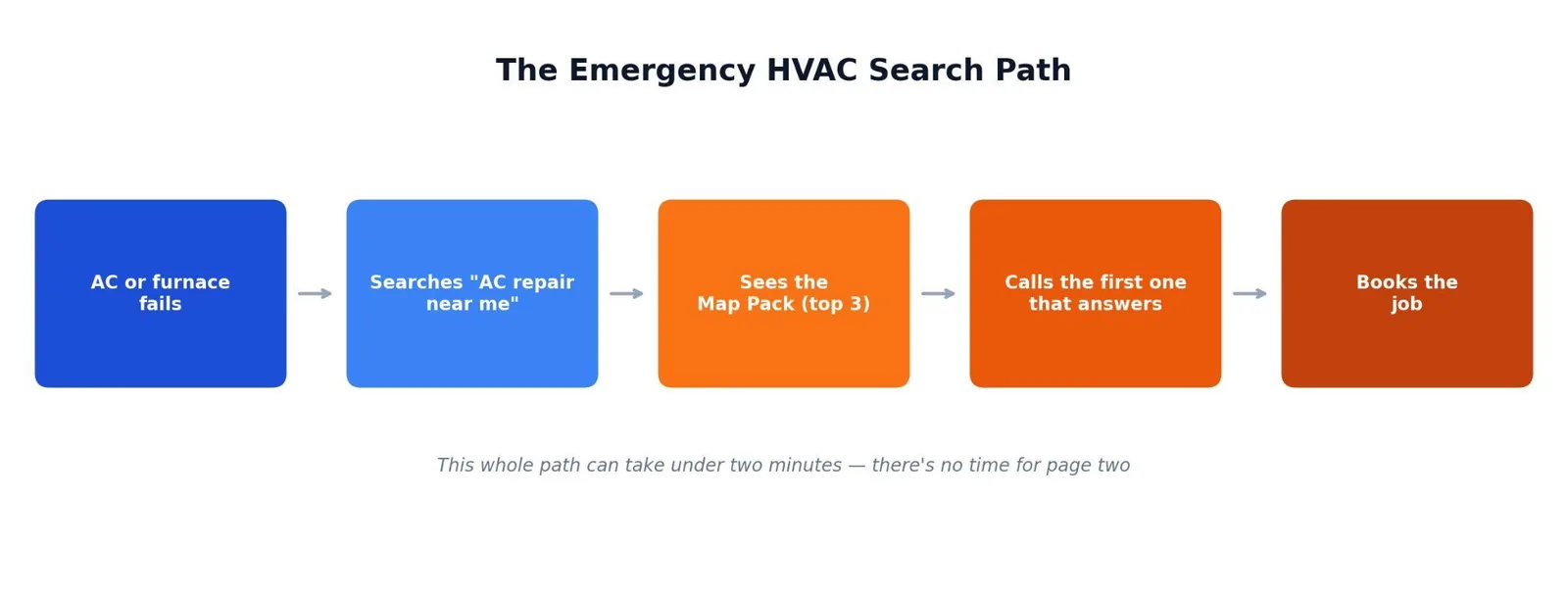
An air conditioner dies on the hottest afternoon of the year, and the homeowner doesn't browse. They grab their phone, type "AC repair near me," and call whichever HVAC company answers first from the results. There's no scrolling to page two during an emergency, and there's no second chance to be the company that showed up.
SEO for HVAC is the work of making sure your business is the one that shows up in that exact moment. It combines local SEO, a fully optimized Google Business Profile, dedicated service pages, and enough technical speed that a homeowner's phone doesn't time out before your number loads. HVAC is one of the most urgency-driven categories in local search, which makes ranking well worth disproportionately more than it does in slower-moving industries.
Key Takeaways
- Local searches convert into customers at a rate of roughly 80 percent (NOVA Advertising, 2026), and with over 1.5 billion "near me" searches happening every month across the United States, the volume behind that urgency is enormous.
- Google Business Profile signals drive approximately 32 percent of Map Pack rankings (SEOVendor, 2026 Local Search Ranking Factors survey), more than any other single factor.
- 88 percent of local mobile searches lead to a call, visit, or other action within 24 hours (Vida, 2026) — an HVAC search is rarely idle browsing.
- A complete Google Business Profile earns roughly 42 percent more direction requests and 35 percent higher click-through rates (Vida, 2026) than a basic, incomplete listing.
- 71 percent of searchers never click past the first page of results, and GBP alone appears in an estimated 93 percent of local searches, according to a 2026 analysis of local search behavior (BizIQ, 2026), making it the single highest-leverage asset most HVAC companies have and rarely fully use.
- A single AC installation can generate USD $3,000 to $15,000 in revenue (FieldServicely, 2026), which is why even a handful of new monthly leads from organic search can materially change a company's month.
What Is SEO for HVAC?
SEO, short for search engine optimization, for HVAC is the process of optimizing a heating and cooling company's website, Google Business Profile (still called GMB, or Google My Business, on some older directories and citation sites), and content so it ranks when local customers search for repair, installation, or maintenance services. Almost every HVAC search carries local and often urgent intent, "AC repair near me," "furnace not working [city]," which means the priorities look different than for a national ecommerce brand. What matters is dominating a specific service area, not competing for the word "HVAC" nationwide.
That local-first, urgency-first structure changes where the effort goes. A fully built-out Google Business Profile, consistent name-address-phone data across citations, dedicated pages for each core service and city, and a website that loads in under three seconds all matter more than chasing broad, high-volume keywords a national lead-generation site like HomeAdvisor already dominates.
Why the Map Pack Decides Who Gets the Call
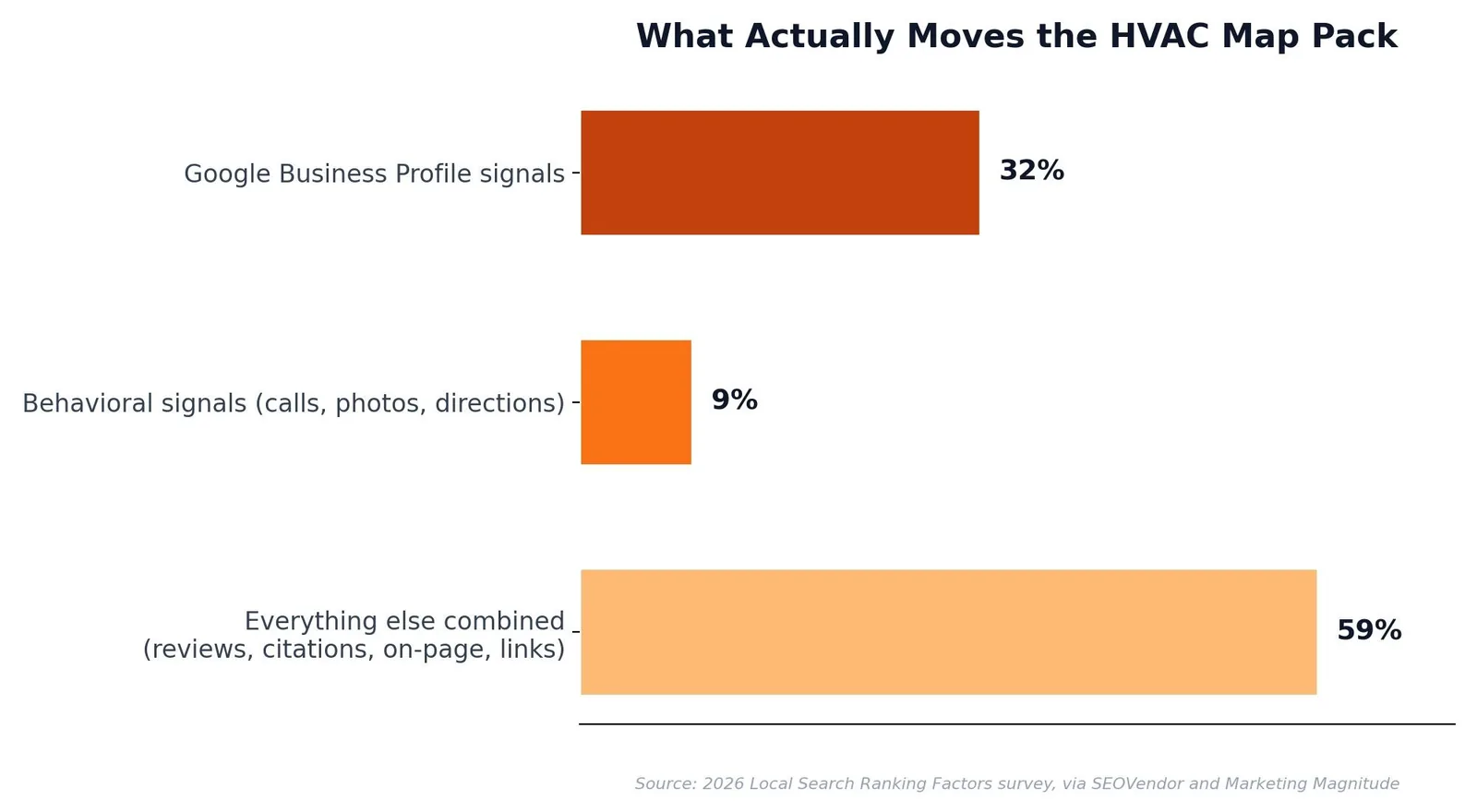
The click math in HVAC is unusually skewed toward the top of the page. 71 percent of searchers never click past the first page of results, and the Google Business Profile appears in an estimated 93 percent of local searches, per a 2026 local search behavior analysis, which makes it functionally the front door to the entire category. A 2026 Local Search Ranking Factors survey (via SEOVendor) found that GBP signals alone drive approximately 32 percent of Map Pack rankings, with behavioral signals like calls, photo views, and direction requests contributing another 9 percent. Everything else, reviews, citations, on-page content, and links, splits the remaining share.
That weighting explains why two HVAC companies serving the same suburb can see wildly different call volumes. One contractor with a complete, active profile can pull dozens of emergency calls a week from local search; a competitor with a dormant, half-filled listing might pull a handful, even with comparable service quality. It usually comes down to which one shows up in the three-box Map Pack above the organic results, not which one does better work.
SEO vs. Local Services Ads (PPC) for HVAC Lead Generation
| Factor | SEO (organic) | Local Services Ads / PPC |
|---|---|---|
| Cost model | Time investment in GBP, content, and reviews | Cost-per-lead or cost-per-click, billed continuously |
| Time to results | Early GBP wins in 30-90 days; dominant rankings in 6-12 months | Immediate, live same day |
| Typical monthly cost | USD $1,000 to USD $5,000 for full-service management | Scales directly with ad spend and market competitiveness |
| Longevity | Content and rankings keep working after publication | Stops the moment ad spend stops |
| Best fit | Building a durable, ongoing stream of both routine and emergency calls | Filling capacity gaps fast, or launching in a brand-new service area |
| Seasonal fit | Compounds year-round, riding both heating and cooling search cycles | Strong for surging demand during extreme weather events |
Most established HVAC companies run both. Local Services Ads and PPC fill immediate capacity during seasonal spikes, while organic SEO keeps producing calls the other months of the year without a recurring per-lead bill.
The HVAC Local SEO Roadmap
Step 1: Claim and fully optimize your Google Business Profile
Choose the correct primary category, typically "HVAC contractor," and add every relevant secondary category: air conditioning repair, furnace repair, heat pump services. Category selection alone factors meaningfully into ranking eligibility, and most companies stop at one category when they should list several.
Step 2: Build genuine review velocity, not just review volume
Google's local algorithm weighs how consistently new reviews arrive, not just the total count. Three to five genuine reviews a month, requested right after service while the experience is fresh, tends to outperform a large but stagnant backlog of older reviews.
A single generic "our services" page competes poorly against dedicated pages for AC repair, furnace repair, heat pump installation, and each city or town actually served. Homeowners search by their specific town name, not by region, so a page addressing "furnace repair in [city]" captures long tail keywords a blended page never will.
Step 4: Fix mobile speed and technical basics
With the majority of local searches happening on mobile, often mid-emergency, a site that takes more than three seconds to load loses the customer back to the search results. Fast load times, mobile-first design, and clean site structure are the difference between capturing that call and losing it to whoever loads faster.
Step 5: Earn HVAC-specific citations and backlinks
Consistent NAP data across Google, Yelp, Facebook, and Bing Places supports local rankings. Industry-specific sources carry outsized authority: ACCA and PHCC directory listings, and manufacturer contractor-locator pages for brands like Carrier, Trane, or Lennox if certified. Never buy bulk backlinks or cheap directory placements; Google's spam systems catch them, and the penalty can erase months of progress.
Step 6: Structure content around seasonal demand and real urgency
Cooling searches spike hard between April and August; heating searches climb from September through February. A digital marketing calendar that anticipates this cycle, including seasonal social media posts alongside GBP updates, captures demand precisely when it peaks rather than running one flat strategy year-round.
Is Your HVAC Business SEO-Ready?
HVAC SEO tool
Is your business SEO-ready?
Check off what's already true for your company. Your score updates as you go.
0 of 5
Check off items above to see how ready your business is.
A Complete Profile Wins More Calls
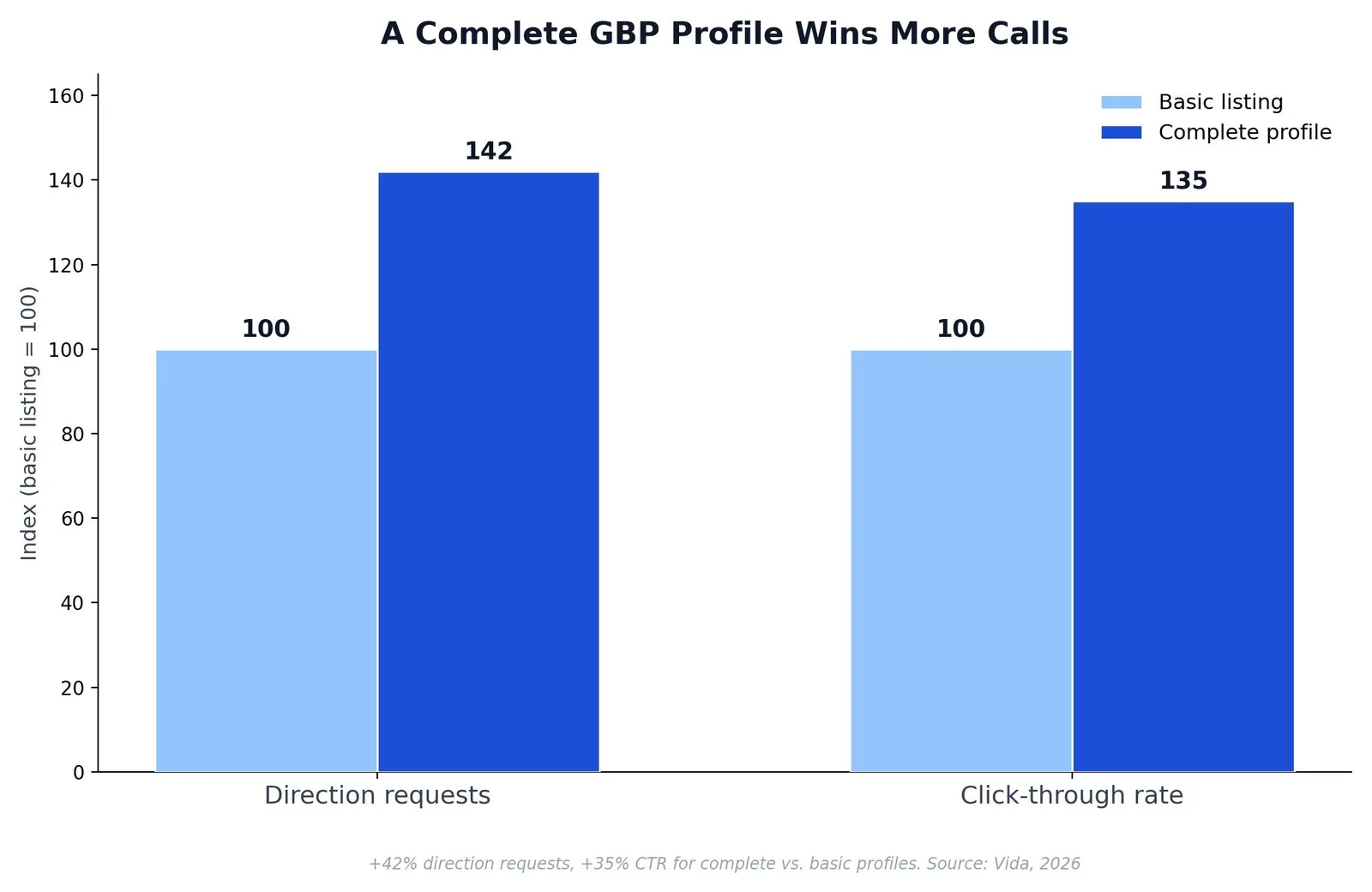
The gap between a basic listing and a fully built-out profile isn't marginal. Complete Google Business Profiles, with detailed service listings, regular photo updates, and active review generation, earn roughly 42 percent more direction requests and 35 percent higher click-through rates (Vida, 2026) than competitors running a bare-bones listing. For a category where 93 percent of local searches touch GBP in some way, that gap compounds into a meaningful share of total call volume.
SEO Tools Every HVAC Business Should Use
Google Search Console and Google Analytics are free and show exactly which searches already bring site traffic and where technical issues are quietly limiting visibility. Google Keyword Planner helps identify realistic local search terms specific to your service area, rather than broad national terms already dominated by lead-generation sites. Google Maps and GBP management tools keep listing data accurate, especially for companies serving multiple towns or counties. For markets like Dallas or Chicago, where dozens of HVAC companies compete for the same searches, a paid rank-tracking tool adds visibility into what's already working for nearby competitors, and can help sharpen an SEO strategy before committing to ongoing SEO services.
Common SEO Mistakes HVAC Businesses Make
The most common one is treating the Google Business Profile as a one-time setup rather than an active asset. A profile that hasn't posted a photo or update in weeks reads as inactive to Google, and activity is a real ranking input, not a cosmetic detail.
Relying entirely on lead-generation aggregators like HomeAdvisor while neglecting an owned website is a close second. These platforms can supplement lead flow, but they also put a company in direct competition with every other contractor on the same page, and the lead itself often isn't exclusive.
Copying one service page across a dozen cities with only the city name swapped is the quieter mistake. Google flags this kind of thin, duplicated content as a doorway page, and it typically fails to rank any of the affected pages well.
And buying cheap backlinks or bulk citation packages risks a Google penalty that can erase months of otherwise solid progress. Earned links from manufacturers, industry associations, and local sponsorships hold up; purchased ones eventually get caught.
Frequently Asked Questions
How much does SEO cost for an HVAC business?
Full-service management typically runs USD $1,000 to USD $5,000 per month, depending on market competitiveness and scope. DIY work on the basics, claiming a Google Business Profile, requesting reviews, keeping the site updated, costs time rather than a direct fee.
How long does it take to see results?
Early wins in Google Business Profile visibility and Map Pack presence can show up in 30 to 90 days. Broader organic traffic and lead growth typically take 3 to 6 months, with dominant rankings in competitive markets taking 6 to 12 months.
Is Google Business Profile really the most important factor?
For local and Map Pack visibility specifically, yes. GBP signals drive roughly 32 percent of Map Pack rankings on their own, more than any other single factor, and the profile appears in an estimated 93 percent of local searches.
Should I use Local Services Ads instead of SEO?
They serve different purposes. Local Services Ads and PPC deliver visibility immediately but stop the moment spend stops; SEO takes longer to build but keeps generating calls without a recurring per-lead cost. Most established companies eventually run both, weighted by season.
Do I need separate pages for every city I serve?
Yes, if those cities are genuinely part of your service area. Each city page needs unique, locally specific content, not a template with the city name swapped, since homeowners search by their specific town and Google treats thin duplicated pages as low quality.
The Bottom Line on SEO for HVAC
HVAC SEO rewards businesses that treat their Google Business Profile as core infrastructure rather than a set-and-forget listing. Between the urgency of the searches, the size of an average job, and how heavily local search decides who gets the call, the return on getting this right is unusually high compared to slower-moving industries.
Start with a full Google Business Profile audit, confirm every relevant category is selected, and check how your site performs on mobile under real conditions. Those three checks alone surface most of what's actually holding a local HVAC company back.
Ready to Turn Local Search Into Booked Jobs?
Coordinating GBP optimization, review generation, technical fixes, and seasonal content all at once is where most HVAC companies run out of bandwidth. Web Tonic's growth marketing team handles the technical SEO, local content, and reputation work covered in this playbook as part of a full-funnel approach that also connects to paid acquisition during peak season, so nothing runs in a silo while you stay focused on the trucks and the crew.
More from Web Tonic: growth marketing services, data & analytics.
Sources: novaadvertising.com · seovendor.co · vida.io · biziq.com · fieldservicely.com