



Table of contents

Only 1,656 of the 111,207 US plumbing, heating and air-conditioning contractor establishments had 100 or more employees in 2023 - enterprise HVAC SEO is a location-page and profile-governance job for that thin top layer. The figures below come from Census, AHRI and Google's own documentation; no study we found reports an HVAC organic click-through rate or cost per lead, so none is quoted.
Key Takeaways
- Census CBP 2023 lists 111,207 plumbing, heating and air-conditioning contractor establishments.
- They employed 1,214,761 people; 76.8% of establishments had fewer than 10 employees.
- Only 1,656 had 100 or more employees, and 24 had 1,000 or more.
- US air conditioner and heat pump shipments fell to 7.75 million in 2025, down 20% (AHRI via ACHR News).
- Heat pumps (3.64 million) outshipped gas furnaces (3.25 million).
- 88% of US households use air conditioning (EIA RECS 2020).
- A Business Profile can list up to 20 service areas.
- Bulk verification opens at 10 or more locations of the same business.
- AI Overviews correlated with a 34.5% lower top-result CTR in April 2025 and 58% lower on December 2025 data (Ahrefs).
- 58.5% of US Google searches ended with zero clicks in 2024 (SparkToro and Datos).
Market structure: a trade of small shops
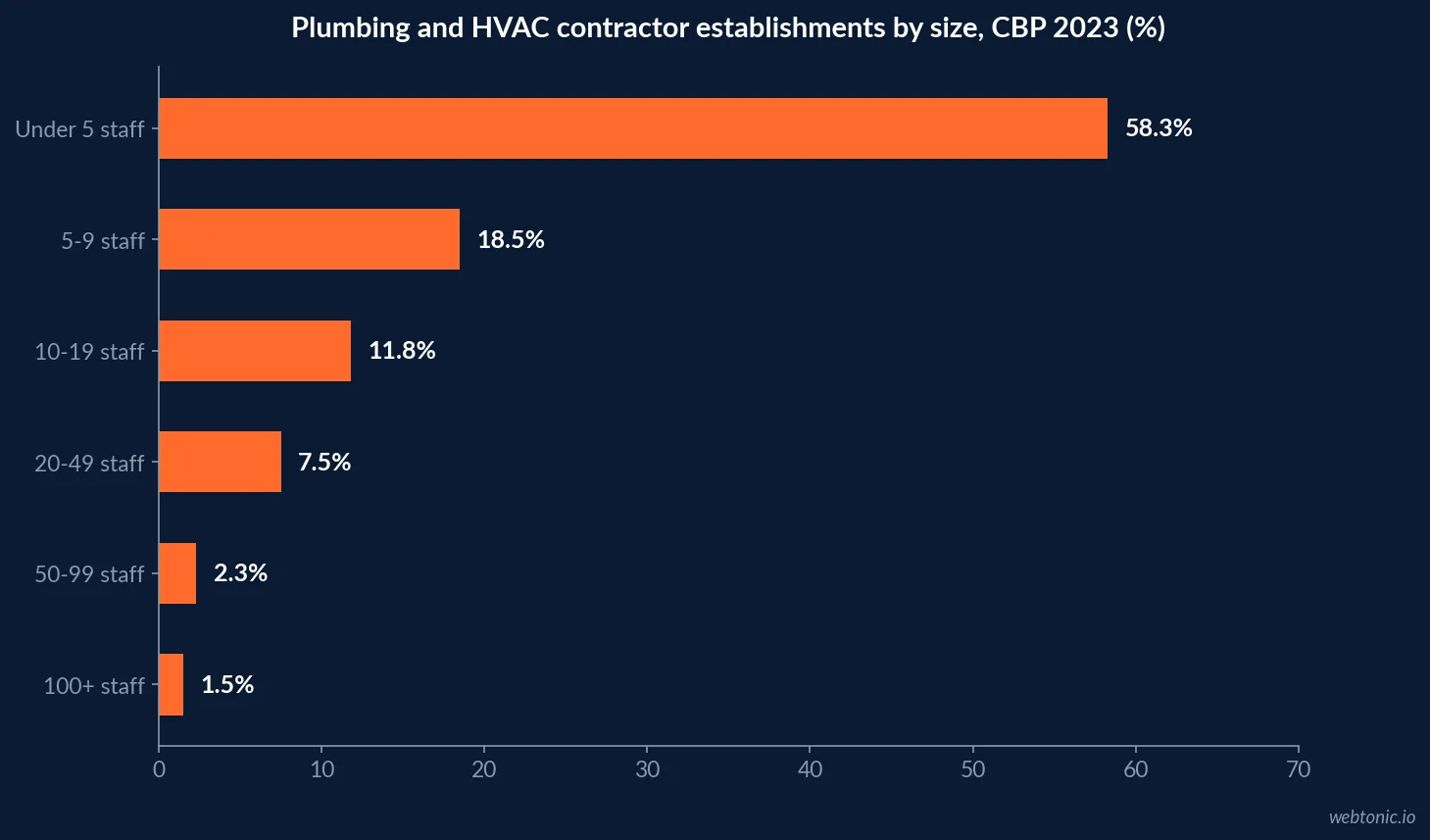
The Census Bureau's County Business Patterns 2023 groups HVAC with plumbing under NAICS 238220. That industry had 111,207 establishments and 1,214,761 employees. 64,871 had fewer than five employees, 76.8% had fewer than 10, and 1,656 had 100 or more - 24 of them with 1,000 or more.
The code does not separate HVAC from plumbing, so treat these as trade-wide counts. Either way, the enterprise tier is about 1.5% of establishments: regional groups, franchise systems and private-equity platforms that operate several local brands under one marketing function.
| Employee size (CBP 2023, NAICS 238220) | Establishments | Share of 111,207 | Location footprint |
|---|---|---|---|
| Under 5 | 64,871 | 58.3% | One address, one profile |
| 5 to 9 | 20,587 | 18.5% | One address, wide service area |
| 10 to 19 | 13,148 | 11.8% | Occasional second branch |
| 20 to 49 | 8,384 | 7.5% | Regional coverage |
| 50 to 99 | 2,561 | 2.3% | Multi-branch |
| 100 or more | 1,656 | 1.5% | Enterprise networks and platforms |
Demand swings that location pages must absorb
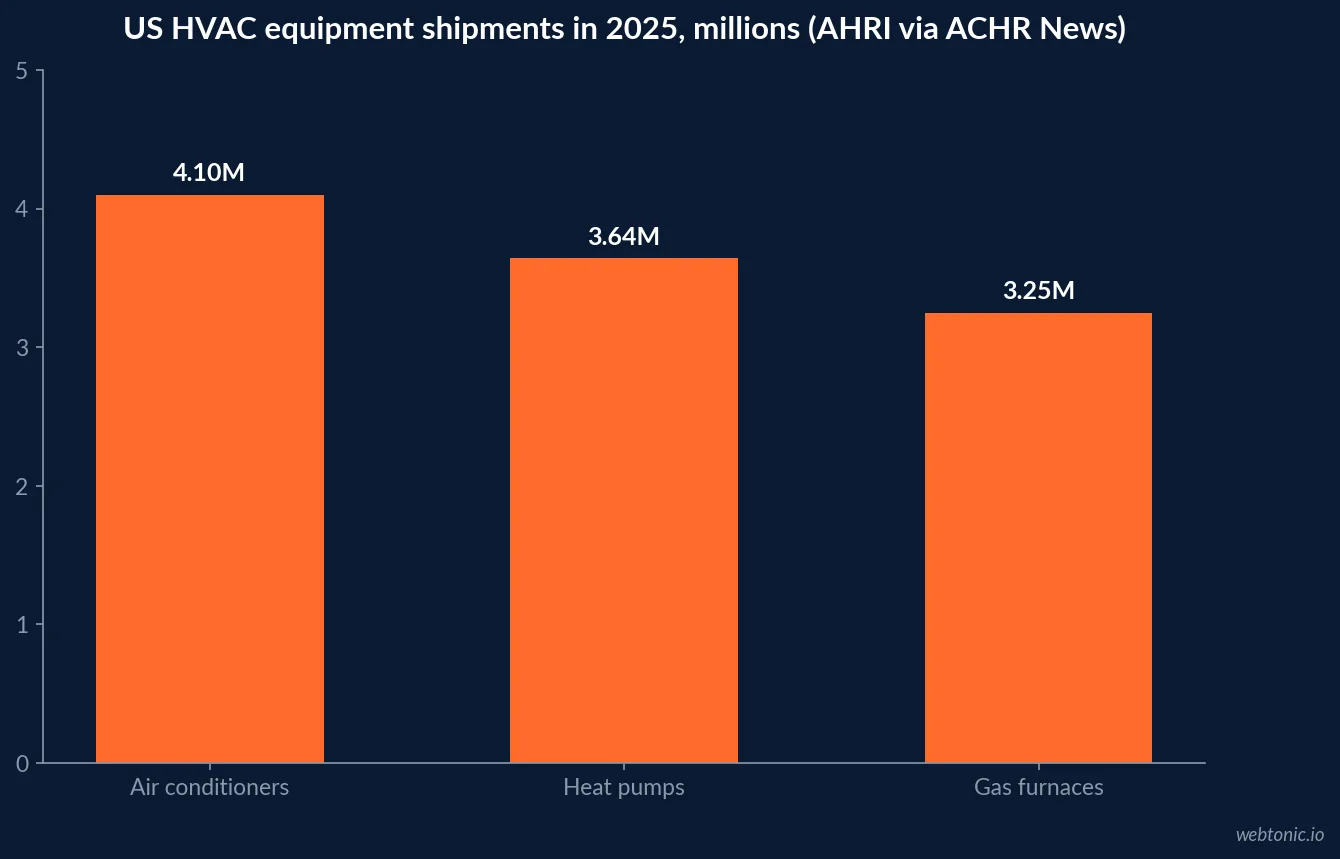
HVAC demand is seasonal and cyclical, and 2025 was a down year for cooling equipment. ACHR News, reporting the Air-Conditioning, Heating, and Refrigeration Institute's December 2025 shipment release (AHRI, published February 2026), put air conditioner and heat pump shipments at 7.75 million, down 20% from 9.68 million; air conditioners alone at 4.10 million, down 26.2%; and heat pumps at 3.64 million, down 11.6%. Gas warm-air furnaces rose 4.1% to 3.25 million.
ACHR News also quoted Carrier chairman and CEO David Gitlin on an earnings call saying the industry averaged 9.7 million units between 2020 and 2024 and delivered about 7.5 million last year by Carrier's estimate. For an enterprise site, that mix shift is a content signal: heat pump and furnace pages need depth as cooling replacement demand cools.
| AHRI category (2025 vs 2024) | 2025 shipments | 2024 shipments | Change |
|---|---|---|---|
| Air conditioners and heat pumps | 7.75 million | 9.68 million | -20% |
| Air conditioners only | 4.10 million | 5.56 million | -26.2% |
| Heat pumps only | 3.64 million | 4.12 million | -11.6% |
| Gas warm-air furnaces | 3.25 million | 3.12 million | +4.1% |
| Gas residential storage water heaters | 4.25 million | 4.18 million | +1.8% |
The installed base behind the searches
The US Energy Information Administration reports from its 2020 Residential Energy Consumption Survey that 88% of US households use air conditioning and two-thirds use central AC or a central heat pump as their main equipment, with the South at 93% and the Midwest at 92%. A national HVAC brand's location pages sit on top of near-universal equipment ownership, which is why repair and maintenance queries exist in every market it serves.
Location pages vs doorway pages
Google's spam policies list doorway abuse examples that include having multiple domain names or pages targeted at specific regions or cities that funnel users to one page, and creating substantially similar pages that are closer to search results than a clearly defined, browseable hierarchy. That is the exact failure mode of a 300-city HVAC template with the town name swapped.
A defensible location page has what the template cannot fake: the branch address and phone, the technicians and licences for that jurisdiction, the service area it actually covers, local equipment mix and recent jobs, and reviews from that branch.
| Page element | Location page | Doorway page | Why it matters |
|---|---|---|---|
| Address and phone | Branch-specific, matches profile | Head office or none | Consistency with Business Profile |
| Service area | Real coverage from that branch | Every town in the state | Google guidelines for service areas |
| Content | Local jobs, equipment, climate | Swapped place names | Spam policy on similar pages |
| Reviews | From that branch | Network-wide or none | Proof of local service |
| Markup | HVACBusiness per branch | One sitewide block | Structured data per location |
Service areas and profiles at network scale
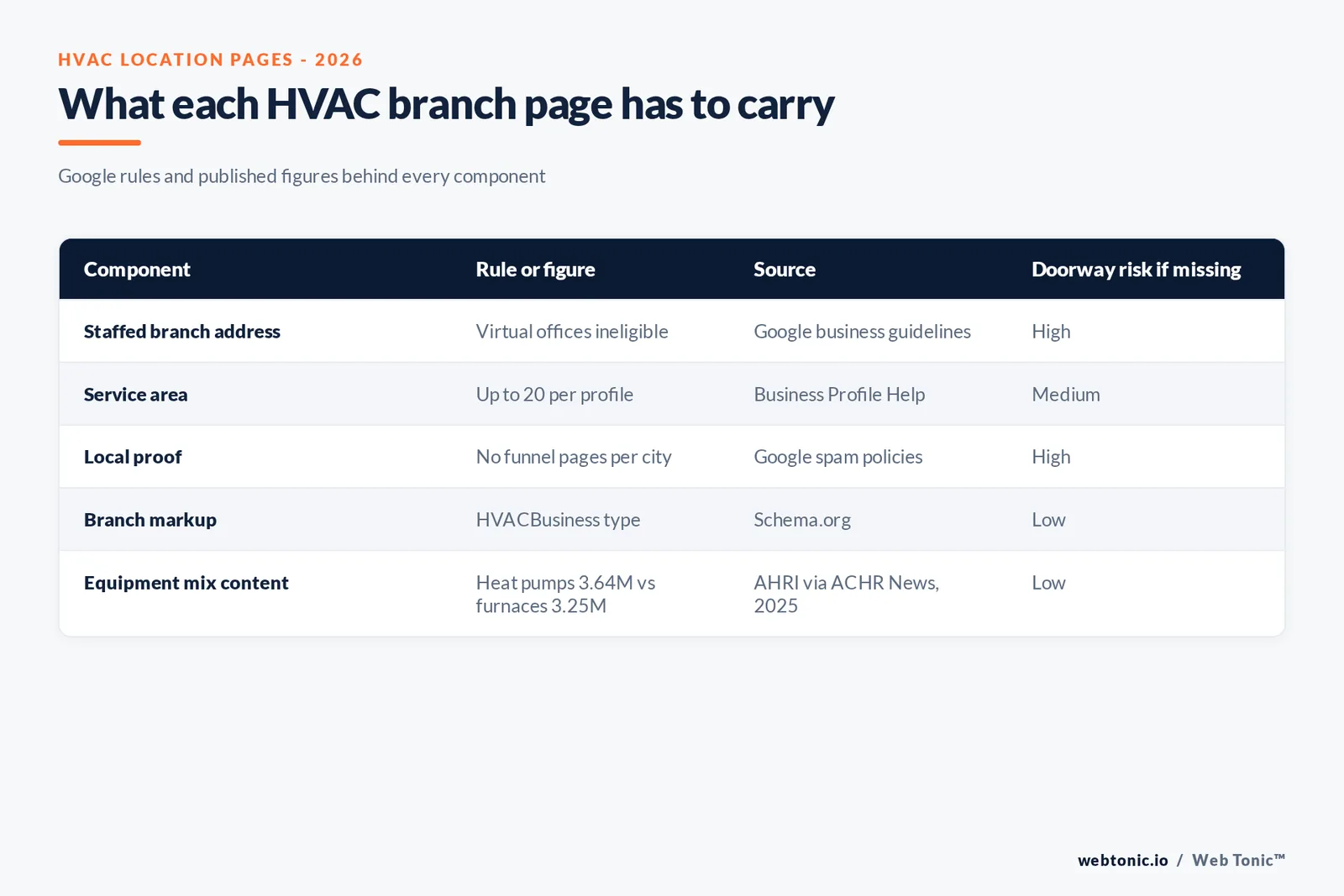
Google's Business Profile help on service areas says you can set up to 20 service areas and that businesses not serving customers at their address should remove the address from the profile. The business representation guidelines say service-area businesses should have one profile for the central office or location, with a designated service area, and that a virtual office is not eligible. Owners with 10 or more locations of the same business can verify in bulk.
For an HVAC platform with 40 branches, that is 40 profiles, each capped at 20 service areas, each needing a staffed address - not 400 profiles for 400 towns.
The bulk verification catch for service-area brands
Bulk verification is the obvious tool for a 40-branch brand, but Google's bulk verification page lists conditions that trip many HVAC networks. The spreadsheet must hold 10 or more profiles from the same business and every profile you manage; agencies with more than one business in one account cannot bulk verify; duplicate, suspended or disabled profiles do not count toward the 10; and the business must not be a service-area business. Uploading the spreadsheet does not itself send a verification request.
Most residential HVAC branches serve customers at the customer's address, which makes them service-area businesses under Google's definition. Hybrid branches with a staffed showroom or counter that receives customers during stated hours are in a different position. Map each branch to one of those two models before planning a bulk upload, because the model decides both the verification route and whether the address can be shown.
| Bulk verification condition | What Google requires | Typical HVAC branch | Planning consequence |
|---|---|---|---|
| Location count | 10+ profiles of the same business | Networks and franchises qualify | Group by brand, not by owner |
| Completeness | Every profile you manage in the sheet | Acquired brands often missing | Inventory profiles first |
| Account type | Agencies with several businesses excluded | Agency-held accounts | Move to brand-owned accounts |
| Profile status | Duplicates and suspended profiles don't count | Legacy duplicates after roll-ups | Merge or remove duplicates |
| Business model | Not a service-area business | Most residential branches are SABs | Verify SAB branches individually |
Regional demand differences
EIA's survey also shows why one national template misfires. Air conditioning use peaks at 93% of households in the South and 92% in the Midwest, and falls to 73% in the West, where the marine climate along the Pacific Coast brings it down to 49%. A branch page in coastal California and one in Texas should not lead with the same service.
Structured data for every branch
Schema.org defines an HVACBusiness type under HomeAndConstructionBusiness, itself a LocalBusiness subtype. Google's LocalBusiness structured data documentation says the markup can tell Google about business hours, different departments within a business and more. At enterprise scale, generate that markup from the same location database that feeds the profiles, so hours and phone numbers change in one place.
Large sites and crawl budget
Most HVAC networks are small by crawl standards. Google's crawl budget guide is intended primarily for large sites with 1 million+ unique pages changing about weekly, or 10,000+ pages changing daily. A 60-branch brand with service, equipment and city pages rarely crosses that; if Search Console shows many URLs as Discovered - currently not indexed, the usual cause is thin templated pages rather than raw size.
Fewer clicks from the results page
Ahrefs' April 2025 study of 300,000 keywords found an AI Overview correlated with a 34.5% lower click-through rate for the top-ranking page, and its re-run on December 2025 data found 58% lower. SparkToro and Datos found 58.5% of US Google searches ended with zero clicks in 2024 and only 360 of every 1,000 reached the open web. Those are informational or all-query figures; for an HVAC brand they argue for investing in the branch profile that answers on the results page, alongside the location page behind it.
| Results-page measure | Figure | Source and period | Scope |
|---|---|---|---|
| Top-result CTR with an AI Overview | -34.5% | Ahrefs, April 2025 | Informational keywords |
| Top-result CTR with an AI Overview | -58% | Ahrefs, December 2025 data | Informational keywords |
| US Google searches with zero clicks | 58.5% | SparkToro and Datos, 2024 | All query types |
| Open-web clicks per 1,000 US searches | 360 | SparkToro and Datos, 2024 | All query types |
| Business Profile service areas | Up to 20 | Google Business Profile Help | Per profile |
Where to start
Sequence matters more than volume. Fix the location data first, because every other layer - profiles, pages, markup and reporting - inherits its errors. Then decide, branch by branch, whether it is a storefront, hybrid or service-area location, since that choice drives verification, address display and service-area limits. Only then add or prune pages, and measure each branch separately so a strong head office does not hide weak locations.
Build one location database, generate profiles, pages and markup from it, prune city pages without local proof, and re-weight content toward heat pumps and furnaces as the equipment mix moves. Our enterprise SEO statistics give the cross-industry view, our HVAC Google Shopping and feed statistics cover the product side, and our data and analytics team can build branch-level reporting - or contact us.
Frequently Asked Questions
What is enterprise SEO for an HVAC company?
It is SEO for multi-location HVAC brands - regional groups, franchise systems and private-equity-backed platforms - where the work is keeping dozens of branch profiles, location pages and markup accurate at once. Census County Business Patterns 2023 shows how rare that scale is: of 111,207 plumbing, heating and air-conditioning contractor establishments, 76.8% had fewer than 10 employees and 1,656 had 100 or more.
How many location pages should an HVAC brand build?
One per real, staffed location, plus service-area pages only where you have genuine local content. Google's spam policies treat pages targeted at specific regions or cities that funnel users to one page as doorway abuse. A page earns its place with the branch address, technicians, service area, local jobs and reviews.
How many service areas can an HVAC Business Profile list?
Google's Business Profile help says you can set up to 20 service areas. Its guidelines add that service-area businesses should keep one profile for the central office or location, and that virtual offices are not eligible.
Is there structured data specifically for HVAC companies?
Yes. Schema.org includes an HVACBusiness type under HomeAndConstructionBusiness, a subtype of LocalBusiness. Google's LocalBusiness structured data documentation explains how to describe hours, departments and other details for each location.
Do AI Overviews affect HVAC search traffic?
No HVAC-specific study we opened measures it. Ahrefs found the presence of an AI Overview correlated with a 34.5% lower click-through rate for the top-ranking page in April 2025 and 58% lower on December 2025 data, on informational keywords. Emergency and repair queries with local intent may behave differently, which is why branch profiles matter.
Sources
US Census Bureau - County Business Patterns datasets
ACHR News - Heat pump, A/C shipments see 20% declines in 2025
AHRI - December 2025 U.S. heating and cooling equipment shipment data
US EIA - Air conditioning in US homes (RECS 2020)
Google Search Central - Spam policies
Google - LocalBusiness structured data
Google - Crawl budget for large sites
Google Business Profile Help - Service areas
Google - Guidelines for representing your business
Google Business Profile Help - Bulk verification
Schema.org - HVACBusiness
Ahrefs - AI Overviews reduce clicks by 34.5%
Ahrefs - Update: AI Overviews reduce clicks by 58%
SparkToro - 2024 zero-click search study


