Table of contents
A traveler finds your hotel on Booking.com, likes what they see, then quietly opens a new tab and searches your hotel's name directly. That second search is the moment that decides whether you keep the full booking value or hand 15 to 25 percent of it to the OTA that just introduced you. Whether you win that moment depends almost entirely on what shows up when they search.
SEO for hotels is the work of making sure your website wins that second search: strong local visibility, a Google Business Profile that answers questions before a guest has to ask, and content that's genuinely more useful than a listing page. None of it replaces OTAs. It just makes sure you're not leaving direct bookings on the table every time a guest already wants to book with you.
Key Takeaways
- Direct bookings cost a hotel roughly 2 to 5 percent per booking, compared to 15 to 25 percent in OTA commissions, making search visibility one of the highest-margin investments available to a property.
- 40 percent of US travelers now book directly with hotels, well above the 28 percent global average, and that gap keeps widening as more properties invest in their own website experience.
- 18 percent of travelers who start their search on an OTA ultimately book direct, a pattern known as the "billboard effect," which means OTA visibility and your own hotel SEO work together rather than against each other.
- A complete, accurate Google Business Profile is the single highest-leverage local SEO asset for a hotel, directly affecting whether you appear for "near me" and destination searches.
- Long tail keywords like "pet friendly hotel downtown" capture relevant searchers with specific needs and far less competition than broad terms like "hotel."
- High quality images and structured data (schema) help search engines understand your property's amenities and pull richer results into the Google SERP.
What Is SEO for Hotels?
SEO for hotels is the practice of optimizing a property's website and online listings so it ranks well in search results and earns direct bookings instead of losing them to OTA commissions. It covers the same fundamentals as any search engine optimization effort: technical health, relevant content, local listings, and keyword targeting, but weighted toward local and long-tail searches, since most travel intent starts with a destination and a need, not a hotel brand name.
That local-and-specific weighting matters because of how the booking journey actually plays out. OTAs handle the majority of hotel bookings industry-wide, roughly 55 percent of the global travel booking market, and that share climbs even higher for independent properties specifically: Cloudbeds' 2026 State of Independent Hotels Report puts OTA share at 63.4 percent for independents, with some markets approaching 80 percent. None of that makes direct bookings a lost cause. It means the website and search presence a hotel controls directly has to work harder per visitor than it used to. Every visitor who reaches the site organically is one who didn't cost a commission to acquire, which is the entire case for hotel SEO marketing.
What Each Booking Actually Costs Your Hotel
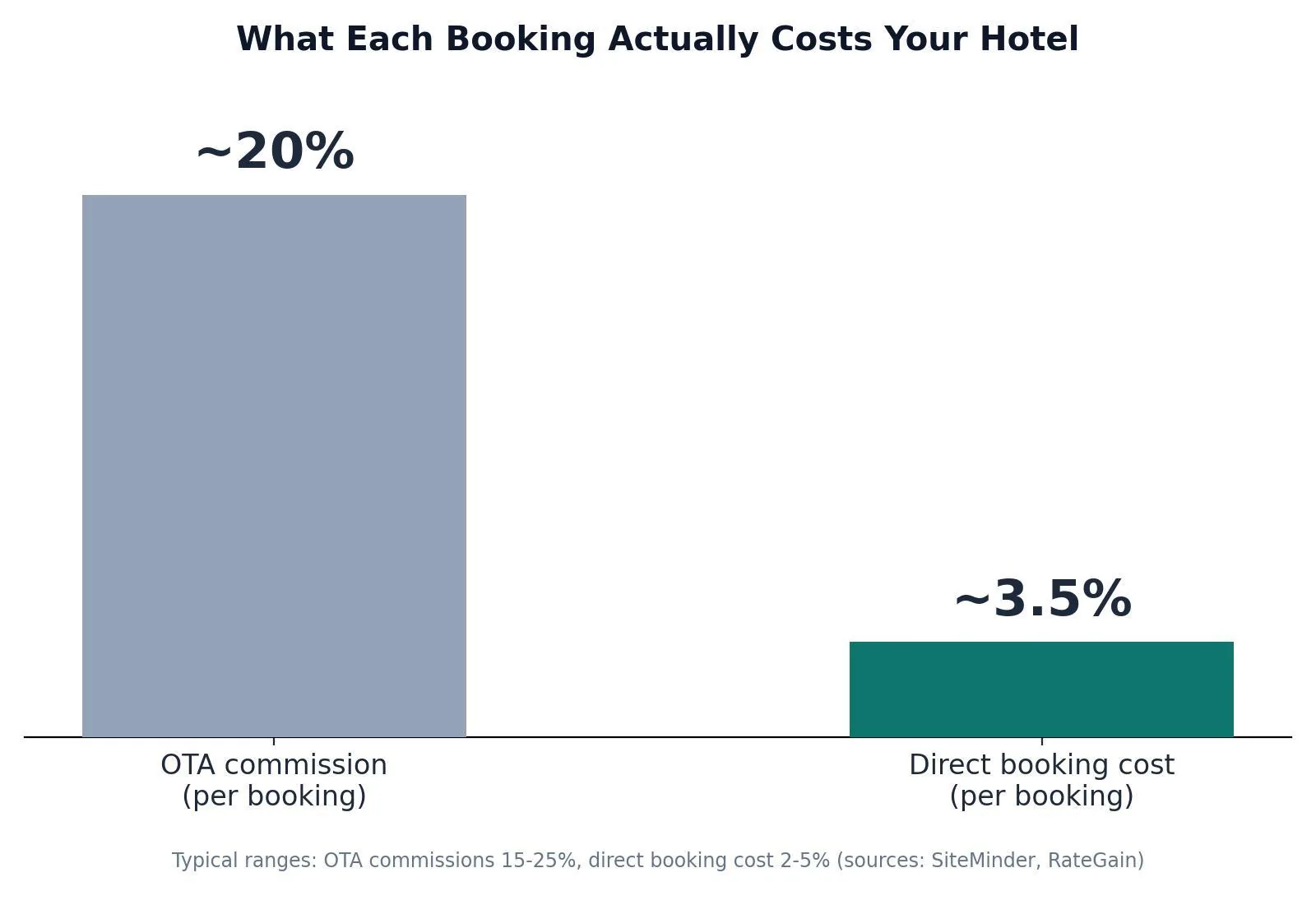
The math behind investing in hotel SEO is straightforward once the numbers are next to each other. Industry cost breakdowns put typical OTA commissions at 15 to 25 percent per booking, while a direct booking through a hotel's own channels typically costs 2 to 5 percent once booking engine fees and payment processing are accounted for.
On a $200 per night booking, using the midpoints of those ranges, that's roughly $193 kept after a direct booking versus closer to $160 after an OTA commission, on every single reservation. Multiply that across a full year of bookings and the case for investing in organic visibility stops being theoretical.
Hotel Distribution Channels Compared
| Channel | Typical Cost | Guest Data Ownership | Best For |
|---|---|---|---|
| Direct website booking | 2-5% (booking engine + processing) | Full ownership | Repeat guests, loyalty programs, highest margin |
| OTAs (Booking.com, Expedia) | 15-25% commission | OTA retains guest data | Global discovery, new guest acquisition |
| Google Hotel Ads / free booking links | Pay-per-click (PPC/SEM) or commission-based | Shared, depends on setup | Capturing high-intent searchers already on Google |
| Metasearch (Google, Apple Maps listings) | Varies, often PPC-based | Limited | Visibility across map and comparison results |
Most properties run all four simultaneously. The goal isn't eliminating OTAs, it's making sure your own hotel website captures its fair share of the guests who are already looking for you by name.
The Hotel Booking Journey
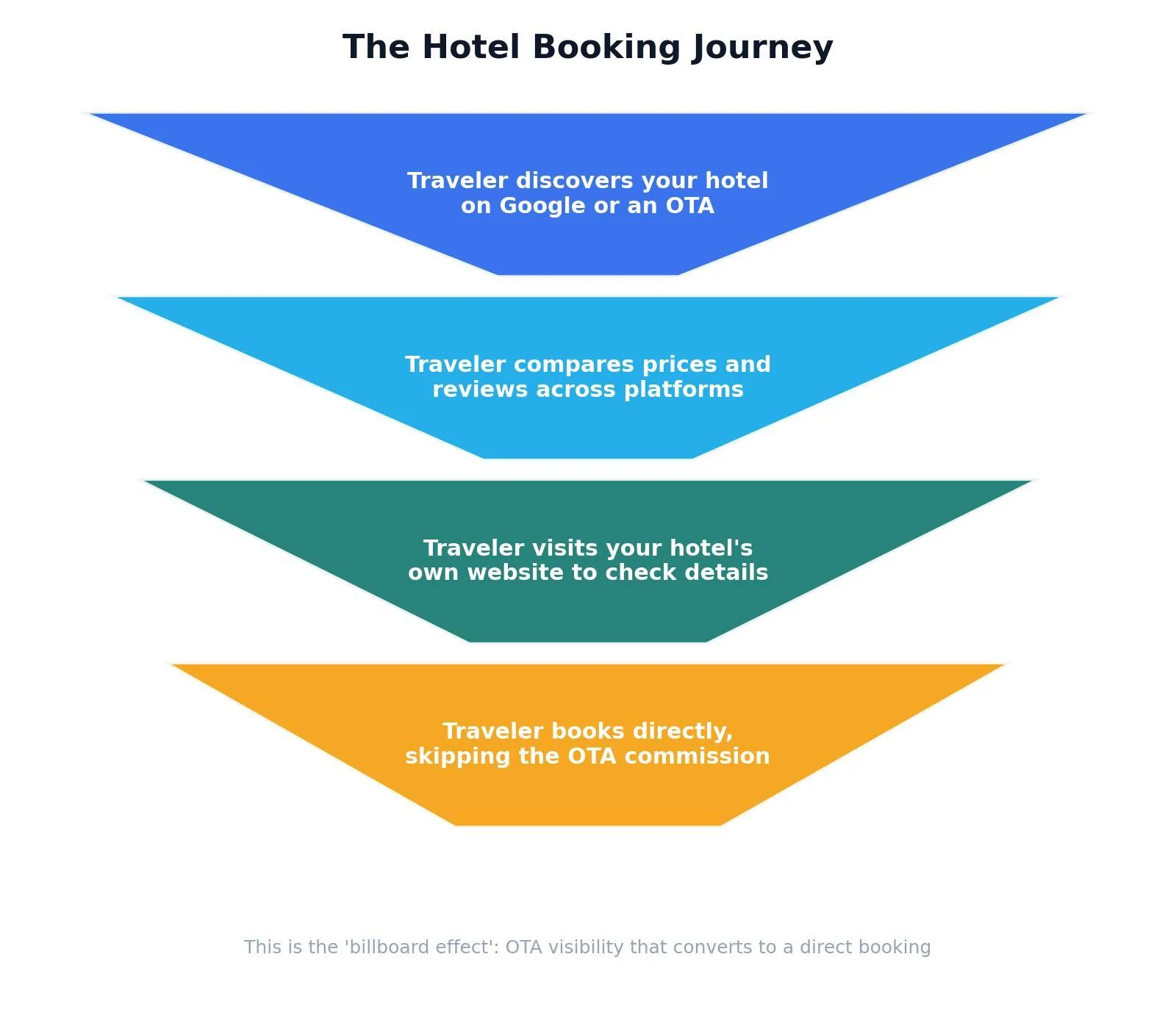
Most bookings follow a predictable path. A traveler discovers your property on Google or an OTA, compares prices and reviews across a few platforms, visits your hotel's own website to confirm details an OTA listing doesn't cover, then books, sometimes directly, sometimes back on the OTA. 18 percent of travelers who start on an OTA complete that loop by booking direct, according to SiteMinder's 2026 Changing Traveller Report. Every improvement to your own site raises the odds that visit ends in a direct booking instead of a bounce back to the OTA.
Direct Bookings Are Already Rising
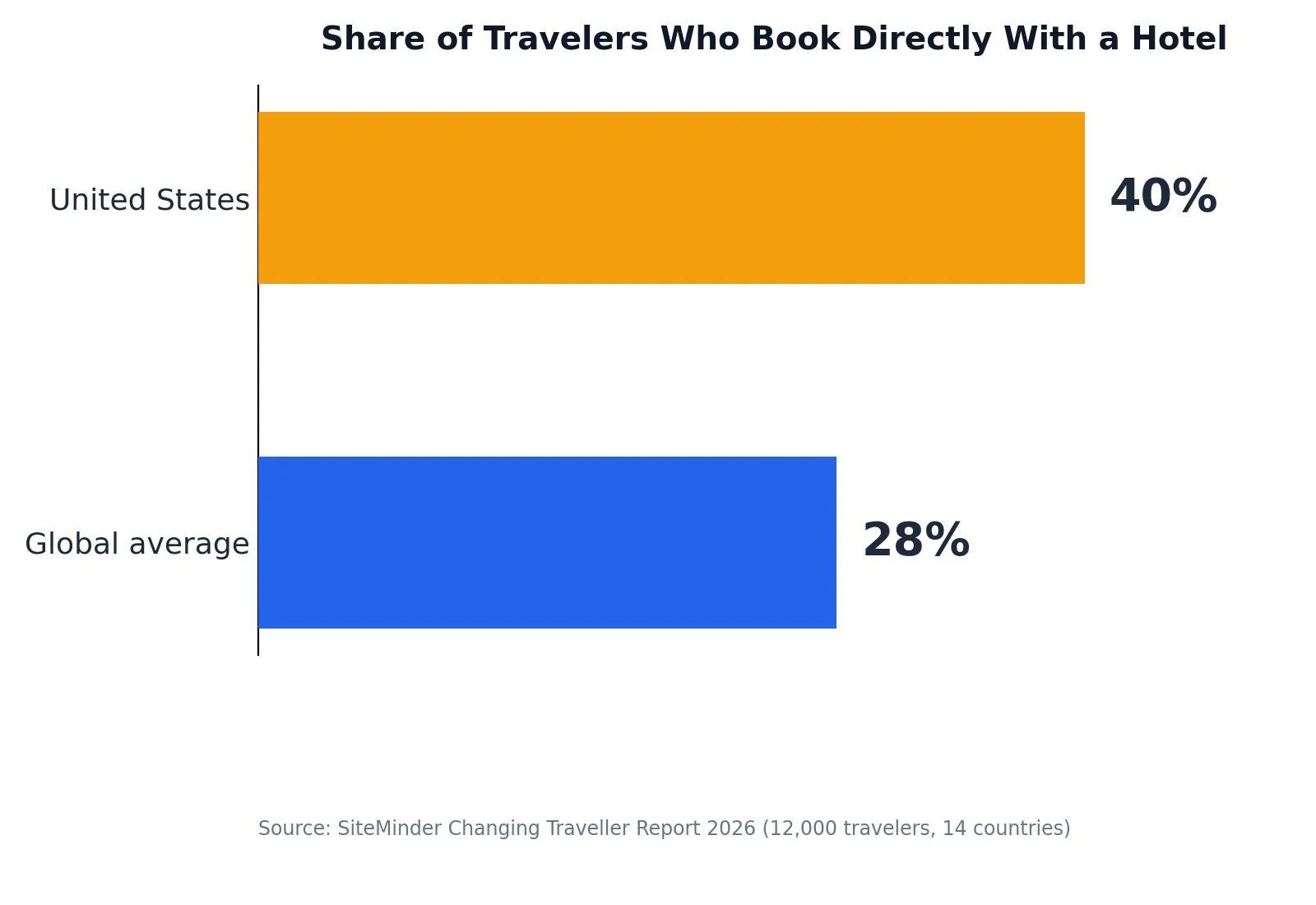
The trend line favors properties that invest in their own search presence. The same SiteMinder research found the global average share of travelers who book direct sits at 28 percent, while US travelers book direct at a notably higher 40 percent, up from 36 percent the year before. That gap reflects, in part, how much more US hotel marketing has shifted toward strong direct websites and search visibility.
The Hotel SEO Roadmap
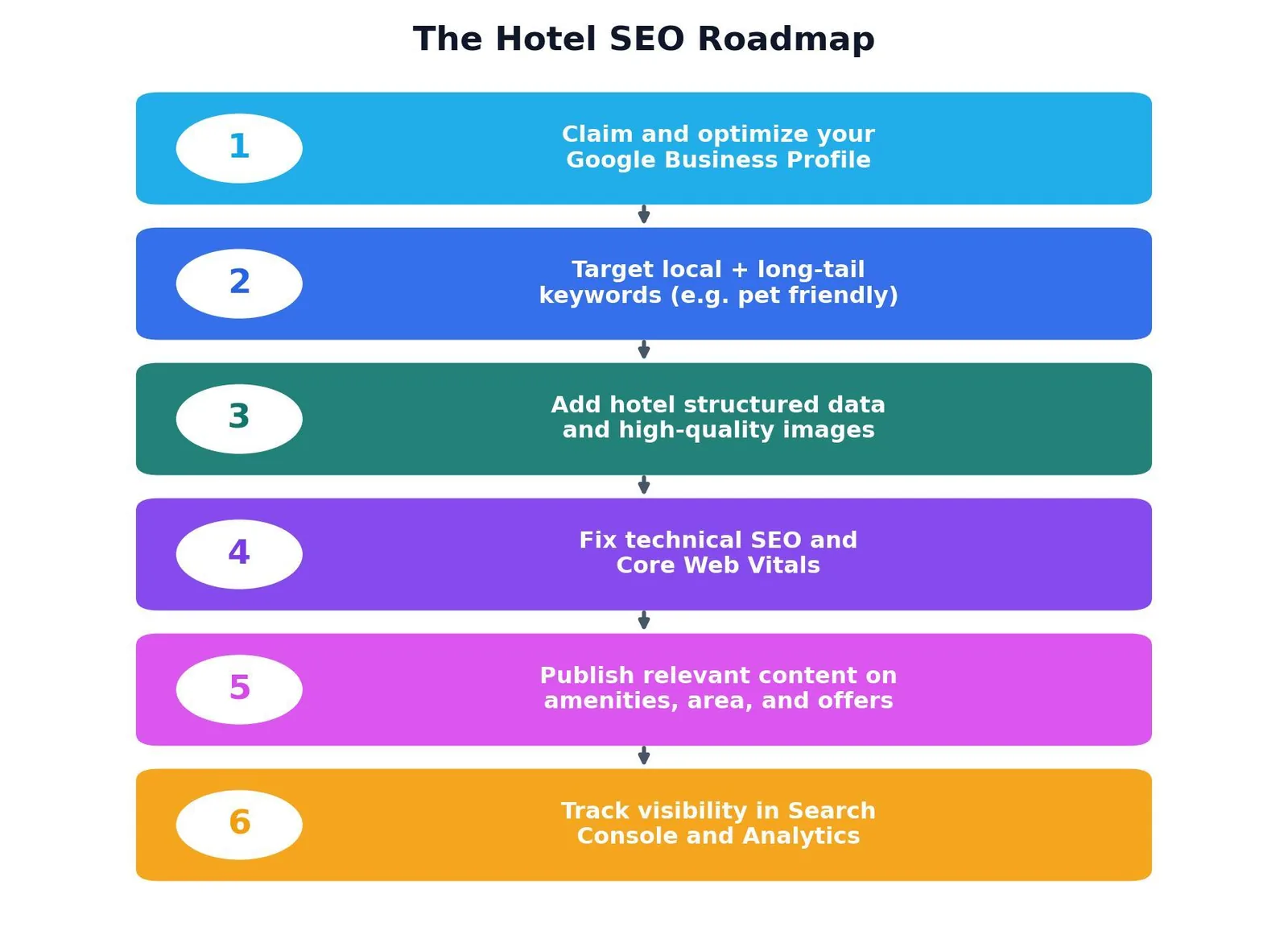
Getting these six steps right will directly affect how much of your booking volume moves through commission-free channels instead of an OTA.
Step 1: Claim and optimize your Google Business Profile
This is the fastest, highest-leverage move available. A complete Google Business Profile, current photos, accurate address phone number, amenities, and booking link, directly affects whether you appear for "near me" and destination-based searches.
Step 2: Target local and long-tail keywords
Broad terms like "hotel" are dominated by OTAs and major chains. The best opportunities are long tail keywords such as "pet friendly hotel downtown" or "hotel near [landmark]." These capture travelers with specific, high-intent needs, and they come with far less competition and a realistic shot at ranking higher in search results.
Step 3: Add structured data and high-quality images
Hotel schema markup, built on the vocabulary schema.org defines for lodging businesses, helps search engines understand room types, pricing, and amenities well enough to surface richer results. High quality images do the rest. Travel decisions are visual, and a weak photo gallery loses bookings that solid content never gets the chance to win.
Step 4: Fix technical SEO and Core Web Vitals
A slow hotel website loses mobile bookings before a guest ever sees a room photo. Google's own Core Web Vitals metrics, a fast content management system, and a simple booking flow all directly affect whether a visit converts.
Step 5: Publish relevant content on amenities, area, and offers
Guests research more than just rooms. Content on nearby attractions, seasonal offers, and specific amenities builds the kind of relevant content that ranks for informational searches and gives travelers a reason to book direct instead of settling for whatever an OTA listing shows.
Step 6: Track visibility in Search Console and Analytics
Google Search Console and Google Analytics show exactly which searches bring guests to the site and which pages actually drive organic traffic that converts, which is the only reliable way to know whether the previous five steps are working.
Hotel SEO tool
Is your hotel set up to win direct bookings?
Check off what's already true for your property. Your score updates as you go.
0 of 5
Check off items above to see how ready you are to win direct bookings.
Common SEO Mistakes Hotels Make
The most common one is leaving the Google Business Profile incomplete or outdated, which costs free visibility in exactly the searches that carry the most local intent.
A close second is chasing broad terms like "hotel" instead of specific long tail keywords, which wastes effort competing for rankings a hotel website realistically can't win against major chains and OTAs.
Weak or inconsistent images across the website and listings quietly cost bookings too, since travelers judge a property visually before reading a word of content.
And treating the direct website as an afterthought behind OTA listings rounds out the list. It guarantees a bigger share of commission-bearing bookings than necessary, even when a guest already searched for the hotel by name.
Frequently Asked Questions
How is SEO for hotels different from general local SEO?
The mechanics overlap heavily with any local SEO hotels effort benefits from: Google Business Profile, consistent listings, and reviews. What's different is the OTA layer. Hotel SEO strategy has to account for the fact that a large share of demand starts on a third-party platform, so the goal is often capturing the "billboard effect" rather than competing head-on for pure discovery traffic.
Do OTAs help or hurt my SEO?
Neither directly, but they compete for the same search real estate. OTA listings often rank well for generic destination searches, which is exactly why owning specific, long tail keywords and a strong Google Business Profile matters more for an independent hotel than trying to outrank Booking.com for "hotels in [city]."
How much should a hotel budget for SEO?
It depends on property size, market competition, and whether work is handled in-house or outsourced, so there's no single figure that applies broadly. Get a quote specific to your property before committing budget, and treat any number quoted in USD as a starting point for negotiation.
Does paid search (PPC/SEM) help alongside hotel SEO?
Yes. Google Hotel Ads and other PPC/SEM campaigns can capture high-intent searchers immediately, especially during slow booking periods, while organic SEO builds the durable visibility that keeps paying off long after any specific campaign ends.
Do voice search and social media matter for hotel SEO?
Yes, though neither replaces the fundamentals in this guide. Voice search queries like "find a pet friendly hotel near me" lean even harder on the same local SEO and Google Business Profile signals already covered here. Social media doesn't directly influence rankings, but it's an increasingly common discovery channel, especially visual platforms, that can send travelers straight to a hotel's website before they ever open an OTA.
The Bottom Line on SEO for Hotels
Every guest who finds your hotel through search instead of an OTA is a booking at full margin instead of one that started 15 to 25 percent smaller. A property with a complete Google Business Profile, a fast and well-photographed website, and content that actually answers what travelers want to know wins more of those moments, consistently, without paying a commission on each one.
Start with your Google Business Profile this week. It's free, it takes an afternoon, and it's the single highest-leverage item on this entire list.
Ready to Turn Search Visibility Into Direct Bookings?
Competing with OTA budgets and algorithm-driven placement isn't something most hotel marketing teams can do with time to spare. Web Tonic's growth marketing team handles the technical SEO, local optimization, and content work covered in this playbook as part of a full-funnel approach that also connects it to paid acquisition and attribution, so your direct channel keeps growing instead of losing ground to commission-based bookings.
More from Web Tonic: growth marketing services, data & analytics.
Sources: mize.tech · cloudbeds.com · rategain.com · siteminder.com · schema.org · web.dev