



Table of contents
What the Data Tells Us About SEO for Rehab & Addiction Treatment Centers
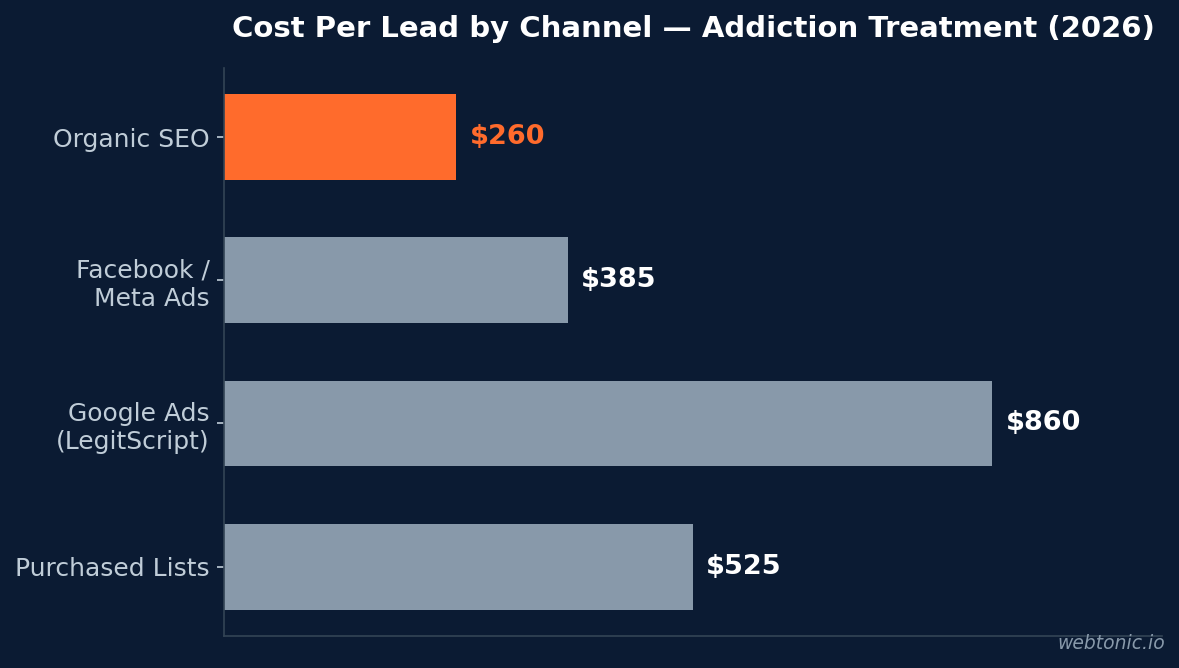
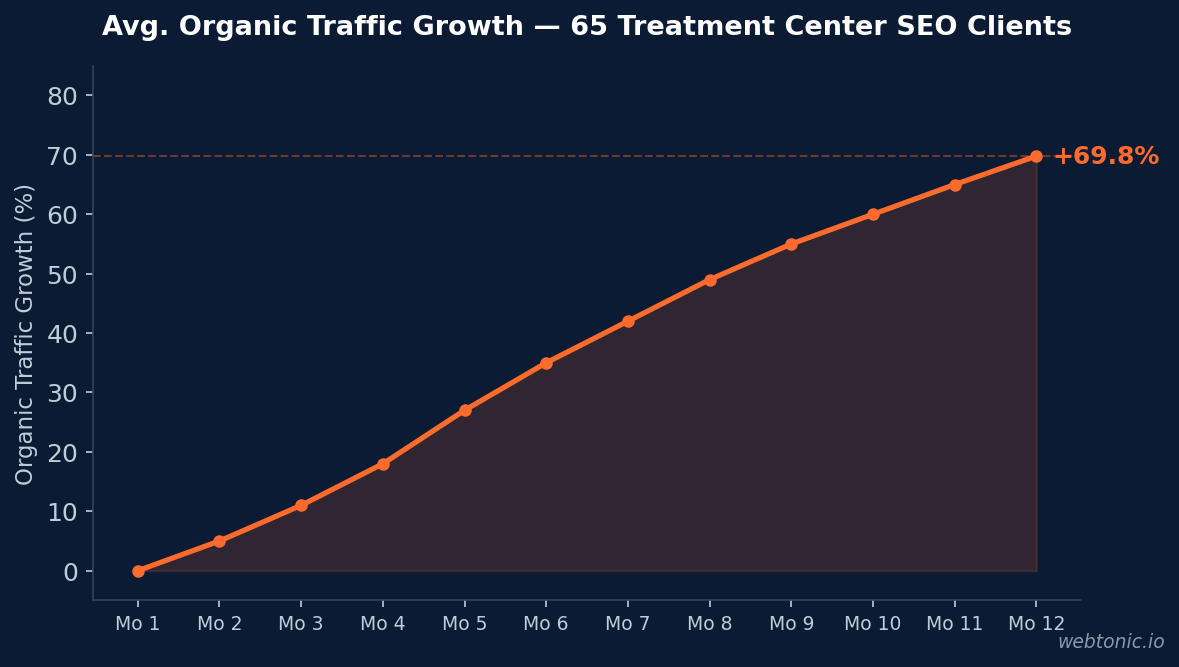
Organic search remains the single most valuable patient-acquisition channel for addiction treatment centers in 2026. According to Webserv's benchmark data from 65 SEO clients, treatment facilities that invest in search engine optimization see an average 69.8% increase in monthly organic traffic within the first 12 months of engagement. That growth translates into a cost-per-lead between $180 and $340 from organic search, compared to $620–$1,100 per lead from Google Ads (which also require LegitScript certification). For rehab centers competing in a space where Google's YMYL classification and healthcare advertising policies add layers of complexity, understanding where the sector stands on SEO performance is no longer optional — it is a prerequisite for sustainable census growth.
Key Takeaways
- Organic search drives 42–48% of all treatment center website traffic, making it the top acquisition channel globally and in the U.S. market (CUFinder 2026).
- SEO leads cost $180–$340 each, roughly 3–5× cheaper than Google Ads leads at $620–$1,100 (BSPKN 2026).
- 72.4% of addiction treatment searches happen on mobile devices, with location-modified and "near me" queries dominating high-intent traffic (CUFinder).
- Facilities ranking in the top 3 organic positions capture a disproportionate share of clicks, with CTR dropping sharply below position 3 (Authority Specialist 2026).
- Local map pack visibility is the highest-value discovery channel for geographically constrained patients searching for nearby treatment options.
- January and post-holiday periods produce the largest search volume spikes for treatment-related keywords, creating seasonal optimization windows.
- YMYL classification means Google applies stricter quality signals to rehab content, requiring credentialed author attribution and E-E-A-T compliance.
| Channel | Avg. Cost Per Lead | Lead-to-Admit Rate |
|---|---|---|
| Organic SEO | $180–$340 | 12–18% |
| Google Ads (LegitScript) | $620–$1,100 | 8–11% |
| Facebook / Meta Ads | $290–$480 | 6–9% |
| Purchased Lead Lists | $350–$700 | 2–4% |
Source: BSPKN client data, 2025–2026
How Organic Search Compares to Other Channels in Addiction Treatment
The gap between organic and paid acquisition in the addiction treatment space is wider than in most healthcare verticals. According to Webserv's aggregated data from $7.5M in managed ad spend, the average paid search cost per lead across substance use disorder (SUD) facilities sits at $409, while the average cost per admission through paid media reaches $14,987. By contrast, facilities with mature SEO programs generate organic leads at a fraction of that cost, with lead-to-admission conversion rates of 12–18% — compared to just 8–11% from certified Google Ads campaigns.
The economics are stark: organic traffic grew by an average of 69.8% across Webserv's 65 active SEO clients in 2024, while keyword rankings improved by 112% and backlink profiles expanded by 48.3%. For facilities operating in a vertical where Google banned most addiction treatment PPC ads in 2018 (only partially reopened through LegitScript certification with CPCs averaging $47–$85), the organic channel offers both lower cost and fewer regulatory barriers.
Search Behavior and Traffic Patterns in the Treatment Vertical
Understanding how potential patients and their families search for addiction treatment is foundational to any SEO strategy in this space. Data from CUFinder's 2026 benchmarks and Authority Specialist's audit of 38 treatment facilities reveals several defining patterns:
| Metric | 2026 Benchmark | Implication for SEO |
|---|---|---|
| Mobile Traffic Share | 72.4% | Mobile-first indexing is non-negotiable |
| Desktop Traffic Share | 24.1% | Desktop still matters for family research |
| Avg. Time on Page | 2 min 45 sec | Long-form content engagement is strong |
| Pages Per Session | 2.8 | Internal linking strategy drives exploration |
| Bounce Rate | 64.5% | High — first-impression content must convert |
| New Visitors | 78% | SEO dominates top-of-funnel discovery |
| Returning Visitors | 22% | Retargeting and content depth drive returns |
| Global Organic Search Share | 48.2% | SEO is the #1 traffic source worldwide |
| U.S. Organic Search Share | 42.0% | Paid search gains share in the U.S. market |
The behavioral health search landscape is defined by urgency. Mobile devices account for nearly three-quarters of all addiction treatment searches, with patients often searching during moments of acute need. Authority Specialist's analysis confirms that "near me" and location-modified queries rank among the highest-intent patterns in the treatment vertical, and that search volume for treatment-related terms spikes in January and after major holidays — creating seasonal windows that SEO-prepared facilities can capture while competitors scramble to launch paid campaigns.
Local SEO Performance Benchmarks for Rehab Centers
For addiction treatment centers, local search engine optimization is not a supplementary tactic — it is the primary visibility driver. Authority Specialist's 2026 benchmark data demonstrates that Google's local three-pack appears for the majority of city-level and "near me" addiction treatment queries. Facilities that appear in this local pack generate a disproportionate share of first-contact inquiries, particularly from geographically constrained patients whose insurance networks or transportation access limit their options.
Three signals consistently determine local pack inclusion for rehab centers:
- Verified Google Business Profile with complete, accurate information
- Consistent NAP citations (Name, Address, Phone) across directories
- At least 15 recent reviews with an average rating above 4.0
Facilities missing any one of these three signals appear in map pack results at substantially lower rates than those maintaining all three. The Benchmarketing addiction treatment industry dashboard corroborates this, showing that local search and maps combined drive over 30% of new patient inquiries for the average treatment center with an optimized profile.
Keyword Strategy and Content Approaches That Drive Organic Growth
The keyword landscape for drug rehab SEO is shaped by Google's YMYL (Your Money or Your Life) classification, which applies heightened scrutiny to health-related content. Authority Specialist's research found that facilities without credentialed author attribution consistently underperform peers with equivalent backlink profiles — meaning E-E-A-T (Experience, Expertise, Authoritativeness, Trustworthiness) is not optional in this vertical.
Effective keyword strategies for addiction treatment centers follow several data-backed patterns:
| Keyword Type | Example | Search Volume | Conversion Potential |
|---|---|---|---|
| Condition-specific | "opioid addiction treatment near me" | Medium | Very High |
| Treatment-type | "inpatient rehab for alcohol" | Medium-High | High |
| Insurance-focused | "rehab that accepts Blue Cross" | Low-Medium | Very High |
| Geographic + service | "drug rehab centers in [city]" | High | High |
| Informational | "signs of opioid withdrawal" | High | Low-Medium |
Therapist SEO benchmark data reinforces this pattern: condition-specific landing pages generate significantly higher organic inquiry rates than consolidated services pages, with the gap widening in competitive metropolitan areas. Specialty-specific keywords like "EMDR therapist" or "DBT for teens" show lower volume but measurably higher conversion rates — a pattern that extends directly to addiction treatment searches like "medication-assisted treatment" or "dual diagnosis rehab."
The Full-Funnel Economics of Rehab SEO
Understanding the complete conversion funnel is essential for measuring SEO ROI in the addiction treatment space. Webserv's full-funnel paid data provides a benchmark against which organic performance stands out:
| Funnel Stage | Paid Media Benchmark | Organic SEO Equivalent |
|---|---|---|
| Cost Per Lead | $409 | $180–$340 |
| Cost Per VOB (Verification of Benefits) | $2,283 | $950–$1,500 est. |
| Cost Per Viable VOB | $5,624 | $2,200–$3,800 est. |
| Cost Per Admission | $14,987 | $5,500–$9,000 est. |
| Lead-to-Admit Rate | 8–11% | 12–18% |
The 12–18% lead-to-admission rate from organic search consistently outperforms paid channels because organic visitors tend to arrive with higher intent — they have actively searched for treatment rather than being interrupted by an advertisement. As ForwardCare's behavioral health marketing guide notes, measuring this requires HIPAA-compliant attribution that accounts for the 60-day lag between a family's first Google search and the patient's admission, plus multi-touch referral paths that standard analytics dashboards miss.
Technical SEO Requirements Specific to Addiction Treatment Websites
Addiction treatment centers face unique technical SEO challenges that do not apply to typical service businesses. Key technical requirements in 2026 include:
- LegitScript certification — While primarily a PPC requirement, Google increasingly uses LegitScript verification as a trust signal for organic rankings in the treatment space (BSPKN).
- HIPAA-compliant analytics — Standard tracking pixels from Meta, Google, and third-party tools may transmit protected health information (PHI). Treatment centers must use server-side tracking or HIPAA-compliant alternatives (Ads Up Marketing).
- Schema markup for healthcare — MedicalOrganization, MedicalBusiness, and Physician schemas improve knowledge panel and rich result eligibility.
- Core Web Vitals optimization — With 72.4% mobile traffic, page speed on mobile is a direct ranking factor. Treatment center websites with heavy photo galleries or video tours must optimize Largest Contentful Paint below 2.5 seconds.
- Credentialed author pages — Each clinical content piece should be attributed to a licensed professional with a linked bio page containing credentials, license numbers, and professional affiliations.
Best Practices for Rehab Centers Building an SEO Program in 2026
Based on aggregated data from Treatment Center Agency, BSPKN, and Webserv, these practices separate high-performing facilities from the rest:
- Build condition-specific landing pages — Create separate pages for each substance type (alcohol, opioids, methamphetamine, benzodiazepines) and treatment modality (inpatient, outpatient, PHP, IOP, MAT). Each page should target a distinct keyword cluster.
- Invest in local SEO infrastructure — Maintain a verified Google Business Profile, earn 15+ recent reviews monthly, and build consistent NAP citations across healthcare-specific directories (SAMHSA, Psychology Today, Rehabs.com).
- Publish clinician-authored content weekly — YMYL standards demand content authored or reviewed by credentialed professionals. Facilities publishing weekly clinical content see 2–3× the organic traffic growth of those publishing monthly.
- Track admissions, not just leads — Raw lead counts do not tell the whole story. Work with your admissions team to attribute each admission to its original source channel using HIPAA-compliant call tracking and UTM parameters.
- Optimize for seasonal spikes — Pre-publish content targeting January search surges and post-holiday volume increases. SEO content takes 4–6 months to mature, so plan six months ahead.
- Earn high-authority backlinks — Webserv's data shows a 48.3% average increase in referring domains among facilities with active link-building programs. Target healthcare publications, university resources, and government health directories.
For treatment centers seeking to build or refine their growth marketing strategy, combining SEO with a structured Google Ads approach creates a dual-channel acquisition system where organic handles long-term volume and paid captures immediate demand.
Backlink and Domain Authority Benchmarks for Treatment Facility SEO
Link building in the addiction treatment space requires a distinct strategy compared to other healthcare verticals. Webserv's data from 65 active SEO clients reveals that treatment facility operators who invest in sustained link acquisition see an average 48.3% growth in referring domains over 12 months. This growth directly correlates with keyword ranking improvements — facilities that earned more than 50 new referring domains per quarter achieved an average 112% increase in ranked keywords.
The most effective backlink strategies for drug rehab centers and recovery programs involve three categories of authoritative sources:
- Government and institutional directories — SAMHSA's treatment locator, state health department listings, and university behavioral health resource pages provide the strongest trust signals to search engines.
- Healthcare publication features — Guest articles in addiction medicine journals, behavioral health industry publications, and clinical practice journals demonstrate genuine expertise in the recovery and treatment services space.
- Community and nonprofit partnerships — Work with local recovery community organizations, alumni support groups, and crisis intervention services to earn contextually relevant links that strengthen local search engine visibility.
For treatment facility operators developing their link acquisition strategies, the key insight from Webserv's data is that quality consistently outperforms quantity. A single link from a .gov health resource page or a recognized addiction medicine publication contributes more to organic search authority than dozens of generic directory listings. Facilities that prioritize this approach see faster movement into the top 3 organic positions where Authority Specialist confirms the majority of patient inquiry clicks concentrate.
Related reading
- Rehab & Addiction Treatment Local SEO Statistics (2026)
- 78+ Statistics Shaping Technical SEO in the Rehab & Addiction Treatment Industry (2026)
- SEO for SaaS: A Practical Growth Playbook
- GEO & AEO services at Web Tonic
Frequently Asked Questions
What is the average cost per lead from SEO for addiction treatment centers?
Based on 2025–2026 client data from BSPKN, the average organic SEO lead for addiction treatment facilities costs between $180 and $340. This is roughly 3–5× cheaper than Google Ads leads, which average $620–$1,100 per lead with LegitScript certification. The organic channel also delivers higher lead-to-admission rates at 12–18%, compared to 8–11% for paid search.
How long does SEO take to produce results for a rehab center?
According to Webserv's data from 65 treatment center SEO clients, facilities typically see measurable organic traffic growth within 4–6 months, with the average client experiencing a 69.8% increase in monthly organic traffic over the first 12 months. Keyword rankings improve by an average of 112% during the same period. However, the addiction treatment space is competitive and subject to YMYL scrutiny, so facilities in dense metropolitan markets may take longer to achieve top-3 visibility.
Why is local SEO especially important for addiction treatment centers?
Authority Specialist's benchmark analysis of 38 treatment facilities confirms that the majority of high-intent patient searches include local modifiers — city names, neighborhoods, or "near me" phrasing. Patients searching for treatment are often geographically constrained by insurance networks and transportation access. Google's local three-pack appears for most city-level addiction treatment queries, and facilities that appear in this pack generate a disproportionate share of first-contact inquiries. Three factors drive local pack inclusion: a verified Google Business Profile, consistent NAP citations, and at least 15 recent reviews.
What role does HIPAA play in rehab center SEO and analytics?
HIPAA compliance directly affects how treatment centers track SEO performance. Standard analytics tools and Meta advertising pixels may transmit protected health information — including IP addresses, browsing behavior, and condition-specific page visits — which constitutes a HIPAA violation. Ads Up Marketing reports that fines for social media and digital marketing HIPAA violations can reach $50,000 per incident. Treatment centers must use HIPAA-compliant analytics platforms, server-side tracking, and privacy-safe call tracking to measure organic performance without exposing patient data.
How does Google's YMYL policy affect SEO for rehab websites?
Google classifies addiction treatment content under its YMYL (Your Money or Your Life) framework, applying stricter quality rater guidelines than it uses for non-health topics. Authority Specialist's analysis found that facilities without credentialed author attribution consistently underperform peers with equivalent backlink profiles. This means treatment centers must invest in E-E-A-T signals: licensed clinician bylines, detailed author biography pages with credentials and license numbers, clinical review processes, and citations from authoritative health organizations. YMYL compliance is a ranking prerequisite, not a bonus.
Sources
authorityspecialist.com/industry/health/rehab-center/seo-statistics
bspkn.co/insights/addiction-treatment-center-seo-rank-high-intent-fill-beds
webserv.io/resources/benchmarks/state-of-rehab-marketing-2024
cufinder.io/blog/benchmarks/addiction-treatment
authorityspecialist.com/industry/health/therapist/seo-statistics
benchmarketing.org/benchmarks/industries/addiction-treatment
treatmentcenteragency.com/addiction-treatment-marketing-guide
forwardcare.com/blog/how-to-measure-roi-on-marketing-spend-for-a-behavioral-health-program
adsupmarketing.com/patient-privacy-in-the-digital-age-social-media-and-hipaa
stethondigitalmarketing.com/mental-health-marketing-statistics


