



Table of contents
Fitness is a local business, so international SEO for gyms mostly means two things: franchise brands with clubs in other countries, and multilingual pages for members at home. No study publishes an international traffic share or hreflang adoption rate for gyms, so this report uses filings, census data and search-engine share instead.
Key Takeaways
- Planet Fitness ended 2025 with 2,896 clubs across the US, Puerto Rico and five other countries.
- Its 2025 club table lists 47 franchise clubs in Mexico, 9 in Panama and 13 corporate clubs in Spain.
- The brand served about 20.8 million members at year-end 2025.
- 78.3% of US residents aged 5+ speak only English at home (Census, 2018-2022).
- Spanish accounts for 61.1% of those who speak another language at home.
- 21.0% of Canadian households were multilingual in 2021.
- CSA Research found 76% of online shoppers prefer product information in their own language (2020).
- 40% will never buy from websites in other languages.
- Google holds 93.81% of search in Spain and 88.08% in Mexico (Statcounter, Sept 2026).
- English is used on 49.5% of websites with a known content language (W3Techs, Oct 2026).
- HFA's 2026 Global Report covers 33 countries and 244 operators with nearly 27,000 facilities.
What international SEO means for a fitness business
Google's own guide to managing multi-regional and multilingual sites separates the two jobs cleanly. A multilingual site "offers content in more than one language", while a multi-regional site "explicitly targets users in different countries". Almost every gym, studio and boutique chain sits in the first group: it serves one metro area but may serve it in two or three languages.
Only franchise brands and equipment or app companies sit in the second group. That split decides the budget. A club owner in Miami, Montreal or San Antonio needs translated membership, class and pricing pages with their own URLs. A franchisor opening in Mexico or Spain needs country versions, local search-engine checks and hreflang annotations that tie every version together.
Nothing in the published record gives a share of gym traffic that comes from abroad, a multilingual click-through rate for fitness, or an hreflang adoption figure for the sector. Where this page needs a number, it borrows one from a named filing, census table or cross-industry survey and labels it as such.
The franchise footprint: where a US gym brand already operates abroad
Planet Fitness reported approximately 20.8 million members and 2,896 clubs as of December 31, 2025, located "in all 50 states, the District of Columbia, Puerto Rico, Canada, Panama, Mexico, Australia, and Spain". The club table in its 2025 annual report shows how thin the foreign footprint still is: 47 franchise clubs in Mexico, 9 in Panama, and 13 corporate-owned clubs in Spain, against 277 corporate-owned clubs in the United States alone.
The same report is candid about search visibility abroad. It says competition "is more significant internationally, where we have a limited number of clubs and more limited brand recognition", and that the company intends "to strategically enter one to two new markets each year". For SEO that means the brand starts each new country with almost no branded search demand, so its local pages have to win on generic queries such as the Spanish equivalents of "gym near me".
| Market outside the 50 states | Published club figure (Dec 31, 2025) | Ownership | SEO implication |
|---|---|---|---|
| Mexico | 47 clubs | Franchise | Spanish (Mexico) pages, Google-led market |
| Spain | 13 clubs | Corporate-owned | Spanish (Spain) pages, separate from Mexico |
| Panama | 9 clubs | Franchise | Spanish pages, can share es-419 copy |
| Canada | Clubs in several provinces | Franchise and 2 corporate in Ontario | English and French versions in Quebec |
| Australia | Clubs in NSW, Queensland, Victoria | Franchise | English (en-AU) version, local pricing |
Search engines in the markets gym franchises enter
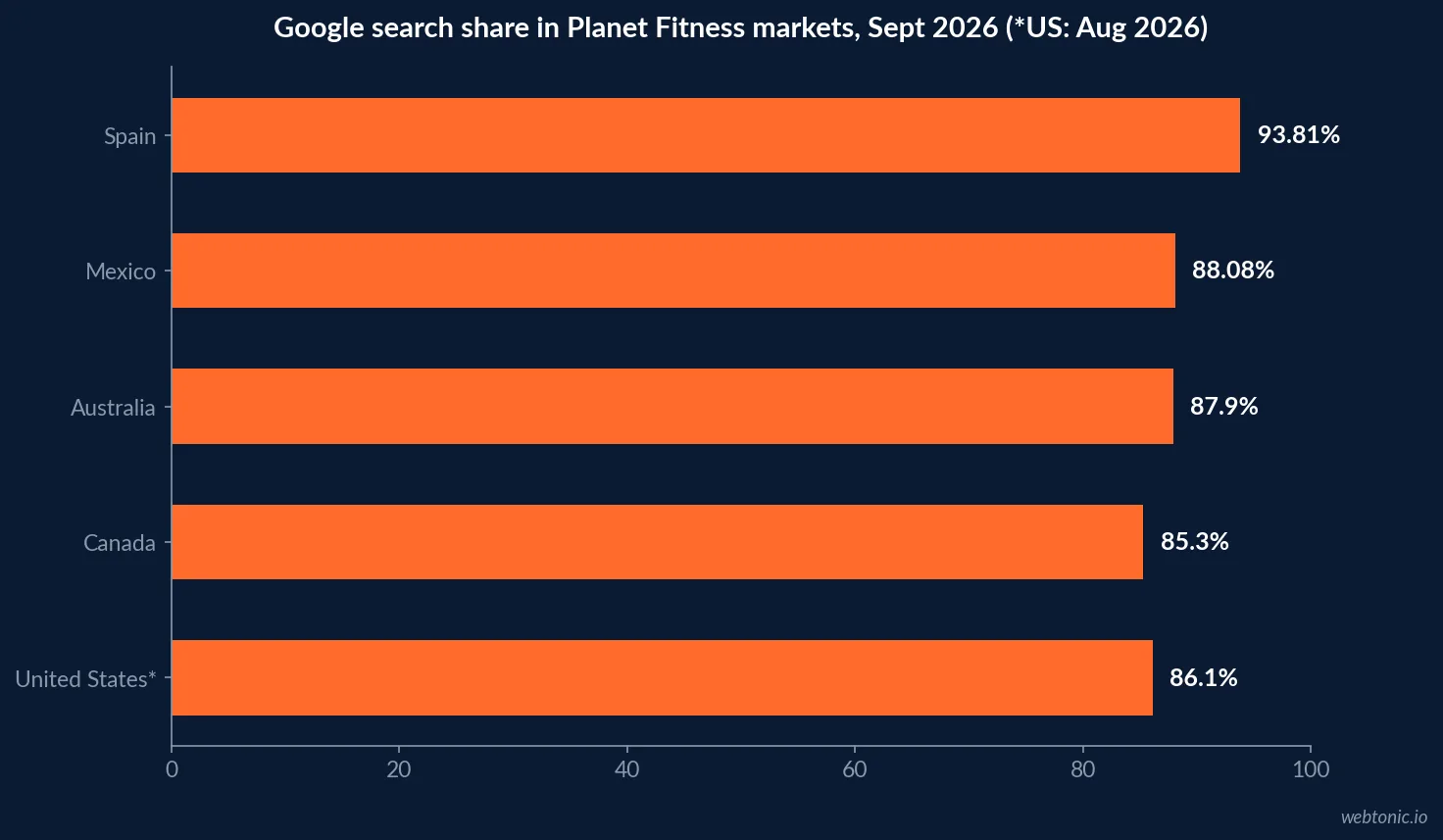
Statcounter's September 2026 figures show Google above 85% in every market where Planet Fitness has clubs: 93.81% in Spain, 88.08% in Mexico, 87.9% in Australia and 85.3% in Canada, where Bing takes 10.06%. In the United States, Google held 86.1% in August 2026.
So for today's fitness franchise markets, local SEO is Google SEO with a translated layer. The calculation changes only if a chain eyes Asia: Naver holds 43.06% in South Korea and Baidu 46.65% in China in the same dataset, and neither reads hreflang the way Google does.
| Country | Google share (Sept 2026) | Second engine | What a gym site should add |
|---|---|---|---|
| Spain | 93.81% | Bing 3.49% | es-ES pages and a Spanish Business Profile |
| Mexico | 88.08% | Bing 9.43% | es-MX pages with peso pricing |
| Australia | 87.9% | Bing 9.17% | en-AU spelling and AUD pricing |
| Canada | 85.3% | Bing 10.06% | en-CA and fr-CA versions, Bing Places |
| South Korea | 47.97% | Naver 43.06% | Naver listing before any launch |
The domestic language market a single club serves
For most gyms the relevant "international" audience lives a few blocks away. The US Census Bureau reported in December 2023 that 78.3% of the population aged 5 and older spoke only English at home in 2018-2022, down from 78.7% in 2013-2017. Among people who spoke another language at home, Spanish accounted for 61.1%, Chinese 5.1% and Tagalog 2.5%.
The same release shows the language gap widens with age: 58.3% of Spanish speakers aged 18-64 spoke English "very well", against 41.6% of those 65 and older. That matters for clubs selling senior programs, aqua classes or physical-therapy partnerships, where the buyer is older and more likely to search in Spanish.
| Census measure (ACS 2018-2022) | Figure | Comparison | Use for a gym site |
|---|---|---|---|
| Speak only English at home (age 5+) | 78.3% | 78.7% in 2013-2017 | Base audience for English pages |
| Spanish among other-language speakers | 61.1% | Largest single language | First translation to fund |
| Chinese among other-language speakers | 5.1% | Second largest | Only in metros with demand |
| Spanish speakers 18-64 speaking English very well | 58.3% | 41.6% for age 65+ | Senior programs need Spanish copy |
| Spanish speakers 5-17 speaking English very well | 79.8% | 80.3% in 2013-2017 | Kids' programs can stay bilingual |
Canada and Quebec: bilingual clubs by law and by habit
Statistics Canada found that more than 3.1 million households, or 21.0%, were multilingual in 2021, and that 4.6 million people (12.7% of the population) primarily spoke a language other than English or French at home. In Quebec, French was one of the languages in 86.8% of multilingual households.
For clubs in Quebec, translation is a legal question before it is an SEO one. Section 52 of the Charter of the French Language, amended in 2022, states that "regardless of the medium used, catalogues, brochures, folders, commercial directories, order forms and any other documents of the same nature that are available to the public must be drawn up in French". A membership sign-up page is an order form in all but name, so French versions come first and English versions must not be offered on better terms.
What Google's documentation tells a gym brand to do
Google gives fitness brands fewer choices than many expect. Its multi-regional guide says it "recommends using different URLs for each language version of a page rather than using cookies or browser settings", because Googlebot "usually originates from the USA" and sends requests "without setting Accept-Language". It also says Google uses "the visible content of your page to determine its language" and does not use lang attributes or the URL.
The localized versions guide adds that hreflang tags must be reciprocal: "If two pages don't both point to each other, the tags will be ignored." It recommends an x-default fallback for unmatched languages, which suits a club locator or a franchise home page with a country selector.
| Decision | What Google's documentation says | Gym example |
|---|---|---|
| Separate URLs | Use different URLs per language, not cookies | /es/membresias next to /memberships |
| Language detection | Google reads visible content, not lang attributes | Translate class names and FAQs, not just menus |
| Auto-redirects | Avoid redirecting by guessed language | Let Montreal visitors switch to English themselves |
| Fallback page | Use hreflang x-default for unmatched languages | A global club finder as the default |
| Reciprocity | Tags are ignored unless both pages point to each other | Each club page links its translations both ways |
| IP targeting | IP location analysis is generally not reliable | Do not swap content by visitor IP |
How much language matters to a buyer
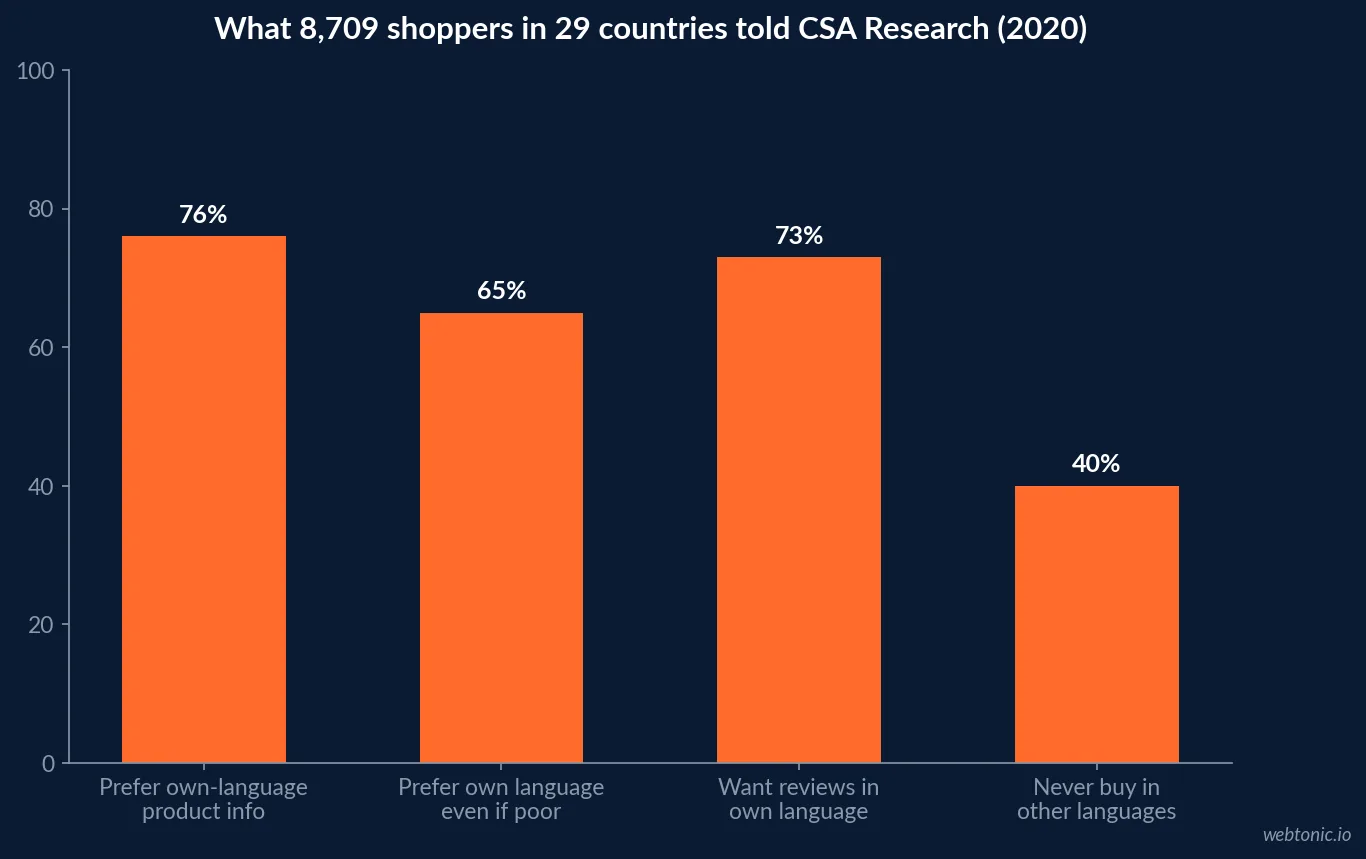
No survey isolates gym members, so the best evidence is cross-industry. CSA Research surveyed 8,709 consumers in 29 countries in 2020 and found 76% of online shoppers prefer to buy products with information in their native language and 40% will never buy from websites in other languages. 65% prefer content in their language even if it is poor quality, and 73% want product reviews in their language if nothing else.
Read the review figure carefully for a gym. Membership decisions lean heavily on reviews and class schedules, both of which a club can localise cheaply: translated class names, a Spanish-speaking trainer tag, and reviews left in the member's own language on the club's Business Profile.
The size of the global fitness market behind franchise expansion
The 2026 HFA Global Report from the Health and Fitness Association covers 33 countries and more than 200 operator profiles; its global survey included 244 operators running nearly 27,000 facilities. In 2025, median net membership grew 6.1% and the median EBITDA margin reached 22.1%. At home, HFA reports that 81 million Americans were members of a fitness facility in 2025.
The headroom sits in low-penetration markets, which is also where a US brand's name means least in search.
| Market (HFA 2026 Global Report) | Members | Facilities | Penetration |
|---|---|---|---|
| India | 13.65 million | 49,300 | 0.9% |
| Brazil | 14.7 million | 45,000+ | 7% |
| China | 50 million | About 50,000 | 3.6% |
| United States | 81 million (2025) | Not stated in release | Not stated |
Which languages the open web already covers
W3Techs reported on October 1, 2026 that English is used by 49.5% of websites whose content language it can identify, followed by Spanish at 6.0%, German at 5.9%, Japanese at 4.9% and French at 4.5%. Spanish is spoken by far more people than that share suggests, which is the commercial case for a Spanish club page: fewer competing pages for the same intent.
| Content language (W3Techs, Oct 2026) | Share of websites | Relevance for fitness brands |
|---|---|---|
| English | 49.5% | Default for US, Canada, Australia |
| Spanish | 6.0% | Mexico, Spain, Panama and US Spanish speakers |
| German | 5.9% | Only for a brand entering DACH markets |
| French | 4.5% | Quebec clubs and France |
| Portuguese | 4.1% | Brazil, HFA's 14.7 million members |
A rollout order that follows the data
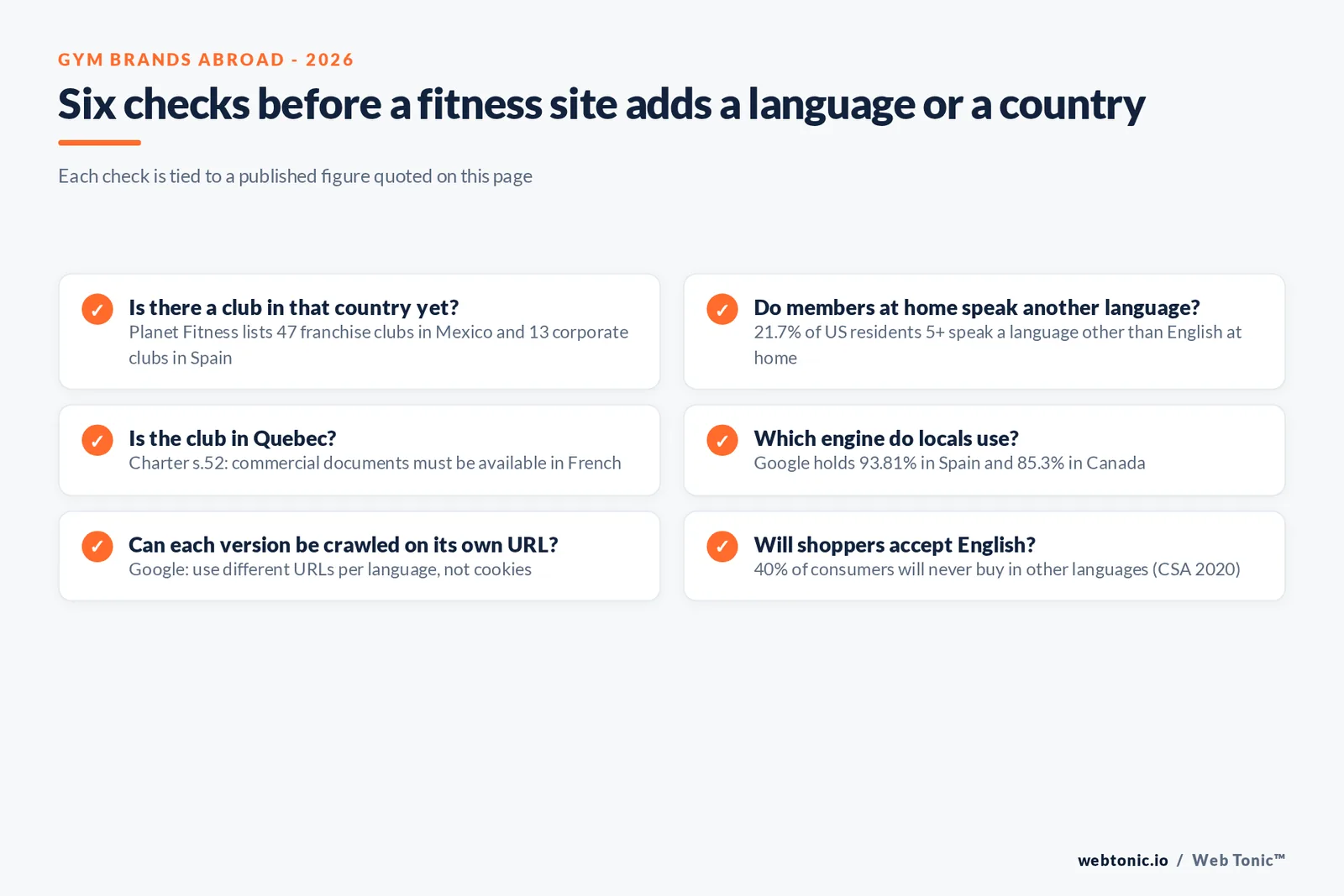
- Start with home-market language pages. With 21.7% of US residents (100% minus 78.3%) using another language at home, Spanish membership and class pages reach more people than a foreign launch.
- Handle Quebec French first if you have a club there. It is a legal requirement under Charter section 52.
- Give each language its own URL and link translations reciprocally with hreflang, plus an x-default club finder.
- Separate Spanish for Mexico and Spain when pricing, currency and offers differ.
- Check the local engine before entering Asia, where Naver or Baidu can outweigh Google.
For brands already managing hundreds of club pages, our analysis of fitness enterprise SEO data covers templates and crawl scale, and our growth marketing team can map a language rollout to club locations.
What the data does not show
There is no published figure for how many gym searches happen in Spanish, what share of fitness sites use hreflang, or whether translated pages lift membership sales. Anyone quoting such a number should name the study. What the record does show is narrower and firmer: where the franchise clubs are, which engines people use there, how many residents speak another language, and what Google and Quebec law require. For app-led brands, see also our fitness app store optimization figures, or contact us to scope a multilingual club site.
Frequently Asked Questions
Does a local gym need international SEO?
Usually not in the cross-border sense. A single club competes inside a few miles, so its international work is really language work: Spanish, French or other pages for residents who search in those languages. The US Census Bureau's 2018-2022 estimates show 78.3% of people aged 5 and older speak only English at home, which leaves roughly one in five residents who use another language, most often Spanish.
Which fitness brands actually run sites in several countries?
Franchise chains. Planet Fitness reported 2,896 clubs at the end of 2025 across all 50 states, the District of Columbia, Puerto Rico, Canada, Panama, Mexico, Australia and Spain, and its annual report says it intends to enter one to two new markets each year. Those brands need country or language versions; an independent studio does not.
Should a gym use a ccTLD, subdomain or subfolder for another country?
Google's multi-regional documentation lists the trade-offs rather than a single answer: country domains give clear geotargeting but are expensive and can only target one country, subdomains are easy to set up, and subdirectories are low maintenance on the same host. URL parameters are marked not recommended. For a franchise entering one new country, a subfolder is the lowest-maintenance option Google lists.
Is Google the only search engine that matters for gym brands abroad?
In the markets where US gym franchises operate today, nearly. Statcounter's September 2026 data puts Google at 93.81% in Spain, 88.08% in Mexico, 87.9% in Australia and 85.3% in Canada. The picture changes in South Korea, where Naver holds 43.06%, and in China, where Baidu leads at 46.65%.
What does Quebec law require of a gym website?
Section 52 of Quebec's Charter of the French Language, amended in 2022, says catalogues, brochures, order forms and similar documents available to the public must be drawn up in French, regardless of the medium, and no other-language version may be offered on better terms. A Quebec club's membership and offer pages therefore need a French version first.
Sources
Planet Fitness - Key year-end metrics 2025
Planet Fitness - 2025 Annual Report
Google Search Central - Managing multi-regional and multilingual sites
Google Search Central - Localized versions of your pages
Statcounter - Search engine market share by country
US Census Bureau - Language spoken at home, ACS 2018-2022
Statistics Canada - Multilingualism in Canadian households, 2021 Census
LégisQuébec - Charter of the French Language
CSA Research - Can't Read, Won't Buy B2C 2020
Health and Fitness Association - 2026 HFA Global Report
Health and Fitness Association - 81 million US members in 2025
W3Techs - Content languages for websites


