Table of contents

Most coaches build a website, publish a handful of posts, and wait for Google to send them clients. It doesn't work that way. Search engines reward sites that consistently answer the exact questions a potential client is typing, and coaching is a crowded field where generic content simply gets buried. The good news: search engine optimization for coaches doesn't require a technical background or a massive budget. It requires the right keywords, a website structured around how people actually search, and enough consistency to let Google recognize you as a credible answer.
This guide walks through keyword research, on-page SEO, local visibility, content strategy, and the technical basics, in the order a coaching business should actually tackle them.
Key Takeaways
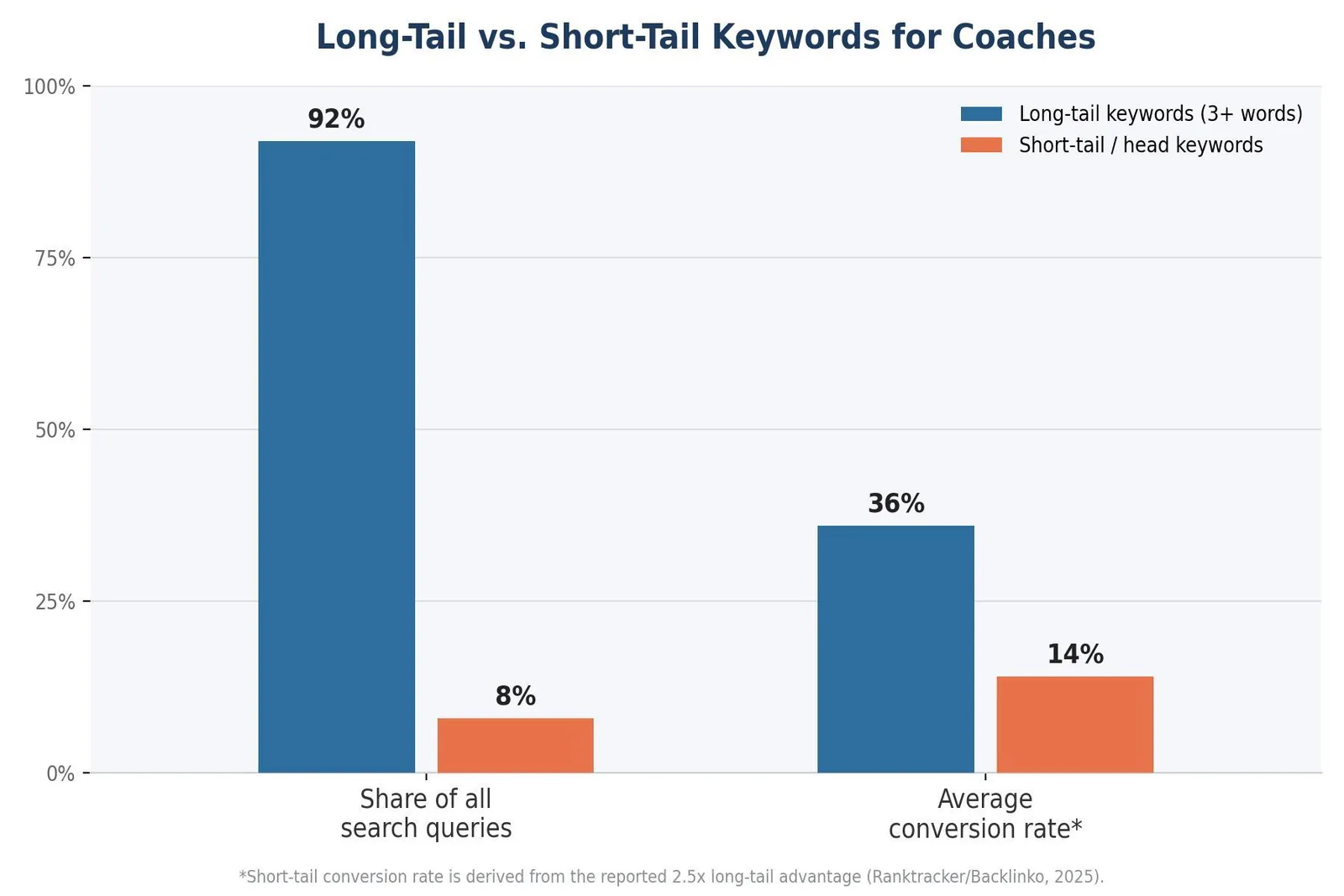
- Long-tail keywords (three or more words) make up the vast majority of searches and convert at roughly 2.5x the rate of short, generic terms.
- A complete Google Business Profile is one of the highest-leverage, lowest-cost moves a local coach can make.
- HTTPS, page speed, and clear site structure are baseline requirements, not bonus points, for ranking.
- Content built for different search intents (informational, commercial, transactional) moves prospects from curiosity to a booked call.
- SEO is a compounding asset: results build over months, not days, but they don't disappear the way paid ads do the moment you stop spending.
Why SEO Matters for Your Coaching Business
Coaching has grown from a niche service into a global profession. The 2025 ICF Global Coaching Study found the profession generated an estimated $5.34 billion USD in revenue over the past year, almost double the 2023 total, and the number of coach practitioners rose 15% since 2023 to a record 122,974, according to the International Coaching Federation's 2025 Global Coaching Study. More coaches means more competition for the same searches, whether that's "life coach near me" in Chicago or "executive coach for founders" in New York. International Coaching FederationInternational Coaching Federation
Paid ads can fill a calendar quickly, but the cost per click resets to zero the moment the budget runs out. SEO works differently. A well-optimized blog post or service page keeps attracting potential clients long after it's published, which is exactly why coaching businesses with an SEO strategy tend to out-compete those relying purely on referrals and social media.
How Search Engines Actually Find and Rank a Coaching Website
Search engines understand a page by crawling its content, evaluating who wrote it, and comparing it against what already ranks for that query. That's the essence of search engine optimization: earning enough trust signals that Google is confident your page deserves the click. Google has been explicit that this evaluation includes security: Google's own Search Central blog confirms that HTTPS is used as a ranking signal, though it remains a lightweight one that carries less weight than high-quality content. SSL is table stakes. On its own it does very little for rankings; strong content still carries far more weight. Google
Beyond security, Google's quality raters assess content through the lens of E-E-A-T (Experience, Expertise, Authoritativeness, Trustworthiness). Google's own guidance on creating helpful content asks creators to evaluate whether their content demonstrates first-hand expertise and a depth of knowledge, and whether someone reading it will leave feeling they've learned enough to achieve their goal. For a coach, that means writing from real understanding of client transformation, not just repeating what every other coaching blog already says. Google
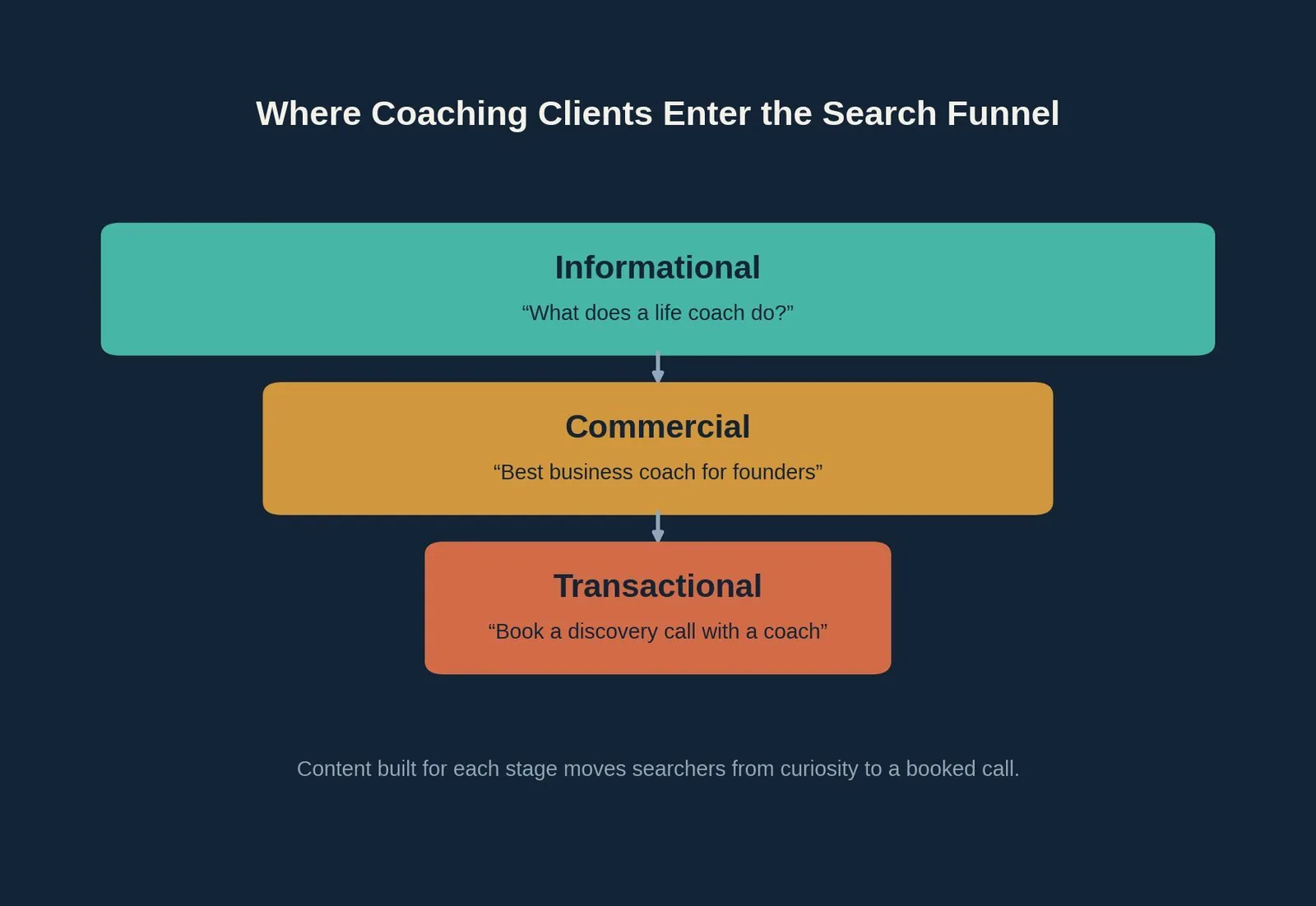
Notice that each stage above calls for a different type of content: an informational blog post answering "what does a life coach do," a comparison-style page for "best business coach for founders," and a clear, frictionless service page for someone ready to book. Trying to force all three into one page rarely works.
Keyword Research: Finding the Terms Your Ideal Clients Actually Type
Keyword research usually starts the same way: guessing at big, obvious terms like "coach" or "coaching." Those terms have enormous competition and vague intent, the kind of terms where you're effectively competing with Amazon, Wikipedia, and every major coaching directory for a spot on page one. The smarter approach leans on long-tail keywords, specific, multi-word phrases that reflect exactly what a searcher wants.
Long-tail keywords of three or more words account for 70 to 92% of all search traffic depending on the source, and they convert at an average of 36%, nearly 2.5 times higher than short-tail terms, according to an analysis of keyword research data compiled by Ranktracker. For a coach, that's the difference between chasing "life coaching" (broad, saturated, vague) and ranking for "life coach for career transitions after 40" (specific, lower competition, high intent). Rank Tracker
Long-Tail Keywords vs. Short-Tail Keywords
| Long-tail keywords (3+ words) | Short-tail / head keywords | |
|---|---|---|
| Example | "business coach for first-time founders" | "business coach" |
| Search volume per term | Low individually, high in aggregate | High |
| Competition | Lower | Very high (often dominated by directories and big brands) |
| Searcher intent | Specific, often ready to act | Vague, early-stage research |
| Typical conversion rate | Higher | Lower |
| Best used for | Blog posts, FAQ pages, niche service pages | Homepage, broad brand awareness |
Free and low-cost tools make this research accessible. Google Keyword Planner shows real search volume ranges tied to your Google Ads account, Ubersuggest offers a simplified view with keyword difficulty scores, and Google Search Console (GSC) shows you which queries are already bringing traffic to your site, often revealing long-tail opportunities you didn't know you were ranking for. Cross-referencing all three tends to surface the best opportunities: terms with real search volume, low-to-moderate difficulty, and clear buying intent.
On-Page SEO: Turning Your Coaching Website Into a Client Magnet
Once you know your target keywords, on-page SEO is about placing them where both search engines and readers expect to see them: the title tag, the H1, the first 100 words, and at least one subheading. Beyond keyword placement, three things consistently separate coaching websites that rank from those that don't:
- High-quality content that fully answers the question. A 400-word post that skims the surface won't outrank a comprehensive guide.
- Clear internal linking. Every blog post should link to a relevant service page, and every service page should link back to supporting blog content.
- A logical site structure. A prospective client (and Google) should be able to tell within seconds whether you coach executives, life-transition clients, or something else entirely.
Search engines are increasingly good at understanding topics rather than just matching exact phrases, which is why forcing a keyword into every sentence backfires. Writing naturally, while making sure the core phrase and its close variations appear where they belong, still outperforms keyword stuffing.
Local SEO for Coaches: Winning Clients in Your City
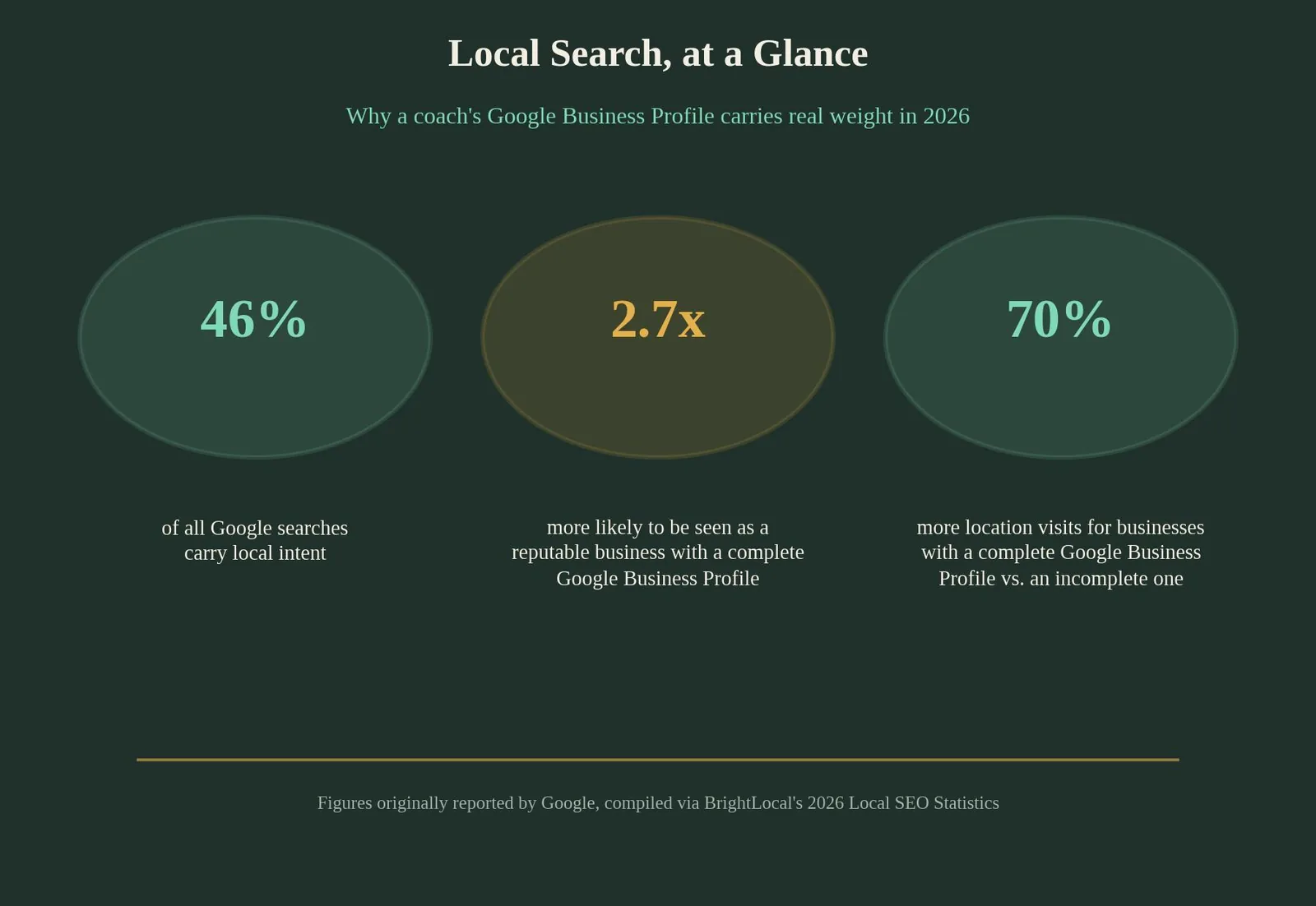
Many coaches work with clients globally, but plenty still run city-based practices or lead in-person workshops, and for them, local SEO is often the fastest path to booked calls. A Google official has confirmed that roughly 46% of all search queries carry local intent, per data compiled by BrightLocal's Local SEO Statistics report, which means a meaningful share of the people searching for coaching services in Chicago, Los Angeles, or anywhere else are specifically looking for someone nearby. BrightLocal
The centerpiece of local SEO is the Google Business Profile (GBP/GMB). Google's own data shows that businesses with complete profiles receive 70% more location visits and are 2.7 times more likely to be considered reputable, compared with businesses whose profile is incomplete, per BrightLocal's 2026 Local SEO Statistics report. A complete profile, filled out with your niche, service area, photos, and regularly collected client reviews, functions as a free storefront that shows up directly in Google Maps results. BizIQ
If you run paid campaigns alongside your organic strategy, keep an eye on CPC (cost per click) for local coaching terms. Broad terms like "business coach" often carry a high CPC because of competition from directories, coaching platforms, and even adjacent industries; geo-specific long-tail terms are almost always cheaper and better qualified.
Content Marketing and Blogging That Actually Attracts Coaching Clients
A blog is the single most flexible SEO tool a coach has, but only if it's built around real questions, not generic filler. Every blog post should have a job: answer one specific question a potential client is asking, in enough depth that they don't need to search again. Well-known figures like Tony Robbins built significant search visibility partly because their content answers the exact language people use when they're stuck: "how to get unstuck," "how to set goals that actually work."
A few practices consistently help coaching blog content perform:
- Structure each post around one clear question or problem, not a broad umbrella topic.
- Use the coach's actual language and frameworks rather than generic coaching jargon that appears on every competitor's site.
- Link blog posts to each other in topic clusters (for example, three or four posts on career transitions linking to one another) rather than leaving them as isolated pages.
- Share posts on social media to build early traffic and signal relevance, even though social shares aren't a direct ranking factor.
- Update older posts periodically rather than only publishing new ones. GSC will show which posts have slipped and could use a refresh.
Technical SEO Basics Every Coach Should Handle
Technical SEO sounds intimidating, but for most coaching websites it comes down to a short list: SSL/HTTPS enabled, a fast-loading mobile site, no broken links, an XML sitemap submitted to Google Search Console, and Google Analytics installed to track what's actually working. None of these require a developer for a typical WordPress or Squarespace-based coaching site; most page builders handle the basics automatically, and a one-time audit catches what's missing.
Try the interactive checklist below to see where your own site stands right now.
SEO Readiness Checklist for Coaches
Check off what's already true for your coaching website, then see where to focus next.
A quick reference from Web Tonic's SEO for Coaches Playbook
Common Mistakes Coaches Make With SEO
- Ignoring long-tail keywords in favor of broad, saturated terms that are nearly impossible to rank for as a smaller site.
- Publishing generic content that reads like it could belong to any coach in any niche, with no distinct point of view.
- Skipping the Google Business Profile setup entirely, even when a large share of local search intent is sitting right there unclaimed.
- Chasing backlinks from irrelevant directories instead of earning links through genuinely useful content.
- Neglecting mobile page speed, even though most searches now happen on a phone.
- Treating SEO as a one-time project rather than an ongoing practice that needs fresh content and periodic updates.
What Does SEO for Coaches Cost, and How Long Does It Take?
Costs vary by scope, but a 2026 survey of 439 SEO professionals by Ahrefs gives a clearer benchmark than the vague ranges often quoted: freelancers average $71.59 USD per hour, agencies average $98.90 USD per hour, and independent consultants average $171.18 USD per hour, according to a breakdown of the Ahrefs pricing data. Monthly retainers are the dominant model, commonly running from $1,500 to $10,000 USD depending on scope, with most small coaching businesses landing in the $2,500 to $5,000 USD per month range. Results take time regardless of budget: early ranking movement typically appears within two to three months, with meaningful traffic gains at six to nine months.
Frequently Asked Questions
Do I need SEO if most of my clients come from referrals?
Referrals are valuable but finite. SEO builds a second, independent channel that keeps working even when your network dries up, and it tends to attract clients who are actively searching for exactly what you offer, not just people who happen to know someone in your circle.
How long before I see results from SEO?
Most coaches start seeing meaningful movement within three to six months of consistent publishing and on-page optimization. Highly competitive terms in saturated niches can take longer, which is part of why long-tail keywords are worth prioritizing early.
Is a Google Business Profile worth it if I coach entirely online?
It's less critical for fully virtual coaches with no service area, but if you serve a specific city, region, or run local workshops, it remains one of the highest-return, lowest-effort tools available.
How many blog posts do I need to rank?
There's no magic number. A smaller number of comprehensive, well-targeted posts consistently outperforms a large volume of shallow ones. Focus on covering your core topics thoroughly before expanding into adjacent ones.
Can I do SEO myself, or do I need an agency?
Solo coaches can absolutely handle the basics: keyword research, on-page optimization, and a Google Business Profile. Agencies tend to add the most value with technical audits, content scaling, and ongoing strategy once a practice is ready to grow beyond a one-person effort.
Turning Search Visibility Into a Full Client Roster
SEO for coaches comes down to making sure the people already searching for exactly what you offer, whether that's "life coach for career transitions" or "executive coach near me," can actually find you before they find someone else. Start with long-tail keywords and a complete Google Business Profile, build content around real questions, and keep the technical basics in order. The compounding effect is real: what you publish this year keeps working for you next year, too.
Ready to Grow Your Coaching Practice?
Getting this right on your own is possible, but it takes months most coaches would rather spend with clients. Web Tonic's growth marketing team handles the keyword research, content, and technical SEO work covered in this playbook as part of a full-funnel approach that also connects it to paid acquisition and local visibility, so your search presence keeps growing while you stay focused on coaching.
More from Web Tonic: growth marketing services, data & analytics.
Sources: coachingfederation.org · developers.google.com · ranktracker.com · brightlocal.com · outerboxdesign.com