Table of contents

URL: /blog/seo-for-chiropractors
A patient wakes up with sciatica flaring down their leg. They don't ask a friend for a recommendation. They open Google and type "chiropractor near me." What happens in the next ten seconds, whether your practice appears in the map results or gets buried on page two, largely decides whether that person becomes your next new patient or your competitor's.
SEO for chiropractors is the work of making sure your clinic shows up at that moment, consistently, for every version of that search. It combines local SEO fundamentals (Google Business Profile, reviews, citations), on-page website work, and enough high quality content to satisfy Google's health-content standards. Because chiropractic care is almost always local, skipping this shows up directly in your appointment book: full or empty.
Key Takeaways
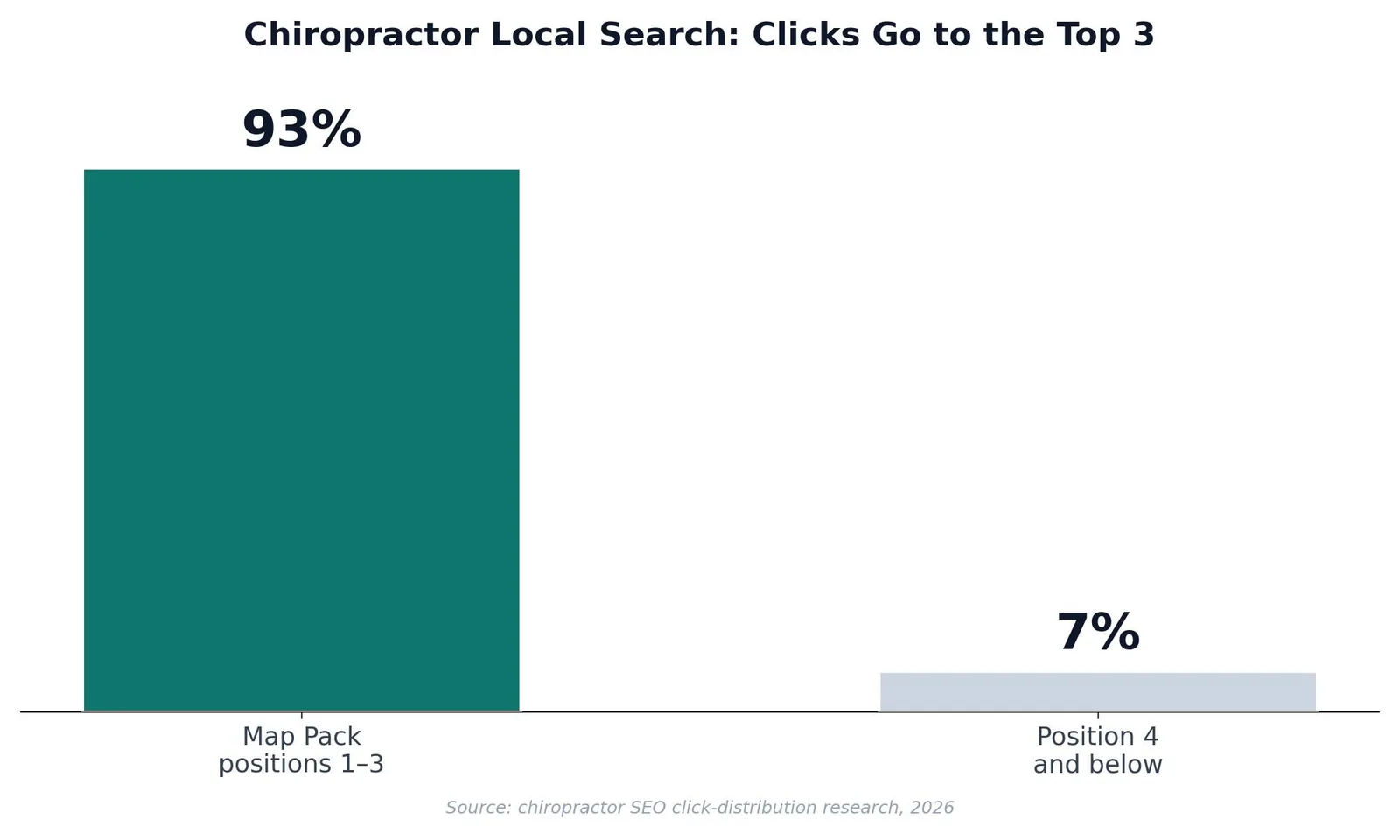
- Businesses ranked in the top 3 Google Map Pack positions receive roughly 126 percent more traffic and 93 percent more calls, clicks, and direction requests than those ranked 4th or lower, so anything outside the top three is competing for scraps.
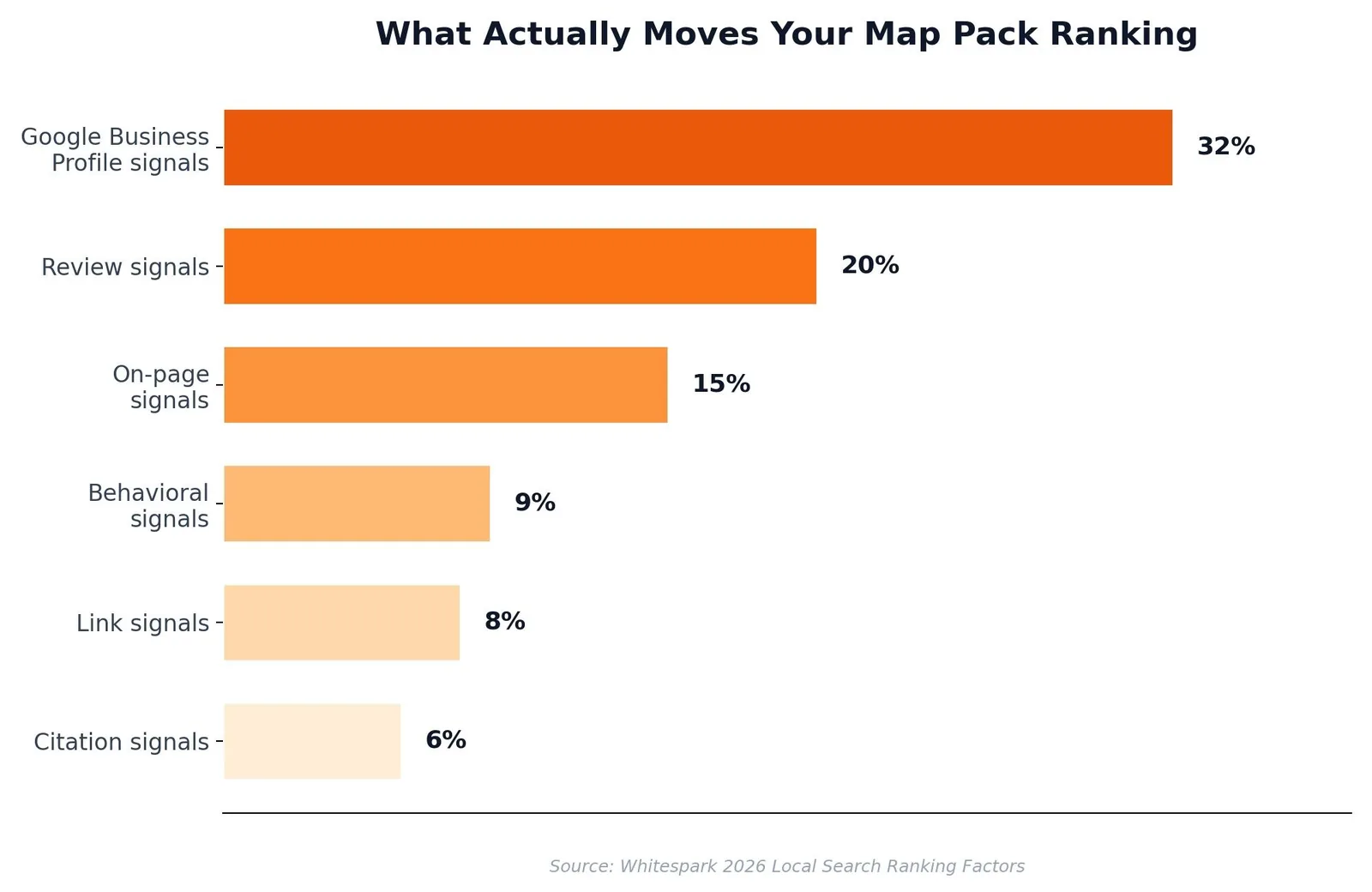
- Google Business Profile signals carry the single largest individual weight (around 32 percent) in local Map Pack rankings, more than reviews, on-page content, or backlinks carry on their own.
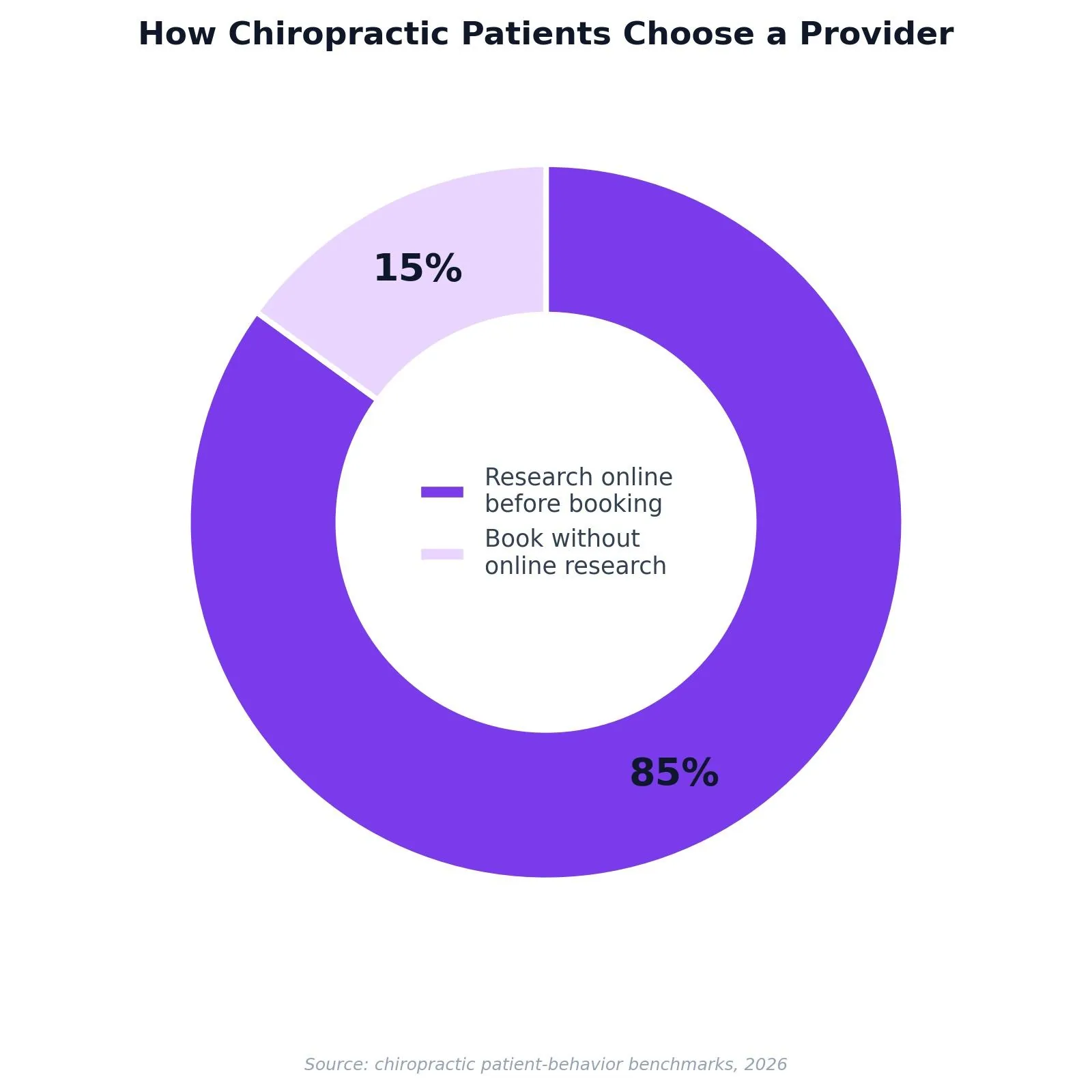
- Recent patient behavior survey data puts the share of patients who check online reviews before booking at 84 percent, so a thin or outdated website actively costs appointments.
- Chiropractic is a YMYL (Your Money or Your Life) category under Google's own Search Quality Rater Guidelines, which means thin or unverified health claims can suppress rankings more aggressively than in most other industries.
- Meaningful ranking movement typically shows up in 60 to 90 days in lower-competition markets, but 6 to 12 months in dense metro areas, so budgeting patience matters as much as budgeting spend.
- AI-powered search (Google AI Overviews, ChatGPT, Perplexity) is becoming a real discovery channel for chiropractic patients, which means content needs to be structured for AEO (Answer Engine Optimization), on top of traditional ranking factors.
What Is SEO for Chiropractors?
SEO for chiropractors is the process of optimizing a clinic's website, Google Business Profile, and online reputation so it ranks for the searches local patients actually use**:** "chiropractor near me," "sciatica treatment [city]," "best chiropractor in [neighborhood]." Unlike national e-commerce SEO, almost every query here carries geographic intent, and almost every patient chooses a chiropractor within a short drive of home.
That local-first reality changes the priority order. A generic SEO strategy built for a national brand would chase broad keywords and backlink volume. A chiropractic practice gets more from a fully completed Google business profile, a steady stream of recent reviews, and website content that speaks directly to the conditions and neighborhoods it serves. Google, and increasingly the AI systems layered on top of it, reward clinics that look active, complete, and trustworthy, not just technically optimized.
Why Local Search Decides Who Gets the Patient
The math is unforgiving once you look at it directly. According to First Page Sage's 2026 click-through rate research, businesses that land in the top three Map Pack positions pull in 126 percent more traffic and 93 percent more calls, clicks, and direction requests than businesses ranked fourth or lower. With most cities carrying 20 to 50-plus chiropractic practices within a ten-mile radius, that top-three spot is a genuinely competitive prize, not a given.
What actually earns that spot is more specific than most owners expect. According to Whitespark's 2026 Local Search Ranking Factors study, Google Business Profile signals account for roughly 32 percent of Map Pack rankings, with review signals close behind at about 20 percent, on-page website signals at 15 percent, and behavioral, link, and citation signals splitting the rest. Your GBP and your reviews matter more than almost anything on your website.
That website still carries real weight once a patient looks past the Map Pack, though, especially since research on patient behavior shows most people don't stop at the map. Recent survey data on how patients choose providers found that 84 percent check online reviews before booking care, with more than half reading at least six reviews before making an appointment.
Local SEO vs. Google Ads for Chiropractic Practices
| Factor | Local SEO (organic) | Google Ads (PPC) |
|---|---|---|
| Cost model | Time investment in GBP, content, and reviews | Ongoing cost per click, no cap without one |
| Time to results | 60-90 days (low competition) to 6-12 months (dense metros) | Immediate, live same day |
| Long-term value | Compounds; rankings persist after the work is done | Stops the moment ad spend stops |
| Best use case | Building durable, ongoing new-patient flow | Filling schedule gaps or launching a new location fast |
| Where patients land | Map Pack, organic results, AI Overviews | Paid search ads above organic results |
| Typical monthly cost | USD $1,000 to USD $3,000 for professional management | Scales directly with ad spend and market competitiveness |
Most practices eventually use both: Google Ads for immediate visibility while a location is new or under-ranked, and local SEO as the channel that keeps generating patients without a recurring per-click bill.
The Chiropractor Local SEO Roadmap
Step 1: Claim and fully complete your Google Business Profile
Every field matters: categories, services, business description, hours, and photos updated regularly. A profile that looks abandoned signals low prominence to Google, one of the three core local ranking factors Google names directly alongside relevance and distance.
Step 2: Build a steady, real review cadence
Reviews carry weight beyond social proof now. AI-powered search results pull language directly from patient reviews when recommending a chiropractor, so recency and detail both matter, not just star rating.
Step 3: Fix on-page fundamentals before publishing content
Fast load times, mobile-friendly design, accurate NAP (name, address, phone) data, and schema markup for local business information form the base. Content published on top of a technically weak site rarely ranks regardless of quality.
Step 4: Publish condition-specific and city-specific pages
A single generic "our services" page competes poorly against dedicated pages for back pain, sciatica, sports injuries, or pediatric care. The same logic applies geographically: a practice serving multiple neighborhoods or towns needs a distinct, non-duplicated page for each service area, not one page with a city name swapped in.
Step 5: Earn local citations and mentions, not bulk directory spam
Consistent NAP data across Google, Apple Maps, Yelp, and industry directories still supports both traditional rankings and AI accuracy. Bulk-submission services promising hundreds of links quickly are far more likely to trigger scrutiny than to help in 2026.
Step 6: Structure content for AI search, not just Google's blue links
Clear, conversational FAQ content that directly answers real patient questions ("What does a chiropractor do for lower back pain?") is increasingly what AI Overviews and tools like ChatGPT pull from when a patient asks a health question near your service area.
Is Your Chiropractic Website SEO-Ready?
Chiropractic SEO tool
Is your practice's website SEO-ready?
Check off what's already true for your clinic. Your score updates as you go.
0 of 5
Check off items above to see how ready your practice is.
What to Expect: SEO Timeline for Chiropractic Practices
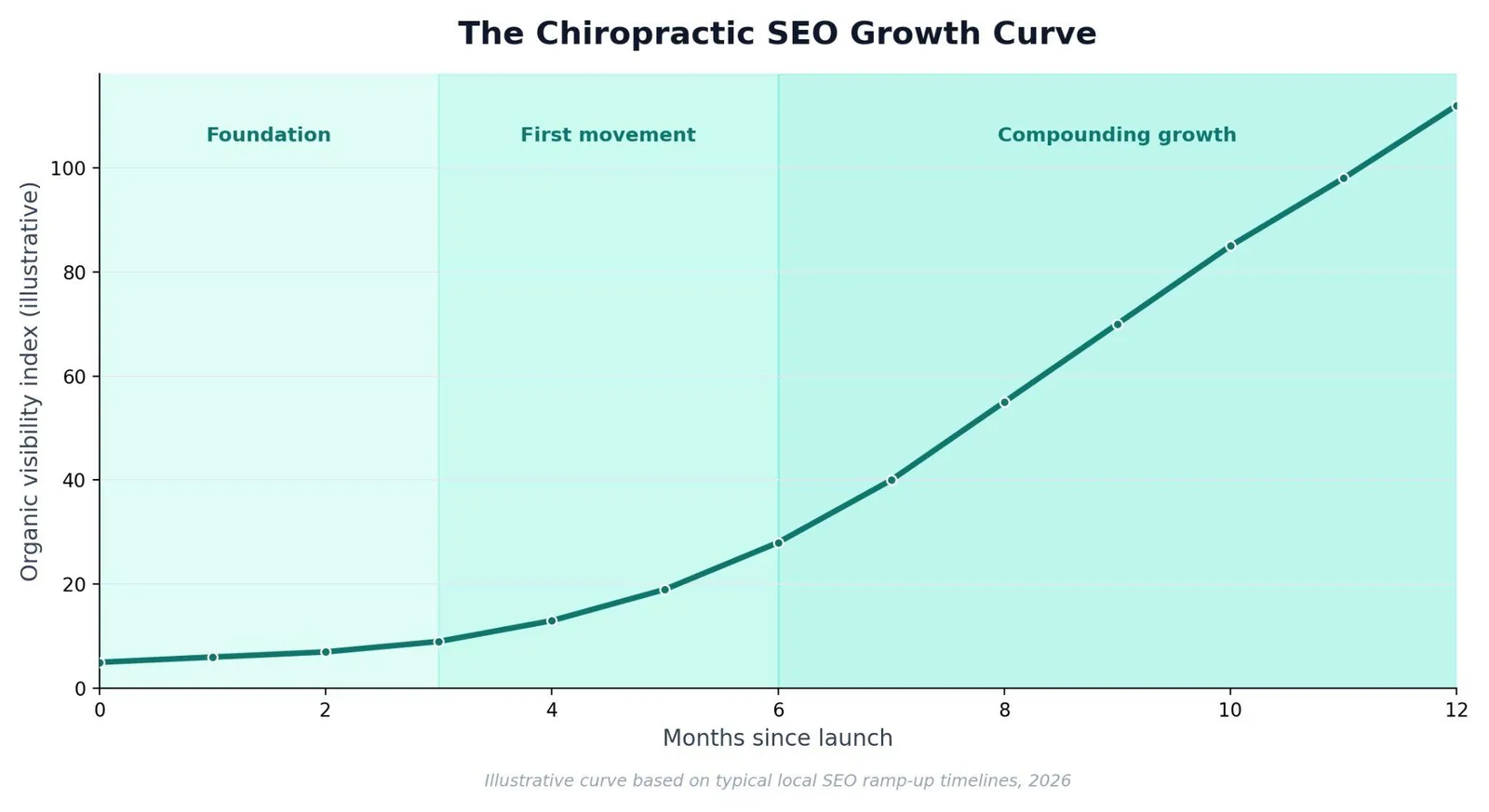
The first three months mostly go into technical fixes, GBP completion, and initial review building — visible ranking movement comes later. Months three through six are when the first Map Pack shifts tend to appear, especially in lower-competition markets. General industry experience puts initial ranking movement at 60 to 90 days for less competitive markets, stretching to 6 to 12 months in dense metro areas like Phoenix, Austin, or San Diego. Past month six, GBP and review work compound with organic content to produce the largest gains.
Practices that pull the plug around month four or five, right before results would have shown up, are the most common self-inflicted failure pattern in chiropractic SEO.
SEO Tools Every Chiropractic Practice Needs
Google Search Console and Google Analytics are free and non-negotiable: they show which searches already bring traffic, which pages convert, and where technical issues are blocking visibility. Google Keyword Planner helps identify realistic, winnable search terms specific to your service area. Ahrefs or a comparable paid tool adds competitive visibility once budget allows, useful for seeing what's already ranking for nearby competitors before committing content resources. Reputation platforms like Healthgrades and Zocdoc also influence how patients evaluate a practice before it ever reaches the website.
Common SEO Mistakes Chiropractic Practices Make
The most damaging one is treating Google Business Profile as a one-time setup. Practices that never update hours, never post, and never respond to reviews send a clear inactivity signal to both Google and prospective patients.
Publishing blog content before fixing technical basics is a close second. A slow, poorly structured site caps how well even excellent content can rank.
Buying bulk citations or backlinks used to work. Now it actively risks penalties. A smaller number of genuinely local, relevant links and mentions outperforms volume every time.
And skipping condition-specific and location-specific pages in favor of one generic services page leaves real search intent, and real patients, unanswered.
Frequently Asked Questions
How much does chiropractor SEO cost?
Professional local SEO management for a chiropractic practice typically runs USD $1,000 to USD $3,000 per month, depending on market competitiveness and scope. Costs vary enough by location and practice size that an exact figure isn't something to take from a general guide; get a quote specific to your market.
How long does it take to rank a chiropractic website?
Expect initial movement in 60 to 90 days in less competitive markets, and 6 to 12 months in dense metro areas. GBP optimization and review building tend to show results faster than organic content alone.
Is Google Business Profile really more important than my website?
For the Map Pack specifically, yes. GBP signals carry the largest single weight in local rankings, ahead of reviews and on-page content individually. That said, a strong website still matters heavily for organic results below the map and for AI search visibility.
Do I need a page for every city I serve?
Yes, if you genuinely serve multiple distinct areas. Each service-area page needs unique, locally specific content, not a template with the city name swapped, since Google treats thin duplicated location pages as low quality.
Does SEO work better than Google Ads for a chiropractic practice?
They serve different purposes rather than competing directly. Google Ads delivers visibility immediately but stops the moment spend stops; local SEO takes longer to build but keeps generating patients without a recurring per-click cost. Plenty of established practices end up running both.
The Bottom Line on SEO for Chiropractors
Chiropractic SEO in 2026 rewards practices that put real weight behind their Google Business Profile and reviews, alongside the website rather than after it. Get the technical basics right, build a real review cadence, publish content for the specific conditions and neighborhoods you actually serve, and give the whole system six to twelve months before judging results.
Start with a full Google Business Profile audit and one week identifying the condition and location searches your practice can realistically win. That is a workable starting point for any practice, regardless of size.
Ready to Turn Local Search Into Booked Appointments?
Coordinating GBP optimization, review growth, technical fixes, and content all at once is where practices lose months they don't have. Web Tonic's growth marketing team handles the technical SEO, local content, and reputation work covered in this playbook as part of a full-funnel approach that also connects to paid acquisition, so nothing runs in a silo while you stay focused on patient care.
More from Web Tonic: growth marketing services, data & analytics.
Sources: firstpagesage.com · medicaleconomics.com · guidelines.raterhub.com · whitespark.ca · support.google.com