Table of contents
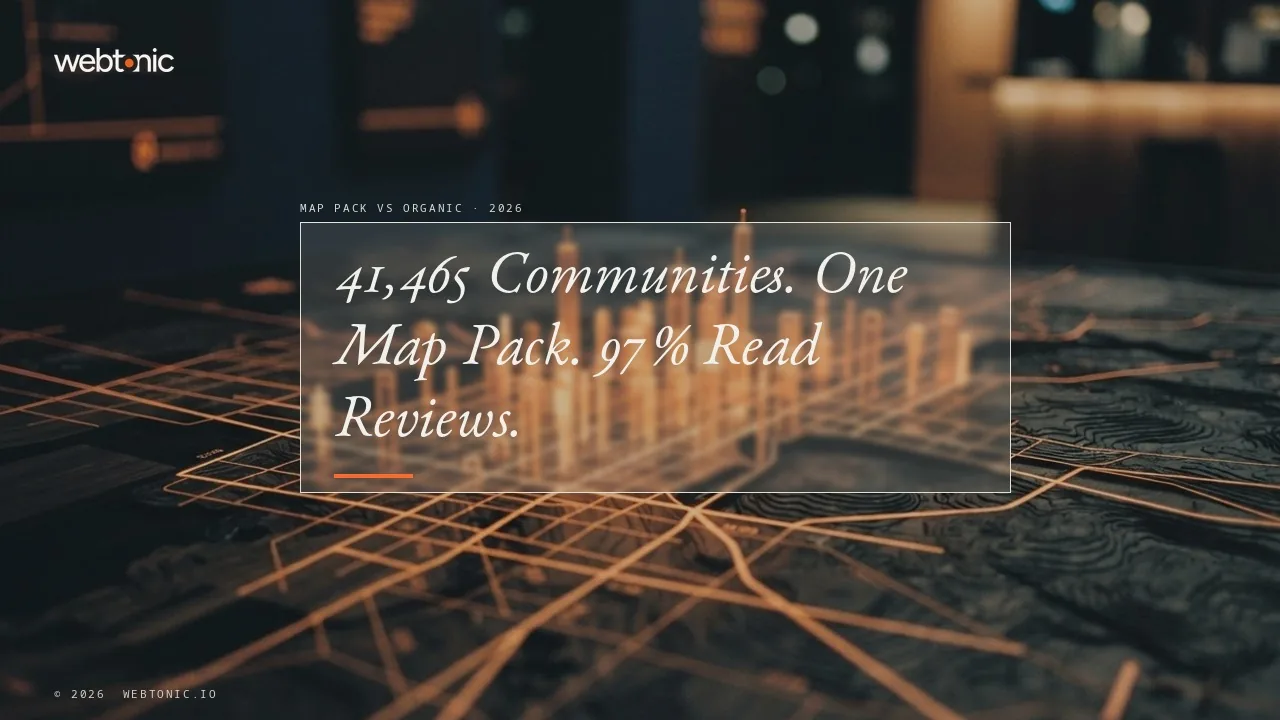
41,465 assisted living communities compete nationwide for the same three-result map pack, and 97% of families read reviews before ever calling one, per BrightLocal's 2026 survey. This page separates what actually drives the map pack from what drives the organic blue links beneath it, using Whitespark's 2026 practitioner ranking-factor survey, BrightLocal's own review data and Aline's inquiry-source CRM data across more than 5,000 communities.
Key Takeaways
- 41,465 assisted living communities compete nationwide for local search visibility (AHCA/NCAL).
- 97% of consumers read reviews before choosing a local business (BrightLocal 2026).
- 41% now "always" read reviews when browsing, up from 29% a year earlier (BrightLocal).
- 500,000 family reviews sit on one senior care platform alone (A Place for Mom).
- 187 ranking factors scored by 47 practitioners in Whitespark's 2026 survey.
- 51% to 54% of inquiries across three of four care types come through the web channel (Aline, Q2 2026).
- 33 licensed units is the average community size competing in that same local pack (AHCA/NCAL).
- 23.4% of the U.S. population will be 65-plus by 2060, up from 18.9% in 2025 (Census Bureau).
- 90% senior housing occupancy crossed in July 2026, tightening the addressable market (NIC MAP).
- $74,400 average yearly cost of assisted living care raises the stakes on every local search click (AHCA/NCAL).
- Relevance, distance and prominence remain Google's own three stated local ranking factors.
- 31% share the "always read reviews" jump was the largest single-year change BrightLocal has recorded.
What decides the map pack, according to the people who watch it daily
Whitespark's 2026 Local Search Ranking Factors report, now in its ninth edition since David Mihm founded it in 2008, surveys 47 local search practitioners in a two-hour session, scoring 187 individual signals from 0 to 5 across Google Business Profile factors, on-page factors, review factors, link factors and behavioral factors. It is a practitioner consensus study, not a leaked algorithm, but it is the most-cited annual benchmark in the local SEO field precisely because Google publishes so little about its own weighting.
Google's own public guidance is narrower but authoritative on the categories that matter: its Google Business Profile help center states plainly that local results are based on relevance, distance and prominence, with prominence covering both a business's real-world reputation and its online signals, including reviews.
| Local ranking factor group (Whitespark 2026) | What it covers | Why it matters for senior living |
|---|---|---|
| Google Business Profile signals | Proximity, categories, keywords in business name | One profile per community location, often 5-30 miles apart |
| Review signals | First and third-party reviews, review quantity and velocity | Highest-weighted family decision factor per BrightLocal |
| On-page signals | NAP consistency, title tags, domain authority | Multi-location NAP drift is common across senior living groups |
| Link signals | Inbound anchor text, linking domain authority | Local press, referral partners and industry directories |
Reviews are doing more work than they used to
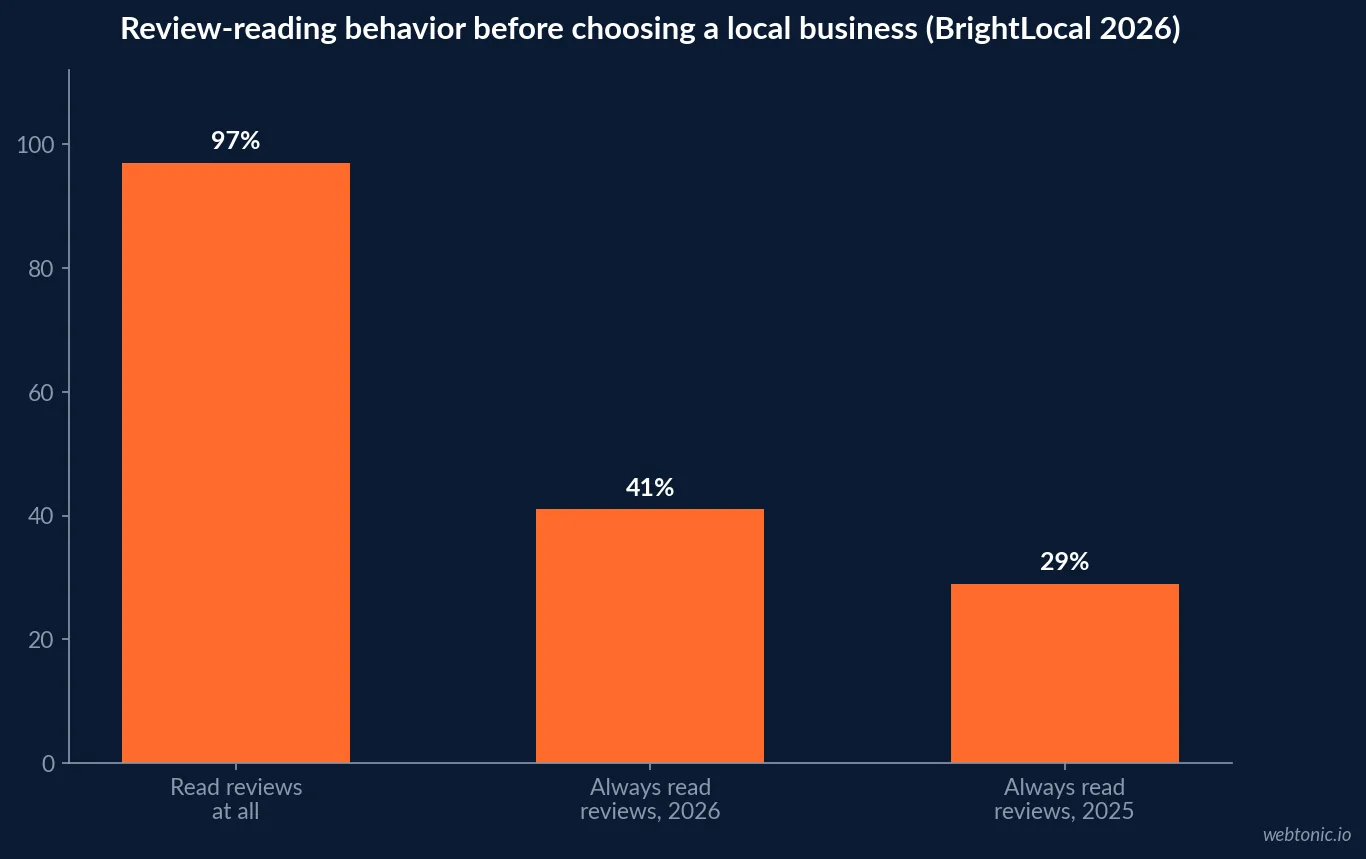
BrightLocal's 2026 Local Consumer Review Survey, run on a representative panel of 1,002 U.S. adult consumers, found that 97% of consumers read reviews for local businesses, and that 41% now say they "always" read reviews when browsing - a jump from 29% in the prior year's edition of the same survey. For a purchase as high-stakes and infrequent as choosing senior living, that behavior compounds: families researching this decision have no repeat-purchase history to draw on, so third-party review volume substitutes for word of mouth. A Place for Mom's own announcement of reaching 500,000 family reviews on its platform is a direct response to that demand.
| Review behavior metric | 2025 | 2026 | Source |
|---|---|---|---|
| Consumers who read reviews at all | n/a (stable, ~97%) | 97% | BrightLocal LCRS 2026 |
| Consumers who "always" read reviews | 29% | 41% | BrightLocal LCRS 2026 |
| Family reviews on one senior care platform | n/a | 500,000 | A Place for Mom, 2026 |
How crowded the map pack actually is
The competitive density behind these rankings is real. AHCA/NCAL's 2026 fast facts count 41,465 assisted living communities nationwide, averaging 33 licensed units each, serving 1,016,424 residents at an average yearly cost of $74,400. Most metro areas carry dozens of these communities inside a single map pack's radius, which is exactly the density Whitespark's practitioners say pushes review velocity and Google Business Profile completeness above almost every other ranking factor - a thin, outdated profile simply cannot compete against a dozen well-maintained ones nearby.
| Market density fact (2026) | Figure | Source |
|---|---|---|
| Assisted living communities nationwide | 41,465 | AHCA/NCAL |
| Average licensed units per community | 33 | AHCA/NCAL |
| Residents served nationwide | 1,016,424 | AHCA/NCAL |
| Average yearly cost of care | $74,400 | AHCA/NCAL, citing Genworth/CareScout 2025 |
Where the organic click actually converts
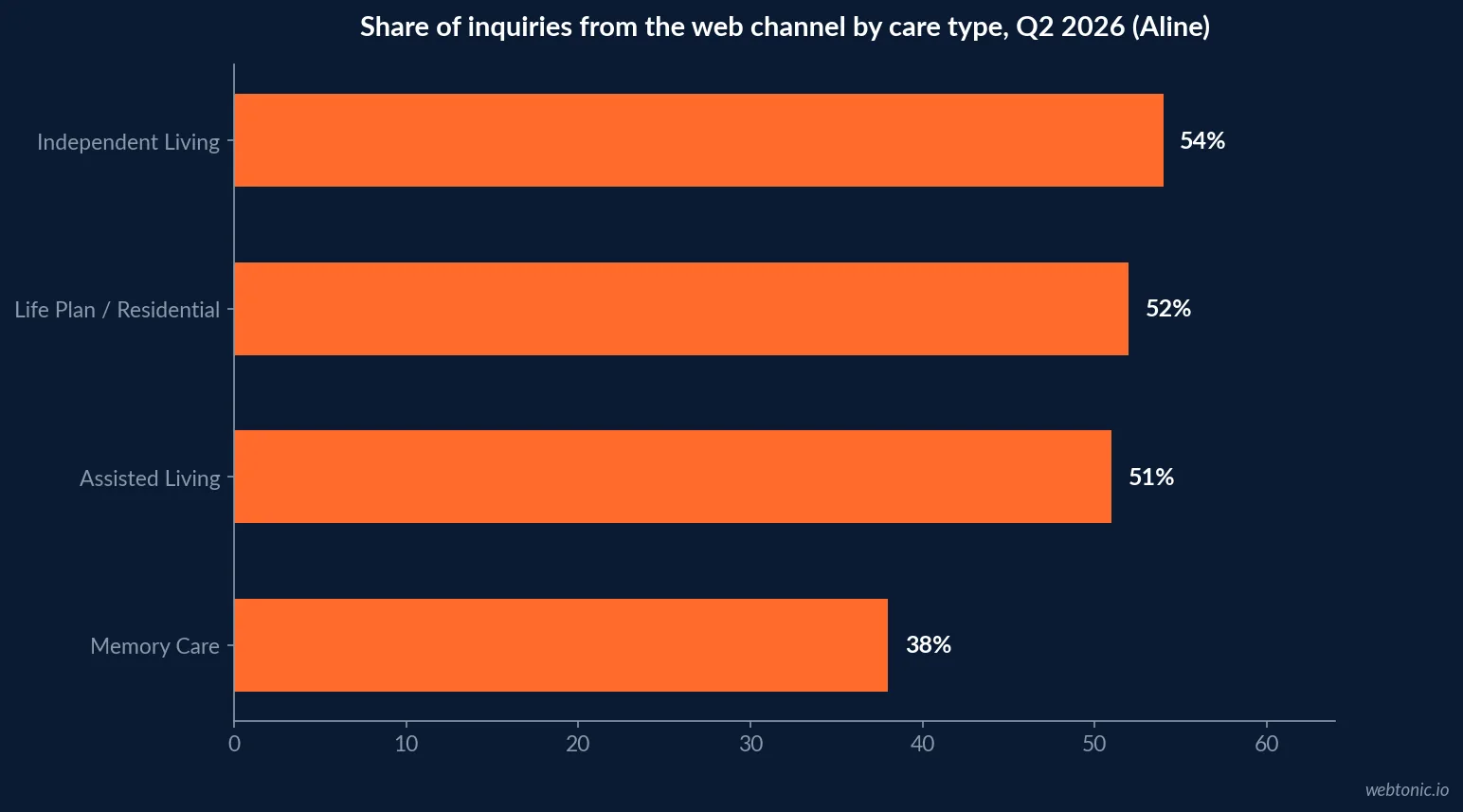
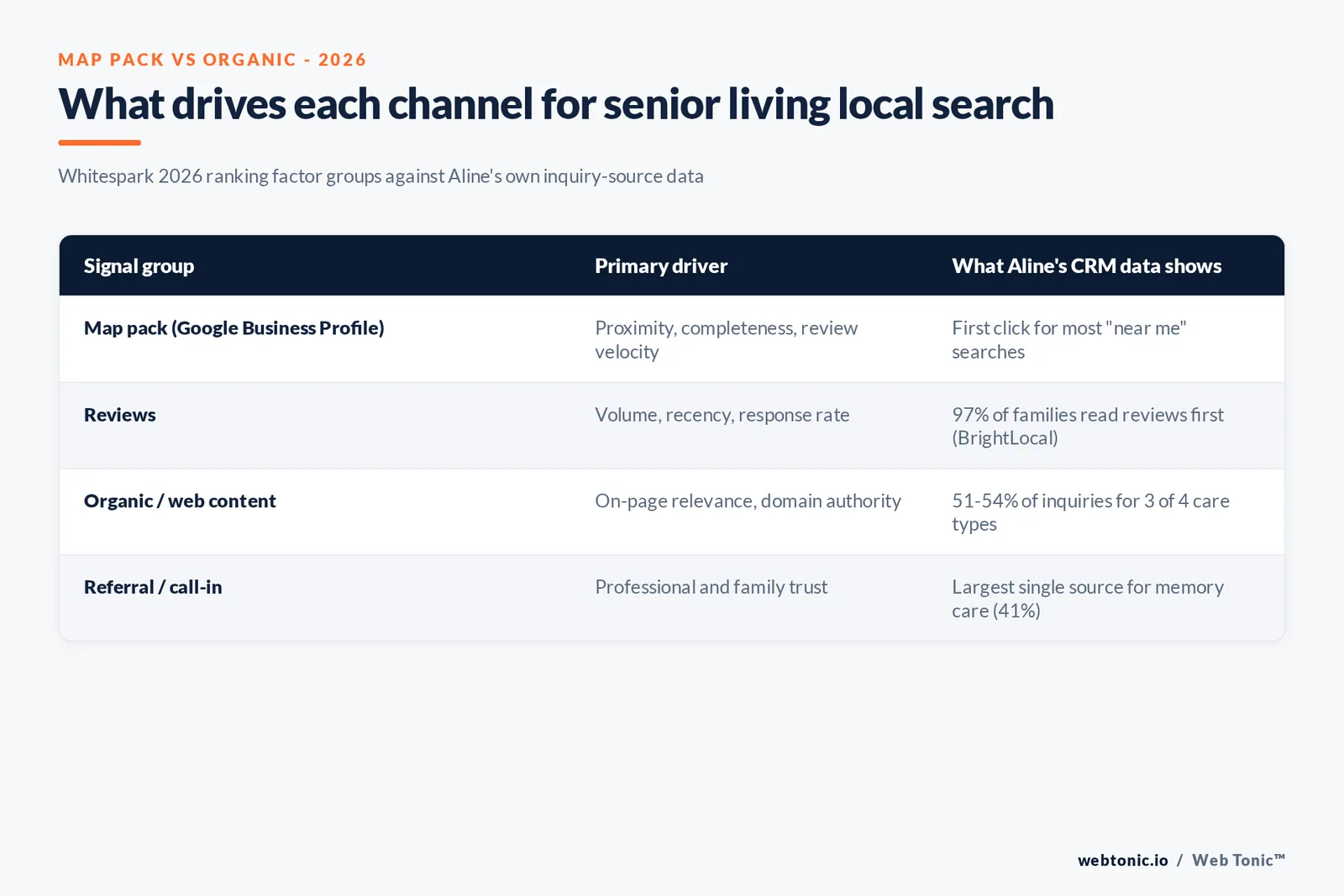
The map pack usually wins the first click, but Aline's Q2 2026 Sales & Marketing Benchmark Snapshot, drawn from CRM data across more than 5,000 senior housing communities, shows the web channel - which captures both organic and direct traffic - supplying 54% of independent living inquiries, 51% of assisted living inquiries, 52% of life plan community inquiries and 38% of memory care inquiries. In three of four care types, web is the single largest inquiry source Aline tracks, ahead of paid search, call-ins and unpaid referrals individually. Memory care's lower web share likely reflects a more urgent, crisis-driven search pattern where a call-in or professional referral moves faster than researching content.
| Method of inquiry, Q2 2026 (Aline) | Independent Living | Assisted Living | Memory Care | Life Plan |
|---|---|---|---|---|
| Web (organic + direct) | 54% | 51% | 38% | 52% |
| Paid | 24% | 26% | 21% | 4% |
| Call-ins | 15% | 13% | 18% | 29% |
| Unpaid referrals | 8% | 11% | 23% | 15% |
The demand growth behind both channels
Two demand-side facts explain why this competition keeps intensifying. U.S. Census Bureau projections put the 65-and-older population share rising from 18.9% in 2025 to 23.4% by 2060, steadily growing the pool of local searches. At the same time, NIC MAP data shows senior housing occupancy crossing 90% across the 31 Primary Markets in July 2026, a level last seen before the 2008 financial crisis. Rising demand against tightening supply means every local search click is competing for fewer open units, which raises the value of ranking well in both the map pack and the organic results beneath it.
Why NAP consistency is harder for multi-location senior living groups
Operators running more than one community face a specific version of the on-page signal problem Whitespark's survey scores: each location needs its own Google Business Profile, its own local landing page, and identical name-address-phone data across every citation source, or ranking signals dilute across duplicate or conflicting listings. A single stale phone number or an old address on one directory is a small thing at one location and a systemic problem across twenty.
What to prioritize first
- Close the review-response gap: with 97% of families reading reviews and 41% now always reading them, an unanswered negative review sits in front of nearly every prospective family.
- Keep Google Business Profile complete per location: hours, services, photos and category accuracy are core to the signal group Whitespark's practitioners weight most heavily.
- Build organic content for the care types where web already wins: independent living, assisted living and life plan communities already convert over half their inquiries through web, so that content deserves the larger share of the SEO budget.
- Do not neglect memory care's referral and call-in channels: at only 38% web share, memory care content should support referral partners and phone conversion, not just organic rank.
What the map pack click-through data adds
Ranking factor weight only matters if the map pack actually captures the click. Google's own local results interface consistently places the three-pack of map results above the first organic blue link for "near me" and "[city] assisted living" style queries, which is exactly the query pattern a family searching under time pressure tends to type. That ordering is why Whitespark's practitioners weight Google Business Profile completeness and review signals above almost every on-page factor for a category like senior living, where the map pack, not the tenth blue link, is most families' first exposure to a community's name.
| Query pattern | Typical result surface | What wins it, per Whitespark 2026 |
|---|---|---|
| "[care type] near me" | Map pack (3-pack) | Proximity + Google Business Profile completeness |
| "[city] senior living" | Map pack + organic blend | Category accuracy + review volume |
| "[community name] reviews" | Organic + review platforms | Review recency and response rate |
| "[care type] cost [city]" | Organic content | On-page relevance, content depth |
What a stale profile costs against 41,465 active ones
The competitive math is unforgiving. If a market carries even a modest slice of the 41,465 AHCA/NCAL-counted communities nationwide, a Google Business Profile missing current photos, service categories or a response to a recent review is competing against neighbors that have all three current. Whitespark's practitioners score review velocity - not just volume - as a distinct ranking input, meaning a community with 40 reviews from three years ago can rank behind one with 25 reviews added in the last quarter.
| Profile health signal | Why it compounds with 41,465 competitors | Source |
|---|---|---|
| Review velocity | Whitespark scores recency separately from raw volume | Whitespark 2026 |
| Category accuracy | Mismatched categories exclude a listing from relevant packs | Google Business Profile Help |
| Photo freshness | Signals an actively managed, currently operating community | Whitespark 2026 |
| NAP consistency | Duplicate or conflicting listings dilute prominence signals | Whitespark 2026 |
Where this fits in a broader marketing plan
Local SEO and paid search are answering different parts of the same funnel: our breakdown of average cost per lead by industry shows how organic visibility changes the blended cost of a lead once it is built out, and our conversion rate benchmarks piece is a useful cross-check against Aline's own care-type conversion figures above. If your communities are still relying on a single, thin Google Business Profile to compete against 41,465 others, a local SEO audit is the fastest way to find the gap.
Frequently Asked Questions
Does the map pack or organic search matter more for senior living?
Both, for different jobs. Whitespark's 2026 Local Search Ranking Factors survey of 47 practitioners scoring 187 signals treats Google Business Profile and review signals as the strongest local pack drivers, while Aline's own CRM data across 5,000-plus communities shows organic web inquiries converting to a tour at 51% to 62% depending on care type - consistently the highest of any lead source it tracks. The map pack usually wins the click; organic content usually wins the tour.
How much do reviews really influence a senior living choice?
A lot, and increasingly so. BrightLocal's 2026 Local Consumer Review Survey reports that 97% of consumers read reviews before choosing a local business, and 41% now say they 'always' read reviews when browsing, up from 29% a year earlier. A Place for Mom's own press release counts 500,000 family reviews on its senior care platform, a number it has built specifically because families researching a parent's care decision want firsthand accounts, not marketing copy.
How many communities are competing for the same local search terms?
AHCA/NCAL's 2026 fast facts count 41,465 assisted living communities nationwide, averaging 33 licensed units each. In most metro areas that means dozens of communities bidding for the same 'assisted living near me' query and the same three-pack of map results, which is why Whitespark's practitioners rank Google Business Profile completeness and review velocity above almost everything else for this kind of competitive density.
What share of senior living inquiries actually come from organic search?
Aline's Q2 2026 method-of-inquiry data shows web-sourced inquiries (which include both organic and direct traffic) at 51% for assisted living, 54% for independent living, 52% for life plan communities and 38% for memory care - the largest single method of inquiry Aline tracks for three of the four care types, ahead of paid, call-in and unpaid referral sources combined in most cases.
Is local SEO different for senior living than for other local businesses?
The ranking mechanics are the same Google local algorithm every local business competes in, per Google's own guidance that relevance, distance and prominence decide local results. What differs is the buyer: Census Bureau projections put the 65-and-older population share rising from 18.9% in 2025 to 23.4% by 2060, but the actual searcher is frequently an adult child researching from a different city, which makes 'near me' proximity signals and consistent NAP data across every location even more important than in a single-location local business category.
Sources
Whitespark - 2026 Local Search Ranking Factors report
Google Business Profile Help - Improve your local ranking on Google
BrightLocal - Local Consumer Review Survey, 2026
A Place for Mom - 500,000 family reviews milestone, 2026
AHCA/NCAL - Assisted Living Facts and Figures, 2026
Aline - Q2 2026 Sales & Marketing Benchmark Snapshot
U.S. Census Bureau - An Aging World, 2026 projections
NIC - Senior housing occupancy trends, 2026