Table of contents
Roofing has no subscription to renew, so its retention marketing has to be built on the re-roof cycle, referrals and reviews instead of a churn dashboard. The numbers below come from InterNACHI's and NAHB's own life-expectancy data and two 2025-2026 industry surveys, not a SaaS metric stretched to fit a trade it was never built for.
Key Takeaways
- 3-tab asphalt shingles last about 20 years, per InterNACHI's life-expectancy chart.
- Architectural asphalt shingles run about 30 years on the same chart.
- NAHB's own study puts asphalt roofs at about 20 years, consistent with InterNACHI.
- Half of all roofing companies say referrals are their #1 source of new business.
- 79% of homeowners seek a roofer through word-of-mouth before searching online.
- 72% of roofers say word-of-mouth is their main way of promoting the business.
- 54% of homeowners contact a roofing firm they have used before.
- 61% of roofers say they are highly likely to service repeat clients.
- 67% of homeowners rate online reviews as very or extremely important to hiring.
- 90% of homeowners read reviews before calling a roofing company, per JobNimbus.
- Three-quarters of roofers feature testimonial reviews on their own site or socials.
- 200 or more reviews correlates with closing more jobs and stronger margins.
- 78% of homeowners are more likely to call a roofer with pricing on its website.
- Most roofers run 21% to 40% gross profit, per JobNimbus's 2026 benchmarks.
- Only roofers tracking job costs weekly stay consistently above 30% margin.
The re-roof cycle is the real lifecycle metric
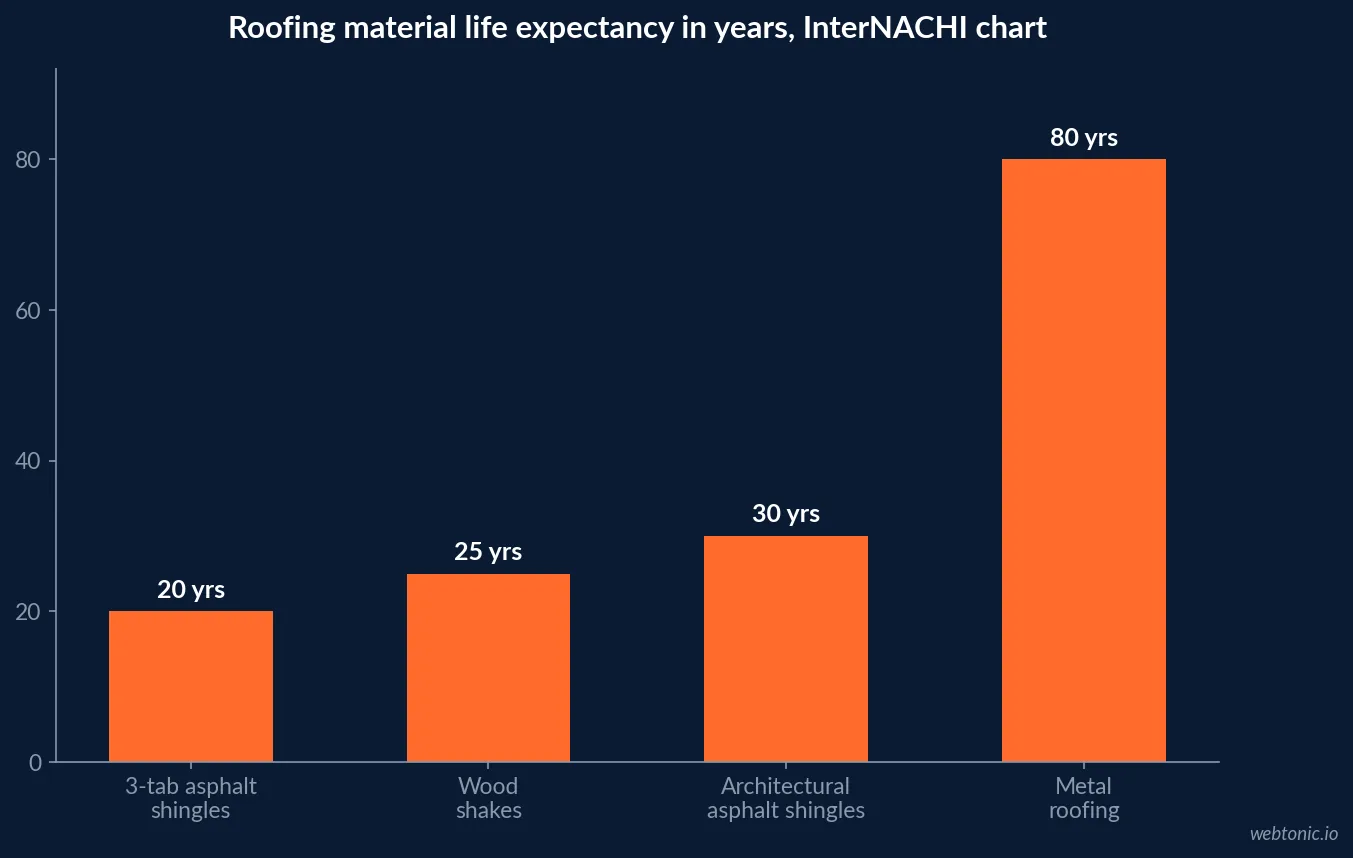
InterNACHI's Standard Estimated Life Expectancy Chart puts 3-tab asphalt shingles at 20 years and architectural (dimensional) asphalt shingles at 30 years. A separate NAHB life-expectancy study of home components puts asphalt shingle roofs at about 20 years as well - both sources land in the same 20-to-30-year window depending on shingle grade and local climate. That window, not a monthly or annual renewal date, is the actual customer lifecycle a roofing retention program is built around.
| Roofing material (life expectancy) | InterNACHI figure | NAHB figure | Retention window implied |
|---|---|---|---|
| 3-tab asphalt shingles | 20 years | ~20 years (asphalt, general) | One re-roof per generation of ownership |
| Architectural asphalt shingles | 30 years | Not separately broken out | Rarely a repeat roof sale |
| Metal roofing | 40 to 80 years | Not separately broken out | Effectively a one-time sale |
| Wood shakes | 25 years | ~30 years | Closer to a mid-cycle repeat |
Referrals and repeat calls carry the book of business
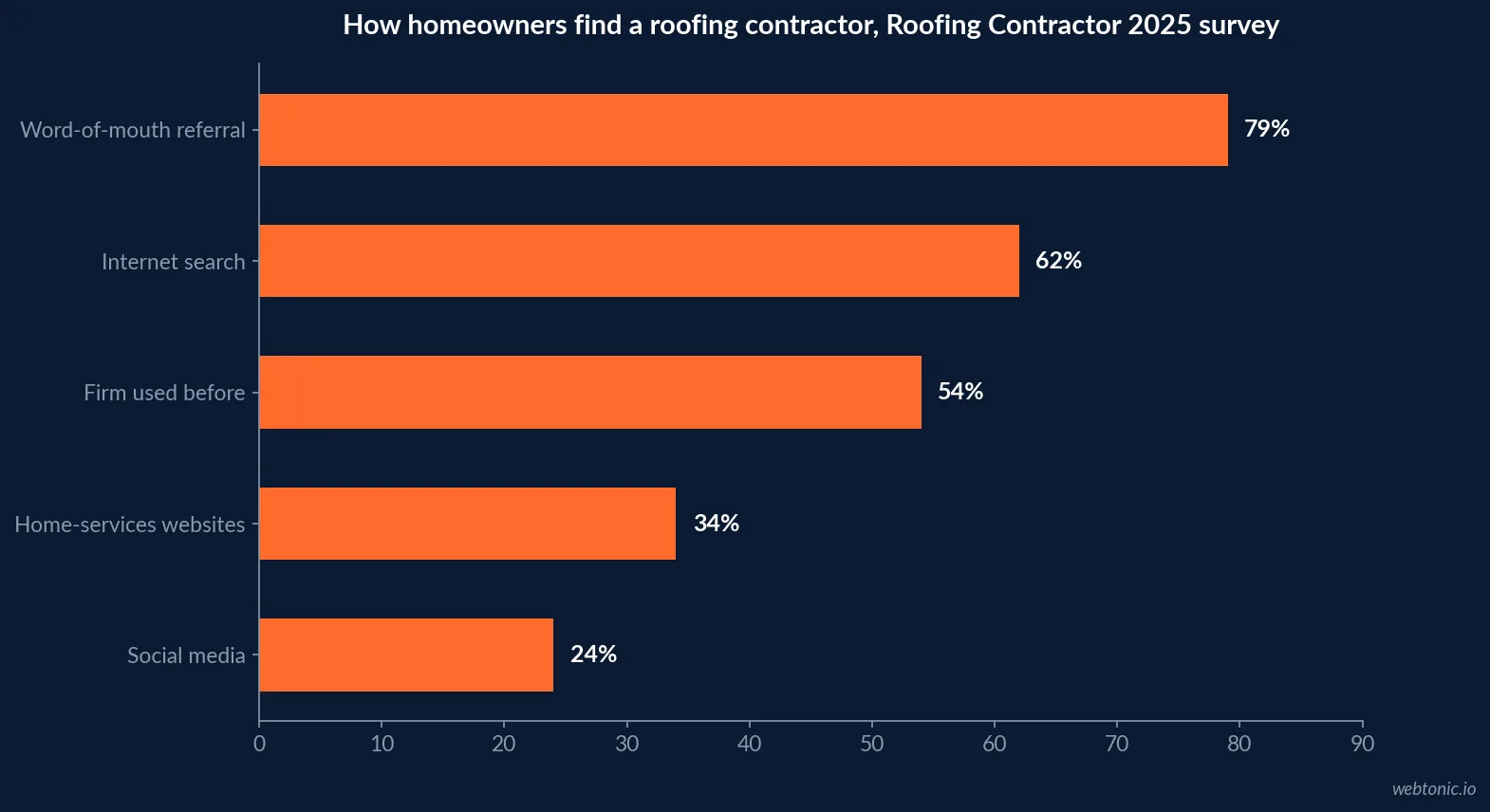
Roofing Contractor's 2025 Homeowner Survey, run with ROOFLE Technologies and Owens Corning and fielded in fall 2024, found 79% of homeowners seek a roofing contractor through word-of-mouth referrals before searching the internet (62%) or contacting a firm they've used before (54%). On the supply side, 72% of surveyed roofers said word-of-mouth recommendations are their main promotion method, and 61% said they are highly likely to service repeat clients. JobNimbus's Peak Performance 2026 report, drawn from thousands of contractor data points, adds that half of all roofing companies name referrals as their number-one source of new business.
| Lead / retention source | Homeowner side | Roofer side | Source |
|---|---|---|---|
| Word-of-mouth / referral | 79% seek this first | 72% call it their main method; 50% call it #1 source | RC 2025 survey; JobNimbus 2026 |
| Internet search | 62% | - | RC 2025 survey |
| Firm used before (repeat) | 54% | 61% highly likely to service repeat clients | RC 2025 survey |
| Home-services websites (Angi, HomeAdvisor) | 34% | - | RC 2025 survey |
| Social media | 24% | 60% use it as a channel | RC 2025 survey |
Reviews are the trust layer that makes referrals convert
Reviews and referrals reinforce each other rather than compete. The Roofing Contractor survey found 67% of homeowners rate online reviews "very" or "extremely" important to their hiring decision, and three-quarters of surveyed roofers already feature testimonial reviews on their own site or social channels. JobNimbus's 2026 data sharpens the number further: 90% of homeowners read reviews before calling a roofing company, and companies carrying 200 or more online reviews close more jobs and report stronger margins. Price transparency reinforces the same trust signal - 78% of homeowners in the 2025 survey said they're more likely to call a contractor who posts pricing on its own website, up from 66% in the prior survey wave.
| Trust signal (2025-2026 data) | Figure | Direction since prior survey | Source |
|---|---|---|---|
| Reviews very/extremely important to homeowners | 67% | Roughly stable | RC 2025 survey |
| Roofers featuring reviews on their own site | 75% | - | RC 2025 survey |
| Homeowners reading reviews before calling | 90% | - | JobNimbus 2026 |
| Homeowners more likely to call with online pricing | 78% | Up from 66% in prior wave | RC 2025 survey |
| Threshold review count correlated with more closed jobs | 200+ reviews | - | JobNimbus 2026 |
What retention protects: margin, not just volume
JobNimbus's 2026 benchmarks tie the same lifecycle behaviors to profitability directly: most roofers report 21% to 40% gross profit, but only those who track job costs weekly and lean on automation stay consistently above 30%. That is not a retention-marketing statistic on its face, but it is the number a referral-and-review program is ultimately protecting - repeat and referred jobs close faster and need less discounting than cold leads, which is why margin discipline and review volume move together in the same report.
What a lifecycle program spends money on, concretely
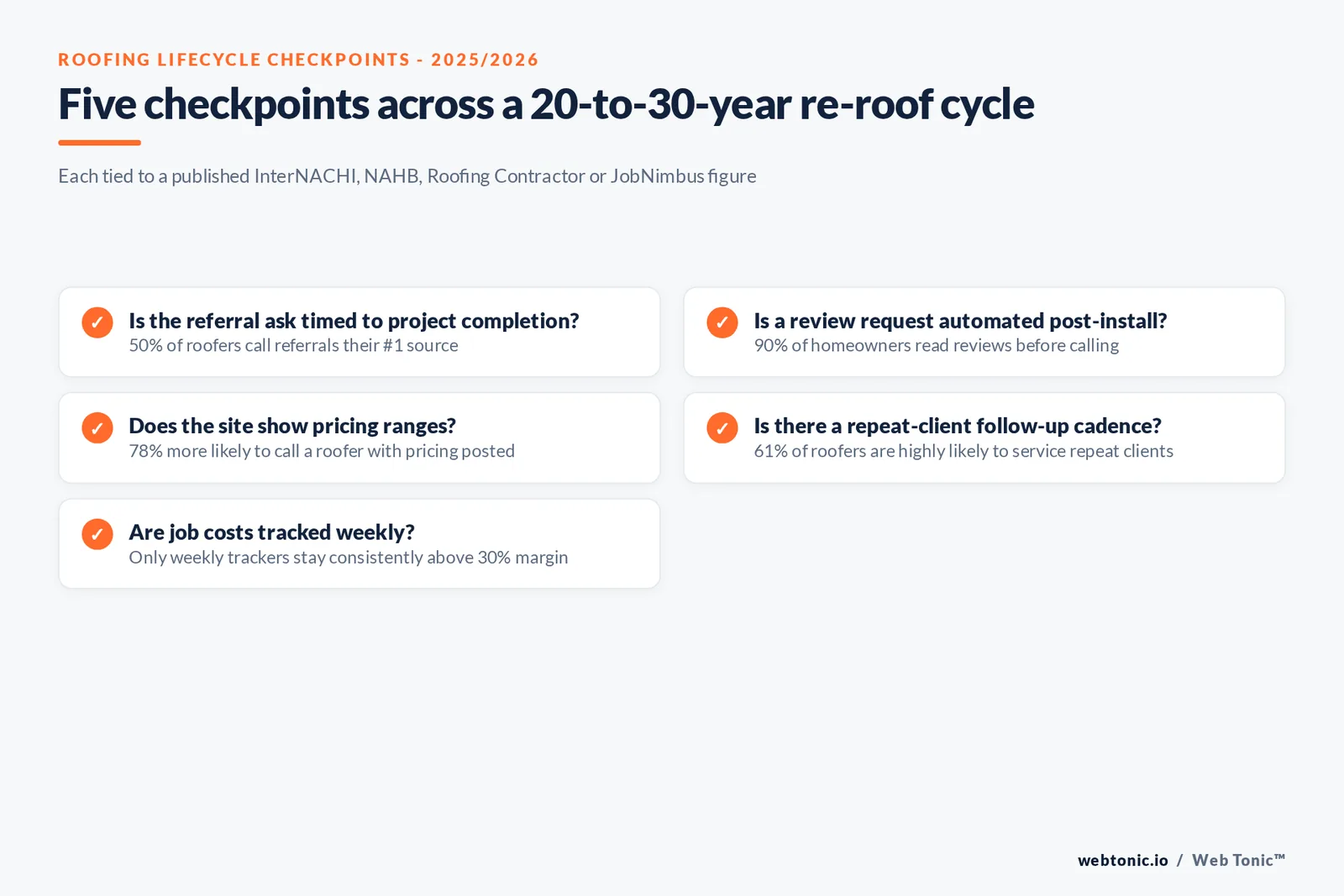
None of the surveys above price a roofing retention program as a line item, so the honest budget is built from the activities the data already shows matter: a review-generation workflow run at project completion (protecting the 90% of homeowners who read reviews first), a referral-ask script built into the same completion call (protecting the 50% who name referrals as their top source), and a records system that can resurface a homeowner for adjacent work well inside the 20-to-30-year shingle-life window. None of these require the SMS/email automation tooling priced on our companion page - they are process changes first, software second.
What warranty length adds to the retention window
Manufacturer warranties stretch the same window further without changing the tactic. InterNACHI's chart puts metal roofing at 40 to 80 years and wood shakes at 25 years, both inside the same broad family of multi-decade materials. A homeowner choosing a longer-life material is not becoming a repeat roof buyer sooner - they are pushing the next full re-roof further out, which raises the relative value of every referral, review and adjacent-service touchpoint in between, since the roof itself will not generate a repeat sale for a generation.
| Retention touchpoint between re-roofs | Typical timing | What it protects | Data point |
|---|---|---|---|
| Post-install review request | Within days of completion | Review volume for future leads | 90% read reviews first (JobNimbus) |
| Referral ask | At project completion / follow-up call | Next referred job | 50% call referrals their #1 source |
| Storm-damage inspection outreach | After a regional weather event | Repair or partial re-roof work | 61% highly likely to serve repeat clients |
| Gutter/ventilation upsell | 1-5 years post-install | Adjacent revenue inside the cycle | Not separately measured in cited surveys |
| Warranty-transfer reminder | At home sale | New-owner relationship | Not separately measured in cited surveys |
What is compressing the re-roof cycle in some regions
The 20-to-30-year window is a national average, not a fixed clock - weather and insurance claims move it materially. Verisk's U.S. Roof Report, using 2025 data, found hail-prone states have 57% of their housing stock with roofs 9 years old or newer, against 38% in non-hail states - insurance-driven replacement is pulling the effective cycle forward in those regions. The same report puts the average roof replacement cost at USD 17,631 and average repair cost at USD 4,699 for 2025. On the demand side, IIBEC's quarterly Market Index Survey for Reroofing, run since Q4 2020 with contractors and consultants across the US and Canada, has shown an index above 50 (indicating expansion) for every quarter surveyed since inception - steady, not cyclical, replacement demand behind the lifecycle number.
| Regional / demand fact | Figure | Source | Effect on the lifecycle window |
|---|---|---|---|
| Hail-prone-state roofs 9 years or newer | 57% | Verisk U.S. Roof Report, 2025 data | Cycle compresses in hail regions |
| Non-hail-state roofs 9 years or newer | 38% | Verisk, 2025 data | Closer to the natural 20-30 year window |
| Average roof replacement cost | USD 17,631 | Verisk, 2025 data | Sets the ticket size retention protects |
| Reroofing demand index | Above 50 every quarter since Q4 2020 | IIBEC Market Index Survey | Steady baseline demand, not boom-bust |
How this compares with the wider retention and lifecycle picture
Roofing's lifecycle runs on a much longer clock than most retention categories. For the cross-industry customer retention and lifetime-value baselines this compares against, see our customer retention statistics and customer lifetime value statistics pages. Our companion breakdown covers the tooling side of the same roofing business - CRM adoption, response speed and SMS/email automation - rather than the multi-decade lifecycle itself.
Building a lifecycle program around a 20-to-30-year sale
The practical program a roofing lifecycle statistic set argues for looks nothing like an ecommerce retention program: instead of a churn dashboard, it needs a referral-request cadence timed to project completion, a review-generation workflow that gets past the 200-review threshold JobNimbus ties to stronger closes, and a records system that can resurface a homeowner a decade later for gutter, ventilation or storm-damage work well inside that 20-to-30-year shingle life. Our growth marketing practice builds that cadence around the actual sales cycle instead of a subscription metric borrowed from software.
For the tooling side of the same lifecycle - CRM adoption, speed-to-lead and SMS/email automation cost - see our companion breakdown of roofing marketing automation numbers. Talk to us about building either program.
Frequently Asked Questions
What is the roofing industry's actual customer lifecycle, if there is no subscription?
It runs on the re-roof cycle rather than a renewal date. InterNACHI's Standard Estimated Life Expectancy Chart puts 3-tab asphalt shingles at 20 years and architectural asphalt shingles at 30 years, while the NAHB's own life-expectancy study puts asphalt shingle roofs at about 20 years. That 20-to-30-year window is the real 'retention period' - a homeowner is not a repeat buyer of roofs, but is a repeat source of referrals, reviews and eventual gutter, siding or solar add-on work well before that window closes.
Where do roofing companies actually get repeat and referred business?
Referrals dominate on both sides of the transaction. JobNimbus's Peak Performance 2026 report finds half of all roofing companies say referrals are their #1 source of new business, and Roofing Contractor's 2025 homeowner survey (with ROOFLE Technologies and Owens Corning) found 79% of homeowners look to word-of-mouth before searching online, while 72% of roofers said word-of-mouth is their main way of promoting the business. Contacting a firm they'd used before accounted for 54% of the homeowner side.
How much do online reviews actually matter to a roofing lifecycle program?
A lot, on both the homeowner and the contractor side of the same 2025-2026 data. The Roofing Contractor survey found 67% of homeowners rated online reviews 'very' or 'extremely' important to their decision, and three-quarters of surveyed roofers feature testimonial reviews on their own sites and social channels. JobNimbus's 2026 report goes further: 90% of homeowners read reviews before calling a roofing company, and companies with 200 or more reviews close more jobs and report stronger margins.
Do repeat clients actually make up a meaningful share of a roofing book of business?
Yes, per Roofing Contractor's 2025 survey: 61% of surveyed roofers said they are highly likely to service repeat clients, alongside the 72% who cite word-of-mouth as their main promotion channel. That is a meaningfully different retention shape than SaaS renewal metrics - it is built from a small number of large, infrequent jobs rather than a recurring subscription payment.
Does a longer shingle warranty change how a roofer should think about retention?
It changes the time horizon, not the tactic. InterNACHI and NAHB both put architectural asphalt shingle life in the 20-to-30-year range, which means a homeowner's next full re-roof may be a decade or two away - the retention play in between is referrals, reviews, and adjacent work (gutters, ventilation, storm-damage repair), not a repeat sale of the same roof.
Sources
InterNACHI - Standard Estimated Life Expectancy Chart for Homes
NAHB / Bank of America Home Equity - Study of Life Expectancy of Home Components (2007, NAHB archive copy)
Roofing Contractor - 2025 Homeowner Survey (with ROOFLE Technologies and Owens Corning)
JobNimbus - Peak Performance 2026: Roofing Industry Benchmarks for Success
Verisk - U.S. Roof Report: The State of America's Roofs (2025 data)
IIBEC - Market Index Survey for Reroofing