



Table of contents
WordPress powers roughly 85–90% of addiction treatment center websites, making it the dominant CMS in behavioral health. Yet the average treatment center site takes 9.7 seconds to render main content on mobile — nearly four times Google's passing threshold. This guide compiles the most current WordPress adoption, performance, security, and HIPAA-compliance statistics for the rehab and addiction treatment industry in 2026.
Key Takeaways
- 85–90% of treatment center websites run on WordPress, far above the CMS's 33% global web share.
- WordPress holds 64% of the detectable CMS market worldwide — more than every other CMS combined.
- 72.4% of rehab website traffic is mobile, but most behavioral health WordPress sites sit in the bottom quartile of Core Web Vitals.
- Average medical website LCP is 9.7 seconds — 7.2 seconds over the 2.5-second passing threshold.
- Realistic LCP target for treatment center sites is 1.8–2.2 seconds at the 75th percentile on mobile.
- 73% of healthcare websites run non-HIPAA-compliant tracking tools, creating PHI exposure risk on WordPress installations.
- HIPAA-eligible WordPress hosting is available from WP Engine, Pressable, Kinsta, and specialty behavioral health hosts.
- Organic traffic rose 31% for rehab blogs using optimized WordPress content architecture over 120 days.
WordPress Adoption in Addiction Treatment
WordPress is the foundation of the behavioral health web. While the platform runs 33.21% of all measurable web origins globally as of April 2026 (GravityKit, citing W3Techs data), its share inside treatment centers is dramatically higher. Webserv's 2026 platform audit found that 85–90% of treatment center sites run WordPress — roughly 2.6× the platform's overall web penetration. The combination of plugin flexibility, HIPAA-eligible hosting, and EHR integration capabilities makes WordPress the default choice for behavioral health organizations.
| Metric | Value | Source |
|---|---|---|
| WordPress global web share | 33.21% of all web origins | W3Techs / GravityKit, Apr 2026 |
| WordPress CMS market share | 64% of detectable CMS sites | W3Techs, 2026 |
| Treatment center WordPress adoption | 85–90% | Webserv platform audit, 2026 |
| Second-place CMS in rehab | Webflow / Squarespace (~5% combined) | Webserv, 2026 |
| Custom-built treatment center sites | ~5% | Webserv, 2026 |
| WordPress sites using Elementor (rehab) | Dominant page builder | Webserv, 2026 |
The rehab sector's WordPress concentration is unusual even within healthcare. General medical practices are more fragmented across Wix, Squarespace, and proprietary EHR-bundled sites. Treatment centers lean WordPress because plugin ecosystems support insurance verification widgets, admissions CRM integrations, and HIPAA-compliant contact forms that other platforms handle poorly or not at all.

Core Web Vitals and Site Performance
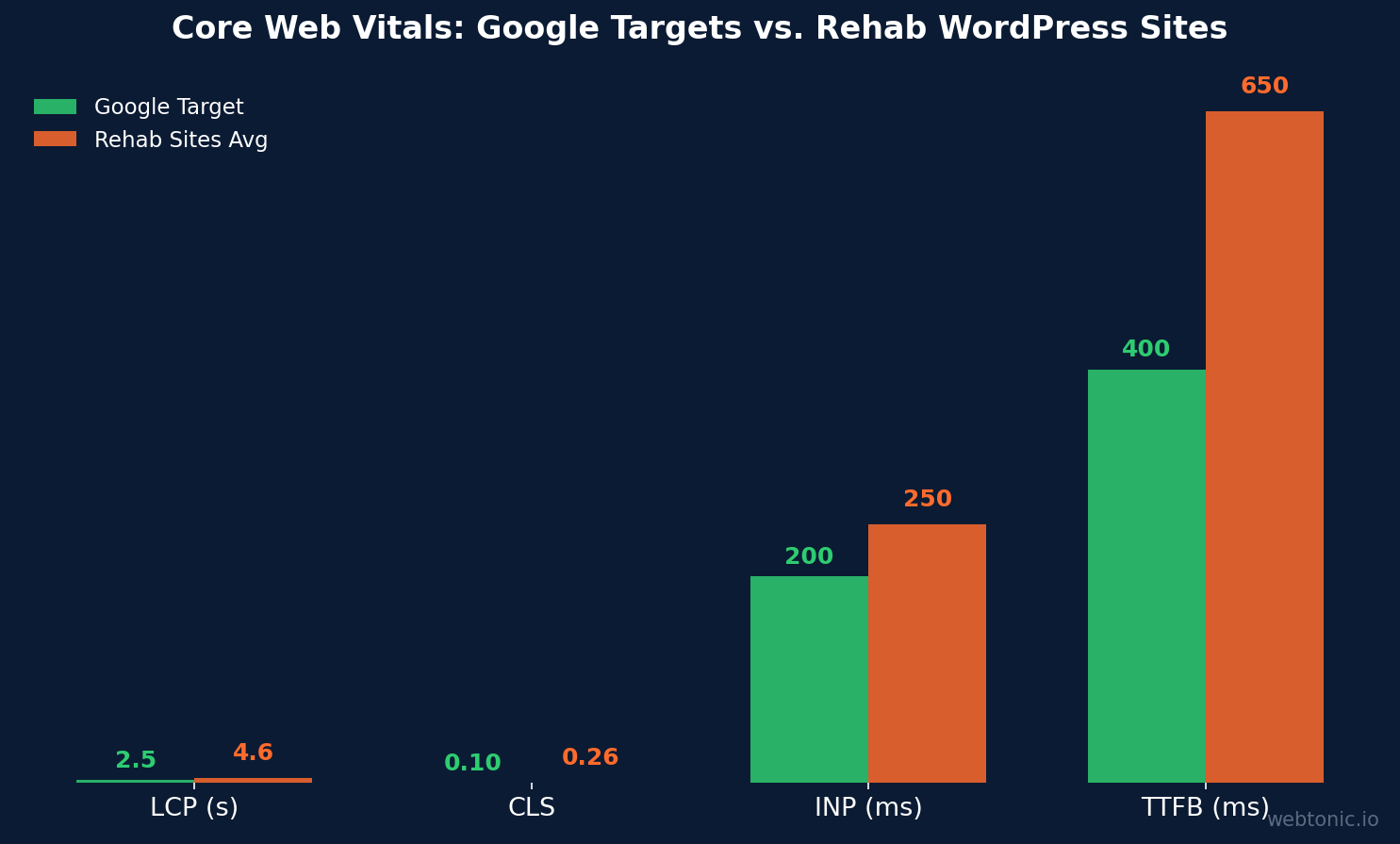
Speed is where WordPress treatment center sites consistently underperform. Borah Labs' July 2026 medical website benchmark analyzed 796 healthcare sites and found an average Largest Contentful Paint (LCP) of 9.7 seconds — a full 7.2 seconds over Google's 2.5-second passing threshold. Treatment center sites specifically perform even worse due to heavy page builders, hero video, premium imagery, and limited in-house technical capacity.
| Performance Metric | Treatment Centers | Healthcare Avg | Google Target |
|---|---|---|---|
| LCP (mobile, 75th pctl) | 3.5–5.8s | 9.7s | ≤2.5s |
| Realistic LCP target | 1.8–2.2s | — | ≤2.5s |
| CLS (Cumulative Layout Shift) | 0.18–0.35 | 0.22 | ≤0.10 |
| INP (Interaction to Next Paint) | 180–320ms | 250ms | ≤200ms |
| TTFB (Time to First Byte) | 400–900ms | 650ms | ≤400ms |
| Mobile PageSpeed score | 25–45 | 35 | 70+ |
Webserv's CWV benchmark for treatment centers sets a realistic LCP target of 1.8–2.2 seconds at the 75th percentile on mobile. Hitting 1.8 seconds produces materially better user experience and ranking signal. Yet most behavioral health sites fall into the bottom quartile of healthcare CWV performance due to unoptimized Elementor builds, render-blocking third-party scripts, and oversized hero images.
Grover Web Design's 2026 benchmark of 32 U.S. WordPress service-business sites found that TTFB under 200ms is achievable with proper hosting, and that sites meeting all three Core Web Vitals thresholds generate 2.3× more leads per visitor than those failing. For rehab centers where 72.4% of traffic is mobile, performance directly impacts admissions volume.
Ben Ryan's 2026 WordPress performance study recommends healthcare WordPress targets of LCP ≤ 2.8s, INP ≤ 200ms, CLS ≤ 0.15, and TTFB under 400ms, with a mobile PageSpeed score of 70+ considered "good enough."
HIPAA Compliance and Security on WordPress
Running a treatment center website on WordPress introduces specific compliance obligations. Webserv's HIPAA compliance guide outlines the minimum requirements: HIPAA-eligible form plugins with signed BAAs, encrypted data transmission, and PHI isolation from analytics pipelines. The HIPAA story for WordPress is mature — eligible hosting is available from WP Engine, Pressable, Kinsta, and behavioral-health specialty hosts.
| Compliance Area | Statistic | Implication |
|---|---|---|
| Non-compliant tracking | 73% of healthcare sites run non-HIPAA-compliant trackers | PHI exposure through analytics scripts |
| GA4 adoption in healthcare | 87% migrated, GA holds 89.5% share | Standard GA4 config is not HIPAA-compliant |
| Active GA4 properties | 14.7M globally | Widespread use amplifies compliance risk |
| HIPAA-eligible WordPress hosts | 4+ mainstream options (WP Engine, Pressable, Kinsta, Cloudways) | No barrier to compliant hosting |
| BAA coverage for forms | Required for any plugin collecting PHI | Standard Contact Form 7 / Gravity Forms NOT compliant without add-ons |
| 42 CFR Part 2 (SUD records) | Stricter than standard HIPAA for addiction treatment | WordPress forms must segregate SUD-related submissions |
The compliance gap is significant: 73% of healthcare websites run tracking tools that are not HIPAA-compliant, exposing protected health information through standard analytics, remarketing pixels, and heatmap services. For addiction treatment centers, the stakes are higher because 42 CFR Part 2 imposes additional restrictions on substance use disorder records beyond standard HIPAA requirements.
Content Architecture and SEO Performance
WordPress blog architecture directly impacts organic admissions for treatment centers. Webserv's 2026 content architecture study found that rehab sites implementing structured blog and resource sections saw organic search sessions hold steady over 120 days while AI Overview citation share rose 4× for condition-related queries. Most notably, admit-attributed conversions from organic traffic rose 31%.
| Content Metric | Before Optimization | After Optimization |
|---|---|---|
| Organic sessions (120-day trend) | Declining | Held flat (against industry decline) |
| AI Overview citations | Baseline | 4× increase for condition queries |
| Admit-attributed organic CVR | Baseline | +31% |
| Average time on page | 2m 45s | 3m 20s+ |
| Bounce rate | 64.5% | 52–58% |
| Pages per session | 2.8 | 3.4+ |
Treatment center WordPress sites benefit from hub-and-spoke content architectures — pillar pages for each substance or condition linking to supporting articles on symptoms, treatment modalities, insurance coverage, and local resources. This structure improves topical authority, internal link equity distribution, and the likelihood of earning AI-generated summary citations.
WordPress Plugin Ecosystem for Treatment Centers
The behavioral health WordPress stack typically includes 15–25 active plugins, covering admissions forms, insurance verification, EHR integration, chat widgets, and compliance monitoring. Key plugin categories and their adoption rates include:
- Page builders (Elementor dominant) — used on the majority of rehab WordPress sites for visual editing without developer dependency
- HIPAA-compliant form plugins — Gravity Forms with HIPAA add-on, HIPAAtizer, or JotForm HIPAA
- SEO plugins — Yoast SEO or Rank Math on 90%+ of WordPress treatment center sites
- Caching and performance — WP Rocket, LiteSpeed Cache, or host-level caching (WP Engine EverCache)
- Security — Wordfence or Sucuri on 65%+ of healthcare WordPress sites
- Chat / click-to-call — critical for the 74.9% of behavioral health leads arriving by phone
- EHR/CRM integration — Salesforce Health Cloud, Kipu, Sunwave, or Alleva connectors
Plugin bloat remains the primary technical debt issue. Each active plugin adds 50–200ms of server-side processing and potential JavaScript render-blocking. Treatment center sites averaging 20+ plugins routinely fail Core Web Vitals without aggressive optimization.
Mobile Experience and User Behavior
Mobile dominance in addiction treatment search is critical for WordPress development priorities. With 72.4% of rehab website traffic arriving on mobile devices and 78% of visitors being first-time users, the mobile WordPress experience directly determines whether someone in crisis takes the next step.
| User Behavior Metric | Value | Impact on WordPress Design |
|---|---|---|
| Mobile traffic share | 72.4% | Mobile-first design mandatory |
| New visitors | 78% | First impression determines conversion |
| Bounce rate | 64.5% | Speed + above-fold CTAs essential |
| Pages per session | 2.8 | Internal linking structure critical |
| Average session duration | 2m 45s | Content depth sustains engagement |
| Phone leads | 74.9% of BH leads | Click-to-call prominent in theme |
WordPress theme selection for treatment centers must prioritize mobile Core Web Vitals, prominent click-to-call buttons, and minimal JavaScript. Premium themes that load 500KB+ of unused CSS and JS on every page are the leading cause of poor mobile performance in behavioral health. Lightweight themes like GeneratePress, Kadence, or Astra with targeted Elementor use produce measurably better outcomes.
Cost and ROI of WordPress for Treatment Centers
WordPress offers the most cost-effective website platform for treatment centers when factoring in flexibility, compliance infrastructure, and long-term total cost of ownership. Here is how the economics break down:
- WordPress hosting (HIPAA-eligible): $50–$250/month depending on provider and traffic
- WordPress development (custom treatment center site): $8,000–$25,000 initial build
- Annual maintenance + updates: $2,400–$6,000/year
- HIPAA-compliant form plugin licensing: $200–$500/year
- Average cost per admission (organic/SEO): $1,200–$3,500 (top-performing sites)
- Patient lifetime value: $18,000–$35,000
- SEO ROI potential: organic generates admissions at 60–75% lower cost than paid search ($94.50 average CPC for rehab Google Ads)
Compared to custom-coded solutions ($50,000–$150,000+) or SaaS platforms with limited healthcare integrations, WordPress provides 5–10× lower initial investment with comparable or superior flexibility. The key is investing in HIPAA-eligible hosting and proper security configuration from day one rather than retrofitting compliance after launch.
Industry Benchmarks: Rehab WordPress vs. Other Verticals
Treatment center WordPress sites face unique challenges compared to other industries using the platform. ElevateWeb's 2026 CMS statistics and Supremo Rehab Marketing's performance data provide context for how rehab sites compare:
| Metric | Rehab / BH | General Healthcare | All Industries |
|---|---|---|---|
| WordPress adoption | 85–90% | 55–65% | 33% |
| Mobile traffic | 72.4% | 58–65% | 60% |
| Average PageSpeed (mobile) | 25–45 | 30–50 | 45–65 |
| Bounce rate | 64.5% | 55–65% | 40–55% |
| HIPAA compliance required | Yes + 42 CFR | Yes | Varies |
| Avg plugins active | 20–25 | 15–20 | 10–15 |
Best Practices for Rehab WordPress Sites
Based on the data, treatment center WordPress sites that outperform follow these patterns:
- Choose HIPAA-eligible hosting from day one — WP Engine, Pressable, or Kinsta with signed BAA. Retrofitting compliance is 3–5× more expensive.
- Limit active plugins to 12–15 — audit quarterly, remove inactive plugins, and consolidate overlapping functionality.
- Use a lightweight theme base — GeneratePress, Kadence, or Astra with Elementor for specific sections, not full-page builds on every page.
- Implement server-level caching — host-level caching (e.g., WP Engine EverCache) outperforms plugin-level caching for TTFB.
- Build mobile-first — design for the 72.4% mobile audience before desktop, with click-to-call buttons above the fold.
- Structure content as hub-and-spoke — pillar pages per substance/condition with supporting content linked contextually.
- Isolate PHI-collecting forms — HIPAA-compliant form plugins with BAA, separate from standard analytics pipelines.
- Monitor Core Web Vitals monthly — target LCP ≤ 2.2s, CLS ≤ 0.10, INP ≤ 200ms on mobile.
- Implement call tracking with HIPAA safeguards — 74.9% of behavioral health leads arrive by phone; track without exposing caller PHI.
- Update WordPress core, themes, and plugins weekly — healthcare sites are high-value targets for exploitation.
Related reading
- Rehab & Addiction Treatment Landing Page Statistics (2026)
- Rehab & Addiction Treatment Shopify Statistics (2026)
- 47 Statistics Shaping Webflow in Rehab & Addiction Treatment (2026)
- Custom Web Development services at Web Tonic
FAQ
Why do most rehab centers use WordPress instead of other platforms?
WordPress dominates treatment center websites (85–90% adoption) because its plugin ecosystem supports the unique needs of behavioral health — HIPAA-compliant forms, EHR/CRM integrations, insurance verification widgets, and admissions workflows. No other CMS offers the same combination of flexibility, compliance-eligible hosting options, and community support for healthcare-specific features. Agencies specializing in treatment center marketing have also standardized on WordPress, reinforcing the ecosystem advantage.
How fast should a rehab WordPress website load?
The realistic LCP target for treatment center sites is 1.8–2.2 seconds at the 75th percentile on mobile. Google's passing threshold is 2.5 seconds, but hitting 1.8 seconds produces materially better rankings and user experience. Most rehab WordPress sites currently score 25–45 on mobile PageSpeed, with the average healthcare site taking 9.7 seconds to render main content — indicating massive room for improvement.
Is WordPress HIPAA-compliant for addiction treatment websites?
WordPress itself is not inherently HIPAA-compliant, but it can be configured for HIPAA compliance. This requires HIPAA-eligible hosting with a signed BAA (available from WP Engine, Pressable, Kinsta, and others), HIPAA-compliant form plugins for any forms collecting protected health information, and careful isolation of PHI from analytics and marketing tools. Addiction treatment sites must also comply with 42 CFR Part 2, which imposes additional restrictions on substance use disorder records.
How many plugins should a rehab WordPress site have?
Performance data suggests limiting active plugins to 12–15 for treatment center sites. The average rehab WordPress site runs 20–25 active plugins, contributing to slow load times and Core Web Vitals failures. Each plugin adds 50–200ms of server-side processing. Focus on essential categories: HIPAA forms, SEO, caching, security, and your admissions CRM — and consolidate or remove everything else.
What is the ROI of investing in WordPress optimization for a rehab center?
Treatment center sites meeting all Core Web Vitals thresholds generate 2.3× more leads per visitor than those failing. Given a patient lifetime value of $18,000–$35,000 and organic admission costs of $1,200–$3,500 (vs. $94.50 CPC on Google Ads), even modest improvements in WordPress performance directly impact admissions volume and revenue. A $5,000–$10,000 optimization investment typically pays for itself within 60–90 days for treatment centers with adequate organic traffic.
Sources
webserv.io — 10 Best Website Platforms for Rehab Centers (2026)
webserv.io — Core Web Vitals for Treatment Center Websites 2026
webserv.io — HIPAA-Compliant WordPress Contact Forms for Treatment Centers
webserv.io — Blog & Resource Architecture for Rehab Admissions
gravitykit.com — WordPress Statistics 2026
borahlabs.us — General Medical Website Benchmarks (July 2026)
groverwebdesign.com — Website Performance Benchmark Study 2026
benryan.com.au — WordPress Performance Benchmarks by Industry 2026
supremorehabmarketing.com — Healthcare and Rehab Web Design Performance Statistics
elevatewebdesign.ca — Small Business CMS Statistics 2026


