



Table of contents
Most rehab and addiction treatment centers operate on WordPress or custom CMS platforms, yet Shopify's growing presence in healthcare e-commerce is reshaping how facilities manage online intake, merchandise, and patient engagement — 41,569 health and wellness stores now operate on Shopify, and the platform's checkout conversion benchmarks consistently outperform industry averages.
Key Takeaways
- 41,569 health and wellness Shopify stores are currently active, representing one of the platform's fastest-growing verticals (StoreInspect, 2026).
- Shopify health and wellness stores convert at 2.0–3.0%, above the platform average, driven by high-intent purchases and repeat buying behavior (EasyApps, 2026).
- Health and wellness checkout conversion has held above baseline for 23 consecutive months, the longest streak of any vertical tracked by PDQ (Pretty Damn Quick, 2026).
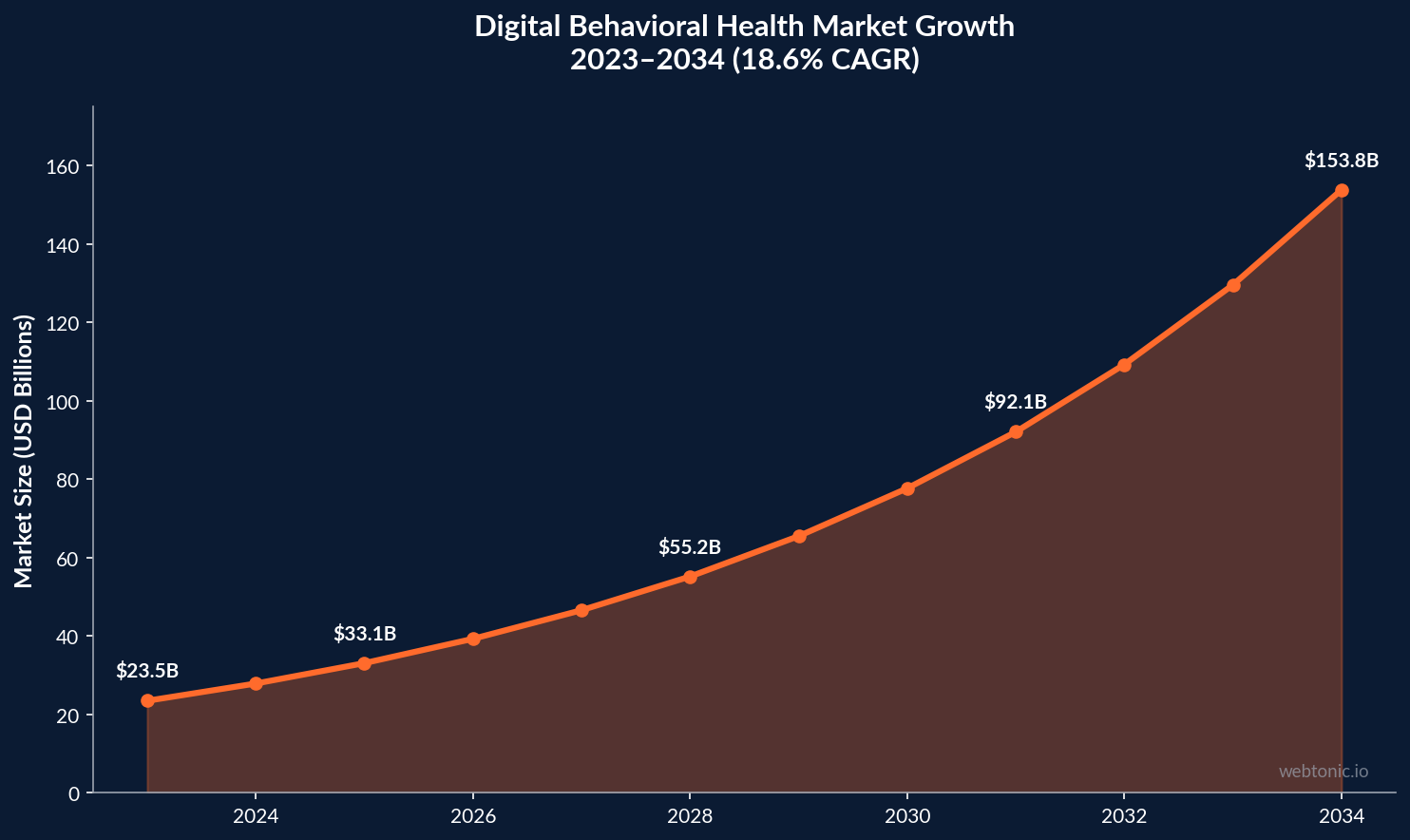
- Digital behavioral health market is projected to reach $153.85 billion by 2034, growing at 18.6% CAGR from a $33.1B base in 2025 (Towards Healthcare, 2026).
- Subscription apps over-index more than any other category in health stores — Skio at 4.8× and Bold Subscriptions at 4.3× adoption rate (StoreInspect, 2026).
- Average rehab website conversion rate is 2.1%, with top performers reaching 5–7% through optimized intake flows (Might Recovery Marketing, 2026).
- Digital patient intake reduces data entry by up to 80%, accelerating the admission funnel for treatment centers that adopt modern commerce platforms (Curogram, 2026).
Shopify Health and Wellness Performance Benchmarks
| Metric | Value | Context | Source |
|---|---|---|---|
| Active H&W Shopify Stores | 41,569 | Top 5 Shopify vertical | StoreInspect, 2026 |
| H&W Store CVR | 2.0–3.0% | Above platform avg (1.4%) | EasyApps, 2026 |
| Checkout Index (H&W) | 1.06× baseline | 23-month above-baseline streak | PDQ, May 2026 |
| Shopify Global Stores | 4.5 million+ | Platform-wide live stores | B2B Data Index, 2026 |
| Avg Apps Per Store | 5.2 | Health stores match avg | StoreInspect, 2026 |
| Subscription App Over-Index | 4.8× (Skio) | Highest category over-index | StoreInspect, 2026 |
| Rehab Website CVR | 2.1% avg / 5–7% top | Treatment center intake | Might Recovery, 2026 |
| Digital BH Market 2034 | $153.85B projected | 18.6% CAGR from $33.1B | Towards Healthcare, 2026 |
Shopify's Position in Health and Wellness E-Commerce
Shopify powers 4.5 million live online stores globally, with health and wellness representing one of the platform's core verticals. 41,569 health and wellness stores currently operate on Shopify, making it the 5th largest vertical on the platform behind apparel, home and garden, beauty and fitness, and food and beverages (StoreInspect).
Across health e-commerce broadly (including WooCommerce, custom carts, and all platforms), WooCommerce holds the largest share of health-related online stores, but Shopify's growth rate in the vertical is outpacing competitors, particularly among mid-market brands that value checkout optimization and subscription infrastructure (AfterShip).
For addiction treatment centers specifically, Shopify usage is concentrated in three operational areas: aftercare merchandise and branded recovery products, supplement and wellness product sales tied to alumni programs, and intake form and payment processing workflows using Shopify's commerce infrastructure alongside clinical systems.
Checkout Conversion and Revenue Performance
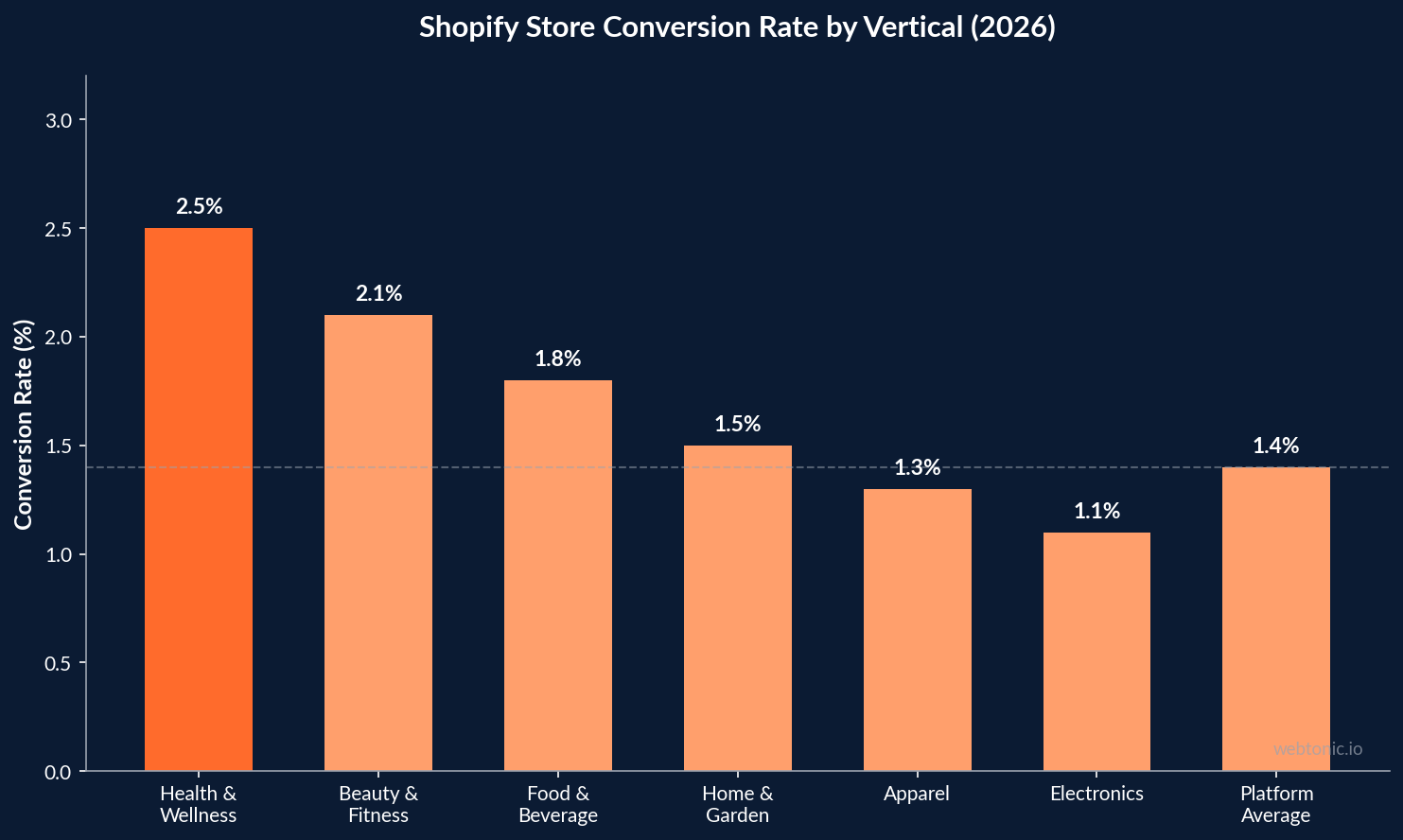
Health and wellness Shopify stores convert at 2.0–3.0%, consistently above the platform average of approximately 1.4% (EasyApps). This premium is driven by high-intent purchasing behavior — consumers searching for health products typically arrive with stronger purchase intent than casual shoppers in discretionary categories.
The most striking benchmark comes from PDQ's Checkout Benchmarks: health and wellness checkout conversion has held at 1.06× the baseline index for 23 consecutive months, the longest above-baseline streak of any vertical tracked. No other category (apparel, consumer goods, food and beverages) has maintained this consistency. This stability reflects the non-discretionary nature of health purchases — consumers don't delay or abandon carts for health products the way they do for fashion or home goods.
Repeat purchasing further strengthens the economics: subscription apps over-index more than any other category in health Shopify stores. Skio leads at 4.8× adoption rate, followed by Bold Subscriptions at 4.3× and Seal Subscriptions at 2.5× (StoreInspect). For treatment-adjacent businesses, subscription models power ongoing supplement delivery, aftercare program memberships, and recurring wellness product fulfillment.
The Digital Behavioral Health Market Opportunity
The broader digital behavioral health market provides context for treatment facilities evaluating technology platform investments. The global digital behavioral health market reached $33.1 billion in 2025 and is projected to grow to $153.85 billion by 2034 at 18.6% CAGR (Towards Healthcare). North America leads market share, driven by insurance coverage expansion, telehealth normalization, and increasing integration of digital tools into treatment workflows.
| Market Metric | 2025 | 2034 (Projected) | CAGR |
|---|---|---|---|
| Digital Behavioral Health (Global) | $33.1B | $153.85B | 18.6% |
| U.S. Digital Mental Health | Dominant share | Growing at 20.25% CAGR | 20.25% |
| Addiction Treatment Market | Growing steadily | Strong expansion projected | Significant |
This growth creates demand for e-commerce infrastructure that supports HIPAA-compliant patient interactions, telehealth integrations, and digital product delivery — areas where Shopify's app ecosystem and headless commerce architecture provide scalable foundations for treatment-adjacent businesses.
Treatment Center Website Conversion Benchmarks
The average rehab website converts at 2.1%, while high-performing treatment center sites achieve 5–7% or higher (Might Recovery Marketing). That gap represents a significant difference in admissions volume and revenue: for a treatment center receiving 5,000 monthly visitors, the difference between 2.1% and 6% conversion translates to 195 additional monthly inquiries.
Conversion rate drivers for treatment center websites:
- Phone calls convert 40–60% higher than form fills — click-to-call placement above the fold is the single highest-impact conversion element for treatment centers (Webserv).
- Reducing intake form fields from 8+ to 4 or fewer produces measurable conversion lifts — families in crisis abandon lengthy forms.
- Digital patient intake systems reduce data entry by up to 80% by moving forms from paper to phone, accelerating the path from inquiry to admission (Curogram).
- A national behavioral health network achieved a 28.7% admit-to-inquiry rate and converted 20,337 patients to treatment in 2025 by optimizing intake call workflows across 200,000+ annual inquiries (ResultsCX).
These benchmarks illustrate why platform selection and checkout flow optimization matter — whether a facility uses Shopify, WordPress, or a custom solution, the conversion infrastructure directly affects the cost per admission and overall marketing ROI.
Shopify App Ecosystem for Health and Wellness
Health and wellness Shopify stores install an average of 5.2 detected apps, consistent with the platform-wide average across all verticals (StoreInspect). However, the types of apps that health stores adopt differ significantly from other categories.
| App Category | Over-Index Rate | Key Players | Relevance to Treatment |
|---|---|---|---|
| Subscription Management | 4.8× (Skio) | Skio, Bold, Seal | Aftercare product delivery |
| Review & Trust | 2.1× | Judge.me, Loox | Patient social proof |
| Compliance & Legal | 1.8× | Compliance tools | HIPAA, regulatory |
| Email Marketing | 1.6× | Klaviyo, Omnisend | Alumni engagement |
| Analytics & Tracking | Standard | GA4, Hotjar | Conversion optimization |
For addiction treatment-adjacent e-commerce (recovery merchandise, supplements, aftercare products), the subscription and compliance app stacks are the most differentiated — these categories directly support the recurring revenue models and regulatory requirements unique to behavioral health commerce.
CMS Platform Comparison for Treatment Centers
While Shopify dominates transactional health and wellness e-commerce, treatment center websites predominantly run on WordPress (powering 43.5% of all websites globally). The platform choice depends on the facility's primary digital objective:
- WordPress — best for content-heavy treatment center websites focused on SEO, blog content, location pages, and educational resources. Dominant in the space due to plugin ecosystem, HIPAA-compliant hosting options, and SEO flexibility.
- Shopify — best for treatment-adjacent e-commerce: recovery merchandise stores, supplement sales, aftercare product fulfillment, and intake payment processing. Checkout optimization and subscription infrastructure are key advantages.
- Custom / Headless — best for multi-facility networks that need tight EHR integration, custom intake workflows, and insurance verification portals. Higher development cost but maximum flexibility.
Many treatment organizations use a hybrid architecture: WordPress for the primary marketing website and Shopify (or Shopify Buy Button embedded in WordPress) for commerce functionality. This approach combines WordPress's SEO capabilities with Shopify's checkout optimization.
Best Practices for Treatment-Adjacent E-Commerce
- Prioritize HIPAA compliance — any platform handling patient data must meet HIPAA security requirements. Shopify Plus offers BAA (Business Associate Agreement) capabilities for qualifying merchants.
- Implement subscription infrastructure early — aftercare product delivery and alumni membership programs generate predictable recurring revenue that compounds over time.
- Optimize checkout for mobile — with 72.4% of treatment-related traffic arriving on mobile, cart and checkout flows must be mobile-native, not desktop-adapted.
- Build trust through transparent product information — third-party testing results, ingredient transparency, and clear return policies drive higher conversion rates in health e-commerce (EasyApps).
- Leverage email for alumni engagement — alumni programs with email automation achieve higher retention rates and drive referral admissions, which convert at significantly lower cost per acquisition than cold channels.
- Connect commerce data to marketing attribution — integrate Shopify analytics with Google Analytics and attribution platforms to track the full journey from initial search to product purchase or referral admission.
Related reading
- Rehab & Addiction Treatment WordPress Statistics (2026)
- Rehab & Addiction Treatment Landing Page Statistics (2026)
- 47 Statistics Shaping Webflow in Rehab & Addiction Treatment (2026)
- Custom Web Development services at Web Tonic
Frequently Asked Questions
Is Shopify suitable for addiction treatment center websites?
Shopify is not the primary platform for treatment center marketing websites, which are typically content-heavy and SEO-focused (WordPress dominates here). However, Shopify excels for treatment-adjacent e-commerce: recovery merchandise stores, aftercare supplement delivery, alumni membership portals, and intake payment processing. Many organizations use a hybrid model with WordPress for marketing and Shopify for commerce.
What conversion rate should a rehab website aim for?
The average rehab website converts at 2.1%, while top performers achieve 5–7%. The primary conversion levers are click-to-call placement (phone calls convert 40–60% higher than forms), form simplification (4 fields maximum), page speed optimization, and trust signals including reviews, accreditations, and staff credentials. A 1-percentage-point improvement on 5,000 monthly visitors equals 50 additional inquiries per month.
How do health and wellness Shopify stores compare to other verticals?
Health and wellness Shopify stores consistently outperform most other verticals in conversion rate (2.0–3.0% vs. platform average 1.4%) and checkout stability (23 consecutive above-baseline months). Subscription app adoption is dramatically higher than any other category, reflecting the recurring-purchase nature of health products. Average order values and customer lifetime values also tend to be above median.
What role does digital commerce play in behavioral health going forward?
The digital behavioral health market is projected to reach $153.85 billion by 2034 (18.6% CAGR), creating massive demand for platforms that can handle HIPAA-compliant patient interactions, telehealth integrations, and digital product delivery. Treatment facilities that build e-commerce infrastructure now — whether through Shopify, custom platforms, or hybrid architectures — will be better positioned to capture this growth through aftercare products, digital program delivery, and alumni engagement commerce.
Is Shopify HIPAA compliant?
Standard Shopify plans are not inherently HIPAA compliant. Shopify Plus offers the ability to sign a Business Associate Agreement (BAA) for qualifying merchants, which is a prerequisite for processing protected health information. Treatment organizations using Shopify for product sales (not patient data) may not require HIPAA compliance for the commerce platform itself, but any integration that touches patient records must meet HIPAA security standards.
Sources
storeinspect.com/report/state-of-shopify
storeinspect.com/blog/best-shopify-apps-for-health-stores
easyappsecom.com/guides/shopify-health-wellness-ecommerce-guide
prettydamnquick.com/shopify-checkout-benchmarks/health-wellness-may-2026
aftership.com/ecommerce/statistics/stores/health
towardshealthcare.com/insights/digital-behavioral-health-market-sizing
mightrecoverymarketing.com/why-rehab-websites-fail-to-convert/
curogram.com/blog/emr-integration/opus/addiction-treatment-admissions-roi
resultscx.com/case-study/national-behavioral-health-network
cufinder.io/blog/benchmarks/addiction-treatment/


