



Table of contents
Video content has become the highest-trust format for addiction treatment marketing — facilities using strategic video see conversion rates jump from 1–2% to 3–6%, while cost per admission drops by 24–34% compared to static-only campaigns.
Key Takeaways
- Facilities with video content convert at 3–6% versus 1–2% for static-only sites, a 2–3× improvement in inquiry generation (Ads Up Marketing, 2026).
- Video ads on Meta reduce cost per admission by 24–34% compared to static image campaigns for behavioral health advertisers (Ads Up Marketing, 2026).
- Healthcare video content generates 1,200% more shares than text and images combined across social media platforms (WifiTalents, 2026).
- Reels deliver the lowest CPC of any Meta format in 2026, approximately 26% below standard feed CPM for behavioral health campaigns (Webserv, 2026).
- Video testimonials produce 35–50% higher CTR than static ad creative in addiction treatment advertising (CUFinder / Webserv, 2026).
- Educational healthcare videos boost landing page conversions by up to 80% when strategically embedded on service pages (Think Branded Media, 2026).
- 71% of healthcare marketers plan to increase their video budget in the next 12 months (WifiTalents, 2026).
Video Marketing Benchmarks for Addiction Treatment
| Metric | Without Video | With Video | Source |
|---|---|---|---|
| Website Engagement Time | 45–60 seconds | 2–5 minutes | Ads Up, 2026 |
| Conversion Rate | 1–2% | 3–6% | Ads Up, 2026 |
| Cost Per Admission | $3,500–$5,000 | $2,200–$3,800 | Ads Up, 2026 |
| Pre-Qualified Leads | 35–40% | 60–75% | Ads Up, 2026 |
| Video Ad CTR (Meta) | — | 2.04% (treatment vertical) | Vici Media, 2026 |
| Reels CPC vs. Feed | Standard feed CPM | 26% below feed CPM | Webserv, 2026 |
| Video Testimonial CTR Lift | Baseline | 35–50% higher | Webserv, 2026 |
| Healthcare Video PAC | — | $353 avg | Think Branded, 2026 |
Why Video Outperforms Static Content in Addiction Treatment
Addiction treatment is an inherently high-trust, high-emotion decision. Families searching for a facility at 2:00 AM are not comparing features on a spreadsheet — they are trying to determine whether a place feels safe, credible, and genuine. Video delivers trust signals that text cannot replicate: tone of voice, body language, facility walkthroughs, and real human stories from staff and alumni.
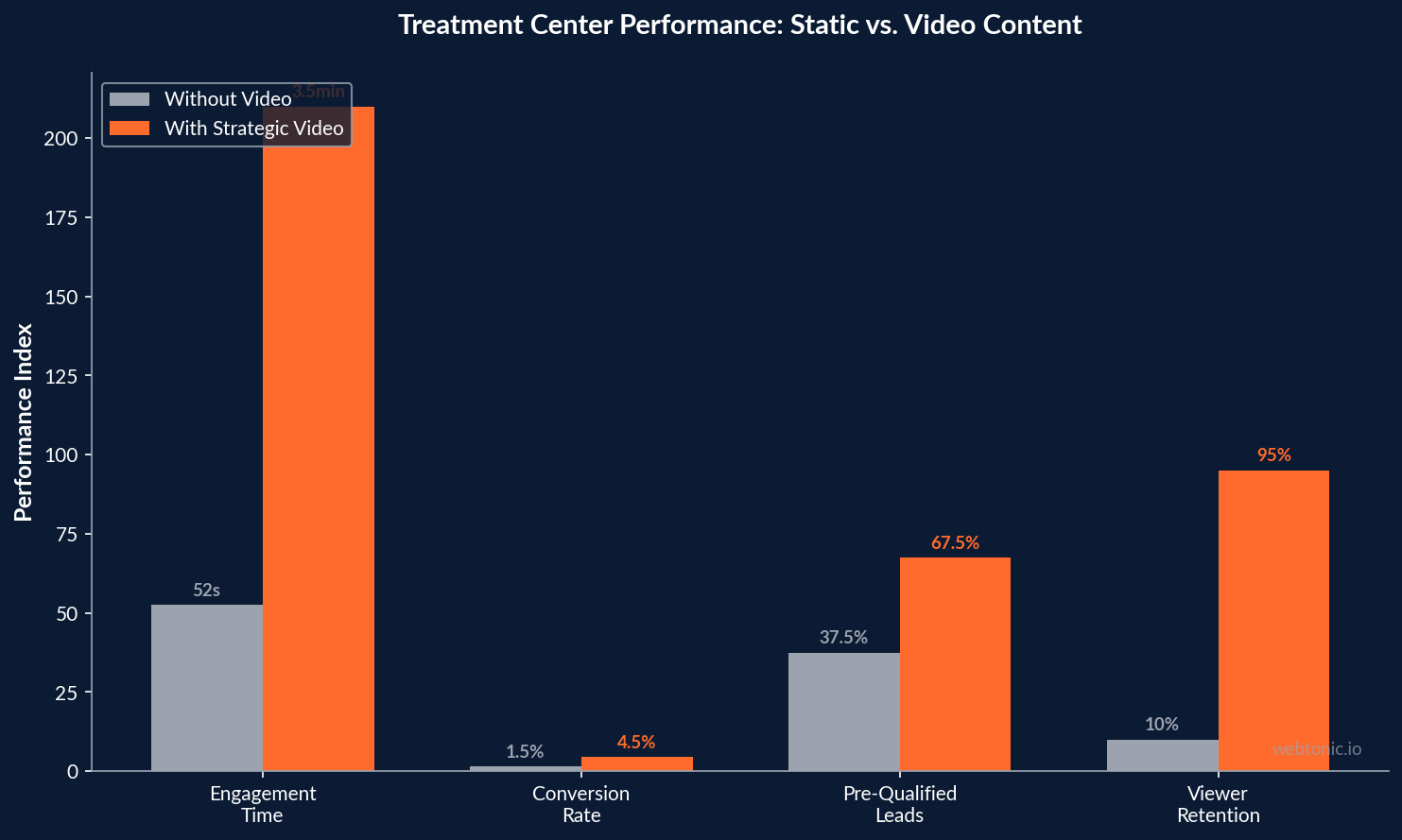
The data reflects this trust premium directly. Facilities with strategic video content see website engagement time increase from 45–60 seconds to 2–5 minutes — a 3–5× improvement that gives the facility more time to build rapport before the visitor decides to call or leave (Ads Up Marketing).
The conversion impact is equally clear: sites with embedded video convert at 3–6% versus 1–2% for static-only experiences. When combined with optimized intake flows, this translates to cost per admission dropping from $3,500–$5,000 to $2,200–$3,800 — a 24–34% reduction for the same media spend.
Healthcare viewers also retain dramatically more information from video: viewers watch 95% of a video message compared to 10% retention from written content (WifiTalents). For treatment centers communicating complex information about programs, insurance, and outcomes, video ensures the message actually lands.
Video Format Performance on Meta for Behavioral Health
Meta's advertising platform has become a primary video distribution channel for addiction treatment marketers. Format selection significantly affects both cost efficiency and conversion quality.
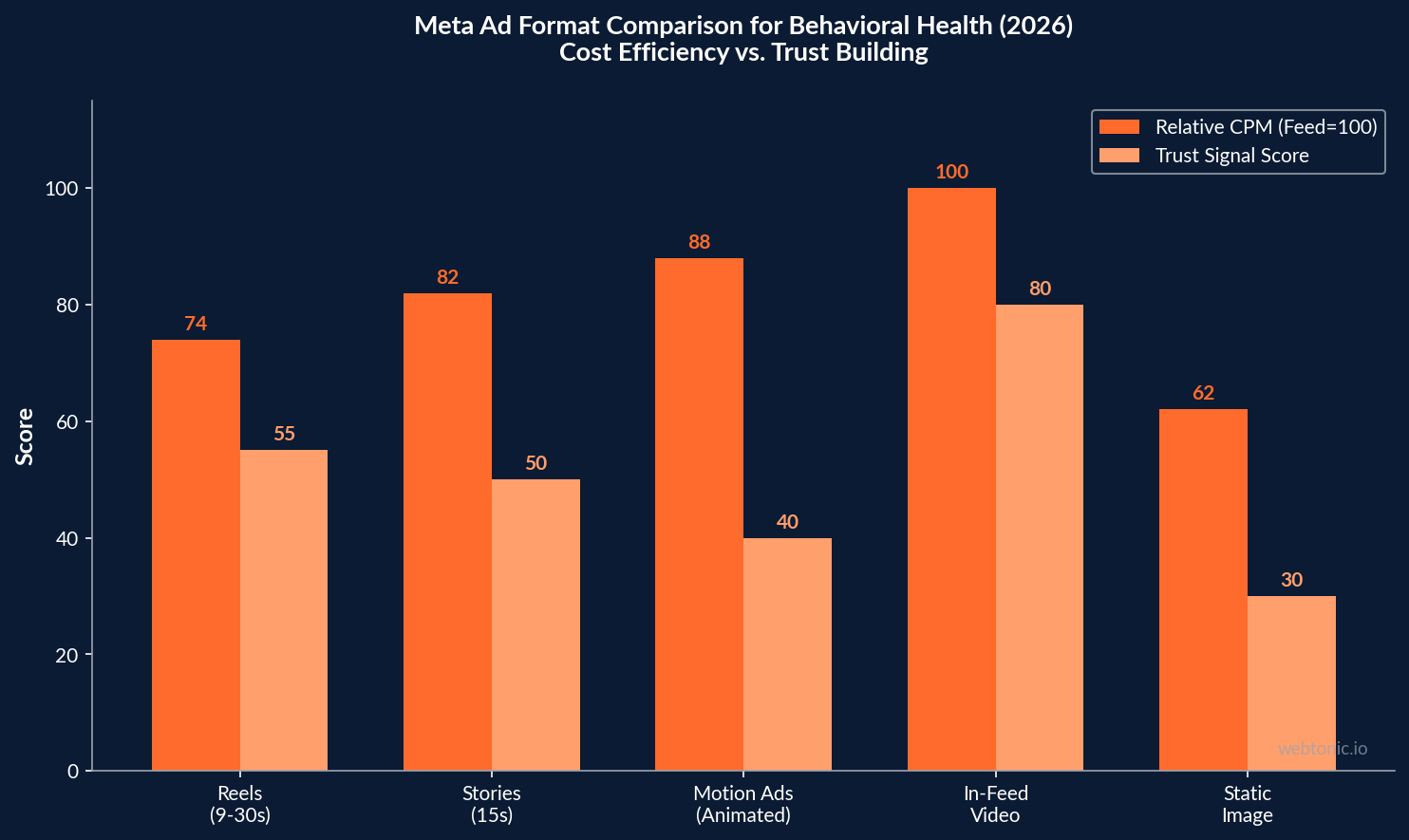
Reels (short-form vertical video, 9–30 seconds) deliver the lowest CPC of any Meta format in 2026, approximately 26% below standard feed CPM for behavioral health campaigns (Webserv). This cost advantage makes Reels the most efficient top-of-funnel video format for awareness and consideration campaigns.
| Format | Best Use Case | Cost Efficiency | Trust Signal |
|---|---|---|---|
| Reels (9–30s vertical) | Awareness, reach | Lowest CPC (−26%) | Moderate |
| In-Feed Video (15–60s) | Consideration, education | Standard | High |
| Stories (15s segments) | Retargeting, urgency | Low CPM | Moderate |
| Static Image | Retargeting catalog | 38% lower CPM (cold) | Low |
| Motion (animated static) | Mid-funnel bridge | Between static & video | Low-Moderate |
Critically, static image ads still earn a place in the format mix. They cut CPM by roughly 38% in cold audiences, produce faster, and outperform video for SKU-style retargeting where the visual catalog is the message (Webserv). The optimal approach is a three-format stack: video for awareness and trust-building, motion for mid-funnel engagement, and static for retargeting and direct response.
Video Types That Drive Treatment Center Admissions
Not all video content performs equally in addiction treatment marketing. The highest-converting video types directly address the unspoken questions families have: "Is this place safe?" "Will they understand what we are going through?" "Can we trust them?"
- Patient/Alumni Testimonials — the single most powerful video format for treatment centers. Authentic testimonials create social proof that no amount of marketing copy can replicate. Testimonials produce 35–50% higher CTR than static ads and significantly increase inquiry-to-admission conversion rates (Webserv). HIPAA and 42 CFR Part 2 compliance is mandatory — explicit consent and de-identification protocols must precede any recording.
- Facility Walkthroughs — virtual tours of living spaces, common areas, and therapeutic environments eliminate the "unknown" that prevents families from committing. Facilities with walkthrough videos on their website see measurably lower bounce rates.
- Meet the Team — short introductions from clinical staff, admissions coordinators, and program directors put faces to names and reduce anxiety about the intake process. Casual, phone-shot vertical videos often outperform over-produced content.
- Clinical Explainers — YouTube long-form (5–15 minutes) covering treatment modalities, insurance navigation, and family support. Strong for SEO-driven organic traffic and brand searches (Webserv).
- Educational Content — videos with proper metadata boost landing page conversions by up to 80% when strategically embedded, while procedure demonstration videos reduce post-treatment callback rates by 50% (Think Branded Media).
YouTube and Long-Form Video Strategy for Treatment Centers
90% of marketers use YouTube for video marketing, and 78% see it as an effective channel for driving results (WebFX). For addiction treatment centers, YouTube serves a distinct role in the marketing funnel: it captures family members conducting educational research before they are ready to call a facility.
YouTube budget allocation for treatment centers typically represents 5–15% of total social advertising spend when video creative is available. The production split typically lands at 60–70% media spend and 30–40% creative production — programs that under-spend on creative ship the same 2–3 video assets for months and watch performance degrade as audiences saturate (Webserv).
The Helio Health case study demonstrates TikTok's potential in the space: their "Treatment Works" campaign accumulated 4.5 million impressions in just eight weeks, with 99% of website visitors being new to the brand. The campaign generated meaningful engagement and expanded awareness far beyond their existing referral network.
For performance creative strategies, the key insight is that video creative fatigue sets in at 3–4 weeks in behavioral health campaigns. Centers need a sustainable production pipeline that delivers 3–5 new video concepts per month to maintain performance — relying on a single hero video will produce diminishing returns within a month.
Measuring Video Marketing ROI in Healthcare
The average patient acquisition cost (PAC) for video and YouTube marketing in healthcare is approximately $353 (Think Branded Media). One documented case achieved $342 PAC through a campaign with $6,150 total investment that acquired 18 new patients.
A healthcare marketing agency documented 3× ROAS improvement after shifting from static to video-led campaigns: overall CTR increased from 0.4% to 1.1% (175% increase), CPL dropped from $75 to $25 (67% decrease), and conversions grew from 33 to 187 (467% increase) (Authority Exposure).
An Amazon Video and OTT campaign for a drug and alcohol addiction treatment facility achieved a 2.04% click-through rate on video ads (well above the industry average) and generated a 121% increase in conversions compared to the previous period (Vici Media).
Email campaigns that include video boost healthcare click-through rates by 300% and achieve 41% open rates, making video-enhanced patient communication one of the highest-ROI marketing channels available (Think Branded Media).
Video Production Best Practices for Treatment Centers
- Prioritize authenticity over production value — imperfect, genuine testimonials outperform polished corporate videos in every treatment center campaign we have reviewed. Family members respond to real emotion, not studio lighting.
- Budget for sustainable production — allocate 30–40% of total video marketing budget to creative production. Treatment centers need 3–5 new concepts per month to avoid fatigue. Phone-shot vertical video is acceptable for social platforms.
- Lead with compliance — 42 CFR Part 2, HIPAA, and platform-specific healthcare advertising restrictions apply to all patient-facing video. Obtain explicit written consent before filming testimonials and ensure de-identification protocols are followed.
- Optimize for mobile-first consumption — 72.4% of treatment traffic is mobile. Use vertical (9:16) formats for Reels and Stories, keep educational content under 3 minutes for social, and include captions (85% of social video is watched on mute).
- Build a format mix — video for awareness and trust-building, motion for mid-funnel, static for retargeting. This three-format stack maximizes reach while controlling creative production costs.
- Track video-specific KPIs — view rate, hook rate (3-second retention), hold rate (15-second), click-through rate, and downstream conversion rate. Connect video engagement to admission attribution to measure true ROI.
Related reading
- 95+ Statistics Shaping Branding & Logo Design in the Rehab & Addiction Treatment Industry (2026)
- Rehab & Addiction Treatment Ad Creative by the Numbers: 2026 Benchmarks & Trends
- Painting Video Marketing Statistics: 2026 Data & Benchmarks
- Branding services at Web Tonic
Frequently Asked Questions
What type of video content converts best for addiction treatment centers?
Patient and alumni testimonials are the highest-converting video format, producing 35–50% higher CTR than static ads and significantly improving inquiry-to-admission rates. The key is authenticity — scripted or overly produced testimonials underperform casual, genuine stories. Facility walkthroughs and "meet the team" videos are the next most effective formats, as they address the anxiety families feel about the unknown.
How much should a treatment center budget for video marketing?
Video marketing for treatment centers typically represents 5–15% of total advertising spend when existing creative is available. The production split should target 60–70% media spend and 30–40% creative production. Facilities need 3–5 new video concepts monthly to combat creative fatigue (which sets in at 3–4 weeks). A sustainable entry point is $2,000–$5,000/month in production combined with $5,000–$15,000/month in distribution.
Do video ads really reduce cost per admission?
Yes. Documented benchmarks show cost per admission dropping from $3,500–$5,000 to $2,200–$3,800 when treatment centers add video to their advertising mix — a 24–34% reduction. Video also increases pre-qualification rates from 35–40% to 60–75%, meaning admissions teams spend less time on unqualified leads. The combined effect is more admissions at lower cost with higher lead quality.
What are the compliance requirements for video marketing in addiction treatment?
Treatment center video marketing must comply with 42 CFR Part 2 (federal substance use disorder confidentiality regulations), HIPAA (patient health information protection), and platform-specific healthcare advertising policies (Meta, Google, and TikTok all restrict health-related claims). Patient testimonials require explicit written consent, and all content must avoid guarantees of treatment outcomes. LegitScript certification is required for Google and Meta advertising in the addiction treatment category.
How quickly does video creative fatigue affect treatment center campaigns?
Creative fatigue typically sets in at 3–4 weeks for behavioral health video campaigns on Meta. Performance indicators include declining CTR, rising frequency, and increasing cost per result. The solution is maintaining a pipeline of 3–5 new video concepts per month and rotating creative regularly. Repurposing long-form content into multiple short-form cuts can extend the production budget while maintaining creative freshness.
Sources
adsupmarketing.com/the-power-of-video-building-trust-with-prospective-patients-before-they-call/
adsupmarketing.com/video-marketing-for-rehabs-how-to-build-trust-before-the-first-phone-call/
webserv.io/resources/blog/video-vs-static-vs-motion-ads-behavioral-health-meta/
webserv.io/resources/blog/best-meta-ad-formats-behavioral-health-2026/
webserv.io/resources/blog/creative-strategy-rehab-addiction-treatment-marketing/
webserv.io/resources/blog/ultimate-guide-social-advertising-rehab-treatment-centers/
thinkbrandedmedia.com/blog/what-types-of-videos-work-best-for-healthcare-marketing-performance-analysis-2026/
thinkbrandedmedia.com/blog/how-do-healthcare-systems-measure-roi-from-video-marketing-metrics-that-matter-for-hospital-cmos/
wifitalents.com/marketing-in-the-health-industry-statistics/
authorityexposure.com/video-roi-how-we-3xed-healthcare-leads/
webfx.com/blog/internet/youtube-marketing-statistics/
vicimediainc.com — Amazon Video OTT campaign case study


