Table of contents

In addiction treatment, brand is the cheapest lever on the most expensive traffic in healthcare. With Google Ads CPCs averaging $94.50, a $285 average cost per lead and cost per admission between $1,500 and $6,000, whether a family trusts your identity in the first eight seconds decides whether that spend converts.
Key Takeaways
- Addiction treatment averages a $94.50 CPC, a 4.10% conversion rate and a $285 CPL; high-intent search leads run $350-$550.
- Cost per admission lands between $1,500 and $6,000, against residential lifetime values of $24,000 to $78,000.
- 72.4% of treatment centre traffic is mobile; organic supplies 48.2% of sessions globally and 42.0% in the US.
- 89% of patients read reviews before choosing a provider, and 75% refuse to book below 4.0 stars - 44% below 4.5.
- 55% have cancelled or avoided a provider because of reviews, up 15 points in nine months.
- 66% say a provider's response to reviews directly influences trust; unprofessional responses are the second-biggest deterrent at 48%.
- Review volume beats a perfect score: 56.8% chose 4.5 stars with 1,050 reviews over 4.9 stars with 25.
- AI tools now influence 36% of provider searches, ahead of Google results at 34%; AI Overviews are the most trusted SERP element at 37%.
- Consistent visual identity raises patient trust by up to 30%, and 88% cite authenticity as the top trust factor.
- 84% of the 47.2 million Americans needing SUD treatment did not receive it - the market gap is real, and so is the scrutiny.
Why the unit economics make brand a financial decision
Start with what a click and an admission cost, because that is the budget branding work is competing with.
| Metric | 2026 benchmark | What brand strength changes |
|---|---|---|
| Google Ads CPC | $94.50 average | Higher CTR and Quality Score on branded, trusted creative |
| Google Ads conversion rate | 4.10% | Landing-page trust signals move this the most |
| Google Ads CPL | $285.00 | Direct function of conversion rate |
| High-intent search CPL | $350 - $550 | Out-of-network programmes pay the premium |
| Meta CPC / CPL | $1.85 / $115.00 | Cheaper leads, lower admit conversion |
| Cost per admission | $1,500 - $6,000 | Trust decides the lead-to-admit step |
| Residential lifetime value | $24,000 - $78,000 | Justifies expensive leads if brand converts them |
| Mobile share of traffic | 72.4% | Identity is judged on a phone, at 2am |
| Bounce rate | 64.5% | Above healthcare norms - trust fails fast |
Channel costs come from 2026 addiction treatment marketing benchmarks and admission economics from 2026 rehab marketing budget analysis. The category can afford expensive leads - it cannot afford leads that arrive at a brand nobody believes.
The trust thresholds families apply before they call
These are hard filters, not soft preferences. A brand fails them before anyone reads a word of copy.
| Trust signal | 2026 data | Change or context |
|---|---|---|
| Check reviews when researching a provider | ~89% | Near-universal behaviour |
| Will not book below 4.0 stars | 75% | Versus 68% across all businesses |
| Will not book below 4.5 stars | 44% | Versus 31% across all businesses |
| Cancelled or avoided a provider over reviews | 55% | Up from 40% in nine months |
| Say a response to reviews influences trust | 66% | Largest year-over-year movement measured |
| Prefer volume over a perfect score | 56.8% | 4.5 stars with 1,050 reviews beat 4.9 with 25 |
| Most influenced by recent reviews | 62% | Recency is a standing requirement |
| Leave a review after a visit | 36% | Supply of proof is the constraint |
| Decided not to contact a provider after researching | 73% | The silent majority of lost demand |
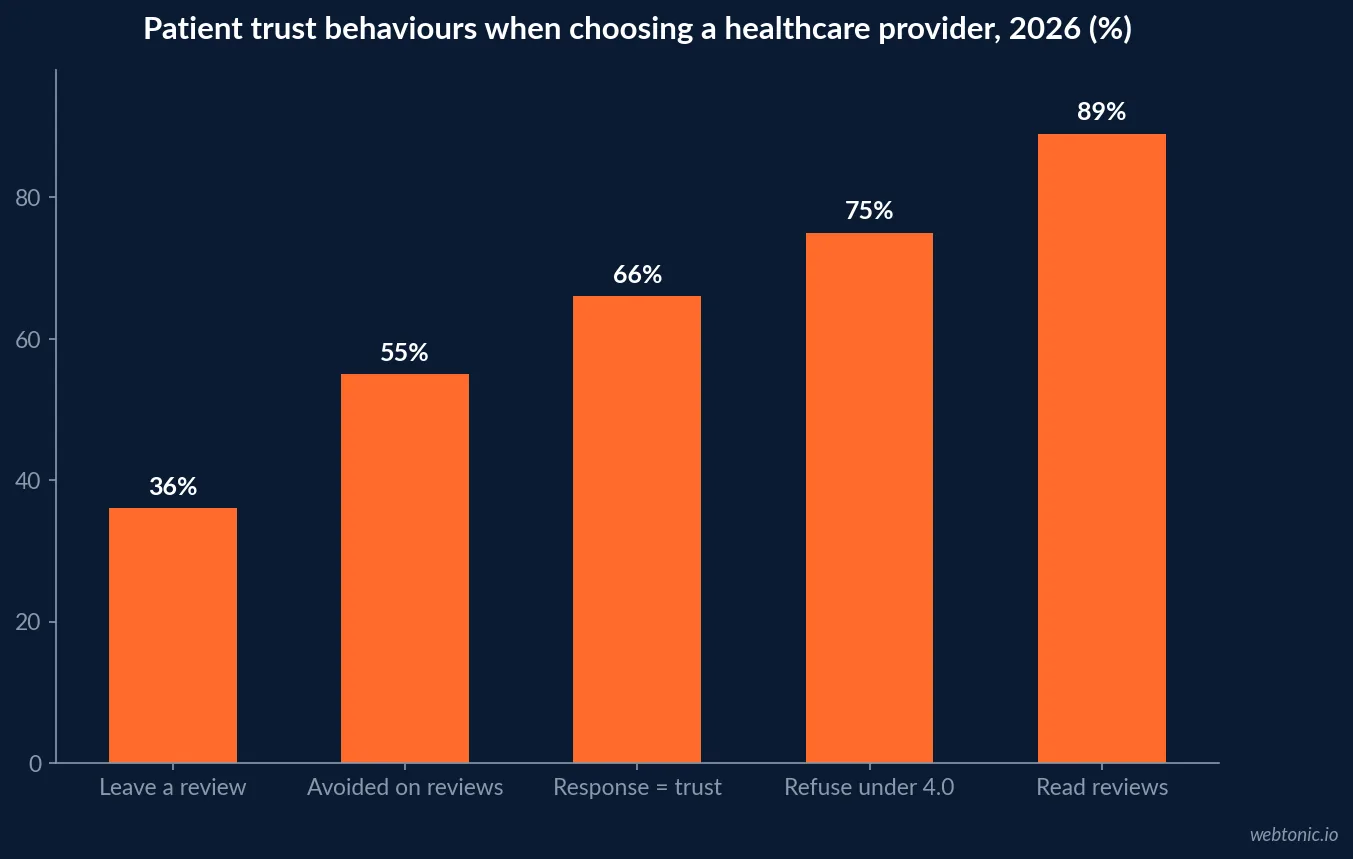
Threshold data is drawn from the 2026 Patient Choice Report and behavioural detail from a patient review behaviour study. For treatment centres the volume finding matters most: a thin review profile reads as a new or unstable facility, which is precisely the fear a family arrives with.
What actually decides the choice
Insurance and location get a facility considered. Brand and reputation win the call.
| Decision factor | Share citing it | Brand implication |
|---|---|---|
| Insurance acceptance | 47% | Publish payer logos and verification clearly |
| Location and proximity | 45% | Local identity and real facility photography |
| Online reviews | 42% | Reputation programme is a brand asset |
| Provider credentials or experience | 35% | Clinical team pages with named licences |
| Recommendation from someone trusted | 32% | Alumni and referrer-facing brand materials |
| Availability and response speed | 26% | Response time is a brand promise |
| Friends and family influence | 43% | Word of mouth still leads the influence mix |
| AI tools (ChatGPT, Claude and similar) | 36% | Ahead of Google results at 34% |
| Social media | 30% | Consistency across channels is visible |
Factor rankings come from 2026 research on how consumers choose providers. Two things kill enquiries fastest: multiple recent negative reviews (56%) and unprofessional responses to them (48%), followed by difficulty contacting the office (40%) and no online presence at all (30%).
Visual identity: the measurable part of brand
Logo work is the least interesting part of a treatment brand and still the part that has to be right.
- 88% of patients say authenticity and honesty in branding are the most important trust factors - stock imagery of models on beaches works against you.
- Consistent visual elements across touchpoints increase patient trust by up to 30%, so the website, admissions PDF, facility signage and Google Business Profile must match.
- Real facility photography is a trust asset: profiles with 100-plus photos prioritising tours, outdoor spaces and amenities perform better in local discovery.
- Clinical credibility beats clinical cliché - named licences, accreditations and a visible medical director do more than a caduceus in the logo.
- Colour and tone should read calm and adult, not clinical-cold or wellness-spa; families are choosing under crisis conditions and pattern-match on seriousness.
- Accessibility is brand: 72.4% of sessions are mobile and legibility at arm's length on a phone is the real design constraint.
- Name and URL stability matter - rebrands mid-campaign reset the review profile that 75% of families screen on.
The consistency and authenticity figures are documented in healthcare brand identity research. Our rehab ad creative benchmarks cover how these identity rules translate into compliant paid creative.
Discovery has moved, and brand has to follow
The surface families trust most is the one most treatment brands do not manage.
| SERP or discovery surface | Share choosing it as most trusted | Typical spend priority |
|---|---|---|
| AI Overviews | 37% | Rarely managed |
| Organic blue links | 20% | Moderate investment |
| Local map pack | 13% | Under-optimised at most facilities |
| Sponsored ads | 7% | Highest spend |
| Used AI tools to research providers | 47% (up 16 pts in 9 months) | Emerging discipline |
| Start with a "specialty near me" query | 55% | Local SEO and GBP |
| Searched for or chose a new provider in 12 months | 72% | Constant demand churn |
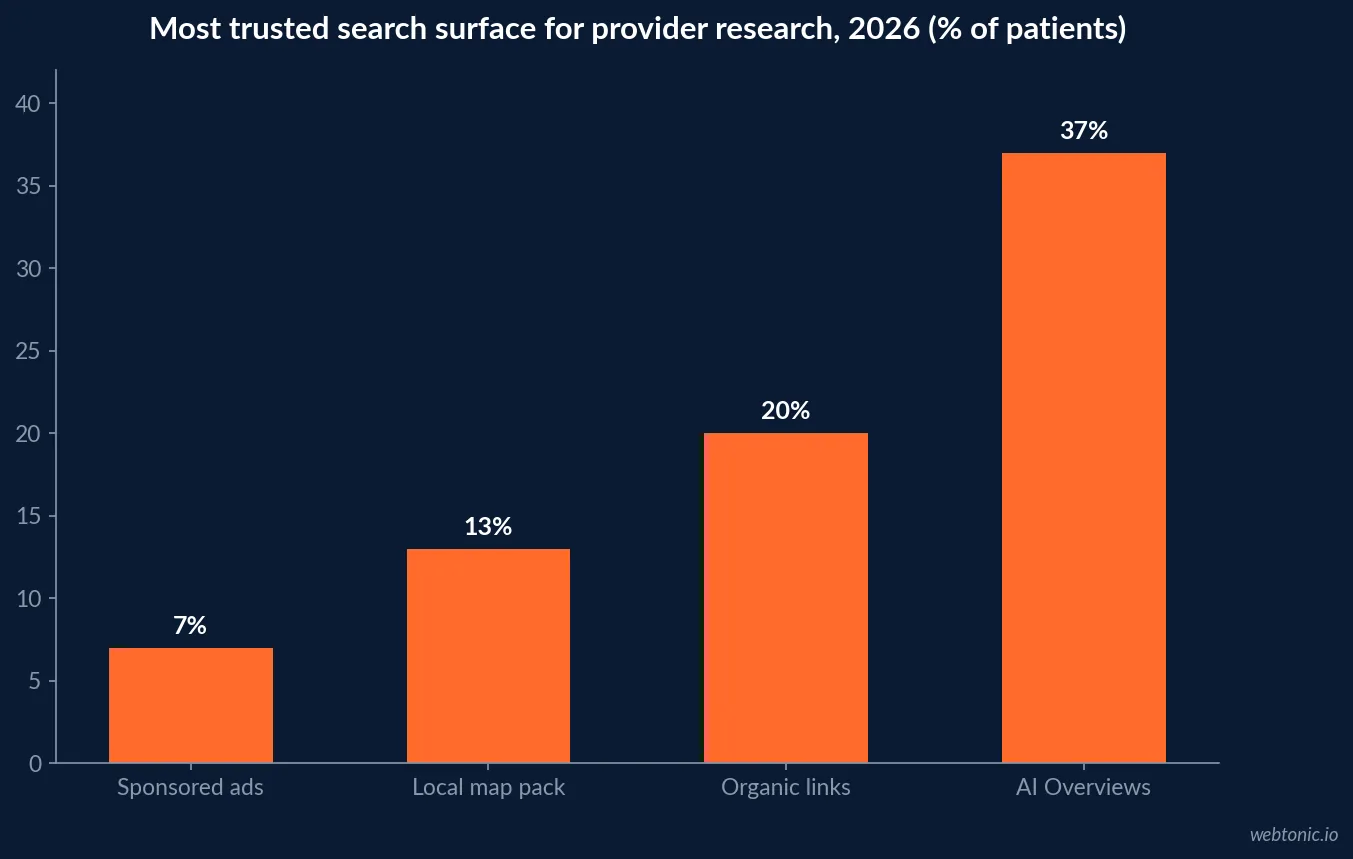
The mismatch is the story: facilities spend most on the surface families trust least. Earned editorial authority is the lever that works on both - one residential centre recorded 352% organic traffic growth from 39 editorial placements at an average domain rating of 80 over nine months, per 2026 rehab lead generation analysis. Brand authority, not ad spend, is what AI systems cite.
Compliance is a branding constraint, not a legal footnote
Every differentiation idea in this category has to survive a certification review.
| Constraint | Requirement or cost | Brand consequence |
|---|---|---|
| LegitScript certification | 15+ criteria, 4-6 week review | Gate for all paid search in the US |
| Certification cost | $2,000 - $4,000 year one, $2,000 - $3,000 annually | Recurring budget line |
| Outcome claims | "90% success rate" style claims risk regulator review | Differentiate on model, not results |
| HIPAA-aware targeting | Restricts audience and retargeting tactics | Brand must earn direct and organic demand |
| Lead-sharing consent | Written consent required for warm handoffs | No quiet lead resale under your brand |
| Website compliance remediation | $500 - $2,500 one-off audit and revision | Legacy sites carry hidden cost |
| Reputation management | $500 - $1,500 per month managed | Directly feeds the 75% star threshold |
Certification mechanics are set out in LegitScript certification guidance for treatment centres, and the trust-risk landscape - lead-generation opacity, unsupported treatment promises, false local presence - is mapped in the 2026 US drug rehab visibility and trust report. A brand that cannot survive that scrutiny cannot buy traffic at all.
The demand context behind the brand
Positioning should reflect the actual market, which is defined by an enormous unmet need and low trust.
| Market or access metric | Latest figure | Positioning implication |
|---|---|---|
| Americans 12+ needing SUD treatment | 47.2 million | Demand vastly exceeds capacity |
| Share who did not receive treatment | 84% | Education, not persuasion, is the first job |
| Adults with SUD who went untreated | 94.5% (from 95.6%) | Marginal improvement only |
| Adolescents and young adults treated when needed | 9.6% (down 1.7 pts) | Family-facing brand matters |
| Could not find a facility | 23.8% of those untreated | Availability messaging is differentiating |
| Counties with no buprenorphine provider | 41.6% | Geography is a brand story |
| Adults with co-occurring SUD and mental illness untreated | 42.6% | Integrated care as positioning |
| Registered opioid treatment programmes | 8,035 | Crowded, undifferentiated field |
National need and treatment-gap figures are summarised from coverage of SAMHSA's latest annual survey with supporting access statistics compiled in addiction treatment industry statistics. The strategic read: in a market where most people who need care never get it, the brands that win are the ones that make the next step feel possible rather than the ones that shout loudest.
A 90-day brand programme for a treatment centre
- Days 1-15: audit every touchpoint against one identity - website, GBP, admissions collateral, signage, staff email. Inconsistency is worth up to 30% of trust.
- Days 1-30: stand up a review programme. You need volume and recency, because 62% weight recent reviews and only 36% of patients leave one unprompted.
- Days 15-45: respond to every review within 48 hours in a named human voice - 66% say responses drive trust and 48% are repelled by bad ones.
- Days 30-60: replace stock imagery with real facility and clinical-team photography; publish licences, accreditations and payer relationships.
- Days 45-75: build the surfaces AI systems cite - clinical authorship, editorial placements, structured facility data - given 36% AI influence and 37% AI Overview trust.
- Days 60-90: re-measure cost per admission, not cost per lead. Brand work should show up between lead and admit, where the $1,500-$6,000 range is decided.
For help sequencing that against paid media, our performance creative team works in regulated categories; a similar identity-consistency argument runs through our HVAC branding statistics for comparison outside healthcare.
What a treatment brand must never do
- Publish outcome statistics without published research behind them.
- Run paid search before LegitScript certification clears.
- Use models and stock beaches instead of the real facility - 88% screen for authenticity.
- Leave reviews unanswered when 66% treat responses as a trust signal.
- Buy aggregator leads under your own brand without consent trails.
- Rebrand mid-campaign and reset the review profile 75% of families screen on.
- Report success on cost per lead while cost per admission drifts.
Frequently Asked Questions
Why does branding matter more in addiction treatment than in most healthcare categories?
Because acquisition costs are extreme and the decision is made under duress. Google Ads CPCs in addiction treatment average about $94.50 with a $285 cost per lead, high-intent search leads run $350 to $550, and cost per admission commonly lands between $1,500 and $6,000. When each click costs that much, whether a family trusts what they land on decides the economics. Brand is not decoration here - it is the conversion layer on top of the most expensive traffic in healthcare.
What trust signals do families check before contacting a treatment centre?
Reviews first, then responsiveness. Around 89% of patients check online reviews when researching a provider, 75% will not book below a 4.0 star rating and 44% require 4.5 or higher, 55% have cancelled or avoided a provider because of reviews - up 15 points in nine months - and 66% say a provider's response to reviews directly influences trust. Notably, 56.8% chose a 4.5-star provider with 1,050 reviews over a 4.9-star provider with only 25, so review volume beats a perfect score.
How much lift does brand consistency actually produce?
Consistent visual identity across digital and physical touchpoints has been associated with up to a 30% increase in patient trust, and 88% of patients say authenticity and honesty in branding are the most important factors in earning it. For a treatment centre that means the logo, colour system, photography, admissions scripts and facility signage have to tell the same story - inconsistency reads as instability in a category where families are already screening for red flags.
Where do treatment centre brands get discovered in 2026?
Search still starts the journey - 55% of patients begin with a "specialty near me" query - but the influence mix has shifted. AI tools are now cited by 36% of searchers, ahead of Google search results at 34% and doctor referrals at 32%; 47% have used AI to research providers, up 16 points in nine months; and AI Overviews are the most trusted part of the results page at 37% versus 20% for organic links and 7% for sponsored ads. Brands are spending most on the surface families trust least.
What can a treatment brand legally claim?
Far less than most marketing teams assume. Google Ads for substance use disorder treatment is gated behind LegitScript certification, which requires passing 15-plus criteria across licensing, clinical staffing, business practices and advertising claims within a 4-to-6-week review, at roughly $2,000 to $4,000 in year one. Specific outcome statistics such as "90% success rate" can trigger state regulator review unless substantiated by published research. Brand differentiation has to come from clinical model, staff credentials, family experience and transparency - not from outcome promises.
Sources
Addiction treatment centres marketing benchmarks 2026
Rehab marketing cost, CPL and ROI benchmarks 2026
2026 Patient Choice Report
Patient review behavioural study
How consumers choose healthcare providers 2026
Healthcare brand identity and trust
Rehab lead generation analysis 2026
LegitScript certification guide for rehab centres
2026 US drug rehab SEO visibility and trust report
SAMHSA annual survey takeaways for SUD treatment
Addiction treatment industry statistics 2026