



Table of contents
A quality backlink in 2026 costs an average of $508.95 per placement, up 45% since 2022 — and for addiction treatment centers operating in a YMYL vertical, the stakes are even higher because low-quality links don't just fail to help, they actively damage rankings.
Key Takeaways
- Healthcare websites need a Domain Authority of 43–55 to compete in organic search, with top 10% performers requiring DA 75+ in YMYL verticals (LinkScope, 2026).
- Only 8.5% of cold outreach emails receive a reply, and it takes an average of 146 emails to earn a single backlink through manual outreach (Backlinko/Authority Hacker, 2026).
- A quality backlink costs $508.95 on average, up 45% since 2022 — with 64% of SEO teams spending $3,000+ monthly on link acquisition (Webserv, 2026).
- Practices with NAP inconsistencies across 3+ citation sources are excluded from Google AI Mode local answers 74% of the time (Webserv, 2026).
- Six mid-DR vertical placements at $3,000 each outperform one $30,000 Tier-1 contributor placement on every measurable AI citation metric (Webserv, 2026).
- 78.1% of SEO professionals report satisfying ROI from link building efforts, making it the highest-satisfaction off-page tactic (Webserv, 2026).
Rehab Link Building Benchmarks at a Glance
| Metric | Benchmark | Source |
|---|---|---|
| Healthcare avg. DA to rank | 43–55 | LinkScope 2026 |
| Top 10% YMYL DA required | 75+ | LinkScope 2026 |
| Avg. cost per quality backlink | $508.95 | Webserv / Ahrefs 2026 |
| Cost increase since 2022 | +45% | Webserv 2026 |
| SEO teams spending $3K+/mo on links | 64% | Webserv 2026 |
| Cold outreach reply rate | 8.5% | Backlinko 2026 |
| Emails per earned backlink | 146 | Authority Hacker 2026 |
| Links from content marketing vs. paid | 2.3× more | Content Marketing Institute |
| Time to see SEO impact from links | 10–16 weeks | Industry benchmark |
| NAP inconsistency AI exclusion rate | 74% | Webserv 2026 |
| SEOs reporting satisfying ROI | 78.1% | Webserv 2026 |
| Page-1 median referring domains | 907 | WebFX 2026 |
Domain Authority and Backlink Profile Statistics
Domain Authority requirements for healthcare and YMYL websites are substantially higher than for general niches. Treatment centers competing in local and national search need a deliberate link-building strategy to meet these thresholds.
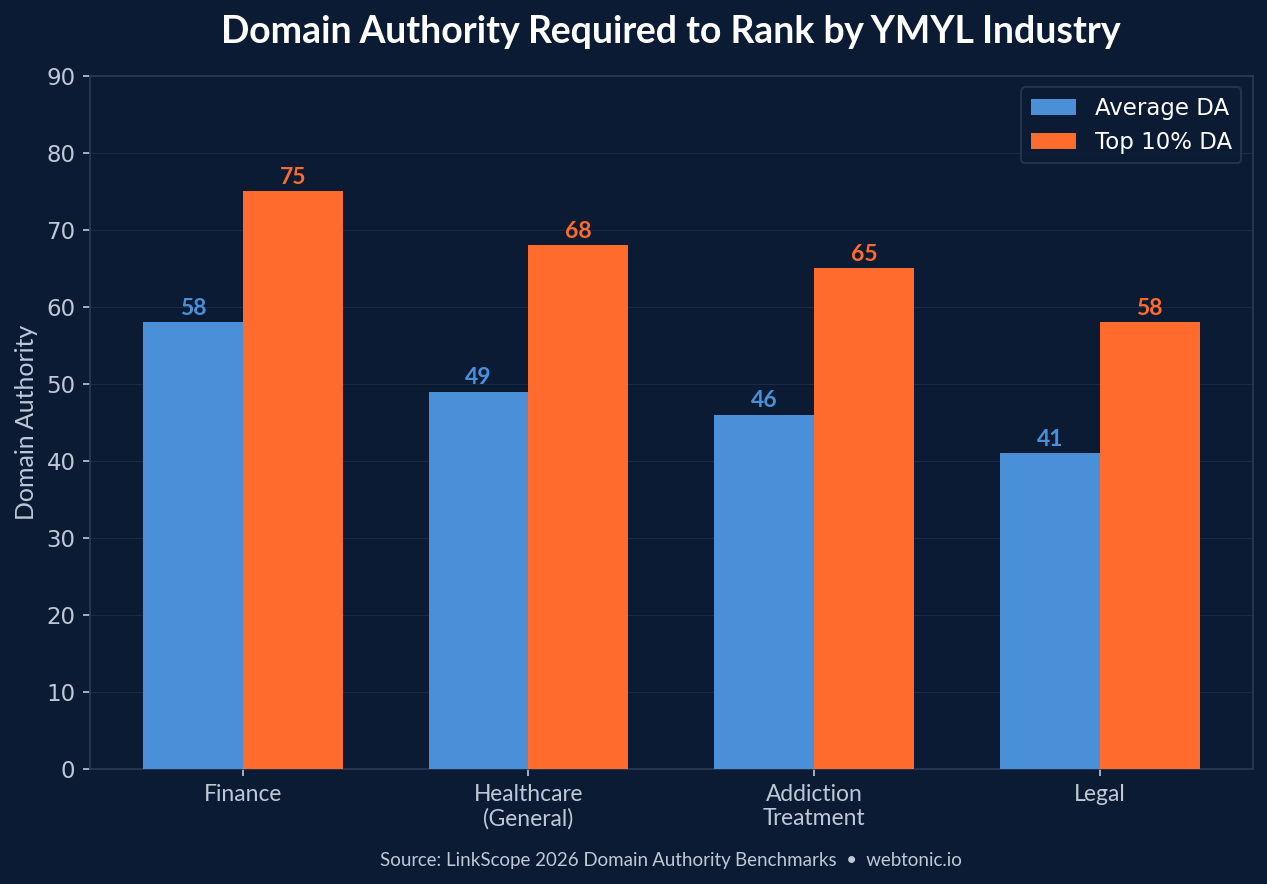
- Healthcare websites need an average DA of 43–55 to rank competitively, with finance averaging DA 58 and legal averaging DA 41 (LinkScope, 2026).
- Top 10% of YMYL websites require DA 75+ to hold page-one positions for competitive keywords (LinkScope, 2026).
- Websites ranking on page one have a median of 907 referring domains, ranging from 76 in apparel to 3,027 in finance and insurance (WebFX, 2026 study of 1,462 domains).
- One case study showed DA growing from 21 to 44 (+110%) with referring domains increasing from 86 to 354 (+312%) over a 12-month off-page SEO campaign in healthcare (Voutopia, 2026).
- The same campaign produced a 247% increase in monthly qualified leads (92 to 319) and 18 local pack top-3 rankings (up from 3) (Voutopia, 2026).
- Paid links and link schemes actively damage rankings in the treatment center vertical — Google applies elevated YMYL scrutiny, and bought links flag faster than in non-health niches (Webserv, 2026).
Backlink Cost and Outreach Statistics
The economics of link building have shifted significantly. Costs have risen, response rates have dropped, and the treatment center vertical faces additional constraints from LegitScript, EKRA, and 42 CFR Part 2 compliance requirements.
- A quality backlink averages $508.95 per placement in 2026, up 45% from $351 in 2022 (Ahrefs / Webserv, 2026).
- 64% of SEO teams spend $3,000 or more per month on backlink acquisition (Webserv, 2026).
- Only 8.5% of cold outreach emails receive a reply — it takes an average of 146 emails to earn one backlink through manual outreach (Backlinko, n=12M emails; Authority Hacker, n=600K+ emails).
- Content marketing generates 2.3× more links than paid link placements, with educational content about addiction, recovery, and treatment outcomes earning links naturally (Content Marketing Institute, 2026).
- Six mid-DR ($3,000 each) vertical placements outperform one $30,000 Tier-1 contributor placement on every measurable AI citation metric for behavioral health (Webserv, 2026).
- Guest posting on random blogs doesn't help treatment centers — the earned-link program that works operates inside LegitScript, EKRA, and 42 CFR Part 2 boundaries (Webserv, 2026).
Local SEO and Citation Statistics
| Local SEO Metric | Benchmark / Stat | Source |
|---|---|---|
| NAP inconsistency → AI exclusion | 74% excluded from AI local answers | Webserv 2026 |
| "Near me" search intent | Among highest-intent patterns | Authority Specialist 2026 |
| Local map pack share of clicks | Higher than organic in many layouts | Authority Specialist 2026 |
| Search volume spikes | January + post-holiday peaks | Authority Specialist 2026 |
| Mobile search dominance | Majority of addiction searches | Authority Specialist 2026 |
| Multiple searches before contact | Patients compare several facilities | Authority Specialist 2026 |
- Practices with NAP inconsistencies across 3+ citation sources are excluded from Google's AI Mode local answers 74% of the time — local SEO and AI search visibility are now the same project (Webserv, 2026).
- "Near me" and location-modified queries are among the highest-intent search patterns in the treatment space, with patients searching during moments of acute need (Authority Specialist, 2026).
- Google's local map pack is a primary discovery channel for patients searching for rehab centers, often outperforming standard organic results in click-through rate (Authority Specialist, 2026).
- Search volume for treatment-related terms spikes in January and after major holidays — seasonality matters for both content publishing and link outreach timing (Authority Specialist, 2026).
- LegitScript certification is increasingly tied to both ad eligibility and organic trust signals, functioning as a de facto link-building prerequisite (Authority Specialist, 2026).
- Organic search accounts for 48.2% of addiction treatment website traffic, while paid search contributes 16.3% globally (CuFinder, 2026).
AI Search Visibility and Link Building
The rise of AI-powered search (Google AI Mode, ChatGPT Search, Perplexity) has created a new dimension for link building in healthcare. Links from authoritative healthcare sources increasingly determine whether a treatment center gets cited in AI-generated answers.
- AI models rarely name specific healthcare providers, doing so in only 17% of responses on average across 40 standardized healthcare questions (Authority Specialist, 2026).
- The AI Recommendation Index for rehab centers is 51.1% — how often ChatGPT, Claude, and Gemini tell users to hire a professional, compared to the 14-industry average of 44.2% (+6.9 pts) (Authority Specialist, 2026).
- LinkedIn is cited in 14.3% of ChatGPT Search responses, 13.5% of Google AI Mode answers, and 5.3% of Perplexity outputs — outranking most DR80+ traditional publications for citation share (SEMrush, 325K-prompt study, 2026).
- Sites publishing hundreds of AI-generated pages without editorial oversight saw 50–80% traffic drops — quality content is now both an SEO and link-building prerequisite (Webserv, 2026).
- Transparent ownership, clear contact details, and a visible correction process form the E-E-A-T foundation that determines whether links to your site carry trust value (Webserv, 2026).
Link Building ROI and Timeline Statistics
| Timeline | Expected Results | Source |
|---|---|---|
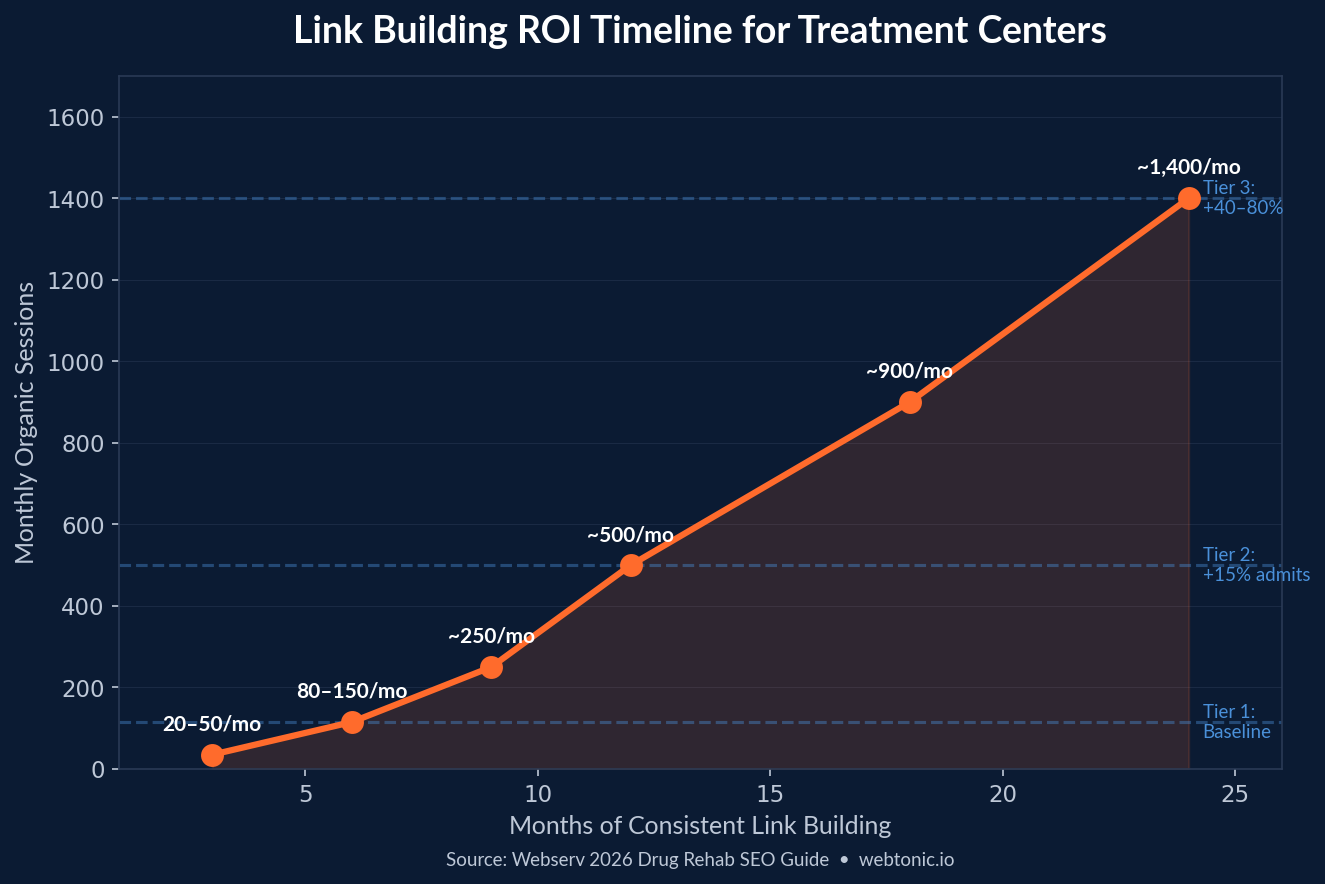
| Months 1–3 | 5–20 keyword rankings, 20–50 organic sessions/mo | Webserv 2026 |
| Months 4–6 | 80–150 monthly organic sessions (floor) | Webserv 2026 |
| Month 6 (Tier 1) | Current admit baseline maintained | Webserv 2026 |
| Month 12 (Tier 2) | 15% admit growth | Webserv 2026 |
| Month 24 (Tier 3) | 40–80% admit growth | Webserv 2026 |
| Healthcare DA growth case | DA 21→44, leads 92→319 in 12 months | Voutopia 2026 |
| SEOs reporting satisfying ROI | 78.1% | Webserv 2026 |
Best Practices for Rehab Link Building
- Prioritize earned links from healthcare-adjacent publications (medical journals, health news outlets, university research pages) over generic guest posting — YMYL quality scrutiny makes relevance critical.
- Invest in digital PR with data-driven content — original research, outcome statistics, and trend analyses earn links naturally and perform better than paid placements on AI citation metrics — a core principle of growth marketing.
- Fix NAP consistency across all citation sources before investing in backlinks — inconsistencies across 3+ sources exclude you from 74% of AI Mode local answers.
- Maintain LegitScript certification and HIPAA-compliant infrastructure as prerequisites, since both affect ad eligibility and organic trust signals.
- Target mid-DR vertical placements ($3,000 each) over expensive Tier-1 publications — six targeted placements outperform one $30,000 generic placement on AI citation metrics.
- Build a LinkedIn presence for clinical staff — LinkedIn is cited more than most DR80+ publications in AI search responses.
- Budget at least $3,000/month for link acquisition with the expectation that ROI compounds over 6–12 months as DA grows.
- Publish editorial-quality content consistently — content marketing generates 2.3× more links than paid approaches.
Related reading
- Rehab & Addiction Treatment Local SEO Statistics (2026)
- 78+ Statistics Shaping Technical SEO in the Rehab & Addiction Treatment Industry (2026)
- Broken Link Building Strategy: What It Is & How to Use It
- Link Building Services services at Web Tonic
Frequently Asked Questions
How much does link building cost for addiction treatment centers?
A quality backlink costs an average of $508.95 per placement in 2026, up 45% since 2022. Most SEO teams spending on link building invest $3,000 or more per month (64% of teams). For treatment centers, the most effective approach is six mid-DR vertical placements at roughly $3,000 each, rather than one premium Tier-1 placement at $30,000. The lower-cost vertical placements outperform expensive generic ones on every measurable AI citation metric. Learn more about our complete Google Ads cost guide.
What Domain Authority do rehab websites need to rank?
Healthcare websites need a DA of 43–55 to compete in organic search, based on 2026 industry benchmarks. The top 10% of YMYL websites need DA 75+ for the most competitive keywords. One documented case study showed a healthcare site growing from DA 21 to DA 44 over 12 months, producing a 247% increase in qualified leads. Treatment centers should focus on steady DA growth through earned links rather than trying to jump DA quickly through purchased links, which Google's YMYL algorithms are designed to detect.
How long does it take for link building to show results?
Expect 5–20 keyword rankings and 20–50 organic sessions per month within the first 3 months. By month 6, most centers see 80–150 monthly organic sessions as a realistic floor. Tier 1 SEO results (maintaining current admit baseline) appear by month 6. Tier 2 results (15% admit growth) typically arrive by month 12, with Tier 3 results (40–80% admit growth) achievable by month 24 with consistent investment.
Can treatment centers buy links safely?
No. Paid links and link schemes actively damage rankings in the treatment center vertical. Google applies elevated YMYL scrutiny to health-related websites, and bought links flag faster than in non-health niches. The alternative is a digital PR and earned-link program that operates within LegitScript, EKRA, and 42 CFR Part 2 boundaries. Content marketing generates 2.3× more links than paid approaches, and those links carry genuine trust signals.
How important are local citations for rehab center SEO?
Critical. Practices with NAP inconsistencies across 3 or more citation sources are excluded from Google's AI Mode local answers 74% of the time. Local SEO and AI search visibility are now the same project. Google's local map pack is a primary discovery channel for rehab searches, and "near me" queries represent the highest-intent search patterns in the treatment space. Fixing NAP consistency should precede any backlink investment.
Sources
authorityspecialist.com — Rehab Center SEO Statistics 2026
webserv.io — Link Building for Rehab Websites
webserv.io — Drug Rehab SEO Complete Guide
linkscope.io — Domain Authority Ranking Benchmarks 2026
growresolve.com — Link Building for Healthcare
misservices.us — Healthcare SEO Statistics 2026
cufinder.io/blog/benchmarks/addiction-treatment
nida.nih.gov — Trends & Statistics
voutopia.com — Off-Page SEO Healthcare


