Table of contents

91% of real estate teams say they are confident which marketing channel drives their best customers, but only 41% can respond to a new lead immediately at any hour - a gap between tracking confidence and tracking follow-through that shows up across CallRail's 2026 Marketing Outlook for Real Estate and NAR's 2026 Technology Report. This page works through what brokerages and agent teams are actually measuring in 2026, what they are still doing by hand, and where a tracking dollar closes the biggest leak first.
Key Takeaways
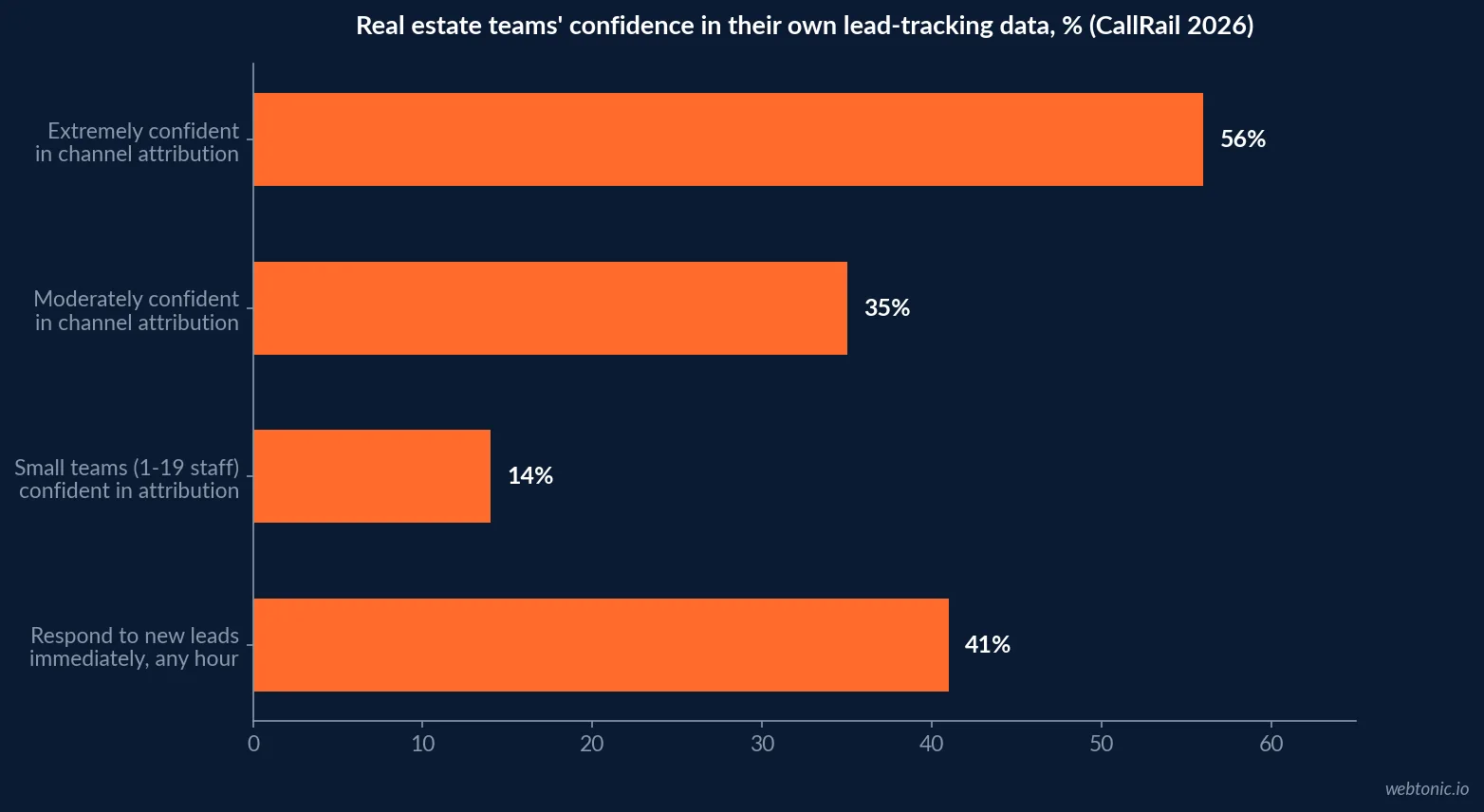
- 56% of real estate teams are "extremely confident" they know which channel drives their best customers.
- Only 14% of small teams (1-19 staff) share that confidence.
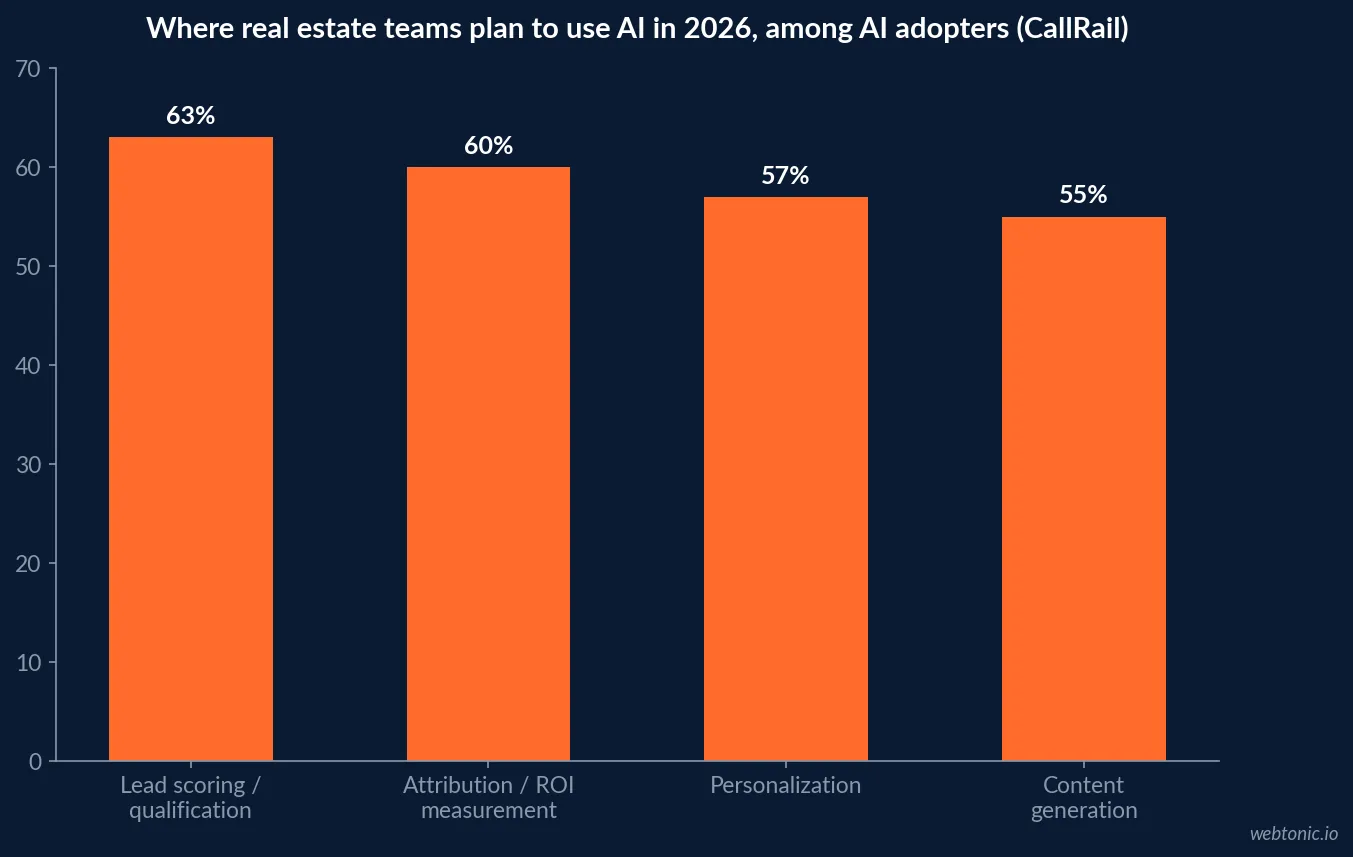
- 63% of AI-adopting teams plan to use it for lead scoring in 2026, the top use case.
- 60% plan to use AI for attribution/ROI measurement, ahead of content generation at 55%.
- Responsiveness now ties with price at 67% as the top reason a buyer picks one business over another.
- Only 41% of teams respond to a new lead immediately, any hour.
- 58% wait until at least the next morning to follow up on off-hours inquiries.
- 39% still manually check voicemail or missed-call lists.
- 56% of teams receive only an automatic response when no one picks up.
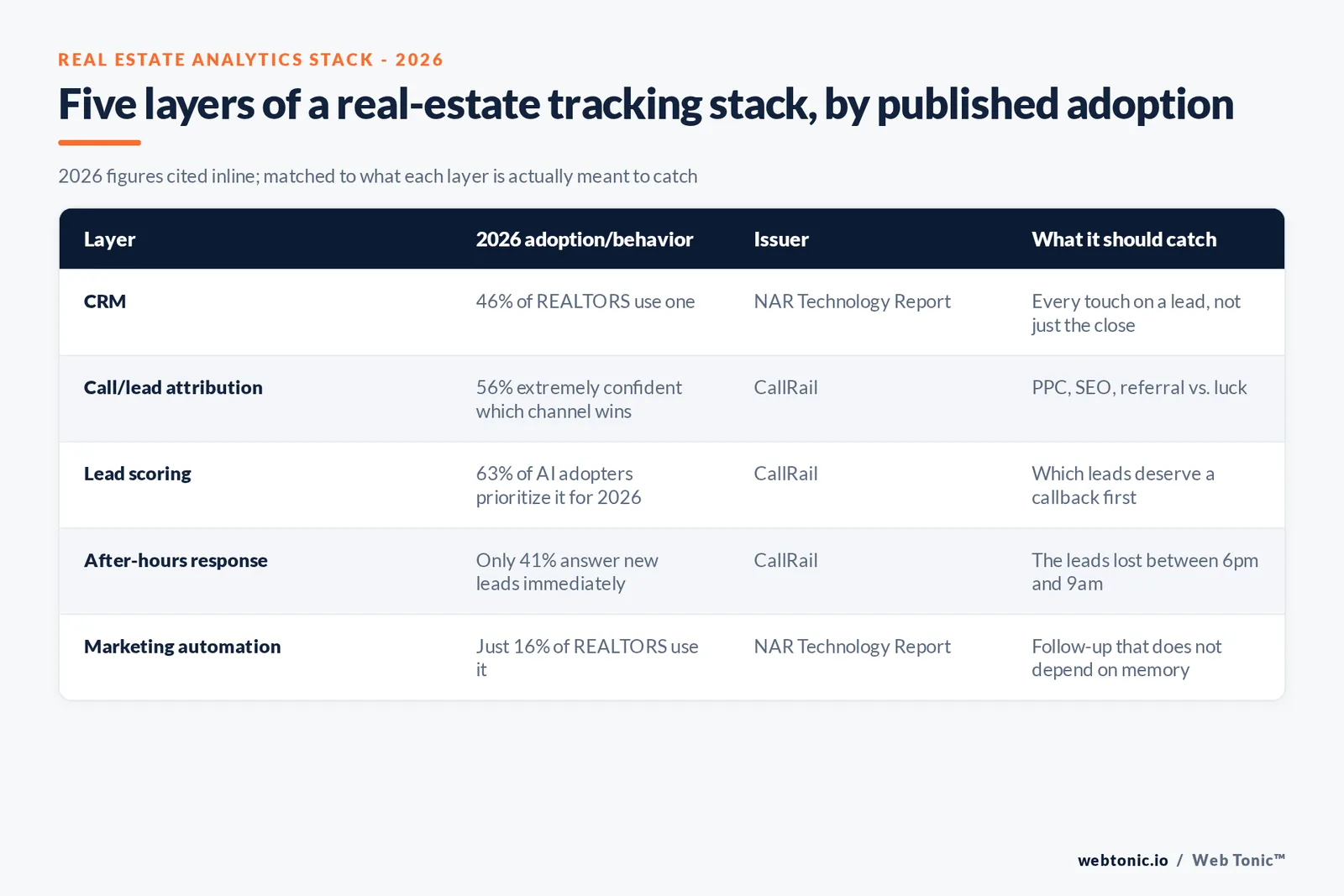
- 46% of REALTORS use a CRM, per NAR's 2026 Technology Report.
- Only 16% use marketing automation, against 96% MLS adoption.
- 21% use a dedicated lead-generation tool.
- 92% of real estate businesses plan to adopt AI in 2026.
- 56% of businesses expect their 2026 marketing budget to grow; 35% expect it flat.
- Discovery still runs through PPC (82%) and SEO (67%) ahead of influencers (64%) and paid social (63%).
- 75% of agents who use AI apply it to listing descriptions; 56% to social posts; 52% to follow-up emails.
- About half of agents budget USD 50 to 500 a month for their entire tech stack.
- 55% of AI-using agents say it has had a positive impact on their business.
The confidence gap: knowing your channels vs. proving it
CallRail's 2026 Marketing Outlook for Real Estate, a survey of 100 US brokerages, home builders, developers, rental agencies and property management businesses fielded in October 2025, is the clearest read on how real estate teams see their own tracking. 56% report being "extremely confident" and 35% "moderately confident" that they know which marketing channel is generating their best customers - a combined 91%. That headline number hides a sharp size split: businesses with 1 to 19 employees report far lower confidence than larger teams, and the report calls out only 14% of the smallest firms as confident, against dramatically higher shares once a team crosses into the 100-plus-employee range where dedicated marketing and analytics roles exist.
The same survey shows 56% of real estate businesses expect their 2026 marketing budget to increase, with 35% expecting it to hold steady - budgets are not the constraint. What differs is whether that spend is instrumented well enough to defend, and for the smallest teams the answer skews toward "we think so" rather than "we can show you." NAR's own 2026 REALTORS Technology Report product page frames the same divide as a tooling question: most agents want their stack to save time and improve the client experience, not to generate more dashboards.
What the analytics stack actually looks like in 2026
NAR's 2026 REALTORS Technology Report, based on 1,200 members surveyed in June 2026, shows where the money and habit actually go. The must-have layer is transactional, not analytical: MLS access sits at 96% and e-signature at 79%. The analytics and marketing-automation layer trails far behind:
| Tool | Share of REALTORS using it (2026) | What it is standing in for |
|---|---|---|
| MLS | 96% | Baseline system of record, not a marketing metric |
| CRM | 46% | Where most 'attribution' actually lives today |
| AI-generated content | 41% | Listing copy, social posts, follow-up drafts |
| Social media scheduling/content tools | 32% | Publishing cadence, rarely tied to leads |
| Lead generation tools | 21% | Paid or syndicated lead capture |
| Marketing automation | 16% | Rule-based follow-up sequencing |
| Predictive analytics | Least-adopted category named in the report | Forecasting who converts next |
Budget growth without instrumentation is not unique to real estate: WordStream's 2026 Search Advertising Benchmarks report notes that cost per click rose for 87% of the 23 industries it tracks, with real estate among the biggest year-over-year increases - which makes a defensible attribution layer worth more in 2026 than it was worth a year ago, not less.
The gap between 96% MLS use and 16% marketing-automation use is the honest starting point for any "real estate analytics" conversation: most agencies are not lacking data, they are lacking a system that acts on it without a human remembering to. NAR's coverage of the 2026 Technology Report and the underlying HousingWire summary both confirm AI adoption is real but concentrated in content, not yet in the scoring or attribution layer where CallRail's AI-adopter data says the 2026 push is headed.
Responsiveness is now an analytics problem, not a manners problem
CallRail's report frames 2026 as the year responsiveness became a tracked KPI rather than a soft expectation. Responsiveness is now tied with price at 67% as the top factor buyers use to choose one real estate business over another. Against that, the operational data is uncomfortable:
| Response behavior | Share of real estate teams | Source |
|---|---|---|
| Respond to a new lead immediately, any hour | 41% | CallRail 2026 |
| Wait until at least the next morning on off-hours leads | 58% | CallRail 2026 |
| Receive only an automatic response when unanswered | 56% | CallRail 2026 |
| Still manually check voicemail/missed-call lists | 39% | CallRail 2026 |
| Cite sales/customer-service training as a top 2026 challenge | 67% | CallRail 2026 |
Why call tracking still earns its place in 2026
Real estate discovery is not one channel. CallRail's respondents report being found through PPC (82%) and SEO (67%) ahead of influencer content (64%) and paid social (63%), and 82% of businesses that implemented paid social, 49% that implemented email and 48% that implemented video marketing in the past year. Without a call-tracking or form-tracking layer sitting under all four, "which channel actually produced this closing" stays a guess dressed up as confidence - which is exactly the pattern behind the 56%-versus-14% gap between large and small teams above. Call and form tracking is what converts "we think Google Ads works" into a number a broker can defend to an owner.
This is the same logic behind cost-per-lead benchmarking across industries: see Web Tonic's average cost per lead by industry breakdown for how real estate's CPL compares once it is actually tracked, and the conversion rate statistics page for how funnel math changes once attribution is trustworthy.
AI is moving from content to conversion, but content still leads
Among agents who already use AI, NAR's 2026 report shows the leading applications are still content-shaped: writing listing descriptions (75%), social media posts (56%) and emails or follow-up messages (52%), with market summaries (about 30%) and drafting in a personal tone (27%) trailing. But CallRail's forward-looking data from real estate businesses already running AI initiatives points the other direction: lead scoring (63%), attribution/ROI measurement (60%) and personalization (57%) all outrank content generation (55%) as 2026 priorities. Read together, the two reports describe the same transition from two angles: content is where AI entered the workflow, tracking and scoring is where it is being pointed next.
92% of real estate businesses plan to adopt AI in 2026 in some form, and NAR separately found 55% of agents already using AI say it has had a positive impact on their business, with only 12% saying they are not using it and have no plans to - down sharply from 32% who said the same in 2025.
Team size changes the analytics conversation more than tool choice does
The starkest number in CallRail's data is not a tool adoption rate; it is the confidence split by company size. Large real estate organizations report high confidence in channel attribution; teams of 1 to 19 people report just 14% confidence in the same question. That is not a tooling gap alone - a solo agent can install call tracking as easily as a 200-person brokerage. It is a bandwidth gap: someone has to read the dashboard, and in a small team that person is also showing houses. That reframes the buying decision for smaller shops: the highest-leverage analytics purchase is not the most sophisticated attribution model, it is whichever tool converts tracked data into an action (a call-back alert, a lead score, a next-step email) without requiring a dedicated analyst to interpret it.
What this means for a brokerage's next tracking dollar
- Fix the after-hours gap before buying a new dashboard: with 58% of teams waiting until the next morning on off-hours leads and responsiveness tied with price at 67% of buyer decisions, an automated capture-and-alert layer likely returns more than a deeper attribution report.
- Treat the CRM as the attribution system of record, since only 46% have one and marketing automation sits at 16% - closing that specific gap, not adding a fourth tool, is where most agencies are thin.
- Point AI at scoring and follow-up, not just copy, since CallRail's AI-adopter data already ranks lead scoring (63%) and attribution (60%) above content generation (55%) for 2026 spend.
- Re-test channel mix against tracked data, not habit: PPC (82%) and SEO (67%) lead discovery per CallRail, and Web Tonic's own data intelligence work for real estate clients starts by wiring exactly this call/form layer before touching the media plan. For a broader read on the account-side numbers, talk to the team about what a real estate tracking audit would surface for your portfolio.
Where discovery still happens before a lead is ever tracked
Before any dashboard sees a lead, that lead came from somewhere. CallRail's respondents named four channels as where new business was found in the past year, and the order matters for how a tracking stack should be wired:
| Discovery channel | Share of businesses reporting it as a source | Tracking implication |
|---|---|---|
| PPC / paid search | 82% | Needs call + form tracking tied to campaign, not just click |
| SEO / organic search | 67% | Needs GBP and organic-call attribution, not just rankings |
| Influencer content | 64% | Needs a distinct UTM/landing path, easy to lose in a shared CRM field |
| Paid social | 63% | Needs platform-side conversion API, not just a pixel |
Budget confidence vs. team capacity to act on data
Marketing spend intentions for 2026 are healthy across the board, but intent to spend and capacity to act on the resulting data are two different lines in the same survey:
| 2026 planning signal | Share reporting it | Source |
|---|---|---|
| Plan to increase marketing budget | 56% | CallRail 2026 |
| Plan to keep marketing budget flat | 35% | CallRail 2026 |
| Cite declining sales as a top concern | 50% | CallRail 2026 |
| Cite sales/customer-service training as a top challenge | 67% | CallRail 2026 |
| Confident in channel attribution overall | 56% extremely + 35% moderately | CallRail 2026 |
Frequently Asked Questions
What percentage of real estate businesses actually track their marketing ROI?
CallRail's 2026 Marketing Outlook for Real Estate, a survey of 100 US brokerages, home builders, developers and property managers, found 56% extremely confident and 35% moderately confident that they know which channel drives their best customers - a combined 91%. That figure drops hard by size: only 14% of businesses with 1 to 19 employees report the same confidence, against a much higher share at 100-plus employee firms. Confidence also is not the same as instrumentation; the same survey found 39% of teams still manually check voicemail or missed-call lists rather than route them through a tracked system.
What analytics tools do most real estate agents actually use day to day?
NAR's 2026 REALTORS Technology Report, based on 1,200 agents, puts CRM adoption at 46%, AI-generated content tools at 41%, dedicated lead-generation software at 21% and marketing automation at just 16% - well behind the 96% who use the MLS and 79% who use e-signature. The gap between MLS-level adoption and marketing-automation adoption is the single clearest sign that most agencies still run attribution and follow-up as a manual process bolted onto a transaction system, not a marketing one.
Where should a brokerage put its first tracking dollar: a CRM, call tracking, or an attribution tool?
The data suggests responsiveness before analytics. CallRail found responsiveness now ties with price (67%) as the top factor buyers use to choose one business over another, yet only 41% of real estate teams can respond to a new lead immediately at any hour, and 58% wait until at least the next morning on off-hours inquiries. A call-tracking layer that flags and time-stamps every missed lead pays for itself before a more sophisticated attribution model does, because it fixes the leak, not just the visibility into it.
Is AI actually changing how real estate teams use their data, or is it mostly marketing content?
It is shifting toward the funnel, not away from it. Among real estate businesses already using AI, CallRail's 2026 survey found lead scoring/qualification the top planned 2026 use case at 63%, ahead of attribution/ROI measurement (60%) and personalization (57%) - all ranked above content generation at 55%. Separately, NAR's 2026 Technology Report found 92% of agents plan some AI use in 2026, with the most common current applications being listing descriptions (75%), social posts (56%) and follow-up emails (52%), so content is still the entry point even as scoring and attribution catch up.
How many real estate leads are lost simply because nobody answered in time?
There is no single published 'leads lost' percentage, but the inputs point to a real gap: CallRail's 2026 data shows only 41% of real estate teams answer a new lead immediately regardless of hour, 58% wait until at least the next morning on evening or weekend inquiries, and 39% still rely on manual voicemail or missed-call checks rather than an automated capture layer. Given that 67% of buyers now weight responsiveness as heavily as price, every hour of that lag is a measurable, if unquantified, leak in the same pipeline the CRM is supposed to be tracking.
Sources
CallRail, 2026 Marketing Outlook for Real Estate (n=100 US real estate businesses, Oct. 2025)
NAHB, coverage of CallRail's 2026 Real Estate Marketing Outlook
NAR, 2026 REALTORS Technology Report coverage (n=1,200 agents)
HousingWire, on NAR's 2026 technology/AI survey findings
LocalIQ, 2026 Real Estate Search Advertising Benchmarks