Table of contents
91% of home sellers still used a real estate agent in 2025, the highest share NAR has ever recorded, even as the same buyers checking listings apply the same review thresholds - 20-plus reviews, 4.5-plus stars - to every other local service they hire. The agent has not been disintermediated; the agent has to clear a review bar that did not exist the last time NAR's satisfaction numbers were this high.
Key Takeaways
- 91% of sellers used a real estate agent to sell in 2025, a record high (NAR).
- 92% of buyers report being satisfied with the overall buying process (NAR).
- For-sale-by-owner sales fell to 5%, an all-time low (NAR).
- 60% of FSBO sellers already knew the buyer before listing (NAR).
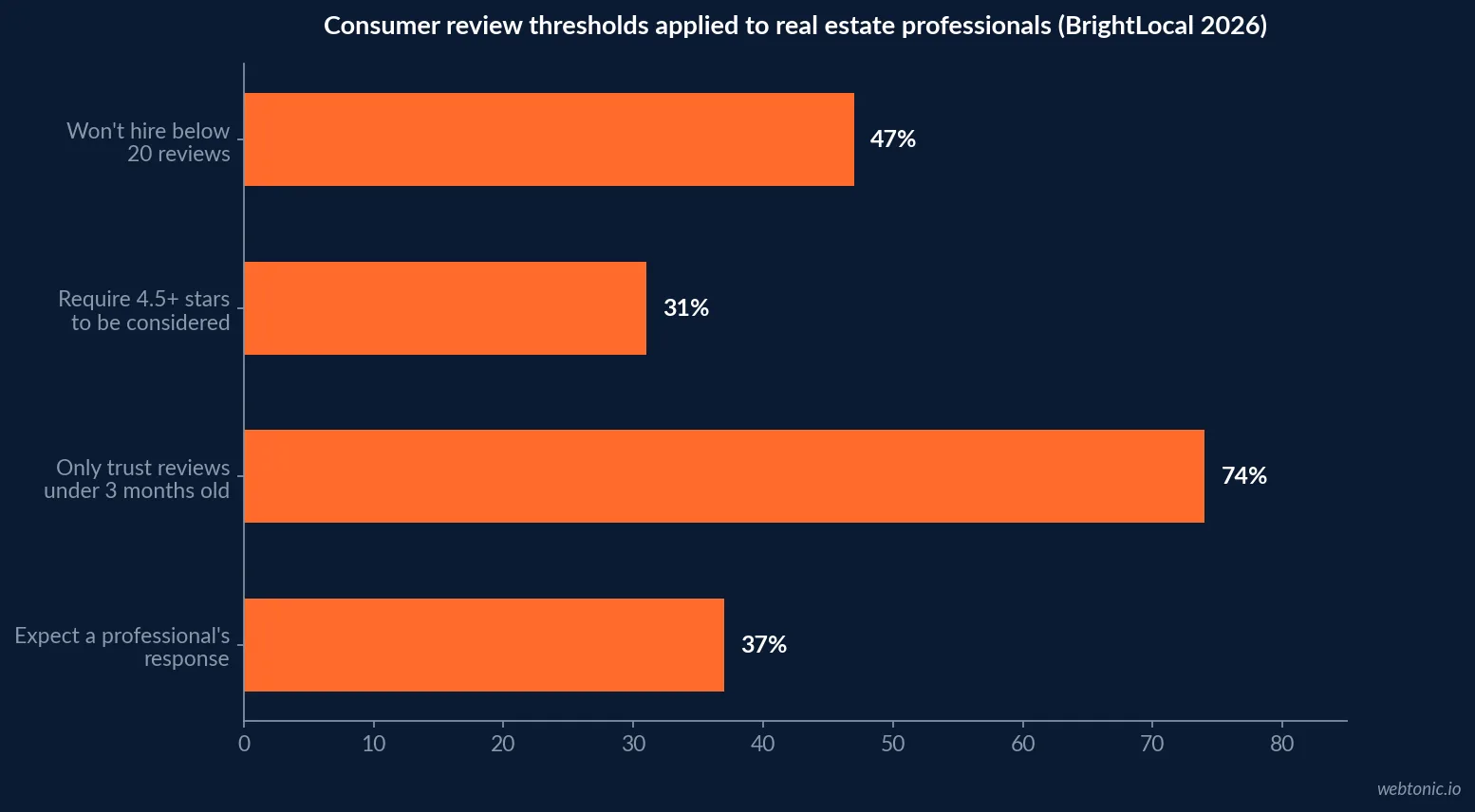
- Cross-industry: 47% of consumers won't hire below 20 reviews (BrightLocal 2026).
- 31% require a 4.5-star rating or higher before they'll call (BrightLocal 2026).
- 74% only trust reviews from the last three months (BrightLocal 2026).
- 37% weigh whether the professional responded to the review (BrightLocal 2026).
- Whitespark's 2026 panel scores GBP signals at ~32% of local ranking weight, review signals at 16-20%.
- NAR's Code of Ethics Article 12 requires a "true picture" in all advertising, testimonials included.
- The FTC's 16 CFR Part 465 rule (final Aug 2024) bans buying or filtering reviews by sentiment.
- The Consumer Review Fairness Act voids any listing-agreement clause blocking an honest review.
- Trustpilot removed 4.5 million fake reviews in 2024, 7% of everything posted.
- Yelp filtered roughly half a million suspected AI-generated reviews in 2025.
- Google can suspend a profile from receiving new reviews under its Fake Engagement policy.
The 2026 benchmarks at a glance
Two sources anchor this page: NAR's 2025 Profile of Home Buyers and Sellers (its long-running annual survey of transacting buyers and sellers, published November 2025) for what actually happened in real estate transactions, and BrightLocal's 2026 Local Consumer Review Survey (1,002 US adults, published February 2026) for the cross-industry review thresholds every local professional now competes under, real estate included.
| Metric | Figure | Source | Year |
|---|---|---|---|
| Sellers who used an agent | 91% | NAR Profile of Home Buyers and Sellers | 2025 |
| Buyers satisfied with the buying process | 92% | NAR Profile of Home Buyers and Sellers | 2025 |
| Sellers who went FSBO | 5% (record low) | NAR Profile of Home Buyers and Sellers | 2025 |
| Minimum reviews to be considered | 20+ | BrightLocal LCRS | 2026 |
| Minimum star rating to be considered | 4.5+ | BrightLocal LCRS | 2026 |
| Review recency window still trusted | Last 3 months | BrightLocal LCRS | 2026 |
Why the agent relationship survived while the review bar rose
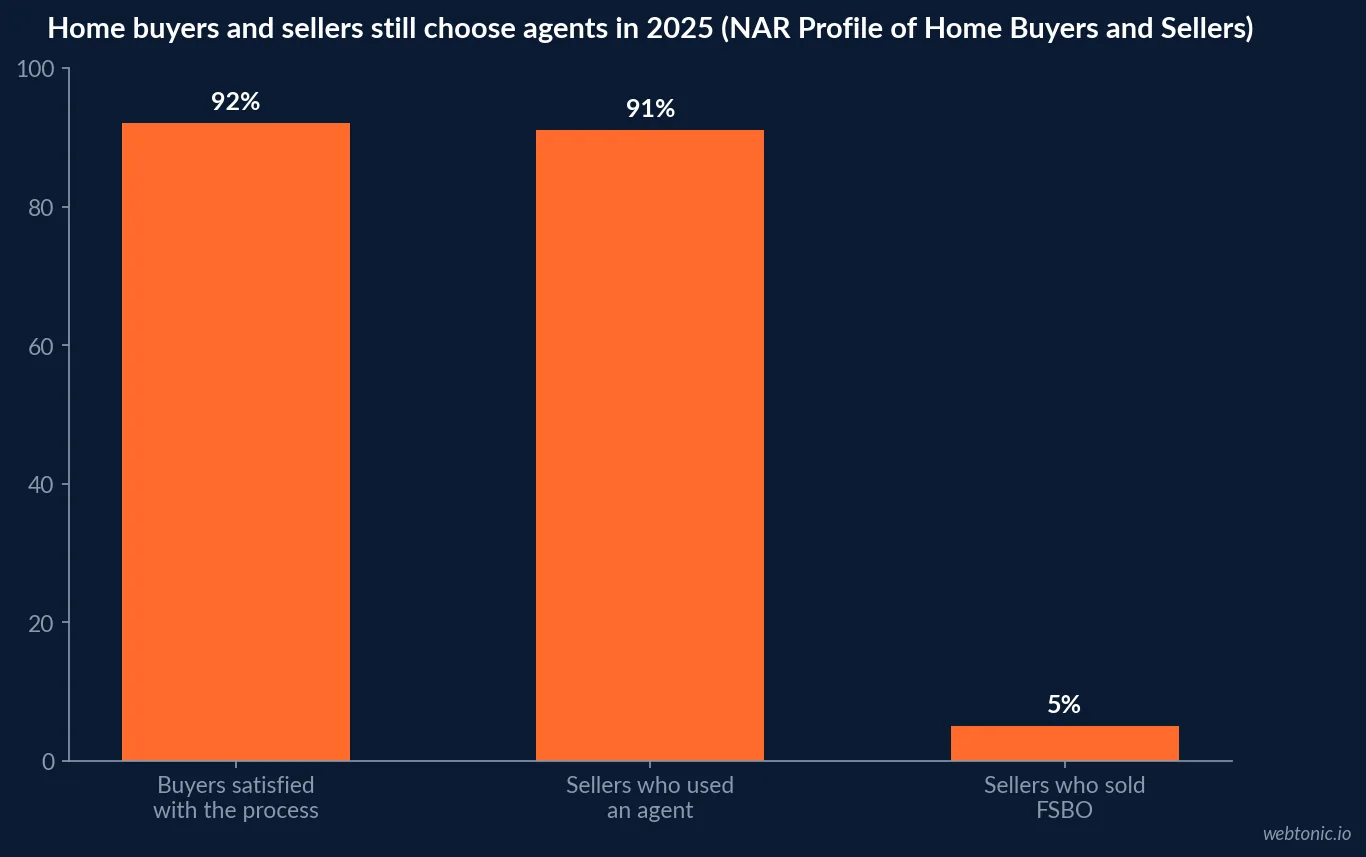
NAR's 2025 data shows the agent relationship is not weakening: 91% of sellers used one, the highest share on record, and 60% of the small FSBO share already knew their buyer going in - meaning most for-sale-by-owner transactions were not really open-market self-service at all. What has changed is what happens before that agent gets the call: a prospect now runs the same review checks against an agent that they run against a plumber or a dentist, and BrightLocal's 2026 data says 47% of them will not call below 20 reviews and 31% will not call below 4.5 stars. Sellers in particular have every incentive to check closely, since the transaction they are entering is very likely the largest financial decision they will make that year.
That creates a real split between agent-level and brokerage-level reputation. An individual agent's reviews travel with them between brokerages; a brokerage-wide rating is an average diluted across every agent under that name, which is why platforms like realtor.com surface a star rating and review count on the individual agent's own profile page rather than only the brokerage's.
| Reputation unit | What it accumulates | Where it's visible |
|---|---|---|
| Individual agent | Personal transaction history and client reviews | Google Business Profile, realtor.com agent page |
| Brokerage | Aggregate rating across every agent under the brand | Google Business Profile, Yelp, brokerage website |
| Team | Shared rating across a named group of agents | Team landing page, sometimes a shared GBP listing |
What NAR's Code of Ethics says about testimonials
Article 12 of the NAR Code of Ethics requires REALTORS to "present a true picture" in their advertising, marketing and other public representations, and NAR's own published case interpretations under Article 12 apply that standard to marketing claims specifically. That standard sits alongside, not instead of, the FTC's rules: an agent curating only the five best reviews out of thirty is a platform and Code-of-Ethics question at once, while inventing a testimonial outright would additionally fall under the FTC's 16 CFR Part 465 prohibition on fake reviews.
| Rule | Issuer | What it restricts for an agent or brokerage |
|---|---|---|
| NAR Code of Ethics, Article 12 | National Association of REALTORS | Advertising and public representations must present a true picture |
| 16 CFR Part 465 | Federal Trade Commission (final Aug 2024) | Fake, bought, or sentiment-incentivized reviews |
| Consumer Review Fairness Act | Federal Trade Commission (2016) | Voids listing-agreement clauses that ban honest reviews |
| Fake Engagement policy | Can suspend new reviews and unpublish existing ones on a profile |
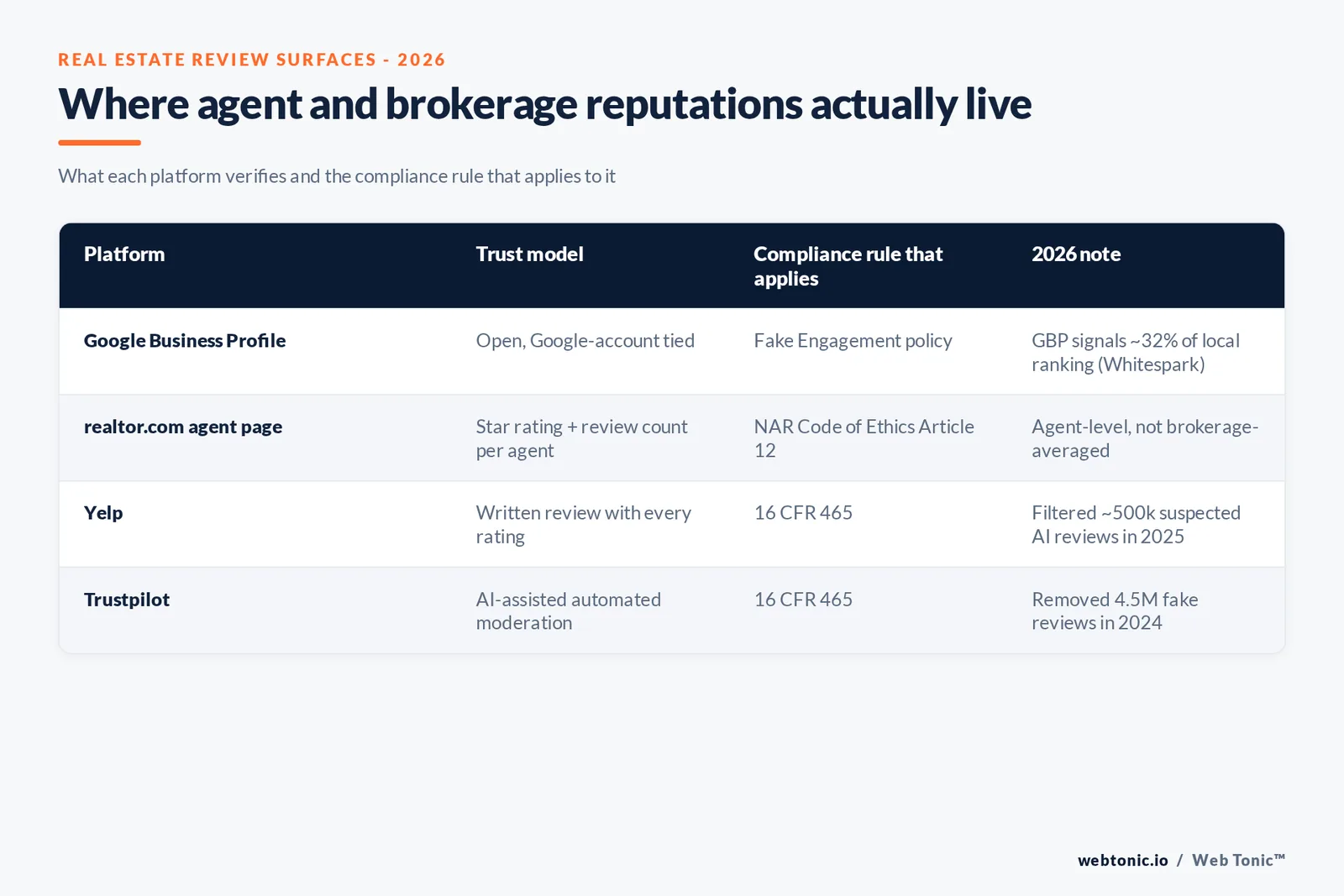
Where real estate reviews actually live
| Platform | Trust model | 2026 note |
|---|---|---|
| Google Business Profile | Open, tied to a Google account | GBP signals ~32% of local ranking weight (Whitespark 2026) |
| realtor.com agent profile | Star rating + written review count on the individual agent's own page | Agent-level, not brokerage-averaged |
| Yelp | Requires written review with every rating | Filtered ~500,000 suspected AI-generated reviews in 2025 |
| Trustpilot | AI-assisted automated moderation | Removed 4.5 million fake reviews in 2024, 90% caught automatically |
| Client testimonial page | Self-published, subject to Article 12's true-picture standard | No third-party verification |
Building a review programme an agent or brokerage can defend
- Ask at closing, not at listing signature - a review written after the transaction actually completes is a stronger, more defensible signal than one requested on optimism.
- Never make requesting a review conditional on the outcome the client got - that crosses into the sentiment-conditioned incentive the FTC's 16 CFR 465 rule prohibits.
- Publish the review count and rating on the individual agent's own page, not only the brokerage's - it is the more agent-specific trust signal a buyer or seller is actually checking.
- Respond to every negative review factually, never disputing a client's account in a way that risks Article 12's true-picture standard.
- Never write a listing-agreement clause restricting reviews - the Consumer Review Fairness Act makes it unenforceable and it invites exactly the scrutiny a thin review profile already gets.
- Keep reviews current - with 74% of consumers discounting anything older than three months, a steady post-closing cadence beats a single burst after a strong quarter.
What review-management support costs an agent or brokerage
Review-request and reputation-monitoring tools for real estate professionals are typically sold per agent or per office per month, with tiers for automated request cadences and multi-agent reporting. Verify any specific figure on the vendor's own current pricing page rather than a fixed rate, and weigh it against what a single lost referral - in a market where 91% of sellers still choose an agent - is worth. A brokerage running fifty agents under one banner faces a different budget question than a solo practitioner: the brokerage-level tool has to aggregate and report per agent, while the solo practitioner mainly needs a simple, reliable request cadence.
Where reputation work fits a broader lead-generation plan
Reviews are one input into how an agent or brokerage ranks and converts, not a replacement for the rest of the funnel. Teams already investing in local SEO for real estate should treat the review thresholds above as part of that same ranking effort, since Whitespark's own panel scores review signals inside the local-ranking mix, not separate from it. Teams running paid search for real estate should expect ad click-through on a named agent to move with review count the same way organic click-through does. And any brokerage building a full growth marketing programme across channels should treat review cadence as a standing line item, not a one-time project - agents can start that conversation here.
| Self-audit question | Why it matters | 2026 source |
|---|---|---|
| Do we hold 20+ reviews on the agent's own profile? | 47% of prospects filter out below that line | BrightLocal LCRS 2026 |
| Is the agent's rating 4.5 stars or higher? | 31% won't call a lower-rated professional | BrightLocal LCRS 2026 |
| Was the most recent review within the last quarter? | 74% discount anything older | BrightLocal LCRS 2026 |
| Does our marketing avoid curated-only testimonials? | Article 12 requires a true picture in advertising | NAR Code of Ethics |
| Does any listing agreement restrict honest reviews? | Such clauses are unenforceable | Consumer Review Fairness Act |
Consumers have a protected right to post an honest review
The FTC's own consumer guidance is direct about this: a business cannot legally stop someone from sharing a genuine review, in any forum, including social media, and the Consumer Review Fairness Act makes any contract clause that tries to do so void. For a listing agreement or buyer-representation agreement, that means a clause requiring a client to submit marketing copy for approval before posting a review, or barring a review entirely, would not hold up if challenged - independent of whatever the brokerage's own internal policy says. That protection runs in both directions: a client also cannot be penalized, through a fee clawback or a withheld referral, for posting an honest but unflattering account of how a transaction went.
Frequently Asked Questions
Are home buyers and sellers actually replacing agents with self-service tools?
Not according to NAR's 2025 Profile of Home Buyers and Sellers: 91% of sellers used a real estate agent to sell, the highest share on record, and for-sale-by-owner sales fell to a historic low of 5%. Reviews have become part of how a buyer or seller chooses which agent, not a reason to skip one - 92% of buyers reported being satisfied with the overall buying process.
How many reviews does an individual agent need, versus a brokerage?
The two operate under the same cross-industry BrightLocal thresholds - 47% of consumers won't use a business with fewer than 20 reviews and 31% require 4.5 stars or higher - but they accumulate reviews differently. An agent's reviews follow the person if they change brokerages; a brokerage's aggregate rating is diluted across every agent under that name, which is why individual agent profiles on platforms like realtor.com typically carry more targeted, verifiable detail than a brokerage-wide score.
Does NAR's Code of Ethics say anything about testimonials or reviews?
Article 12 of the NAR Code of Ethics requires REALTORS to “present a true picture” in their advertising and other public representations. NAR's own case interpretations under Article 12 address misleading claims in marketing materials; a curated or fabricated set of testimonials that misrepresents an agent's actual track record would fall under that same true-picture standard, independent of whatever the review platform itself allows.
Can a brokerage buy or filter out negative reviews legally?
No. The FTC's 16 CFR Part 465 rule (final August 2024) prohibits buying, selling or incentivizing reviews conditioned on sentiment, and the Consumer Review Fairness Act separately voids any contract clause that tries to stop a client from posting an honest review. A listing agreement clause requiring only positive feedback, or barring a review altogether, is unenforceable.
Where do most real estate reviews actually get read?
Google Business Profile carries the bulk of local-search visibility, with Whitespark's 2026 panel scoring GBP signals at roughly 32% of local ranking weight and review signals at 16-20%. Agent-specific platforms like realtor.com display a star rating alongside a written review count directly on the agent's own profile page, which is a more agent-specific surface than a general local map pack.
Sources
NAR - 2025 Profile of Home Buyers and Sellers, Highlights
NAR - Top 10 Takeaways from the 2025 Profile of Home Buyers and Sellers
NAR - Case Interpretations Related to Article 12
BrightLocal - Local Consumer Review Survey 2026
Whitespark - 2026 Local Search Ranking Factors
FTC - Final rule banning fake reviews and testimonials (16 CFR 465)
FTC - Consumer Review Fairness Act
FTC - Your right to post honest reviews
realtor.com - agent reviews
Trustpilot - Trust Report 2025
Yelp - 2025 Trust & Safety Report