Table of contents

Real estate lifecycle marketing has a budget question underneath the strategy question: NAR's own annual surveys show half of a typical agent's business already comes from repeat and referral clients, yet the technology stack most agents budget for is not built to keep in touch with them. This page uses only NAR's Profile of Home Buyers and Sellers, 2026 Member Profile and 2026 REALTORS Technology Report — no Web Tonic pricing, no invented spend splits.
Key Takeaways
- The typical REALTOR earns 28% of business from repeat clients (median, 2026 Member Profile).
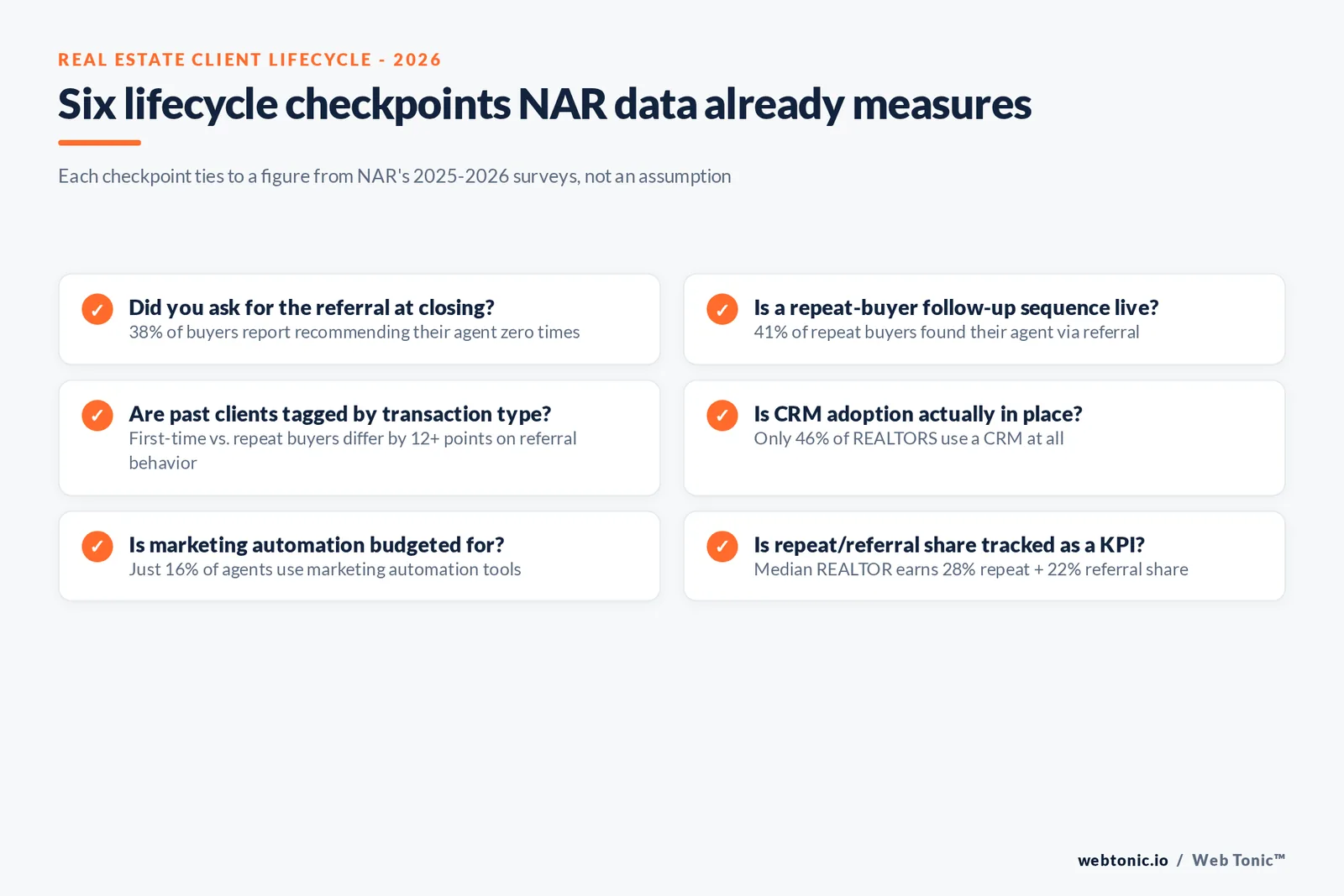
- Another 22% comes from referrals by past clients and customers (median).
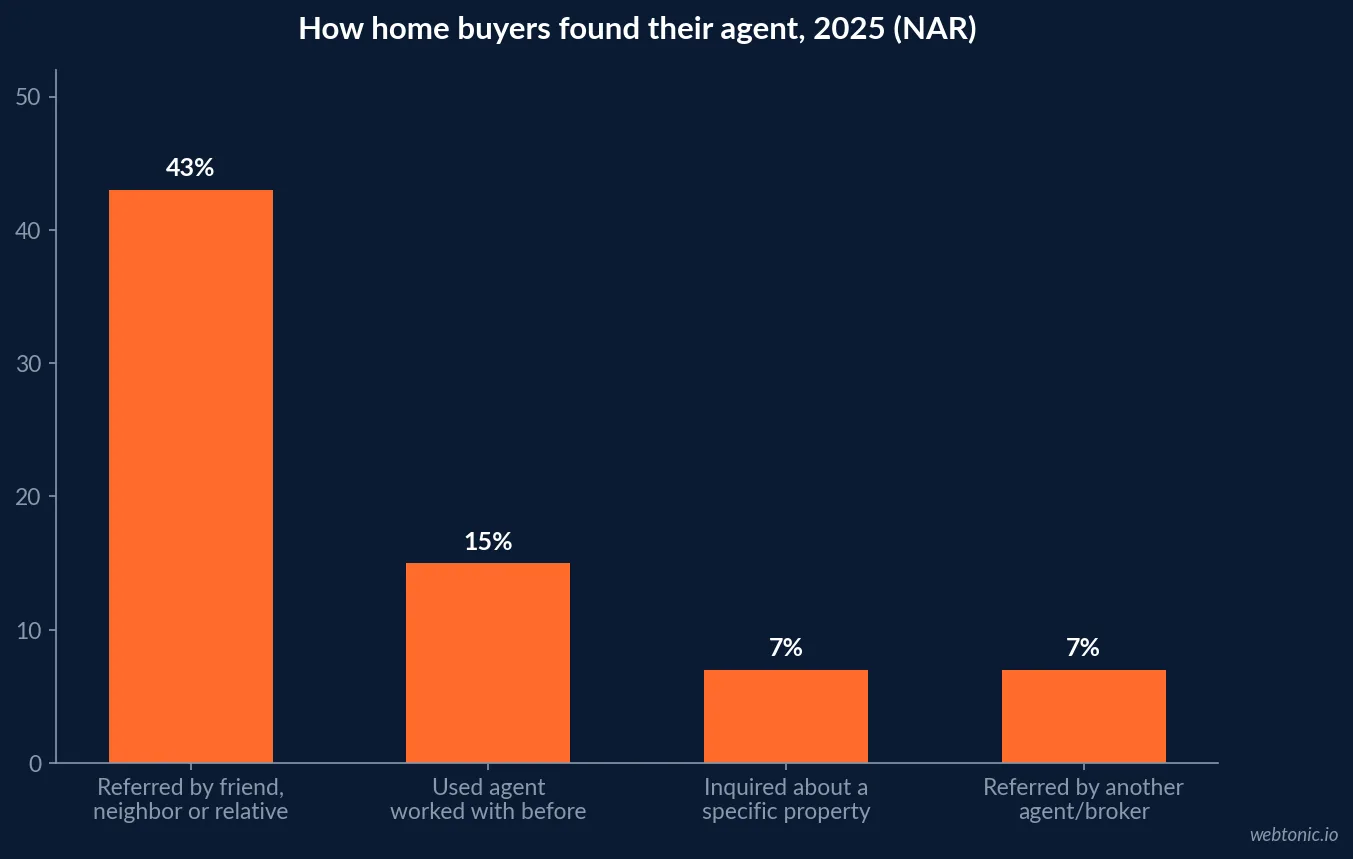
- 43% of all home buyers were referred by a friend, neighbor or relative (NAR 2025).
- 49% of first-time buyers found their agent through a personal referral.
- 41% of repeat buyers found their agent through a referral, and 18% reused a past agent.
- 76% of repeat buyers interviewed only one agent before deciding.
- 91% of buyers would use their agent again or recommend them, 76% "definitely".
- 62% of buyers had already recommended their agent within a year of closing.
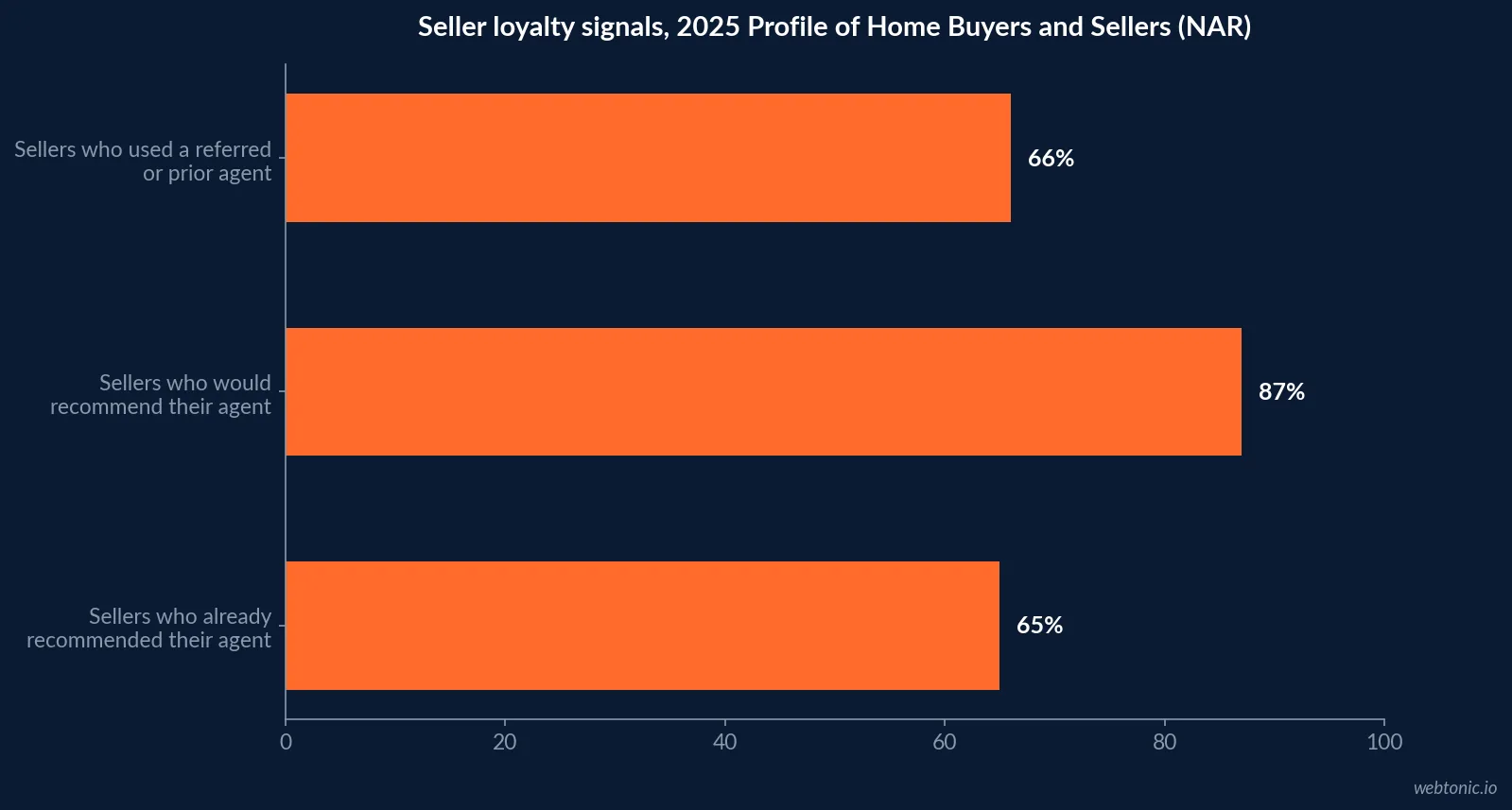
- 66% of sellers used an agent referred to them or worked with before.
- 87% of sellers would recommend their agent for future services.
- 65% of sellers had already recommended their agent within a year.
- About half of agents budget USD 50–500 a month for technology (2026 Tech Report, n=1,200).
- Only 16% of agents use marketing automation tools at all.
- CRM adoption sits at 46%, well behind e-signature at 79%.
- Median REALTOR business expenses were USD 9,530 in 2025, up from USD 8,010.
- Median REALTOR tenure with a current firm is 6 years.
Benchmarks at a glance
| Metric | Figure | Source (edition) |
|---|---|---|
| Repeat-client share of business (median) | 28% | NAR 2026 Member Profile |
| Referral share of business (median) | 22% | NAR 2026 Member Profile |
| Buyers referred by friend/neighbor/relative | 43% (all), 49% (first-time) | NAR 2025 Profile of Buyers & Sellers |
| Sellers who used a referred/prior agent | 66% | NAR 2025 Profile of Buyers & Sellers |
| Buyers who would use agent again/recommend | 91% | NAR 2025 Profile of Buyers & Sellers |
| Agents with marketing automation tools | 16% | NAR 2026 REALTORS Technology Report |
Repeat and referral business is already half the pipeline
The 2026 NAR Member Profile (NAR's own Feature Sheet), covering 2025 business activity across roughly 1.44 million members, reports the typical REALTOR earns a median of 28% of business from repeat clients and customers and another 22% through referrals from past clients. That is half of a typical practice built on relationships that already exist, before a single dollar of acquisition marketing is spent. Established agents skew higher: those with 16 or more years of experience report the deepest repeat-and-referral base, which is consistent with lifecycle marketing compounding rather than resetting every year. The general economics point the same way: Bain & Company has long argued that raising retention by as little as 5% can lift profits by as much as 95% (Bain & Company, cross-industry, not a real estate figure).
How buyers actually find their agent
The 2025 Profile of Home Buyers and Sellers (transactions between July 2024 and June 2025) breaks the buyer's search out by first-time versus repeat status.
| How buyer found agent | All buyers | First-time buyers | Repeat buyers |
|---|---|---|---|
| Referred by (or is) a friend, neighbor or relative | 43% | 49% | 41% |
| Used agent previously to buy or sell a home | 15% | 3% | 18% |
| Inquired about a specific property online | 7% | 7% | 7% |
| Referred by another real estate agent/broker | 7% | 8% | 6% |
| Website, without a specific reference | 6% | 7% | 5% |
On the seller side the same report finds 66% of recent sellers used an agent that was referred to them or had worked with in the past — 37% through a personal referral and 29% through a prior relationship — and 80% of sellers contacted only one agent before committing.
Satisfaction is high; the follow-up ask is the gap
NAR's 2025 survey found 91% of buyers would use their agent again or recommend them to others, with 76% saying "definitely." 62% had already recommended their agent within a year of closing, and 18% had done so four or more times — though the median across all buyers is still just once, and 38% report recommending their agent zero times. On the seller side, 87% would recommend their agent (75% definitely) and 65% already had, with a median of two recommendations and 24% recommending four or more times.
| Times recommended agent (since transaction) | Buyers | Sellers |
|---|---|---|
| None | 38% | 35% |
| One time | 15% | 12% |
| Two times | 19% | 18% |
| Three times | 10% | 11% |
| Four or more times | 18% | 24% |
What agents actually budget for the tooling behind this
NAR's 2026 REALTORS Technology Report, based on 1,200 agents, found about half budget USD 50 to 500 a month on technology, 22% spend more than USD 500, and 18% spend under USD 50. Against that spend, adoption of the tools that actually run a lifecycle program lags: CRM sits at 46% and marketing automation at just 16%, both well behind e-signature (79%) and showing-schedule tools (68%). Median total business expenses across all REALTORS reached USD 9,530 in 2025, up from USD 8,010 the year before, with vehicle costs the single largest line.
| Technology | Adoption among REALTORS | Rank |
|---|---|---|
| MLS access | 96% | 1 |
| E-signature | 79% | 2 |
| Showing schedule tools | 68% | 3 |
| CMA / pricing tools | 59% | 4 |
| CRM | 46% | 6 |
| Marketing automation | 16% | 13 |
Real estate vs. a generic small-business retention motion
| Dimension | Real estate (NAR data) | Generic small business |
|---|---|---|
| Primary loyalty signal | Would use agent again / recommend (91% buyers, 87% sellers) | NPS or repeat-purchase rate |
| Referral share of new business | 43% of buyers referred by personal network | Varies widely by category |
| Typical cycle length | One-off per transaction, years apart | Often monthly/recurring |
| Where budget concentrates today | E-signature, MLS, showing tools | CRM/automation in mature categories |
Where lifecycle budget should move first
- Formalize the recommend-and-refer ask — 38% of buyers report recommending their agent zero times despite 91% saying they would.
- Shift technology spend from single-transaction tools toward the 16%-adopted marketing-automation category, where the gap between satisfaction and follow-through is largest.
- Segment past-client outreach by repeat vs. first-time status; repeat buyers already skew toward reusing or referring a known agent (59% combined) and respond to a different message than first-time buyers.
- Track the two NAR income shares (28% repeat, 22% referral) as a brokerage-level KPI, not just an individual-agent metric.
Common mistakes in real estate lifecycle marketing
- Treating every past client as cold once the transaction closes, despite 91% buyer and 87% seller willingness to recommend.
- Spending technology budget on transaction tools only — e-signature and MLS access are near-universal, but the follow-up layer (CRM, automation) is where adoption is thinnest.
- Treating first-time and repeat buyers the same, when NAR's own data shows a 12-point swing in referral behavior between the two groups.
How many agents buyers actually contact before hiring one
Zillow's 2025 Consumer Housing Trends Report for Agents — Zillow's own annual survey of recent buyers and sellers — found 50% of buyers hired the first agent they contacted in 2025, up from 47% in both 2023 and 2024. The typical (median) buyer contacted their eventual agent twice before hiring. Repeat buyers convert faster: 44% of repeat buyers hired their agent after just one contact, versus 38% of first-time buyers, and first-timers were noticeably more likely to shop 2 or more agents (54%) than repeat buyers (46%). That gap is the lifecycle case for a fast, high-trust first response with past clients, where the shopping behavior itself is already shorter.
| Buyer contact pattern | All buyers, 2025 | First-time buyers | Repeat buyers |
|---|---|---|---|
| Hired the first agent contacted | 50% | 46% | 54% |
| Contacted 2 or more agents | 50% | 54% | 46% |
| Hired agent after exactly 1 contact | 41% | 38% | 44% |
Related benchmarks
For adjacent retention and lifecycle data outside real estate, see Web Tonic's customer retention statistics and customer lifetime value statistics pages, or the growth marketing service page for how a referral-and-repeat program gets built and tracked.
What top-performing agents already know about repeat and referral share
Redfin's own 2025 agent pay report, covering agents on its Redfin Next commission model, found the top 10% of Redfin agents draw 30% of their deals from returning clients and another 28% from personal-network referrals — 58% combined from relationships that already exist. On dollars earned specifically, 66% of top agents' commission bonuses come from loyalty and agent-generated deals, versus 34% from first-time site connections. One agent quoted in the report put her repeat-and-referral share at 85% of total business. For context on the size of the profession this data sits inside, the National Association of Realtors counted roughly 1.44 million REALTOR members as of mid-2026, and the U.S. Bureau of Labor Statistics counted 532,200 real estate broker and sales agent jobs in 2024, projecting 3% growth (about 16,500 jobs) through 2034, per the BLS Occupational Outlook Handbook. That means any repeat-and-referral gain compounds across a large, fragmented base of individual producers rather than a handful of large brokerages.
| Agent segment | Repeat-client share | Referral share | Source |
|---|---|---|---|
| Top 10% Redfin agents (deals) | 30% | 28% | Redfin 2025 agent pay report |
| Typical REALTOR (income, median) | 28% | 22% | NAR 2026 Member Profile |
Frequently Asked Questions
How much of a REALTOR's business comes from repeat and referral clients?
NAR's 2026 Member Profile, covering 2025 business activity, puts the typical REALTOR's repeat-client share at a median of 28% and referral share from past clients and customers at a median of 22%. Combined, that is half of a typical agent's business coming from people who already know them, which is why the lifecycle motion — staying visible to past clients — carries more weight than most acquisition spend.
How do most home buyers actually find their agent?
The 2025 Profile of Home Buyers and Sellers (transactions July 2024–June 2025) found 43% of all buyers were referred by a friend, neighbor or relative, rising to 49% among first-time buyers. Among repeat buyers specifically, 41% found their agent through a referral and another 18% simply used the agent they had worked with before — meaning well over half of repeat-buyer relationships never touch a paid channel at all.
What should a brokerage budget for the technology behind lifecycle marketing?
NAR's 2026 REALTORS Technology Report, based on 1,200 agents, found about half budget USD 50 to 500 a month for technology tools, 22% spend more than USD 500 a month, and 18% spend under USD 50. CRM adoption sits at 46% and marketing automation at only 16%, well behind e-signature (79%) and showing-schedule tools (68%) — the tooling most agents have is not built for staying in touch with past clients.
Would most buyers and sellers actually use the same agent again?
Yes, by a wide margin. NAR's 2025 Profile found 91% of buyers would use their agent again or recommend them to others (76% said definitely), and 87% of sellers said the same (75% definitely). The gap between that satisfaction and the referral numbers above is the lifecycle opportunity: most clients are willing advocates who are never asked.
What is a repeat buyer actually worth to an agent's pipeline over time?
NAR's 2025 data shows 62% of buyers had already recommended their agent within the first year after closing, and 18% had done so four or more times. On the seller side, 65% had recommended their agent at least once and 24% four or more times, with a median of two recommendations. A single satisfied client who is followed up with, rather than filed away, keeps generating referral volume for years.
Sources
NAR — 2025 Profile of Home Buyers and Sellers, Highlights
U.S. Bureau of Labor Statistics — Occupational Outlook Handbook, Real Estate Brokers and Sales Agents (2024)
NAR — The Feature Sheet: 2026 Member Profile
NAR Newsroom — 2026 Member Profile release (June 2026)
NAR — 2026 REALTORS Technology Report coverage (n=1,200)
Zillow — 2025 Consumer Housing Trends Report for Agents
Redfin — One Year of Redfin Next: Top Agents' Pay Report (2025)
NAR — Membership Count, Mid-2026