Table of contents

A real estate agency's international SEO budget should be sized from two published numbers: the foreign buyers who actually purchase in its state, and the residents who speak another language at home. For most US brokerages, international SEO is less about sites abroad and more about Spanish-language listings for local buyers and a few translated pages for cross-border buyers from Canada and Mexico. No survey publishes what agencies spend on this, so the cost side below uses vendors' own list prices.
Key Takeaways
- Foreign buyers bought 67,100 US existing homes worth USD 45.3 billion (April 2025 to March 2026, NAR).
- That is 19.1% less dollar volume and 14% fewer homes than the prior year.
- The foreign-buyer median price was USD 465,000; 48% paid all cash.
- Canada leads at 16% of buyers, then Mexico 14%, China 11% and India 9%.
- China still spent the most: USD 7.6 billion.
- Florida draws 20% of foreign buyers, California 19%, Texas 12%.
- 78.3% of US residents age 5+ speak only English at home (ACS 2018-2022).
- Spanish is 61.1% of other-language speakers.
- 40% of consumers will never buy from sites in other languages (CSA Research, 2020).
Real estate international SEO at a glance
| Metric | Figure | Period | Source |
|---|---|---|---|
| Foreign-buyer purchases | 67,100 homes | Apr 2025 - Mar 2026 | NAR 2026 report |
| Dollar volume | USD 45.3 billion | Apr 2025 - Mar 2026 | NAR 2026 report |
| Change in dollar volume | -19.1% | vs Apr 2024 - Mar 2025 | NAR 2026 report |
| Median foreign-buyer price | USD 465,000 | Apr 2025 - Mar 2026 | NAR 2026 report |
| All-cash share | 48% (28% all buyers) | Apr 2025 - Mar 2026 | NAR 2026 report |
| Speak only English at home | 78.3% | 2018-2022 | Census ACS 5-year |
The foreign-buyer market is shrinking, not growing
The National Association of REALTORS 2026 International Transactions report (released July 29, 2026) puts foreign purchases at USD 45.3 billion, down from USD 56 billion, and 67,100 homes, down from 78,100: "the second-lowest level since NAR began tracking foreign buyer activity in 2009". The previous edition had shown a 33.2% rise. Any budget that assumed foreign demand would keep climbing should be reset to this lower base.
Two buyer types matter for SEO. Recent immigrants and visa holders living in the US bought 37,600 homes (56%) worth USD 21.8 billion; buyers living abroad bought 29,500 (44%) worth USD 23.5 billion. The first group searches from inside the US, often in English or Spanish; the second searches from its home country, which is where locale targeting and hreflang start to matter.
| Buyer type (NAR 2026) | Homes | Share | Dollar volume | Where they search from |
|---|---|---|---|---|
| Resident foreigners (recent immigrants, visa holders) | 37,600 | 56% | USD 21.8B | Inside the US |
| Non-resident foreigners | 29,500 | 44% | USD 23.5B | Their home country |
| All foreign buyers | 67,100 | 100% | USD 45.3B | Mixed |
Where foreign buyers come from
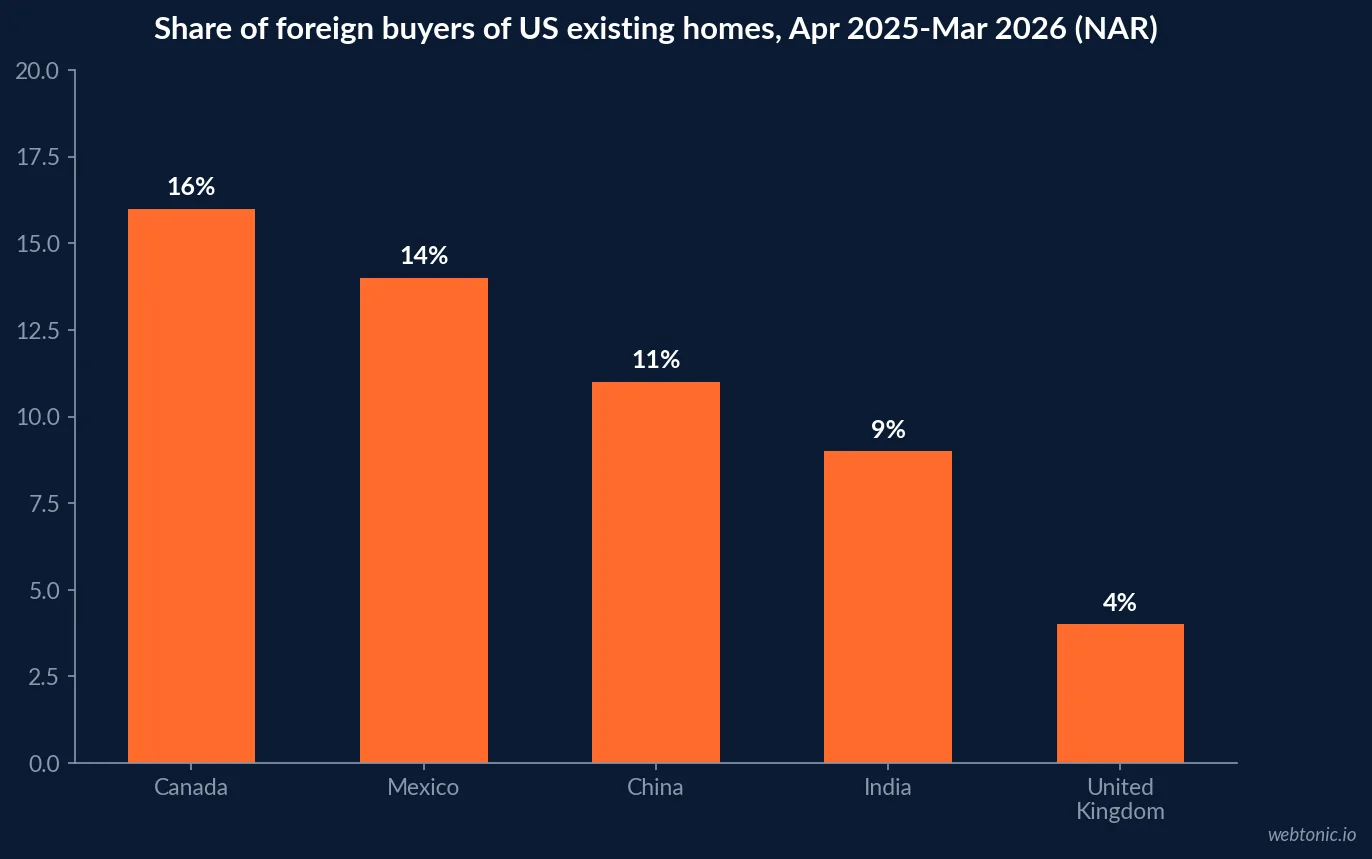
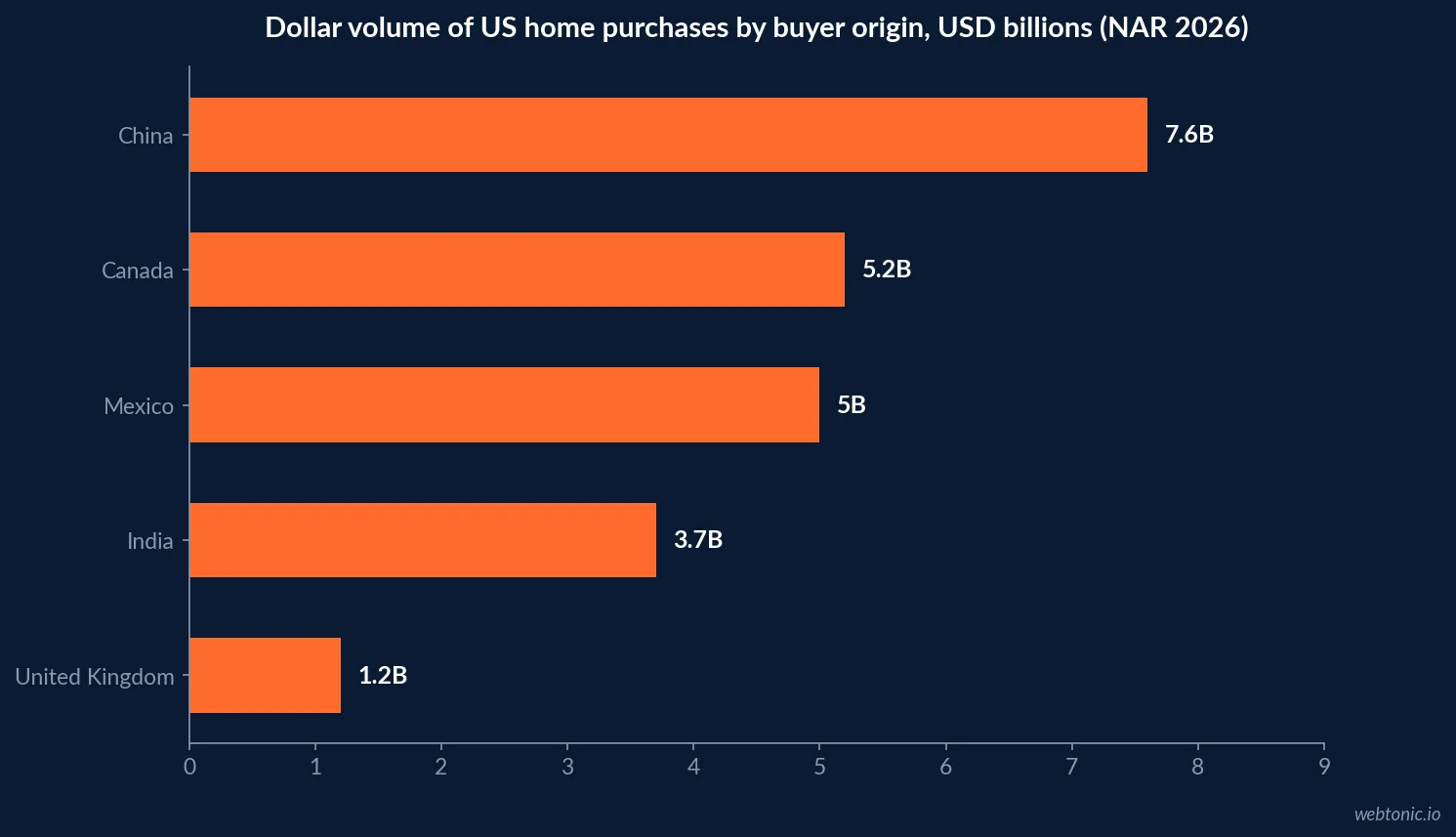
Canada returned as the top country of origin with 16% of purchases, up from 14%, while China, last year's leader, fell to third. Mexico takes 14%. Dollar volume ranks differently: China remains the largest source at USD 7.6 billion, reflecting an average purchase price of roughly USD 1 million.
| Origin | Share of buyers | Homes | Dollar volume | Prior-year share |
|---|---|---|---|---|
| Canada | 16% | 10,700 | USD 5.2B | 14% |
| Mexico | 14% | 9,400 | USD 5.0B | 8% |
| China | 11% | 7,400 | USD 7.6B | 15% |
| India | 9% | 6,000 | USD 3.7B | 6% |
| United Kingdom | 4% | 2,700 | USD 1.2B | 4% |
The prior-year shares come from NAR's 2025 edition, when China led at 15%. Mexico's rise from 8% to 14% is the biggest move and the strongest case for Spanish-language listing content.
Which states justify the spend
Florida remains the top destination with 20% of foreign buyers, then California at 19%, Texas at 12%, and New Jersey and Georgia at 4% each. A brokerage in those five states has a measurable foreign audience; elsewhere the numbers are too thin to fund localized pages for buyers abroad.
| Destination state | Share of foreign buyers | Budget reading |
|---|---|---|
| Florida | 20% | Strongest case for Spanish and Canadian-targeted pages |
| California | 19% | Chinese-language content has the dollar case |
| Texas | 12% | Spanish content serves foreign and local buyers |
| New Jersey | 4% | Selective, neighbourhood-level pages |
| Georgia | 4% | Selective, neighbourhood-level pages |
The bigger audience is already local
For most agencies the larger multilingual audience lives in the market already. The US Census Bureau reports that 78.3% of people age 5 and older spoke only English at home in the 2018-2022 American Community Survey, down from 78.7% in 2013-2017. Among those who spoke another language, Spanish accounted for 61.1%, Chinese 5.1% and Tagalog 2.5%. Among working-age Spanish speakers (18-64), 58.3% spoke English "very well", so a large share of potential buyers would be better served in Spanish. This is multilingual domestic SEO, and it is what international SEO mostly means for a local brokerage.
Language preference and buying
CSA Research surveyed 8,709 consumers in 29 countries in 2020 and found 76% prefer to buy products with information in their native language, while 40% will never buy from websites in other languages. The survey covered online purchases, not homes, so it is a general signal, not a property benchmark. NAR's data shows the foreign home buyer is a cash-heavy, higher-price buyer; what it does not show is whether language on the website changed any of those purchases.
Search engines in buyer origin countries
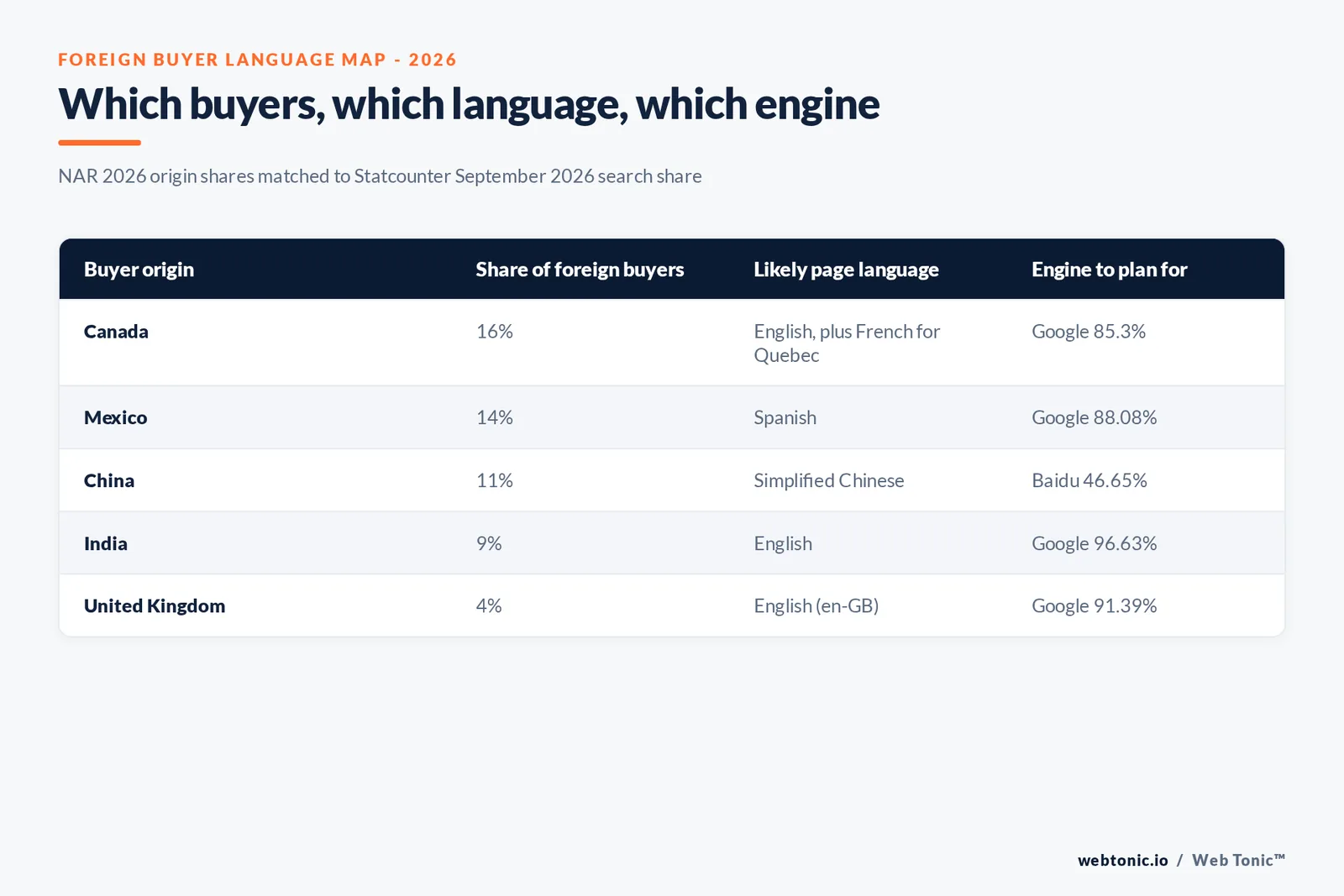
Statcounter data for September 2026 shows Google dominates four of the five top origin countries: 85.3% in Canada, 88.08% in Mexico, 96.63% in India and 91.39% in the United Kingdom. China is different, with Baidu at 46.65% and Google at 1.46%. For Chinese buyers, a translated page on a US domain will rarely be found through search at all; agents and portals carry that traffic.
What changed between the 2025 and 2026 editions
Comparing NAR's two latest editions shows how quickly the foreign audience moves. Units fell from 78,100 to 67,100, the median price from USD 494,400 to USD 465,000, and the all-cash share edged up from 47% to 48%. The destination mix also shifted: California rose from 15% to 19% of foreign buyers and Texas from 10% to 12%, while Florida slipped from 21% to 20%. An agency that set its language plan from the 2025 edition would have over-weighted Chinese and under-weighted Spanish. NAR's chief economist linked the decline to fewer international visitors and tourists, noting that a slightly weaker dollar "did not induce more activity". That is NAR's interpretation; the report does not isolate causes. For SEO budgeting the practical point is to re-read the origin table each July when the new edition lands and move content spend toward the languages that are growing.
| Measure | 2025 edition (Apr 2024 - Mar 2025) | 2026 edition (Apr 2025 - Mar 2026) | Direction |
|---|---|---|---|
| Homes bought by foreign buyers | 78,100 | 67,100 | Down 14% |
| Dollar volume | USD 56 billion | USD 45.3 billion | Down 19.1% |
| Median price | USD 494,400 | USD 465,000 | Down |
| All-cash share | 47% | 48% | Up 1 point |
| Top origin | China 15% | Canada 16% | Leader changed |
| Florida share of buyers | 21% | 20% | Down 1 point |
| California share of buyers | 15% | 19% | Up 4 points |
Clicks are getting harder to earn in any language
Translated pages compete in results that increasingly answer the question before the click. Pew Research Center found users clicked a traditional result on 8% of visits when an AI summary appeared, against 15% without one (March 2025 data, US adults). Ahrefs measured a 34.5% lower click-through rate for the top result when an AI Overview was present in April 2025, and 58% lower in its February 2026 update on December 2025 data. SparkToro and Datos put US zero-click searches at 58.5% in 2024. These studies are English-language and US-based; no published study measures the same effect for Spanish or Chinese property searches. Listing pages with unique local detail, photos and prices in the buyer's language are the content type least easily replaced by a summary, which is another reason to translate guides and listings rather than generic blog posts.
What translation tools cost a brokerage
There is no real-estate-specific price study, so these are list prices from the vendors' own pages, fetched in October 2026. Weglot notes its USD prices are an estimate of the euro price. DeepL shows euro prices for Germany.
| Option | List price | Languages / allowance | Fits |
|---|---|---|---|
| Weglot Business | USD 32 a month (EUR 29) | 3 languages, 50,000 words | Spanish plus French for Canadian buyers |
| Weglot Pro | USD 87 a month (EUR 79) | 5 languages, 200,000 words | Spanish, Chinese, French and more |
| DeepL Pro Individual | EUR 7.49 a month, billed annually | 300,000 characters a month | Agent-written listing copy |
| DeepL Pro Team | EUR 24.99 per user a month | 1,000,000 characters per user | Small team translating listings |
Listing volume drives cost. A brokerage that machine-translates every IDX listing will run through a 50,000-word allowance quickly; translating neighbourhood guides and buyer resources first keeps the plan on a lower tier. Google's multilingual guidance also asks for one language per page and warns against "side-by-side translations".
Where agents say their leads come from
The NAR 2025 Technology Survey lists social media as the top source of quality leads for 39% of members, ahead of CRM at 23% and MLS sites at 17%; members' own websites were cited by 12%. Website-led international SEO therefore competes with channels agents already trust more, which is a reason to keep its budget proportional to the foreign and other-language demand in your market.
A budget order for agencies
- Check your state's share of foreign buyers (Florida 20%, California 19%, Texas 12%).
- Check your county's language data in the Census ACS before choosing languages.
- Translate guides and buyer resources first, listings second.
- Give each language its own URL with hreflang; do not switch language by IP.
- Leave Chinese-market search to portals unless you can serve Baidu.
For the domestic SEO baseline see our real estate enterprise SEO data, and for app discovery our real estate app store data. Measuring which language pages produce leads is a data and attribution job.
Frequently Asked Questions
How big is the foreign-buyer market for US homes?
NAR's 2026 International Transactions report counts 67,100 existing-home purchases by foreign buyers from April 2025 to March 2026, worth USD 45.3 billion, down 14% in units and 19.1% in dollar volume. The median price was USD 465,000 and 48% paid all cash, against 28% of all existing-home buyers.
Which languages should a real estate website add first?
Start from your own market. Nationally, NAR's top origins are Canada 16%, Mexico 14%, China 11%, India 9% and the United Kingdom 4%, which points to Spanish and Simplified Chinese before anything else. For local residents, the Census Bureau's 2018-2022 ACS shows Spanish accounts for 61.1% of people who speak a language other than English at home. Florida, California and Texas brokerages see the most foreign demand.
What does a translated listing site cost?
There is no real-estate-specific price survey. Translation tool list prices are public: Weglot (October 2026) lists USD 32 a month for three languages and 50,000 words and USD 87 for five languages and 200,000 words, with USD shown as an estimate of the euro price. IDX listing feeds can exceed word allowances quickly, so check word counts before choosing a tier.
Is international SEO worth it for a local brokerage?
Only where the buyers are. Florida draws 20% of foreign buyers, California 19% and Texas 12%, while New Jersey and Georgia take 4% each. A brokerage outside those states will usually get more from Spanish-language pages for local residents than from pages aimed at buyers abroad.
Do foreign buyers search on Google?
Mostly. Statcounter's September 2026 data shows Google at 85.3% in Canada, 88.08% in Mexico, 96.63% in India and 91.39% in the United Kingdom. China is the exception, with Baidu at 46.65% and Google at 1.46%, so Chinese buyers are often reached through WeChat, portals or agents rather than Google results.
Sources
NAR - 2026 International Transactions release
NAR - 2025 International Transactions release
NAR - 2025 Technology Survey
US Census Bureau - Language spoken at home, ACS 2018-2022
CSA Research - Consumers prefer their own language
Statcounter - Search engine share by country
Weglot - Pricing
DeepL - Pro plans
Google Search Central - Multilingual sites
Pew Research Center - AI summaries and clicks
Ahrefs - AI Overviews and clicks